'Craftsmanship has again become fashionable in high places, just as it did in the last few recessions.'
The concept of craftsmanship has never been as relevant and timely as it is today. Assailed on all sides by – among many other tendencies - flexible working, short-termism, portfolio careers, quick-fix training and the cult of celebrity, it has recently re-entered public debate with a new sense of urgency. Why?
A bestseller in hardback, this series of linked essays by the man who ran the Royal College of Art for many years is now available in paperback, and explores the crafts in education, in history and literature, in the contemporary arts landscape, in the language, in the digital age, taking an unsentimental, hard-headed look at craftsmanship today. Only when the romantic cobwebs have been blown away, it argues, can the key importance of the crafts be fully understood.
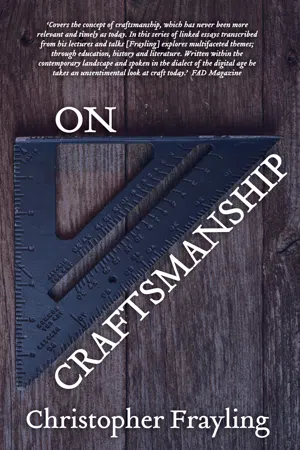
- 184 pages
- English
- ePUB (mobile friendly)
- Available on iOS & Android
eBook - ePub
About this book
Information
1. The Schoolmaster and the Wheelwrights
GEORGE STURT’S BOOK. The Wheelwright’s Shop was written between 1920 and 1921. It describes events which had occurred at 84 East Street, Farnham some 30 years before. For many readers and craft practitioners it is a classic account – perhaps even the classic account – of a particular craft written ‘from the inside’: not a soft-focus evocation of a craft, written by someone who occasionally does a spot of gardening and who consequently thinks that manual labour is terrific fun; nor a coffee-table book, using all the latest technology to tell us that most of the latest technology is all bad; but an unpretentious little book which – for all sorts of reasons – has steadily acquired an enormous critical reputation. Partly, the current reputation of The Wheelwright’s Shop is due to the fact that – like so many of the nostalgic reminiscences written or compiled during the British agricultural depression of the 1920s – it seems to strike a distinct chord today, a time when retrospective regret has become both fashionable and commercially exploitable; at a time when ‘villages of the mind’ are an established part of haute culture. Partly, the reputation dates from the 1930s, when cultural analysts such as F.R. Leavis and Denys Thompson turned The Wheelwright’s Shop into a key text from the great tradition of English literature, an embodiment of age-old values which were thought at the time to be seriously under threat from the twin forces of ‘Americanism’ and ‘modern economic life’.
But the importance of George Sturt’s The Wheelwright’s Shop seems to me to go well beyond the contemporary nostalgia boom and the inter-war fascination with the world we have lost – although both of these have ensured the book a very wide circulation. The Wheelwright’s Shop remains a major contribution to the understanding of that much-misunderstood term ‘craftsmanship’, which can be read, even today, at many different levels. The theme which holds the work together is the theme of a schoolmaster trying hard – sometimes embarrassingly hard – to understand exactly what a small group of craftspeople actually do. As such, the book is of considerable interest to anyone who seeks to write about the practice of a particular craft, from an historical or a contemporary point of view. And since Sturt’s earliest published writings, in the mid to late 1880s, were congruent with the social theories of William Morris, the way in which he originally approached the subject is of considerable interest as well.
At one level, The Wheelwright’s Shop is the chronicle of a transformation within one particular productive activity – from handicraft to a small assembly line; from the Surrey wagon to the traction engine; from William Morris, Victorian socialist, to William Morris, automobile magnate – with due emphasis given to each of the stages in this transformation: the abandonment of ‘Saint Monday’ and the traditional holidays; regular hours of work; clocking in; the arrival of systematic management in the form of a manager named William Goatcher, appointed from outside; the attempt to speed up the production process in order to attract local farmers; and, finally, the introduction of new technology and the change from craft workshop to garage. At another level, as the cultural analysts of the 1930s were quick to point out, it appears to be a sustained lament for the ‘passing of Old England’ – a lament which uses words like ‘craftsmanship’, ‘handwork’ and ‘skill’ in a fairly sentimental way, to heighten the contrast: the most interesting thing about this theme is that Sturt occasionally stood outside it, showing himself to be very aware of what he was thinking ‘naturally’. In his Journal of 1899, he wrote that it was very dangerous to romanticise the past, to indulge in Merrie Englandism, or to expect to gatecrash the ‘comely social life’ described in Goldsmith’s Deserted Village; at one point, he even suggested that a sure way to prevent present nostalgia was to imagine the nostalgia with which future generations (from ‘anno 2000, say’) would describe the 1890s, for their own purposes. A woman wrote to him, shortly after the publication of his most popular book at the time, Change in the Village, complaining that ‘the old village life was not so nice in reality as I have made out,’ to which Sturt could only reply that conversations with some local villagers went ‘far to bear out the truth of what she urges’, and that life was ‘squalid or at any rate rough and insanitary’. ‘I would not go back,’; he later wrote, ‘I would not lift a finger, or say a word, to restore the past time’ – for to do so would be to ‘harden into a hide-bound conservative’, the worst kind of antiquarian. Nevertheless, he chose to ignore much of the squalor, and the vague feeling that his employees the wheelwrights might have resented his presence all along, when he constructed his picture of The Wheelwright’s Shop in the early 1920s.
At yet another level, the book is a detailed illustrated account of the techniques of the wheelwrights as Sturt eventually came to understand them – for the record, so that they would not be lost forever – and in particular of the ways in which these techniques had slowly adapted (or not) to changing material circumstances: the section of the book devoted to the ‘dish’ shape of a cartwheel is the most famous example, but there are many others such as Sturt’s description of the ‘putting on’ of metal tyres.
And finally, we come to what is from my point of view the most important level, the attempts by Sturt the schoolmaster to enter the ‘invisible college’ represented by the wheelwrights, an invisible college which represented for him a radical change of social and intellectual direction. The phrase ‘invisible college’, by the way, originated during the Commonwealth period, when it was applied to what was later to become the Royal Society. In sociological analysis, it has come to mean a social circle which is distinguished by the greater density of relations between its members than between members and non-members. Some sociologists have seen ‘invisible colleges’ as the social location of distinctive sets of ‘technical and cognitive norms’; others have simply seen them as the social location for a particular set of shared assumptions.
George Sturt took over the management and trading of the family wheelwright’s shop in 1884, at the age of 21. His father, Francis Sturt, who had been ‘made a wheelwright’ from an early age, had managed the shop since 1865, when he had inherited it from George Sturt senior. In the book The Wheelwright’s Shop, which was put together some thirty years ago after the event, Sturt has very little to say about the circumstances of the changeover:
In 1884 he died; and I, for my part, did not know how to carry on even the ordinary business. I had no more than a month, if as much as that, of my father’s guidance in it. He was, in fact, sickening for his last illness, when I entered the business in 1884. Ruskin’s Fors Clavigera had made me think meanly, if not meanly enough, of the school teaching which had been my work since 1878; and under the same influence of Ruskin’s book I felt that man’s only decent occupation was in handicraft. I shudder yet smile to think now what raw ideas swayed me then; yet the enthusiasm so ill-reflected in them was the sweetness of life to me in every disillusionment that was to come. They saved me from the worst sordidness of business. Finishing my school work with the first term of 1884, namely the day before Good Friday, I took four days of rest …and began work at the shop on Easter Tuesday.
The picture is of an idealistic young schoolmaster who has gleaned all sorts of images of the arts and crafts from his reading of Ruskin – in particular the idea that ‘man’s only decent occupation was in handicraft’ – and who is providentially chosen by his father, at just the right moment, to continue the family tradition. Actually, as Sturt’s personal Journal shows (and there are over 4000 manuscript pages of it, kept in the British Library), this was far from the case. In the first place, his brother Frank was originally the man chosen to take over the business: he was the son who knew something about the trade (‘he had more practice in some parts of it than I ever enjoyed’), but the wheelwrights gave him such a rough time (‘insulting him with covert innuendo’) – and he appears to have responded to this so clumsily – that he ‘faded out’ after two years, in the early 1880s. In the second place, Sturt’s departure from Farnham Grammar School was not entirely on account of what he was later to call his ‘Ruskinian absurdities’. Ever since 1879 he had been teaching Geometry and Drawing as a pupil teacher, and since 1873 he had been a regular attender at the drawing classes held at Farnham Art School, then in the Town Hall. But throughout the early 1880s he was plagued by the asthma he had contracted before he was twelve months old and by a series of attacks of bronchitis. Long hours in the classroom did not suit either his temperament or his health and there is evidence that he rapidly became disillusioned with a world of ‘children that vex and colleagues that are distasteful’. He was, he later said, in danger of ‘knowing everything and being trained to do next to nothing’, and he was convinced that most of the teaching was in the interests of the educators rather than of the pupils. His commitment to the task seems to have steadily diminished as he felt more and more like a painter painting a picture of someone painting a picture of someone painting a picture, in other words as he lost all personal engagement with the subjects he was supposed to be teaching. Add to this his firm conviction that he would in time have been moulded into a ‘commodity in the teaching market’, and you have more than sufficient reason for his honourable discharge from the Grammar School – without recourse to the works of John Ruskin.
But the Ruskin reference does provide one clue to the kinds of problem encountered by the schoolmaster as he attempted to adjust to life in the shop. For Sturt left the school with ambitions to contribute to the public debate about art and society, with which both Ruskin and William Morris were associated in his mind, and in the early years at 84 East Street he spent every hour of his leisure – the hour between six and seven in the morning, and the hours after eight at night – on ‘literary exercises, anything that seemed to uplift me above the sordid cares (as I thought them) that would come with daylight’. In retrospect Sturt concluded that his mind was ‘priggishly puffed up’ for most of this time, but the Journal of 1890 is full of sentiments like ‘If I had some regular work – literature – that I could always turn to, would not much of my best time be saved? At least I should have less temptation to spend my activity on ledgers or bills and these are surely well enough served in moments more dull….’
Throughout this early period at the shop, Sturt sustained a lively correspondence with the novelist Arnold Bennett, who acted as his informal literary agent and who insisted on addressing him from London as ‘my dear villager’. Bennett was convinced that ‘Writing occupies all his thoughts in a way I had never suspected. With the most perfect naturalness, he regards everything as “material”…. A more literary temperament than his it would be difficult to conceive.’
Bennett was equally convinced that Sturt’s many complaints about the amount of time he had to spend in the shop were simply excuses to put off the inevitable day when he would decide to write full-time: ‘I know that your “foreman”, or some other legendary griffin with claws worries you, but I fail to rid myself of the idea that what you want is simple steam….’ The thing that Arnold Bennett did not understand (for the simple reason that Sturt never told him) was that George Sturt had to keep up the family business – two unmarried sisters, Susan and Mary, were entirely dependent on the wheelwright’s shop for their income.
Nevertheless, the Journal reveals that Sturt thought seriously about selling the shop twice before his thirtieth birthday; the first time in January 1891 when he wrote that the petty affairs at East Street were sapping his will to live; and again in 1894 when he applied (probably unsuccessfully) for a civil service post in the Department of Science and Art. In 1891 a solution was found in the person of William Goatcher, coach-builder, who was engaged as ‘foreman-manager’ to take some of the administration off Sturt’s shoulders; and in 1894, Sturt consoled himself with the thought that a successful application would have meant having to move up to London, leaving the Farnham region for the first time in his life. In short, if Sturt had had the confidence to rely on his writings as a sole source of income – the commentaries on Ruskin and Morris, the novels, and finally the book reviews for the literary journals – he would almost certainly have found some way of unloading the business.
But he lacked that confidence and, in time, he came to lack the commitment as well. Between 1885 and 1889, Sturt did contribute a series of articles to William Morris’s journal The Commonweal – on craftsmanship and modern industrial methods, Ruskin’s educational theories and life in the East End sweatshops – and he continually re-read Ruskin’s Fors Clavigera to convince himself that he had been forced into the right decision when he stopped working as a schoolmaster; but, as Arnold Bennett never ceased to remind him, his heart did not seem to be in it any more. Day-to-day life in the wheelwright’s shop was slowly convincing him that both Ruskin and Morris had idealised the concept of ‘craftsmanship’ beyond all recognition: on 6 November 1892, he wrote in his Journal of ‘these fantastic reversions to old methods – so common nowadays – which seem to aim at reviving traditions dead and gone. Take, for instance, William Morris’s “Kelmscott Press” series. I cannot help thinking that Morris’s admiration for ancient work (no doubt very admirable) has in some ways led him astray.’ The trouble with Morris’s writings was that the author was fond of ‘a sort of backward looking, with a sense of meanness in our own lives. ’This a secondhand nobility that we get, and the heroism that delights us is not our own, but our ancestors’.’ It was ironic, Sturt later added, that one of the wealthiest men in England should spend so much of his time manufacturing a ‘visionary paradise’ for working men – the original champagne socialist: but at least Morris had some practical experience of the crafts he admired, which might explain why working men were prepared to listen to him. Even the conviction Sturt had gleaned from the Fors Clavigera – that ‘man’s only decent occupation was in handicraft’ – was by the 1890s categorised as a ‘Ruskinian absurdity’.
But there was one aspect of Ruskin’s thought which continued to mean a great deal to the owner of the wheelwright’s shop, in such times of doubt, and that was his critique of the educational system. Indeed, Sturt never tired of his running battle with the authorities at Farnham Art School – a battle which seems to have been partly based on his reading of Ruskin. In December 1890, he complained to the painting staff that there was too much emphasis on formal knowledge in their teaching – ‘superior humbug’ – and not enough on ‘know-how’ – ‘pure-drawing’ and ‘the technicalities’. In November 1891, he suggested that the teaching of ‘elements of pure design’ had become hopelessly confused with the practical training of students through design. ‘I wish to show the possibility of teaching first the elements of pure design, and then the limitations of applied design, leaving technicalities to be learned in a more practical way. And I would like to show how, in past days, design was (as I believe) handed down traditionally, as the making of wheels was handed down. But I have no proofs at hand.’ The elements of pure design were the key, of course, but where ‘technicalities’ were concerned, there was no substitute for learning by doing; the mistake was to imagine that know-how could be taught directly from books.
From the evidence of the Journal, two passages in Ruskin’s Fors Clavigera would have struck a distinct chord in Sturt at this time, apart from the general attack on reductionism which is contained in that collection. In the first, Ruskin is observing the behaviour of two American girls, in a railway carriage travelling from Venice to Verona. The girls are obviously wealthy, and have apparently enjoyed the advantages of the best ‘enlightened philosophical education’ that money could buy:
…they were travelling through a district which, if any of the world, should touch the hearts and delight the eyes of young girls. Between Venice and Verona! … But they perceived … nothing but the flies and the dust. They pulled down the blinds the moment they entered the carriage, and then sprawled, and writhed, and tossed among the cushions of it … Only one sentence was exchanged, in the fifty miles, on the subject of things outside the carriage (the Alps being once visible from a station where they had drawn up the blinds).
‘Don’t those snow-caps make you cool?’
‘No – I wish they did.’
And so they went their way, with sealed eyes and tormented limbs, their numbered miles of pain.
One of the main troubles with the Grammar School curriculum, wrote Sturt, was that it did not encourage the pupils to use their eyes.
In the second passage, Ruskin is describing the cuckoo clock on the wall of his nursery in Herne Hill:
I havn’t the least notion how any such clock says ‘Cuckoo’, … and I don’t know how a barrel-organ produces music by being ground; nor what real function the pea has in a whistle. Physical sciences – all this – of a kind which would have been boundlessly interesting to me … if only I had been taught it with due immediate practice and enforcement of true manufacture, or, in pleasant Saxon, ‘handiwork’. But there shall not be on St. George’s estate, a single thing in the house which people don’t know how to make…
One of the main problems in Farnham, wrote Sturt, was that the students wou...
Table of contents
- Cover
- Title page
- Copyright page
- Contents
- Introduction
- 1. The Schoolmaster and the Wheelwrights
- 2. Forever Ambridge
- 3. Skill – a word to start an argument
- 4. The Professor of Digging
- 5. Things Men Have Made
- 6. The Medium and the Message
- 7. Shape Shifting
- 8. The New Bauhaus
Trusted by 375,005 students
Access to over 1.5 million titles for a fair monthly price.
Study more efficiently using our study tools.
Frequently asked questions
Yes, you can cancel anytime from the Subscription tab in your account settings on the Perlego website. Your subscription will stay active until the end of your current billing period. Learn how to cancel your subscription
No, books cannot be downloaded as external files, such as PDFs, for use outside of Perlego. However, you can download books within the Perlego app for offline reading on mobile or tablet. Learn how to download books offline
Perlego offers two plans: Essential and Complete
- Essential is ideal for learners and professionals who enjoy exploring a wide range of subjects. Access the Essential Library with 800,000+ trusted titles and best-sellers across business, personal growth, and the humanities. Includes unlimited reading time and Standard Read Aloud voice.
- Complete: Perfect for advanced learners and researchers needing full, unrestricted access. Unlock 1.5M+ books across hundreds of subjects, including academic and specialized titles. The Complete Plan also includes advanced features like Premium Read Aloud and Research Assistant.
We are an online textbook subscription service, where you can get access to an entire online library for less than the price of a single book per month. With over 1.5 million books across 990+ topics, we’ve got you covered! Learn about our mission
Look out for the read-aloud symbol on your next book to see if you can listen to it. The read-aloud tool reads text aloud for you, highlighting the text as it is being read. You can pause it, speed it up and slow it down. Learn more about Read Aloud
Yes! You can use the Perlego app on both iOS and Android devices to read anytime, anywhere — even offline. Perfect for commutes or when you’re on the go.
Please note we cannot support devices running on iOS 13 and Android 7 or earlier. Learn more about using the app
Please note we cannot support devices running on iOS 13 and Android 7 or earlier. Learn more about using the app
Yes, you can access On Craftsmanship by Christopher Frayling in PDF and/or ePUB format, as well as other popular books in Art & Art General. We have over 1.5 million books available in our catalogue for you to explore.