Drawing is perhaps the most immediate medium through which an idea can be articulated. Illustration takes drawing into the narrative realm. The illustrations that we see as children stay with us forever; they play a seminal role in the development of our imagination.
On Illustration argues that this unassuming artistic discipline can enrich a person's experience of cultural life provided the illustrator's talent is matched by the courage and intelligence of the client.
The book is an insight into Andrzej Klimowski's practice, and will help define the role and status of the illustrator in today's creative industries.
- 112 pages
- English
- ePUB (mobile friendly)
- Available on iOS & Android
eBook - ePub
On Illustration
About this book
Information
1
Amsterdam
In April 1991 I persuaded Eye, the international graphic design magazine, to send me to Amsterdam to cover Henryk Tomaszewski’s retrospective exhibition at the Stedelijk Museum. I had not seen my old professor for nearly ten years and was eager to catch up with all the news. After I left Warsaw I corresponded with him and received beautifully illustrated Christmas and Easter cards from him, characterized by his wicked sense of humour. During the period of martial law many of his letters were marked by the censor’s thick black lines cancelling out words and even whole sentences. They introduced a certain drama to Henryk’s idiosyncratic handwriting.
I arrived at my hotel in the evening and set about formulating questions that I wished to ask him during the interview. That night I slept badly. I heard the roar of wild beasts and the cacophonous songs of exotic birds. At breakfast I told the waitress of my dream. She smiled and told me that my room overlooked the city zoo.
We met up in a café a couple of hours before the opening of the private view. We eyed each other up; I had lost much of my hair, he was more hunched over. We embraced and started our conversation. I asked him about the poster announcing his show, which was pasted on hoardings and billboards throughout the city. It was eye catching, so different to all the other posters. I pointed out to him that his work stood apart from that of his colleagues. Henryk smiled and, trying to avoid false modesty, nodded his head.
Perhaps the fact that my work is so distinguished, that it “shines” in its disparity is due to having been left behind with my outdated manufacturer’s craft.
I have not been affected by new technology. Even if I were to learn to operate the digital programmes I would never be able to create a “new flower”, I would not find a new voice, a new tonal range. I am stuck with my paintbrush. Most graphic designers still have their paintbrushes, but they lie hidden in the recesses of their studios. For me they remain key instruments.
‘So how did you arrive at the design of your exhibition poster?’ I asked him.
I rarely have exhibitions; my work belongs in the streets and the bookshops. But in the late-Sixties I had a retrospective in Switzerland and I designed a poster that, I think, answered the brief perfectly. Look, the work of an artist, a designer, is a continual struggle with form; the eye and the image. So I painted the profile of a head in grey emphasizing the eye in green outlined in black. The eye was fixated on a patch of red colour hovering before it. I simply portrayed this constant battle between the eye and colour. The rest was simple. Under the profiled head and shoulders I set the information: Henryk Tomaszewski... The name of the museum... The dates, etc, etc.
This was done cleanly with a sans serif font, in order to anchor the freehand illustration above it.
When the museum’s curator in Amsterdam asked me for a poster for this show, I panicked. I had no idea what to do. How could I improve on the profile I painted all those years ago? I had already made the perfect exhibition poster. But I said to myself, Henryk, you have to maintain standards; you can’t bring shame upon yourself.
I frantically scoured the studio and looking into a plan chest drawer I brought out a drawing, a long forgotten sketch.
Tomaszewski reaches into his pocket for a pencil and on a paper napkin draws the word LOVE in capitals. Next to the L he draws an O; below them he adds a V and an E. He doesn’t write the letters, he draws them. The L is slightly curved at the top; the O resembles an open mouth. On the printed poster it is overlaid by a red circle like lipstick. The V takes the form of the female sex, with dashes of expressive strokes around it suggesting pubic hair, while the E has an extra horizontal stroke, giving the impression that it was painted at great speed.
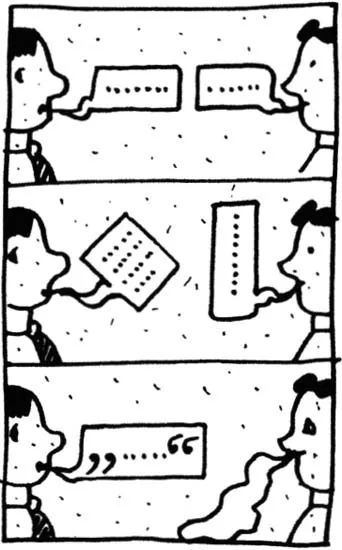
The immediacy of his drawing is what characterizes his designs and illustrations. Looking at one of his posters one gets the impression that it is being acted out before your eyes: the energy of the drawing process is still evident. To my mind this quality is very hard to pull off successfully. You see it in music or in acting: no two actors will play the same role the same way. One will always seem more genuine, more alive. An illustrator may work out a conceptually sound idea for a picture, just as an actor will study and learn his lines, but when it comes to the execution of the drawing or delivering a speech something may be missing. That something is a life force, or what the French call élan.
The picture message of LOVE is contained within a sober typographical framework: the artist’s name runs across the top of the poster in upper and lower case Baskerville, underneath it in a small point size and ranged left the words: posters, drawings. In the bottom right corner on a neutral grey panel Tomaszewski includes the name of the museum and the dates of the exhibition.
He sighs with relief and puts down his pencil. ‘I managed to pull it off.’ Tomaszewski loves, I thought to myself, and my mind went back to how much time and thought he dedicated to us, his students at the Academy.
I asked him about teaching, whether it gave him anything.
‘Nothing’, was the short answer. ‘Getting up in the morning, shaving, travelling across the city, and then having to comment on senseless scribbles the students brought in. Of course it was different when I came across someone who really wanted to learn, someone like Mr Klimowski...’
I stirred in my seat, and we both laughed.
Momentarily I remembered an incident when I asked him for a reference letter to help me become a member of the Polish Artists’ Union, a qualification without which I could not practice my profession. I carried the letter to the Ministry of Culture and seeing it was not sealed I took a peak at its contents. One sentence struck me by its coquettish ambiguity. It read: ‘teaching Klimowski was almost a pleasure.’
Our coffees arrived and in no time Tomaszewski was drawing on another napkin. A couple of years ago he had a similar experience of receiving a commission which he found difficult to respond to. To mark the two hundredth anniversary of the French Revolution, the Committee for Human Rights invited leading international designers to submit a design for what was to be a prestigious collection of posters. He was facing a dilemma as to whether he could invent anything original for such a poster. So much had been said and written about the French Revolution; all its noble aims had been fulfilled. Aspirations of Li...
Table of contents
- Cover
- Title page
- Copyright page
- Contents
- Introduction
- 1. Amsterdam
- 2. Brno
- 3. Birmingham
- 4. Moscow
- 5. London
- List of Illustrations
Trusted by 375,005 students
Access to over 1.5 million titles for a fair monthly price.
Study more efficiently using our study tools.
Frequently asked questions
Yes, you can cancel anytime from the Subscription tab in your account settings on the Perlego website. Your subscription will stay active until the end of your current billing period. Learn how to cancel your subscription
No, books cannot be downloaded as external files, such as PDFs, for use outside of Perlego. However, you can download books within the Perlego app for offline reading on mobile or tablet. Learn how to download books offline
Perlego offers two plans: Essential and Complete
- Essential is ideal for learners and professionals who enjoy exploring a wide range of subjects. Access the Essential Library with 800,000+ trusted titles and best-sellers across business, personal growth, and the humanities. Includes unlimited reading time and Standard Read Aloud voice.
- Complete: Perfect for advanced learners and researchers needing full, unrestricted access. Unlock 1.5M+ books across hundreds of subjects, including academic and specialized titles. The Complete Plan also includes advanced features like Premium Read Aloud and Research Assistant.
We are an online textbook subscription service, where you can get access to an entire online library for less than the price of a single book per month. With over 1.5 million books across 990+ topics, we’ve got you covered! Learn about our mission
Look out for the read-aloud symbol on your next book to see if you can listen to it. The read-aloud tool reads text aloud for you, highlighting the text as it is being read. You can pause it, speed it up and slow it down. Learn more about Read Aloud
Yes! You can use the Perlego app on both iOS and Android devices to read anytime, anywhere — even offline. Perfect for commutes or when you’re on the go.
Please note we cannot support devices running on iOS 13 and Android 7 or earlier. Learn more about using the app
Please note we cannot support devices running on iOS 13 and Android 7 or earlier. Learn more about using the app
Yes, you can access On Illustration by Andrzej Klimowski in PDF and/or ePUB format, as well as other popular books in Design & Design General. We have over 1.5 million books available in our catalogue for you to explore.