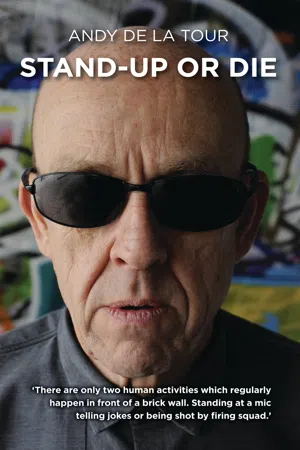
Originally part of the UK alternative comedy scene, Andy de la Tour spent many years on the circuit, performing with the likes of Rik Mayall, Ben Elton, Alexei Sayle and French and Saunders. After a 20-year break from stand-up he returned to New York City, the genre's spiritual home, to start all over again in the back-rooms and dive bars of the Big Apple.
This is one man's journey through New York's underground comedy scene. From 'Rubber Bullets' in lower Manhattan to the 'Hot Tub' in Brooklyn, Andy takes the stand. Can he make them laugh? Will New Yorkers stomach his outsider's take on Obama, the Tea Party and 9/11? Andy's a long way from home and dying is not an option.
- 112 pages
- English
- ePUB (mobile friendly)
- Available on iOS & Android
eBook - ePub
Stand-Up or Die
About this book
Information
1. TOURISTS ON A VISA-WAIVER
If there’s early middle-age, middle middle-age and late middle-age, I am definitely early to middle middle-age. In 2010 my professional life was at a standstill. My varied, or rather ‘maverick’, career had almost ground to a halt. Writer, actor, theatre director, I am all those things yet the phone had virtually stopped ringing. Periods of ‘resting’ – or unemployment as most people experience it – lengthening in inverse proportion to time spent pursuing my multi-stranded working life. Not wanting to feel sorry for myself any more (in which I am an expert) I came up with a hare-brained scheme. Or rather another hare-brained scheme. A misguided move to Derbyshire had been the most recent, although quite how living in the Peak District would have reversed the lack of work opportunities remains an unsolved mystery. Previously I’d even flirted with the idea of moving to France. To do what? Start up a B & B? A cheese farm? Despite my name I don’t even speak French. But maybe not a totally insane idea. My partner, actor and novelist Susan Wooldridge, and I are fortunate enough to own a tiny cottage on the Normandy coast where we’ve spent many happy weeks and months over the last decade.
But none of my schemes addressed the problem. I was profoundly frustrated creatively and any new adventure had to get the creative juices going if it was to be of any use. I was never going to write the definitive baby-boomer novel or follow in Monet’s footsteps, capturing the astonishing beauty of the Normandy coast on canvas, but I decided to make an unusual creative choice. It involved travelling but not to France and I desperately needed – and wanted – Susi’s unconditional support. A flicker of doubt, disbelief or even a word of caution from her would have been enough to strangle such a fragile idea at birth.
I chose my words carefully. We were taking one of our favourite walks, from our village of Sotteville-sur-Mer, along the clifftop path towards the neighbouring village of Saint Aubin, when I said that I had an ‘idea brewing’ about what I’d like to do. The idea of course had already fully brewed and fermented but I didn’t want to scare her. ‘I want to rediscover my creative roots’, I continued, ‘Go back to where I started in the “business” and try to remember why I wanted to do it. I’m thinking of doing some stand-up comedy. Again.’ I had an important thing to add before she could reply. ‘But I don’t want to do it here,’ – we both understood ‘here’ to mean London or the UK rather than a field on the edge of a Normandy cliff – ‘I want to do it in New York.’ To her eternal credit, Susi (the only ‘Susi’ I’ve ever known, by the way, who isn’t a Susie, Suzie, Suzy or even Susy) didn’t snort derisorily, gasp in confusion or even offer a faintly patronising smile. She just looked me straight in the eye and said ‘Great. When are we going?’
Susi knew that I’d done a little stand-up in the US before but not much of the detail. It was back in 1982, eight years before we met, and I’d gone to the US on an Arts Council grant to ‘study’ stand-up comedy. Hard to believe that in those days the Arts Council gave bursaries to actors, directors, designers, whoever to ‘diversify’ their skills. My application for the then tidy sum of £500 to travel to San Francisco, Los Angeles and New York to look at the newly emerging phenomenon of stand-up comedy was, according to one Arts Council official, the most interesting bursary application they’d ever received. Usually it was actors who wanted money for tap dancing lessons.
I must have seen 15 shows and 40 stand-up comedians in the space of just over a fortnight. I think I saw all the stand-up comedians that were around. In New York at the time there were only six comedy clubs – but twice as many as London – and Jerry Seinfeld was on the brink of fame. I hadn’t planned to – and my £500 wasn’t dependent on it – but I decided to do some stand-up myself, if I could persuade any of the clubs to give me a spot. In San Francisco I even enrolled in the then increasingly popular San Francisco Comedy Competition. I went on and did my five minutes. The laughter was sporadic and the applause polite. I didn’t make it to Round Two. By the time I got to New York, the final leg of my expedition, I was determined to give it another go. I went to the newly opened Comedy Cellar in Greenwich Village and told a very nice woman that I was a UK comic ‘in town’ for a few days and would she give me a spot? Without a moment’s hesitation she said ‘How’s Thursday?’ To put this into present-day perspective, I now know New York stand-up comedians who’ve been trying to get a spot at the Comedy Cellar for two years.
Thursday night came and I thought I’d prepared my short ‘set’ quite well, especially in light of my San Francisco experience. But I made the cardinal mistake that any performer makes at his or her peril. I was so nervous I had a drink. In fact I had a couple of drinks. In fact by the time I stepped in front of the mic I was drunk. My short set seemed an eternity. It feels like it’s still going on. I died, was cremated and forgotten in the space of five minutes. Not one single person laughed once. That had happened to me on a previous occasion but that hadn’t been my fault (really); Alexei Sayle and Robin Williams were to blame but that’s a story for later. I returned to London with a hangover, the experience the night before adding to the sour taste in my mouth. The grim memory was an itch that over the years I would periodically scratch. So when I suggested to Susi that I wanted to do stand-up in New York, it was also to kill a ghost. I somehow still needed to put things right, as if somewhere in the purgatorial sub-stratum of the city there was the soul of a dying English comedian which needed to be put out of its misery.
But something else contributed to Susi’s immediately positive response to my latest off-the-wall plan. She had never seen me do any stand-up comedy, not once in the twenty years we’d been together. The very last paid performance I had done as a stand-up was March 14th, 1990, only ten weeks before she and I first met. I’d completed a 100-date tour with Rik Mayall over the course of the previous year and decided to ‘retire’ from stand-up comedy at the end of our last show, at the Royal Shakespeare Theatre in Stratford-upon-Avon of all places. And now I wanted to do some stand-up for the first time in twenty years and it had to be in New York, the Mecca of stand-up comedy. From her point of view, it was simply too wonderful and crazy an idea not to be wholeheartedly endorsed.
Four months later, we arrived in New York for a ninety-day visit, the maximum allowed as tourists on a visa-waiver. And technically that’s all I still was, a tourist.
2. ‘ARE YOU READY FOR SOME COMEDY???’
Melanie welcomed us with open arms. A friend of a very old friend of mine, she’d offered us her not so small apartment – actually two apartments knocked into one – for an absurdly low rent and was in New York for only a couple of days to coincide with our arrival. Then she was back to Port-au-Prince in Haiti as part of the UN mission there, helping to patch up the country after the devastating earthquake. The apartment, in an old five storey walk-up, couldn’t have been more comfortable or in a better Manhattan location, the upper east side two blocks from the east river. Perfect. We had really fallen on our feet and got the trip off to the best possible start.
Introducing ourselves with small-talk of flights, time differences and the whereabouts of the nearest ‘wash and fold’ laundromat, I was deliberately vague about the purpose of our visit. I had made a decision some weeks before we left London that Susi and I weren’t to tell anyone – literally nobody – of my private quest to tread the comedy boards again. Even my acting and literary agents in London were kept in the dark. The reason for the secrecy was simple: I had absolutely no certainty that I’d even manage one gig and the last thing I wanted was friends, family or even strangers all enquiring enthusiastically about how it was going – or not going, which was the likelier outcome. The Party line – on both sides of the Atlantic – was that we were in New York for an extended vacation but with some ill-defined ‘work meetings’ thrown in. It wasn’t complete fiction, I did have some meetings lined up with a few theatre directors whom I could talk to about some plays I’d written. And Susi and I did intend to take in some of the sights and sounds of the ‘Big Apple’. I never read or heard that phrase, by the way, in the whole three months of our visit. Likewise the expression ‘Ground Zero’. These places only exist in the minds of visitors.
Neither of us knew New York well and we’re good at getting out and about to see the sights when we visit places. We had been in New York together once before nine years previously, but that visit had been for only ten days. In 2000 we’d both performed in the premiere of Harold Pinter’s last play, Celebration, at the Almeida Theatre in London and that production, with the whole of the original cast, had been included in a short ‘Harold Pinter’ season at the Lincoln Centre in the summer of 2001. On that trip, we’d squeezed in some of the main attractions, the Metropolitan Museum, Ellis Island, the Frick museum and a ride around the island of Manhattan on a boat. If we’d known then that the World Trade Centre only had six weeks left standing we might have visited the Twin Towers too. So in 2010 we still had plenty of Manhattan and further afield to explore.
But first things first, I had to check out the New York stand-up comedy scene. It would have changed in the twenty-eight years since I’d experienced it first time around. And I didn’t have one single contact. Not a name, an email address, not even a recommended comedy venue. There was only one place I could start – the comedy listings in Time Out New York. I never really appreciated the physical accuracy of the phrase ‘My heart sank’ until I had perused what the city had to offer. Taking the printed and online versions of Time Out together I counted between twenty and thirty stand-up comedy shows every single night. Monday to Sunday. Six in the evening to midnight and beyond. Over a hundred and fifty a week. If I saw two shows every night of my stay I might just catch every show once. Where to begin?
I knew there’d be little point in presenting myself at the topend comedy venues, The Comic Strip, Caroline’s on Broadway or even, yes, the old Comedy Cellar in McDougall Street in the vain hope of blagging my way on stage. These clubs had become very touristy, twenty-five dollars a head and two-drink minimum, churning out two or three shows a night, five or six acts a show. Stand-up comedy was big business. I hadn’t done stand-up for such a long time I wanted to start small – very small. The smaller the better.
Poring over the listings again, it became obvious where the more downmarket venues were. I knew there had to be some kind of ‘alternative comedy’ scene – which New Yorkers know by the far sexier name of ‘underground comedy’ – and I came across a couple of dozen regular weekly stand-up shows that were either free or five to ten dollars. The venues weren’t on Broadway either. In Manhattan they were mainly on the Lower East Side, the East Village or over in Greenwich Village. They were also in Brooklyn and Queens but I wasn’t quite brave enough yet to venture into the ‘boroughs’. I had no idea what any of these shows were like but who could resist the sound of them? They went by the names of ‘Hot Tub’, ‘Rubber Bullets’, ‘Tell Your Friends’, ‘Righteous Kill’ and ‘Lasers in the Jungle’.
I made a rough plan for the following week, allowing us a couple of days to get settled in; the fridge stocked, Metrocard bought and a couple of pay-as-you-go mobiles sorted out. I pencilled in four evenings, four different places, four different shows. First up, Sunday night, 8 p.m., at The Beauty Bar near Gramercy Park. I’m not sure why I was surprised but the venue was actually a bar and beauty salon combined. Some barstools, a couple of hairdresser chairs with washbasins and a back room for the comedy. A different function for every hour of the day. Being a Sunday evening nobody was having a manicure or getting their hair done but I bet on Monday mornings the place buzzed. The barman confirmed there was a stand-up show due to start at eight so I bought my beer and went through to the back room. It was empty. I was the only person and it was five to eight. Loud music played, some sort of country rock but I’m no expert.
I hovered for a few minutes, unsure of what to do. A young guy wandered in, followed by another young guy who seemed to know him. I now noticed a small raised dais by the far wall. The first young guy went into an alcove and reappeared with a mic on a stand which he put on the dais. The second young guy fiddled with a lamp and pointed it vaguely at the mic. The two guys exchanged a few words but neither acknowledged the third guy in the room. They then disappeared. I was about to cut my losses and flee when a loud group of three young women came in, cokes in hand, and took the best seats in the house, a leather-covered bench right in front of the dais. Laughing and joking over the music they were clearly regulars, here for their customary fun Sunday night out. I couldn’t possibly bottle out now so I took my seat in the back corner and waited. By about eight twenty-five the audience had swollen to nine and the two young guys reappeared. One turned the lamp on, the other jumped up onto the stage, grabbed the mic out of the stand and yelled loudly, ‘Are you ready for some comedy???’ More like a scream really and the PA system was surprisingly efficient. It would have filled the Albert Hall. The sound was eardrum bursting. He repeated himself ‘Are you ready for some comedy???’ The three girls at the front pump-fisted the air so the guy went ‘Awright!!!’ and went straight into a three minute riff about what a fantastic line-up of comedians he had for us. To be fair, one or two of the five acts that followed weren’t bad. They were quite funny as long as you don’t mind your comedy based entirely on getting laid, Facebook, Twitter, iPhone apps, bodily functions and how hilarious old people are. These are after all the daily preoccupations of most young white men in New York. Or in London or almost anywhere I suppose. And the comedians were all young white men. It wouldn’t be the first show I’d see with only young white men strutting their stuff, not by a long chalk.
By ten o’clock the show was over. I can’t say I wasn’t disappointed. I don’t know what I was expecting; maybe I wanted to stumble into a smoke-filled den where a latter day Lenny Bruce was delivering cutting-edge commentary about the disintegration of American society since Nine-Eleven. Nowhere is smoke-filled these days of course but I wasn’t expecting the stand-up comedy to be quite so, well, juvenile. Innocent. If this was the ‘underground’ scene then more had changed in the three decades since I’d been here than simply the multiplication of venues.
I got back to the apartment to find Susi fast asleep. She woke briefly to ask me how my evening went. ‘I think I might have made a terrible mistake,’ I said.
3. STAND-UP COMEDY IS NOT FUN
It’s a common myth that the early days of the so-called ‘alternative comedy’ scene in Britain were dominated by angry young left-wing comics. There were quite a lot of us who fitted that bill, more or less, but many who didn’t and that’s no criticism. One of the best and most consistent comedians at The Comedy Store and The Comic Strip at the time was Rik Mayall whose comic persona, ‘Rik’, was an hilarious piss-take precisely of the ‘angry left-wing’ youth, a character then made famous by the cult TV series ‘The Young Ones’. But the nascent stand-up comedy scene of the late 1970s and 1980s was blessed with – some said owed its existence to – the election of a right-wing Tory government led by Margaret Thatcher. Satirical or topical comedy, in its stand-up form, certainly found a comfortable home in the burgeoning comedy scene. Indeed there were occasions when simply to mention the name of Thatcher with a sneer was enough to get a huge undeserved laugh if not an even more undeserved round of applause. One of the advantages of pioneering a new cultural scene or trend – be it punk rock, alternative comedy, hip-hop, whatever – is that you don’t have to be good, you just have to be first.
But there’s no doubt the comedy of those early years had something special even if many if not most acts were far from hilarious. It was its differentness, its unselfconscious disrespect for all that had gone before, good and bad. Predictably, very few of the first wave of so-called ‘alternative’ comedians went on to pursue successful careers out of comedy. Only the most consistently funny and original performers such as Alexei Sayle, Ben Elton, Dawn French and Jennifer Saunders, survived the glare of television exposure. They were followed soon after by many more, the likes of Vic Reeves and Bob Mortimer, Paul Whitehouse and Harry Enfield, who in their different way extended the reach of ‘alternative’ comedy, with or without a subversive political agenda.
I know that the stand-up comedy scene i...
Table of contents
- Front Cover
- Half-Title Page
- Title Page
- Copyright
- Contents
- 1. Tourists on a Visa-Waiver
- 2. ‘Are You Ready for Some Comedy???’
- 3. Stand-Up Comedy is not Fun
- 4. Nine Shows Over Three Nights
- 5. An Evening of Lesbian Stand-Up
- 6. Downtown for My Inaugural Gig
- 7. Before I Morphed into Jim Davidson
- 8. Too Many Shows Chasing Too Few Punters
- 9. 9/11 Was off Limits
- 10. I had Actually Done it
- An Extra Bit
Trusted by 375,005 students
Access to over 1.5 million titles for a fair monthly price.
Study more efficiently using our study tools.
Frequently asked questions
Yes, you can cancel anytime from the Subscription tab in your account settings on the Perlego website. Your subscription will stay active until the end of your current billing period. Learn how to cancel your subscription
No, books cannot be downloaded as external files, such as PDFs, for use outside of Perlego. However, you can download books within the Perlego app for offline reading on mobile or tablet. Learn how to download books offline
Perlego offers two plans: Essential and Complete
- Essential is ideal for learners and professionals who enjoy exploring a wide range of subjects. Access the Essential Library with 800,000+ trusted titles and best-sellers across business, personal growth, and the humanities. Includes unlimited reading time and Standard Read Aloud voice.
- Complete: Perfect for advanced learners and researchers needing full, unrestricted access. Unlock 1.5M+ books across hundreds of subjects, including academic and specialized titles. The Complete Plan also includes advanced features like Premium Read Aloud and Research Assistant.
We are an online textbook subscription service, where you can get access to an entire online library for less than the price of a single book per month. With over 1.5 million books across 990+ topics, we’ve got you covered! Learn about our mission
Look out for the read-aloud symbol on your next book to see if you can listen to it. The read-aloud tool reads text aloud for you, highlighting the text as it is being read. You can pause it, speed it up and slow it down. Learn more about Read Aloud
Yes! You can use the Perlego app on both iOS and Android devices to read anytime, anywhere — even offline. Perfect for commutes or when you’re on the go.
Please note we cannot support devices running on iOS 13 and Android 7 or earlier. Learn more about using the app
Please note we cannot support devices running on iOS 13 and Android 7 or earlier. Learn more about using the app
Yes, you can access Stand-Up or Die by Andy de la Tour in PDF and/or ePUB format, as well as other popular books in Ciencias sociales & Biografías de ciencias sociales. We have over 1.5 million books available in our catalogue for you to explore.