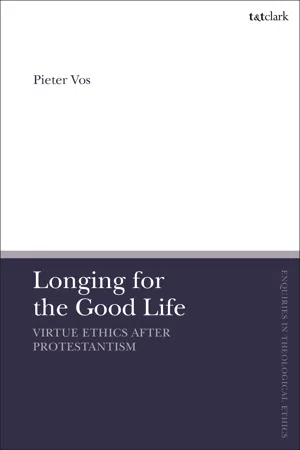
This book argues that Protestant theological ethics not only reveals basic virtue ethical characteristics, but also contributes significantly to a viable contemporary virtue ethics. Pieter Vos demonstrates that post-Reformation theological ethics still understands the good in terms of the good life, takes virtues as necessary for living the good life and considers human nature as a source of moral knowledge.
Vos approaches Protestant theology as an important bridge between pre-modern virtue ethics, shaped by Aristotle and transformed by Augustine of Hippo, and late modern understandings of morality. The volume covers a range of topics, going from eudaimonism and Calvinist ethics to Reformed scholastic virtue ethics and character formation in the work of Søren Kierkegaard. The author shows how Protestantism has articulated other-centered virtues from a theology of grace, affirmed ordinary life and emphasized the need of transformation of this life and its orders. Engaging with philosophy of the art of living, Neo-Aristotelianism and exemplarist ethics, he develops constructive contributions to a contemporary virtue ethics.
- 224 pages
- English
- ePUB (mobile friendly)
- Available on iOS & Android
eBook - ePub
Longing for the Good Life: Virtue Ethics after Protestantism
About this book
Information
Chapter 1
Sources of the Good Life
What does it mean to live well? This may count as the central question not only of classical virtue ethics but also of a philosophical current of thought that has emerged in the past decades, known as ‘philosophy of the art of living,’ which claims to retrieve a central concern of Antique philosophy. It is central to how the Christian faith was understood by Christian thinkers in late Antiquity as well and continues to be so in contemporary Christian ethics. These currents of thought provide contrasting as well as overlapping answers to the question. In this chapter, I will focus on these three different ways of understanding the good life: philosophy of the art of living, classical virtue ethics, and Christian thought in late Antiquity, by focusing on what each of them considers to be the sources of the good life.
Contemporary philosophy of the art of living can be traced back to Michel Foucault’s work in the 1970s and 1980s, which discovered in the writings of Greek and Roman philosophers an argument in favor of a ‘care of oneself’ (souci de soi).1 In an interview Foucault explains this interest: “What strikes me is the fact that in our society, art has become something which is related only to objects and not to individuals, or to life. . . . But couldn’t everyone’s life become a work of art?”2 In a way close to Nietzsche’s saying that one should create one’s own life by styling it through long practice and daily work,3 Foucault argues that “we have to create ourselves as a work of art.”4 Foucault refers to Pierre Hadot, who analyzed philosophy in Antiquity as a way of life rather than as a theory about life.5 From these initial investigations of Greek and Roman philosophical schools, a popular philosophy of the art of living emerged, represented by, among others, the German philosopher Wilhelm Schmid, the Dutch humanistic philosopher Joep Dohmen, and the North American philosopher John Kekes.6 In some respects, philosophy of the art of living is close to virtue ethics and its recent revival,7 yet there are significant differences. In this chapter I will argue that the philosophy of the art of living resembles classical virtue ethics only in a limited sense.
Theologically, it is of interest that recently attempts have been made to develop a Christian art of living. In Germany, Peter Bubmann and Bernhard Sill presented a Christliche Lebenskunst,8 and in the Netherlands, several proposals have been made to bring the philosophy of the art of living (levenskunst) in conversation with the Christian tradition.9 These attempts are challenging, since in the philosophical presentations of the art of living Christianity—and any religiosity—is strikingly absent as a valuable source of wisdom for an art of living. Many of its features are even explicitly rejected. According to Foucault, in the Christian way of life as advocated after Hellenism, life was predominantly defined as the renunciation of all earthly ties, that is, of everything that includes love of oneself and relatedness to an earthly self.10 In an interview he remarks: “From that moment on, the self was no longer something to be made but something to be renounced and deciphered.”11 Instead of care of the self and self-development, Christianity propagated self-renunciation and the denial of any self-interest for the sake of God and the other.12 Dohmen follows this interpretation and adds that in the Christian understanding of life “the soul’s purity, needed to be unified with God, has to be acquired by way of self-repentance, self-examination and confession, accompanied by an ascetic and repentant way of life attuned to this”13—features that entirely contradict ideals of autonomy and personal liberty in modern philosophy of the art of living. In a less historical exposition Dohmen states: “The Christian does not want to reach a state of autonomy at all, but aims to show that he dissociates himself from this world and from his own past.”14 Schmid, too, basically refers to Christianity in a negative way, for example, as responsible for the negation of the human being’s bodily nature in a crusade against the lusts.15 According to Kekes, the old “religious answer” did not tell the believer how life can be good in the present world, but it only told how to live here and now in order to enjoy the good life in the hereafter.16
In this chapter, based on an interpretation of some relevant aspects of the late Antique Christian thinker Augustine, I will argue not only that this criticism is largely unjustified, but also that the modern philosophy of the art of living itself contains problematic understandings of the good life as a manageable life project solely depending on my own human will and personal choices. The shortcomings that are contained in this conception can be corrected by taking into account core elements of the Christian tradition and its understanding of the good life and the virtues. Before exploring this, I will start with a short analysis of the philosophy of the art of living as basically modern in nature and as quite different from classical and Neo-Aristotelian virtue ethics. This is followed by an analysis of how contemporary theological accounts of the art of living address the challenges of the philosophy of the art of living. By bringing the premodern Christian tradition of Augustine into dialogue with two other currents of thought, we will gain an impression of the contours of a particular Christian virtue ethical framework that is continuated to a great extent in (post-)Reformation theology, as will be demonstrated in the course of this book.
Art of Living: A Modern Project
Wilhelm Schmid explains the popularity and relevance of the philosophy of the art of living from the current situation of late modernity: the end of the grand narratives and ideologies including their utopian dreams.17 Late modern people no longer live in a world in which life is sustained by social ties and traditions or in which nature provides the human being with a telos according to which life is to be lived. Instead, they must take care of themselves as individuals, choosing how to live their life and according to which standards. Since traditional institutional and social structures are losing their normative regulating function, the human life course has increasingly become a matter of individual construction. Philosophy of the art of living starts from the late modern condition that life has become a void that must be filled, that it will have been in vain if we won’t have shaped it ourselves. Art of living is an attempt to fill this void.18
According to philosophers of the art of living, modern people often do not have an adequate idea of what it means to live and how to find direction in their lives.19 By returning to the classical ideas of practical wisdom and the good life, a philosophy of the art of living aims to offer what has been lost in modernity: care of the self, attention to the important existential questions, self-examination, self-improvement—in short, an art of living. It relates a modern conception of a self-regulating, autonomous self to the practical wisdom and ‘care of the self’ as central aims of classical philosophy. In Foucault’s view, ἐπιμέλεια ἑαυτοῦ or cura sui, care of the self, was characterized by the fact that the art of existence—the τέχνη του βίου—was dominated by the principle that one must take care of oneself, which includes both care of the soul and care of the body as well as self-knowledge and self-examination in a series of clearly defined exercises, with the aim to ‘convert’ oneself to a state of self-mastery (ἐπιστροφή εἰς ἑαυτόν or potestas sui).20
Although philosophy of the art of living can be seen as a retrieval of classical philosophy, late modern conditions are in many respects decisive. These conditions imply that we can no longer accept the classical ideas of reality and human nature, which in the ‘synoptic ethics’ of the Greek and Roman philosophers determined how a human being should act. According to Dohmen, “Ideas about human behavior cannot be derived from insights into nature or from human nature.”21 Hence, the philosophy of the art of living is basically organized around modern concepts like life project, self-direction, authenticity, autonomy, and personal will. Without pretending to give a fully fledged description of the whole branch of this philosophy, a short overview reveals that these modern conceptions are indeed predominant. Kekes, for instance, relates ‘art of life’ primarily to the notion of ‘life project.’ Each life involves numerous different activities, of which some are instrumental to the continuation of life, others are chosen because they reflect a person’s interests, aspirations or values, and some of them endure and become a person’s chief preoccupations throughout life. These last are a person’s life projects.22 Living a good life depends on engagement in personally satisfying and well-chosen life projects in a way that exemplifies one’s ideal of personal excellence, according to one’s will.
Characteristic of the philosophy of the art of living is the recognition of a fundamental plurality in people’s personal life views. Life views have become a matter of individual choice and different people will make different decisions, “each of which may be reasonable, because their decisions must reflect the differences in the characters and circumstances of the deciders.”23 Although the decision for a life view does not imply a radical opposition to tradition, it emphatically depends on one’s own choice and will: the conception of the good life should be one’s own and not the result of influences over which one has no control.24 And although living the good life requires a sense of one’s limited ability to control reality and an understanding of one’s vulnerability to contingency,25 life basically appears to be a matter of self-mastery and self-management. Dohmen admits that many things befall us as fortune or misfortune, but what counts is “to determine how much latitude one has within the concrete context of action,” and how to deal with both one’s limitations and potential in a practical way.26
Life is seen as an art because it is a creative, imaginative, individual endeavor to make life into a good life, not as a life that is lived rightly in a moral sense, but as a life that is successful and looks beautiful. Although an ethical orie...
Table of contents
- Cover
- Half-Title
- Series
- Dedication
- Title
- Contents
- Preface
- Acknowledgements
- List of Abbreviations
- Introduction
- Chapter 1 SOURCES OF THE GOOD LIFE
- Chapter 2 CHALLENGING EUDAIMONISM
- Chapter 3 CALVINISM AND THE BREAKDOWN OF TELEOLOGY
- Chapter 4 RETRIEVING REFORMED SCHOLASTIC VIRTUE ETHICS
- Chapter 5 CHARACTER FORMATION AS KIERKEGAARDIAN EDIFICATION
- Chapter 6 PUTTING ON CHRIST
- Chapter 7 THE FRAILTY OF HUMAN VIRTUE
- Chapter 8 THE SANCTIFICATION OF ORDINARY LIFE
- Bibliography
- Index
- Copyright
Trusted by 375,005 students
Access to over 1.5 million titles for a fair monthly price.
Study more efficiently using our study tools.
Frequently asked questions
Yes, you can cancel anytime from the Subscription tab in your account settings on the Perlego website. Your subscription will stay active until the end of your current billing period. Learn how to cancel your subscription
No, books cannot be downloaded as external files, such as PDFs, for use outside of Perlego. However, you can download books within the Perlego app for offline reading on mobile or tablet. Learn how to download books offline
Perlego offers two plans: Essential and Complete
- Essential is ideal for learners and professionals who enjoy exploring a wide range of subjects. Access the Essential Library with 800,000+ trusted titles and best-sellers across business, personal growth, and the humanities. Includes unlimited reading time and Standard Read Aloud voice.
- Complete: Perfect for advanced learners and researchers needing full, unrestricted access. Unlock 1.5M+ books across hundreds of subjects, including academic and specialized titles. The Complete Plan also includes advanced features like Premium Read Aloud and Research Assistant.
We are an online textbook subscription service, where you can get access to an entire online library for less than the price of a single book per month. With over 1.5 million books across 990+ topics, we’ve got you covered! Learn about our mission
Look out for the read-aloud symbol on your next book to see if you can listen to it. The read-aloud tool reads text aloud for you, highlighting the text as it is being read. You can pause it, speed it up and slow it down. Learn more about Read Aloud
Yes! You can use the Perlego app on both iOS and Android devices to read anytime, anywhere — even offline. Perfect for commutes or when you’re on the go.
Please note we cannot support devices running on iOS 13 and Android 7 or earlier. Learn more about using the app
Please note we cannot support devices running on iOS 13 and Android 7 or earlier. Learn more about using the app
Yes, you can access Longing for the Good Life: Virtue Ethics after Protestantism by Pieter Vos in PDF and/or ePUB format, as well as other popular books in Theology & Religion & Christian Denominations. We have over 1.5 million books available in our catalogue for you to explore.