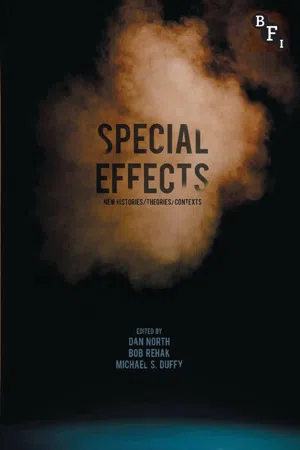
As blockbusters employ ever greater numbers of dazzling visual effects and digital illusions, this book explores the material roots and stylistic practices of special effects and their makers.
Gathering leading voices in cinema and new media studies, this comprehensive anthology moves beyond questions of spectacle
to examine special effects from the earliest years of cinema, via experimental film and the Golden Age of Hollywood, to our
contemporary transmedia landscape.
Wide-ranging and accessible, this book illuminates and interrogates the vast array of techniques film has used throughout its history to conjure spectacular images, mediate bodies, map worlds and make meanings.
Foreword by Scott Bukatman, with an Afterword by Lev Manovich.
eBook - ePub
Special Effects
New Histories, Theories, Contexts
- 304 pages
- English
- ePUB (mobile friendly)
- Available on iOS & Android
eBook - ePub
Special Effects
New Histories, Theories, Contexts
About this book
Information
1 TECHNIQUES
ECTOPLASM AND OIL
METHOCEL AND THE AESTHETICS OF SPECIAL EFFECTS
ETHAN DE SEIFE
Methyl Cellulose 101
When the credits for recent, apparently ‘all-natural’ films such as The Help and Moneyball (both 2011) list, respectively, twenty-two and sixty-eight digital-effects artists and technicians, one may be forgiven for conflating the terms ‘special effects’ and ‘digital effects’. Yet even in an era when nearly every Hollywood film employs digital compositing, digital colouring, digital rotoscoping and/or several other computer-based processes, a great deal of money and many skilled professionals in the special-effects industry are concerned with practical effects: those made of metal, clay, plastic and other materials. Even though computer-generated imagery (CGI) is shiny and game-changing, the computers used to produce it are simply tools, not unlike like those used to construct models, miniatures and maquettes.
But no special-effects toolkit is limited to conventional tools. There is room in it for far less solid stuff, as well. One of the strangest, most ubiquitous, most versatile and most fascinating of all the devices of practical special effects is a substance called methyl cellulose, far better known by the trade name ‘methocel’, given it by Dow Chemical, the company whose scientists invented it in the 1930s.1 A most peculiar kind of goop, methocel has, for several decades, ‘played’ all manner of viscous substances, from mud in The Return of the Living Dead (1985)2 to demonic slime in Drag Me to Hell (2009)3 to pterodactyl excrement in The Flintstones (1994).4 Even in films heavily dependent on CGI, methocel is a special-effects staple. Scott Heger, head chemist of Blair Adhesives, the largest and most important supplier of methocel to American film and television productions, notes that George Lucas’s Star Wars prequels (1999–2005), which employ few three-dimensional elements besides actors, used 20,000 gallons.5 Methocel’s remarkable versatility extends to the fact that it often provides a real, physical base for digital augmentation. To cite but two examples: both Ben Stiller’s confrontation with a giant octopus in Night at the Museum: Battle of the Smithsonian (2009) and Jon Voight’s egestion by a colossal snake in Anaconda (1997) were rendered on screen with a combination of digital and practical effects. While the octopus and snake were rendered digitally, methocel gives these actors actual coats of cephalopod slime or reptile saliva, as the situation required. Atop those viscous layers of ooze, digital technicians rendered further glisten to enhance the visual force of the scenes. In this way, a practical technology such as methocel complements and combines in complex ways with the latest in digital technologies; these examples point the way toward a more nuanced understanding of the interdependence of analogue and digital special-effects techniques.
As with the advents of colour, sound, 3D, CGI and other technologies that have been folded into moviemaking craft, methocel has generally been used to complement the overarching goal of Hollywood film: clear and coherent narration. In this way, it is just another element of style that – just like three-point lighting, the match on action and the split-field diopter – has served to emphasise and clarify narratively relevant emotions, characters and actions. As David Bordwell writes, every tool and technique of film style has historically been engaged in the Classical Hollywood cinema in order to convey salient narrative information.6
Nevertheless, methocel’s particular and unusual properties have nudged it into certain types of cinematic functions and meanings, as its properties encourage certain stylistic possibilities and discourage others. Taking two methocel-heavy films – Ghostbusters II (1989) and There Will Be Blood (2007) – as its chief examples, this essay begins an investigation into the ways in which methocel affects visual style in American film. How does methocel intersect with other elements of mise en scène? Does its use open up or close off certain possibilities in editing or cinematography? How, in other words, has methocel been employed not only to achieve the established stylistic and narrative goals of the Hollywood cinema, but to alter them, or to offer novel or creative aesthetic options?
A different, but related, goal of this essay is to use an analysis of the functions of methocel to suggest that the general tenor of scholarship on special effects could benefit from a reorientation. Much extant academic writing on special effects – whether from a practical, ‘how do they do it?’ perspective, or from a more scholarly purview – is preoccupied with notions of trickery, trompe l’oeil and ‘unmasking’ the deceptive impulses that purportedly undergird the cinema. In this way, the bulk of special-effects scholarship owes a certain debt, acknowledged or not, to apparatus theory, the rather distrustful strain of film theory whose quintessential statement is Jean-Louis Baudry’s ‘Ideological Effects of the Basic Cinematographic Apparatus’. In that essay, Baudry argues that the very lenses, cameras, projectors and screens involved in film production and exhibition collude to produce an ‘illusionistic’ effect that, in encouraging us to believe that we are ‘inscribed’ into a depicted fictional world, is a psychologically and economically repressive system designed to obliterate one’s own self and identity.7 For Baudry, the cinematic apparatus is the logical and most frightening extension of the creation of the ‘idealised spectator’, a notion that he connects to the establishment of so-called Renaissance perspective in painting. And, indeed, the logical extension of Baudry’s own argument is that, if the most fundamental components of cinematic exhibition – lens, projector, screen – all conspire to create an illusion that threatens self-identity, then such further fripperies as special effects are attractive, if redundant, efforts that cement the loss of self. It is a hardline, deeply sceptical view that nevertheless strongly inflects a good deal of scholarship on special effects.
Norman Klein’s book The Vatican to Vegas: A History of Special Effects, while not the only text to espouse such an attitude, embraces this notion so thoroughly as to be nearly parodic:
Hollywood f/x have their charm. They are jumbo-sized hoaxes. They are unabashed. They tell you how much fun it is to cheat. They promise you more than your money’s worth, every dollar on the screen. They cruise you in their stretch limousine. They know that melodrama looks like a gag. Then they claim that size is everything. So every year they stretch even more, more horizontal, more ‘cineramic’ (wider, more immersive). … Hollywood f/x is so playfully lopsided, it reveals secrets about the global economy, particularly about production methods.8
Klein’s take on special effects ignores such historical considerations as craft practices, conventions of cinematic narration and budgetary concerns, opting instead for ‘big ideas’ about the ways in which special effects must be understood as devices to pull off ‘hoaxes’ that are somehow linked to economic malfeasance. I submit that there is nothing of the hoax whatsoever in the use of methocel, or of special effects in general, even in Hollywood, that most devious of illusion factories. Methocel, like every other special-effects device and technique, is a tool designed to enhance a film’s narrative and emotional content – to present an object or character in such a way as to make it exceptional or unusual. In so doing, methocel renders its object of especial narrative and/or emotional import, and calls visual attention to it for being particularly significant. The mission of special effects in general is not to ‘trick’ viewers into believing some sort of cinematic hoax. It is to impart visual force to certain elements of fictional narratives.
Chemical and Physical Properties
The particular properties of methyl cellulose are the reasons for its ubiquity in motion-picture special effects, and for its multifarious uses in a great many other industries. Methyl cellulose is a polysaccharide molecule derived entirely from cellulose – generally, wood pulp. In its pure form, it is a white powder; the addition of water turns it into a viscous goop. But adding water to methocel is not a straightforward process, as the compound possesses the unusual property of thickening when heated and thinning when cooled. Once dispersed in water, the resultant goo may be further thickened, thinned, coloured and textured: the special-effects benefits of this manipulation are obvious.
Organic, non-toxic and edible, methocel is nevertheless indigestible, as the human gut does not have the enzymes required to break down its particular family of polymers.9 For special-effects craftspeople, this quality is a great boon: should the situation require, an actor could ingest methocel with no ill effects – indeed, with no effects at all.
Methyl ce...
Table of contents
- Cover
- Title Page
- Contents
- Acknowledgments
- Foreword
- Notes on Contributors
- Introduction
- 1/Techniques
- 2/Bodies
- 3/Screens
- Index
- eCopyright
Trusted by 375,005 students
Access to over 1.5 million titles for a fair monthly price.
Study more efficiently using our study tools.
Frequently asked questions
Yes, you can cancel anytime from the Subscription tab in your account settings on the Perlego website. Your subscription will stay active until the end of your current billing period. Learn how to cancel your subscription
No, books cannot be downloaded as external files, such as PDFs, for use outside of Perlego. However, you can download books within the Perlego app for offline reading on mobile or tablet. Learn how to download books offline
Perlego offers two plans: Essential and Complete
- Essential is ideal for learners and professionals who enjoy exploring a wide range of subjects. Access the Essential Library with 800,000+ trusted titles and best-sellers across business, personal growth, and the humanities. Includes unlimited reading time and Standard Read Aloud voice.
- Complete: Perfect for advanced learners and researchers needing full, unrestricted access. Unlock 1.5M+ books across hundreds of subjects, including academic and specialized titles. The Complete Plan also includes advanced features like Premium Read Aloud and Research Assistant.
We are an online textbook subscription service, where you can get access to an entire online library for less than the price of a single book per month. With over 1.5 million books across 990+ topics, we’ve got you covered! Learn about our mission
Look out for the read-aloud symbol on your next book to see if you can listen to it. The read-aloud tool reads text aloud for you, highlighting the text as it is being read. You can pause it, speed it up and slow it down. Learn more about Read Aloud
Yes! You can use the Perlego app on both iOS and Android devices to read anytime, anywhere — even offline. Perfect for commutes or when you’re on the go.
Please note we cannot support devices running on iOS 13 and Android 7 or earlier. Learn more about using the app
Please note we cannot support devices running on iOS 13 and Android 7 or earlier. Learn more about using the app
Yes, you can access Special Effects by Dan North, Bob Rehak, Michael S. Duffy, Dan North,Bob Rehak,Michael S. Duffy in PDF and/or ePUB format, as well as other popular books in Media & Performing Arts & Film & Video. We have over 1.5 million books available in our catalogue for you to explore.