How do people access movies today? What are the most popular and powerful channels for media distribution on a global scale? How are film industries changing in the face of media convergence and digitisation?
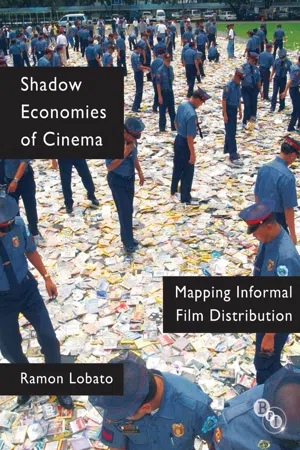
To answer questions such as these, argues Ramon Lobato, we must shift our gaze away from the legal film business and toward cinema's shadow economies. All around the world, films are bought from roadside stalls, local markets, and grocery stores; they are illegally downloaded and streamed; they are watched in makeshift video clubs, on street corners, and in restaurants, shops and bars. International film culture in its actually-existing forms is a messy affair, and it relies to a great extent on black and grey media markets. Examining the industrial dynamics of these subterranean film networks across a number of different sites – from Los Angeles to Lagos, Melbourne to Mexico City – this book shows how they constitute a central rather than marginal part of audiovisual culture and commerce.
Combining film industry analysis with cultural theory, Shadow Economies of Cinema opens up a new area of inquiry for cinema studies, putting industry research into dialogue with wider debates about economic informality and commodity circulation. Written in an accessible style, this book offers an original 'bottom-up' perspective on the global cinema industry for researchers and students in film studies, cultural studies, and media and communications.
- 176 pages
- English
- ePUB (mobile friendly)
- Available on iOS & Android
eBook - ePub
About this book
Information
1
Distribution from Above and Below
Avid viewers of The Simpsons may recall a particularly amusing episode from 2005 called ‘Thank God, It’s Doomsday’. After seeing a Christian propaganda movie called Left Below, Homer becomes convinced that the Rapture is coming and rallies the citizens of Springfield to prepare for the impending apocalypse. The fated hour arrives and he is lifted up to heaven, where he meets – and subsequently annoys – God, who decides to turn back time and reverse the Rapture rather than endure the presence of Homer in paradise.
Aside from some gags about numerology and Evangelism, this Simpsons episode also contains compelling evidence of the power of informal film distribution networks. The Left Below film that has such a profound effect on Homer is not a figment of Matt Groening’s imagination but a tongue-in-cheek reference to an actually existing series of B-grade films – the Left Behind (2000, 2002, 2005) trilogy – which achieved an extraordinary level of success among US Evangelicals in the early 2000s. Its presence in The Simpsons is testament to Left Behind’s status as one of the most unusual pop-culture phenomena of the last decade, a film franchise which sold an astonishing 6 million DVDs via a grassroots distribution strategy that bypassed the Hollywood system.1
Based on a series of popular books, the Left Behind movies were the brainchild of a small Niagara Falls company called Cloud Ten Pictures. Cloud Ten decided to forgo the usual theatrical release model and market the films in its own way. Rather than screening Left Behind in cinemas, it released the film straight-to-DVD and focused its attention on the film’s primary market: Evangelical communities. Thousands of ‘church cinema’ screenings were held across the USA, with ministers promoting the film enthusiastically from the pulpit. Sometimes the film’s stars (mostly B-grade actors like Kirk Cameron, from the 1980s sitcom Growing Pains) would show up as well. Hundreds of thousands of Americans saw the Left Behind movies in these church cinemas.2 Millions more purchased the DVDs to watch at home.
Operating outside the established structures of the US film industry, the producers of Left Behind challenge our ideas about the distinction between independent and mainstream cinema culture. Companies like Cloud Ten have their own ideas about how to produce, distribute, market and exhibit movies. The highly organised and efficient model of church screenings combined with DVD sales constitutes a viable alternative to mainstream releasing patterns. Regardless of what we may think about the ideological content of Left Behind, or the resurgence of the religious Right in the USA, this example vividly illustrates the power of informal networks. Approaching these shadow circuits not as anomalies but as an integral feature of the audiovisual landscape can help to generate a new understanding of how movies travel inside and outside established channels.
This chapter expands on one of the fundamental arguments of the book: that our ideas about what cinema is and where it circulates have been shaped around specific (but far from universal) distribution models. I want to suggest that there are other stories to be told about distribution, and that we can think about this topic in a broader way. The present chapter develops this idea by revisiting the existing body of research on film industry structure and exploring how and where this literature does – and does not – account for unconventional distribution models like that of Cloud Ten. In this way, I clear some space for a revisionist history of nontheatrical and informal distribution circuits within the dominant narratives of film industry analysis, and provide theoretical foundations for the case studies to come in later chapters.
REDEFINING DISTRIBUTION: THEORY AND PRACTICE
It may be helpful at this point to consider how the term ‘distribution’ is used in both common speech and in film industry discourse. In the most general sense, distribution involves the dispersal of matter or information across a given geographical area or temporal period. According to the Oxford English Dictionary, it is the ‘action of dividing and dealing out or bestowing in portions among a number of recipients’.3 This action has both a passive mode (the distribution of cancer genes in a population) and an active mode (the distribution of pamphlets by political activists).
In its active mode, distribution becomes an industrial process and a cultural technology. Soft drink distribution, for example, begins at the end of the production line and involves all those activities which are required to facilitate purchase, many of which would typically be subcontracted to logistics contractors. These include importation of the finished product, payment of taxes and duties, transport to warehouses and retailers, stocktaking and inventory, collection of payment, liaison with vendors, price monitoring and so on. This part of the product lifecycle also involves a variety of informational activities such as marketing, advertising and public relations, which occupy an increasingly important role within the distribution process.
Distribution acquires new shades of meaning in different contexts. For example, ideas of distribution and redistribution play important roles in political philosophy, and economic redistribution is a central practice within public policy. Taxation, industry subsidies, welfare payments – these are all concerned with the distribution and redistribution of resources and money.4 But while the idea of distribution is a key plank of social democratic government, it is far from uncontested. In the USA, ‘redistributionist’ is an insult hurled by conservatives at liberals.5 This reminds us that questions of distribution are nothing if not political. If we understand politics as a struggle for power and resources, then distribution is politics at its purest.
In film industry discourse, distribution has a more concrete set of meanings. Conventional typologies, such as those offered in media studies textbooks, describe distribution as the segment of the film industry linking production and exhibition/consumption, involving the sale, reproduction, delivery, translation, marketing and promotion of motion pictures in various territories and across all formats, from 35mm prints to digital downloads. Compared to production, the distribution sector receives little public attention. Yet it constitutes the biggest part of the overall industry in terms of personnel and revenues, as the following quote from former 20th Century-Fox executive Strauss Zelnick makes clear:
The bulk of our business is distribution. Probably three quarters of our employees are involved in generating revenues. Out of the other quarter, most are involved in counting revenues, and then we have about twelve people who are involved in actually making movies. The bulk of our business is financing, distributing, and accounting. We have a huge staff that does nothing but license our pictures in all markets around the world.6
The distribution sector that Zelnick describes here is in a state of ongoing reinvention. Even within the relatively stable Hollywood studio structure, distribution practices have evolved significantly over the years in the face of technological developments and regulatory realignments.
The early years of cinema were characterised by a gradual formalisation of distribution processes, and increasing complexity in the chain from production to consumption. In the USA, the first formal distribution structures were the film exchanges that appeared at the turn of the twentieth century.7 Exchanges institutionalised the informal practices of swapping and trading that were common among exhibitors. These exchanges would purchase films from producers and then rent them out to exhibitors. Over time a system of price differentiation began to emerge with new releases attracting a higher rate than older titles. A subscription system also took hold, meaning that exchanges committed to buy the output of a particular producer over a given period of time.8
The studio era was characterised by increasing levels of standardisation in distribution. The Runs–Zones–Clearances system established for the first time a formal hierarchy of exhibitors, reflecting a strategic ‘spatial and temporal separation of markets’ that has been central to mainstream distribution strategy ever since.9 Films began their run in the swanky metropolitan theatres, then after a strictly monitored embargo period (the clearance) migrated to second- and third-run venues located on the urban fringes before ending up in far-flung regional theatres. Control of distribution proved to be the basis of the US studios’ dominance and the guarantee of their future prosperity.10
This system of strategic market segmentation was extended to include formats as well as theatre circuits in the post-television era. The ‘windowing’ model, involving the staggered movement of content across overlapping release windows (theatrical, cable, DVD, pay-TV, broadcast TV and so on), became the master logic of mainstream film distribution in the latter half of the twentieth century. The role of the major studios and distributors, evocatively described by Edward Epstein as ‘dream clearinghouses’, has since been to oversee and manage the flows of money and data that these movements generate.11 In the internet age, distribution has taken on yet more meanings. As formats proliferate and converge, the objective of distribution is to exploit film content across as many different platforms as possible. Intellectual property exploitation and enforcement take centre stage as the emphasis shifts towards monetisation of content in a multi-channel environment.
Film historians and political economists who have analysed the evolution of this model often focus on power relations between studios, producers, exhibitors and the state. As a result, there is a rich body of work on the structural organisation of film distribution pipelines in the USA and internationally. Janet Wasko and Thomas Guback, among others, have written widely and lucidly on this topic. Guback emphasises the role of ‘the policies developed by the American industry to capture and maintain markets and to obstruct foreign competition’ as instrumental to the global dominance of Hollywood.12 This body of work reminds us that the business of mainstream film distribution is characterised by oligopoly and collusion, and it offers a powerful critique of the studios’ business practices. At the same time, it places certain circulatory systems (chiefly, studio distribution) squarely at centre of the analysis and relegates others to the sidelines of film history.
This top-down perspective on distribution is in part a product of the methodological norms of film industry research, in which certain forms of empirical knowledge are privileged. Chief among them is box-office revenue, the holy grail of industry knowledge.13 Box-office data, compiled by the studios and market research firms like Nielsen, constitute the basis upon which success and failure, dominance and marginality, are judged. Yet box-office data is only one part of the story of a film’s circulation through diverse markets. It does not, for example, tell us how many people watch a given film on TV, how many buy the DVD then make copies for their friends, how many download the film, or buy a bootleg copy at their local corner store or street market. It is also highly vulnerable to manipulation by the studios.14
In her influential book Desperately Seeking the Audience, Ien Ang describes these industrial knowledge-generation practices as the ‘institutional point of view’. For Ang, who was writing about broadcasting industries in the 1980s, technologies of audience measurement work to represent consumer activity in statistically concrete ways. The objective is for distributors to come to know and understand their publics as assemblages of empirical data. This necessarily involves an erasure:
In the everyday realm, living with television involves a heterogeneous range of informal activities, uses, interpretations, pleasures, disappointments, conflicts, struggles, compromises. But in the considerations of the institutions that possess the official power to define, exploit and regulate the space in which television is inserted into the fabric of culture and society, these subjective, complex and dynamic forms of audiencehood are generally absent; they disappear in favour of a mute and abstract construct of ‘television audience’ onto which large-scale economic and cultural aspirations and expectations, policies and planning schemes are projected.15
Ang is pointing here to the epistemological dimensions of distribution practice. In her account, knowledge of media practice is shaped for institutional uses and expressed in institutional vocabularies, suppressing informal circulations and experiences. A key task of media scholarship is to deconstruct the ‘politics of knowledge’ that governs this relation.16 Ang’s point applies equally to cinema. Critical analysis of film industries must be careful not to take the forms of knowledge these industries produce at face value, lest we end up reproducing the same familiar narratives about how film circulates and is consumed. It is important to acknowledge the many gaps in the industry’s data sets, and to think about how these shape o...
Table of contents
- Cover
- Title Page
- Contents
- Preface
- Acknowledgments
- Introduction
- 1. Distribution from Above and Below
- 2. The Straight-to-video Slaughterhouse
- 3. Informal Media Economies
- 4. Nollywood at Large
- 5. Six Faces of Piracy
- 6. The Grey Internet
- Conclusion: Coordinates for Studying Distribution in a Digital Age
- Appendix: A Film Distribution Research Guide
- Notes
- Bibliography
- Index
- eCopyright
Trusted by 375,005 students
Access to over 1.5 million titles for a fair monthly price.
Study more efficiently using our study tools.
Frequently asked questions
Yes, you can cancel anytime from the Subscription tab in your account settings on the Perlego website. Your subscription will stay active until the end of your current billing period. Learn how to cancel your subscription
No, books cannot be downloaded as external files, such as PDFs, for use outside of Perlego. However, you can download books within the Perlego app for offline reading on mobile or tablet. Learn how to download books offline
Perlego offers two plans: Essential and Complete
- Essential is ideal for learners and professionals who enjoy exploring a wide range of subjects. Access the Essential Library with 800,000+ trusted titles and best-sellers across business, personal growth, and the humanities. Includes unlimited reading time and Standard Read Aloud voice.
- Complete: Perfect for advanced learners and researchers needing full, unrestricted access. Unlock 1.5M+ books across hundreds of subjects, including academic and specialized titles. The Complete Plan also includes advanced features like Premium Read Aloud and Research Assistant.
We are an online textbook subscription service, where you can get access to an entire online library for less than the price of a single book per month. With over 1.5 million books across 990+ topics, we’ve got you covered! Learn about our mission
Look out for the read-aloud symbol on your next book to see if you can listen to it. The read-aloud tool reads text aloud for you, highlighting the text as it is being read. You can pause it, speed it up and slow it down. Learn more about Read Aloud
Yes! You can use the Perlego app on both iOS and Android devices to read anytime, anywhere — even offline. Perfect for commutes or when you’re on the go.
Please note we cannot support devices running on iOS 13 and Android 7 or earlier. Learn more about using the app
Please note we cannot support devices running on iOS 13 and Android 7 or earlier. Learn more about using the app
Yes, you can access Shadow Economies of Cinema by Ramon Lobato in PDF and/or ePUB format, as well as other popular books in Media & Performing Arts & Film History & Criticism. We have over 1.5 million books available in our catalogue for you to explore.