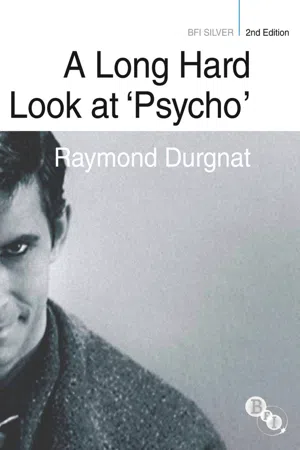
Upon its release in 1960, Alfred Hitchcock's Psycho divided critical opinion, with several leading film critics condemning Hitchcock's apparent encouragement of the audience's identification with the gruesome murder that lies at the heart of the film. Such antipathy did little to harm Psycho's box-office returns, and it would go on to be acknowledged as one of the greatest film thrillers, with scenes and characters that are among the most iconic in all cinema. In his illuminating study of Psycho, Raymond Durgnat provides a minute analysis of its unfolding narrative, enabling us to consider what happens to the viewer as he or she watches the film, and to think afresh about questions of spectatorship, Hollywood narrative codes, psycho-analysis, editing and shot composition.
In his introduction to the new edition, Henry K. Miller presents A Long Hard Look at 'Psycho' as the culmination of Durgnat's decades-long campaign to correct what he called film studies' 'Grand Error'. In the course of expounding Durgnat's root-and-branch challenge to our inherited shibboleths about Hollywood cinema in general and Hitchcock in particular, Miller also describes the eclectic intellectual tradition to which Durgnat claimed allegiance. This band of amis inconnus, among them William Empson, Edgar Morin and Manny Farber, had at its head Durgnat's mentor Thorold Dickinson. The book's story begins in the early 1960s, when Dickinson made the long hard look the basis of his pioneering film course at the Slade School of Fine Art, and Psycho became one of its first objects.
- 264 pages
- English
- ePUB (mobile friendly)
- Available on iOS & Android
eBook - ePub
A Long Hard Look at 'Psycho'
About this book
Information
A Long Hard Look at ‘Psycho’
THE CREDIT SEQUENCE
The Paramount logo fades to a black screen, which turns light grey as music starts: chunky staccato chords under keening violins. From the right-hand edge, black stripes stretch across the screen; more appear, at unpredictable heights, till they block the screen like a window-blind. Against the last bands, streaking across at middle height, white angular flecks appear, like enigmatic signs, and turn out to be the tips and tails of letters, slashed laterally and vertically disaligned. The ‘window-blind’ breaks up as more black bands thrust in, pushing the last grey strips off left. The bits of letters click together, to read, bold white on the all-black field: ‘Alfred Hitchcock’s’. Uncompleted syntax holds the screen for a full two seconds, until the letters’ middle stratum skids left, pursued by more grey bands, which amass in a tight, though still staggered, formation. They rebuild the ‘window-blind’ striation, but this time from grey on black (reversing the earlier construction process). New shards of letters slide in, but before any words can crystallise, the blank grey bands scud back the way they came (surprise reversal of directional thrust). On the now black background, the scattering of broken letters slide and snap together, spelling ‘Psycho’, for about two seconds, until that word, too, cracks into three strata. They slip a little notch sideways, but in opposite directions, so that each letter, vertically misaligned, seems to jerk and tug against itself. The word disintegrates – not, as the generally lateral kinetic has led us to expect, laterally – but, instead, the letters’ top halves fly up and away and off the screen, while their lower halves plunge off the bottom of the frame. Since each half of a letter implies the other half, and it all happens so fast, it’s as if our word-world suddenly doubles and splits and speeds in opposite directions, like a ‘troubled reflection’.
This vertical split begins a second, mainly vertical, phase. From mid-screen level, like a virtual horizon, columns stretch upwards and downwards unevenly, and simultaneously, like a restless graph. Various lines split into groups and rove in block formations.
The last phase, or ‘movement’ (to borrow a musical term), is more leisurely; it leaves time and space for areas bearing credits. Whether single names, or blocks of names, they zip in, abruptly stop, abruptly scud off. The conjunction of names, which we try to read along the line, with shiftings in non-linear space, which patterns and pictures use, disconcerts our perceptual scanning processes. On the final credit, to Hitchcock as director, the music quietens, while the grey upright columns retract, upwards and downwards, into a suggested ‘horizon’, and continue moving slowly, quietly, as if stealthily. They gradually disappear, through a cross-fade, into a photographic landscape: a city skyline, sun-bleached and torpid, with desert mountains beyond.

Motion Painting in Greys
The credit sequence was designed, and hand-made, by Saul Bass, using animation, pixilation and live-action photography. The stripes were rods painted the ‘colour’ required, and pushed across by hand; however, they’re so featureless, so flat-on, that they register as ‘pure pattern’, as non-representational forms, as abstractions. The music, too, is abstract. This little film-within-a-film deploys the idioms of avant-garde abstraction, and extends the tradition of Eggeling, Ruttmann, Lye, McLaren. It also qualifies as ‘concrete’ art, since its moving kinetics, violently disturbing the mechanisms of human perception, emphasise the actual physical presence of the graphic patterns.
The bands and columns imply some cold, geometrical order; its thrusts, shifts and vectors are unpredictable. Brutally rapid changes disorganise us. The images, without the music, would be softly unstable, slithery; but the pistoning music gives them its impact. The ‘lettrist’ scraps and flecks add another, wayward chaos, like the fitfully fluttering ‘angel’ in Borowczyk’s Les Jeux des anges (1964). Both films are exercises in ‘structuralist’ grid-forms as madness. Here, everything resembles hypnagogia (the ‘break-up’ of gestalts and forms, well-known in the states between sleeping and waking). Its driving energy, its streams of cognitive dissonance, don’t just metaphor, they inflict perceptual disintegration. Some unseen activity keeps imposing rigid pattern and then disintegrating them, like obsession and hysteria. By 1960 the structures and modes of schizophrenia were being re-explored by, among many others, ‘existential’ psychiatrist R. D. Laing, whose The Divided Self (1960) was poised to become a radical cult. Herrmann’s music uses stringed instruments only, but its counterpoint of chugging chords and skeetering violins evokes Stravinsky’s The Rites of Spring (1913), whose modernist neo-primitivism asserts the stunted compulsions of the mad animal, man. Narrative-wise, the credits of Psycho are entirely meaningless; yet, like an ‘abstract overture’, in visual kinetic, they presage its theme – disintegrating thought. (Do the striations suggest a window-blind, therefore voyeurism? Do the flecks evoke bird claws? Or a flock of birds? Whose screaming is the violins?) As the columns subside, and fade into the city, the suggestion is not that they’ve stopped operating, but that their sinister energy continues, quietly, invisibly, ‘behind appearances’.
♦
SCENE 1: Phoenix, Arizona: Exterior
The camera moves slowly around a white-ish cityscape. Mid-screen subtitles scud abruptly in, from alternate screen edges, then whizz off, brief reminders of the credits’ spirit of panic: ‘Phoenix, Arizona/Friday December 12/ 2:43 p.m.’ The camera drifts forward, slides around an imposing building, and finds a shabby part of town. It dives towards a high rear window, sneaks in under the blind, and discovers Marion (Janet Leigh), in her underwear, flat on a bed, a man in dark trousers standing beside her.

From God’s Eye View to Crotch-High View
White was an occasional convention for oppressive heat. The overall ‘scene’, though continuous, comprises four different ‘zones’: a high-angle cityscape, a zoom-in to and through a window, the abruptly dark room (relative to the sunlight) and the room lit normally, as befitting gradually adjusted vision. The camera starts high in the sky, and ends down by a man’s groin. The script treats all this as one continuous scene, and Hitchcock originally intended one long shot from a helicopter, from where a zoom would look in through a window, and then, being seemingly inside the room, become an interior, shot from the exterior! Since 1949, the ‘ten-minute takes’ of Rope held the record for the movie shot with the longest running time. Now Psycho would bid for the longest continuous distance travelled by the camera. Its along-the-way ingenuities would renew the admiration of Hitchcock’s Hollywood peers and help offset his stooping to a low-budget production, whose sex and violence many ‘Old Hollywood’ people would abhor. That apart, Hitchcock, like many Hollywood craftsmen, loved solving technical difficulties, as a personal private challenge, as craft for craft’s sake, art for art’s sake.
In 1960, the new zoom lenses were just about up to all this, but other problems were probably insurmountable. Would any American city allow a helicopter so close beside a building? And wouldn’t its hovering flight adjustments make the extended zoom jerk unwatchably? As things are, the succession of separate shots is of interest: they make up one, virtually continuous trajectory in space, and, in that sense, they’re ‘all one scene’; yet they’re also several separate scenes: an exterior, and an interior; a landscape very long shot and, miles from there, a close shot low in a narrow room.
From Wysiwyg to Wysilltyg
Movie technicians, watching with gimlet eyes for craft practicalities, would much admire Hitchcock’s cunning paraphrase of his Plan A. What looks, to the layman, like a ‘flight across the city’ is three separate shots, from three different fixed points, each combining a pan and zoom, and so suggesting ‘onward travel’. The separate shots are fused by cross-fades (from which we’re slightly distracted by both the sudden titles and briefly conspicuous buildings). The last zoom over the city ends in a downwards and sideways shift (a sort of side-slip) towards a wall of rear windows; in mid-dive a cross-fade introduces a steeper shot, and then a last cross-fade introduces a near-horizontal track-in, from closer in, and from the other side of the window. This last cross-fade is so quick it’s virtually a cut, and the changed angle makes a little visual ‘jolt’ –what some editors call a ‘hard cut’ and what Eisenstein called a ‘montage collision’. This particular cut enlivens but doesn’t disrupt the sense of a long, long camera movement. It’s just – an early tremor…
The film forms revealed by a ‘close reading’ don’t invalidate the ‘layman’s impression’; they’re intended to suggest it. Non-technical spectators normally ‘overlook’ the exact forms of films, and with good reason. They’re looking for other things: the story, its ‘human interest’, its moods, its ‘atmosphere’ (a hot, white, dry city), its ‘poetic’. The text itself is one thing; its intended reading isn’t ‘literal’ in the least. Form is the spectator’s springboard to an idea: but the idea is only part of the meaning; the full meaning is the overall movement of his mind: it’s A to B, not just B. Meaning exists, not in the text, but in the mind of the spectator. In that sense, it’s ‘only subjective’, but insofar as it’s shared between spectators, and therefore consensual, it’s an objective social fact. By and large, a film is like an iceberg: What You See Is a Lot Less Than You Get. (‘Get’ in the American sense – ‘to intuitively understand’ – ‘D’you get it?’, in English, ‘D’you see?’)
The High Window
Probing camera + hard-to-reach window + blind may well imply voyeurism – but this flying, diving camera is no ordinary peeping Tom: it’s hardly human – more like a bird’s-eye view, or a God’s-eye view. After those ‘shifting abstract forms’, the camera’s destination suggests a secret event astir, that we earthbound creatures can’t see, but that somebody up there can.
The System’s Eye Versus the Naked City
Surveillance/omniscience, of a shabby, chaotic city, was a ‘social realist’ focus. It loomed large in the post-war cycle of ‘documentary thrillers’, like The Naked City and Call Northside 777 (both 1948) and persisted through TV ‘police procedurals’ like Dragnet (filmed 1954). Often, it balanced ‘liberal social authority/responsibility’ against the unruliness of real life and criminal subversion of society. These time-place subtitles suggest a great precision – yet, their skidding on and off unsettles us.
Look in Any Window
A different attitude entirely inspires the interest in city windows in another ‘social realist’ genre: movies about the ‘little lives’ of ‘ordinary people’ (as against glamour and escapism, Hollywood’s stock-in-trade). Cameras rove around windows in a ‘populist’ cycle c 1930 (The Crowd, Street Scene, Sous les toits de Paris, 42nd Street). In 1954, Rear Window harks back to it, as a crippled photographer inspects another ‘cross-section’; about this time, the ‘populist’ genre makes a little comeback, with, notably, Marty (1955) and The Wrong Man (1957).
For Psycho, Hitchcock sought a ‘documentary’ quality (in a very loose sense of the word: critics then spoke of ‘semi-documentary’, meaning, ‘social realistic fiction with much location work and documentary trimmings’). This film’s first third is steeped in ‘everyday realism’, in the grey details of ordinary life – unsatisfying love-making, mean-minded point-scoring in a dreary office …Its protagonists are all ‘ordinary people’, ‘little people’ – a secretary, a hick-town storekeeper, a passive youth in a moribund motel. They’re all losers, locked in sad lives. To be sure, the stars imbue them with beauty, charisma, energy and style, which from one angle is escapism. But if other things are right, these qualities may claim ‘poetic licence’, as metaphors for qualities, or potentialities, or ‘soul’, which ‘ordinary people’ often feel they have but can’t live out except in their imaginations (or at the pictures). Much of Psycho pursues Hitchcock’s on-and-off interest in ‘ordinary people’, in ‘little people’ – in people like the cinema audience of those days – as in Blackmail/A Woman Alone (1930), Shadow of a Doubt (1943), The Wrong Man and the first third of Rear Window.
Without claiming Psycho for neo-realism, is Marion’s plight-and-flight so very different from some Rossellini movies with Ingrid Bergman on a spiritual journey? Or Chabrol’s ‘poetico-realistic’ Les Bonnes femmes (1960)?
♦
SCENE 1 (CONTINUED): Phoenix Hotel Bedroom
Marion Crane (Janet Leigh), in her white underwear, lies on a hotel bed, smiling up at Sam Loomis (John Gavin), who mops his bare chest with a handy towel. Pleased with himself, he remarks that she forgot her lunch (quick cut to a sandwich). They fall to kissing (again?), her body sloped forward as urgently as his. Yet, even as they caress, she talks about leaving: it’s time overdue she returned to her office and dyspeptic boss. Sam complains he’ll be at a loose end until it’s time to catch his plane. He runs a hardware store in Fairvale, a rural town in northern California; he’s burdened by his dead father’s debts, and alimony to his ex-wife. He can only afford a cheap hotel, and trips that are tax-deductible. He fears that a decently comfortable marriage is out of the question for at least two years. Marion offers to share his poverty, in marriage; but he seems to prevaricate, and she all but breaks off the affair.


Sexual Types of Ambiguity
What are they up to, half-undressed on that bed?
In 1959 Hays Office morality still dominated movies, despite social trends epitomised by, notably, the Kins...
Table of contents
- Cover
- Title Page
- Contents
- Foreword to the 2nd Edition: The Tip of the Iceberg
- Introduction
- Developing the Film
- A Long Hard Look at
- Matters Arising
- Notes
- Credits
- Bibliography
- Index
- eCopyright
Trusted by 375,005 students
Access to over 1.5 million titles for a fair monthly price.
Study more efficiently using our study tools.
Frequently asked questions
Yes, you can cancel anytime from the Subscription tab in your account settings on the Perlego website. Your subscription will stay active until the end of your current billing period. Learn how to cancel your subscription
No, books cannot be downloaded as external files, such as PDFs, for use outside of Perlego. However, you can download books within the Perlego app for offline reading on mobile or tablet. Learn how to download books offline
Perlego offers two plans: Essential and Complete
- Essential is ideal for learners and professionals who enjoy exploring a wide range of subjects. Access the Essential Library with 800,000+ trusted titles and best-sellers across business, personal growth, and the humanities. Includes unlimited reading time and Standard Read Aloud voice.
- Complete: Perfect for advanced learners and researchers needing full, unrestricted access. Unlock 1.5M+ books across hundreds of subjects, including academic and specialized titles. The Complete Plan also includes advanced features like Premium Read Aloud and Research Assistant.
We are an online textbook subscription service, where you can get access to an entire online library for less than the price of a single book per month. With over 1.5 million books across 990+ topics, we’ve got you covered! Learn about our mission
Look out for the read-aloud symbol on your next book to see if you can listen to it. The read-aloud tool reads text aloud for you, highlighting the text as it is being read. You can pause it, speed it up and slow it down. Learn more about Read Aloud
Yes! You can use the Perlego app on both iOS and Android devices to read anytime, anywhere — even offline. Perfect for commutes or when you’re on the go.
Please note we cannot support devices running on iOS 13 and Android 7 or earlier. Learn more about using the app
Please note we cannot support devices running on iOS 13 and Android 7 or earlier. Learn more about using the app
Yes, you can access A Long Hard Look at 'Psycho' by Raymond Durgnat, Henry K. Miller in PDF and/or ePUB format, as well as other popular books in Medios de comunicación y artes escénicas & Películas y vídeos. We have over 1.5 million books available in our catalogue for you to explore.