Britain emerged from war a changed country, facing new social, industrial and cultural challenges. Its documentary film tradition – established in the 1930s and 1940s around legendary figures such as Grierson, Rotha and Jennings – continued evolving, utilising technical advances, displaying robust aesthetic concerns, and benefiting from the entry into the industry of wealthy commercial sponsors. Thousands of films were seen by millions worldwide. Received wisdom has been that British documentary went into swift decline after the war, resurrected only by Free Cinema and the arrival of television documentary. Shadows of Progress demolishes these simplistic assumptions, presenting instead a complex and nuanced picture of the sponsored documentary in flux.
Patrick Russell and James Piers Taylor explore the reasons for the period's critical neglect, and address the sponsorship, production, distribution and key themes of British documentary. They paint a vivid picture of institutions – from public bodies to multinational industries – constantly redefining their relationships with film as a form of enlightened public relations. Many of the issues that these films addressed could not be more topical today: the rise of environmentalism; the balance of state and industry, individual and community; a nation and a world travelling from bust to boom and back again.
In the second part of the book, contributors from the curatorial and academic world provide career biographies of key film-makers of the period. From Lindsay Anderson's lesser-known early career to neglected film-makers like John Krish, Sarah Erulkar, Eric Marquis and Derrick Knight, a kaleidoscopic picture is built up of the myriad relationships of artist and sponsor.
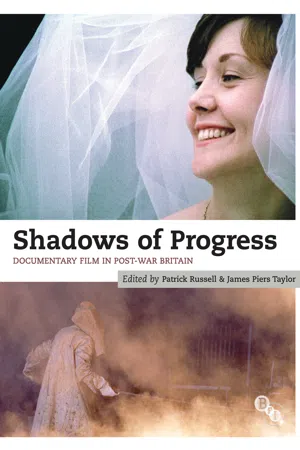
eBook - ePub
Shadows of Progress
Documentary Film in Post-War Britain
- 384 pages
- English
- ePUB (mobile friendly)
- Available on iOS & Android
eBook - ePub
Shadows of Progress
Documentary Film in Post-War Britain
About this book
Information
PART ONE:
Between the Tides: Mapping Post-War Documentary
1 The Long Tail
Britain’s post-war documentarists have been thrice overshadowed. First, by the towering presence of what came before them, the ‘Documentary Movement’ of John Grierson and others. Second, in the field of film criticism, they were elbowed aside by a short-lived contemporary development: the ‘Free Cinema’. Finally, as the fortunes of the documentary film gradually fell the status of television documentary increasingly rose.
In contrast to the post-war documentarists, the ‘original’ British Documentary Movement has been generously supplied with memoirists and chroniclers, cultists and critics. These writers did much to maintain its profile in the cultural memory of its own century: an analogue epoch in which printed texts played a larger role in the maintenance of general knowledge, and the establishment of canons, than they do in the digital epoch in which this book is published. Although far from unanimous in their judgments, most studies of the Movement share a common chronological frame of reference. In one such influential history, Elizabeth Sussex’s The Rise and Fall of British Documentary, the ‘rise’ begins in 1929, when John Grierson, under the guidance of Stephen Tallents, made Drifters for the Empire Marketing Board Film Unit.1 The ‘fall’ sets in during the late 1940s, leading to the demise of the Crown Film Unit, the EMB Unit’s direct descendent, in 1952. In such texts, if later documentaries get referred to at all, then it’s briefly and apathetically.2
A problem with the story of the ‘fall’ is that it can’t be a quantitative one: a slight dip in documentary production in the late 1940s was soon followed by twenty years of huge growth. The biographical story of fall is only superficially more persuasive. The careers of some of the early Movement’s most influential leaders – notably Grierson’s and Paul Rotha’s – stumbled in the late 1940s, while film-makers like Harry Watt and Pat Jackson were largely departing documentary altogether. However, other members of the Movement – Arthur Elton and Edgar Anstey are the salient examples – went on to have remarkably stable, successful post-war careers. More to the point, the second generation of documentarists upon whom this book is focused were but a heartbeat from the first: variously inspired by the Movement or reacting against it. In terms of personnel, there is more evidence for continuity than collapse, so many post-war documentarists having been either trained by or working under their immediate predecessors. On one or two occasions, even sacked by them.
Has the ‘fall’ been measured qualitatively, then – are the later films, however numerous or closely linked to what came before, simply inferior? Any answer is necessarily subjective and begs further questions. Are the two periods’ outputs to be compared via the best examples, by the worst, or by the median? On all three counts, the post-war documentary at least holds its own, and on the last it is arguably far superior. Technical competence increased; talent did not precipitously decline. If postwar documentary certainly failed to yield a single film-maker of the stature of a Humphrey Jennings, nevertheless many of the directors discussed in Part II of this book were no less gifted than many of their more famous predecessors.
While both generations of documentary film-making were financed in much the same way, by state bodies, private industry and other institutions, for this very reason the second generation tends to be treated more sceptically. A great deal of documentary history is animated by a slightly whiggish tendency to be written in terms of ‘progress’. The word ‘movement’ itself suggests progression and has both political and artistic connotations. Politically, progress is usually taken to mean travel on a left-ish path. Artistically, ‘progress’ is defined in romantic terms – those of autonomy and originality. These judgmental tendencies coalesce with the aforementioned biographical orientation of general histories of the Movement. The story of film-makers like Rotha, for instance, is easily told as a heroic bottom-up struggle by artists, scorning the commercial film trade, to secure alternative forms of patronage for documentary films with a political or artistic cutting edge. World War II saw such documentary come into unprecedented sums of money for production, in the form of state sponsorship for films at one with national purpose but consistent with collective ideals. This undoubtedly encouraged the more politically inclined in the Movement to hope that a similar relationship could blossom post-war, whereby backing from a state more closely aligned with socialistic ideals would usher in a new era of official funding for artistically fresh films allied to radical social purpose. From this perspective, the late 1940s fall is indeed a palpable one, as the cash-strapped Attlee government had bigger things on its mind than the plight of the Documentary Movement. To likeminded historians, having traced the central line of the Movement’s relationship with the state from the EMB, through the GPO, to the Crown Film Unit, its closure will indeed represent a terminus.
For many admirers of the British Documentary Movement, its 1930s reliance on sponsorship is judged a progressive one, by comparison with alternative models. During the post-war period, however, the balance of influence over form and content shifted somewhat from the ‘artist’ to the sponsor. This process was inevitable (and indeed legitimate, insofar as it was the sponsor’s money that was being spent), but for such Movement admirers it is easily equated with stagnation. As for ideology: although the entire national consensus had moved to the left, on screen the vague ‘politics’ of the documentary film at the very least moved no further left than that new consensus. For ideological critics of the Documentary Movement, already sceptical of the extent of the radicalism of Grierson and his colleagues, this lack of progression is presumably to be equated not just with stagnation but also with reaction. In any case, as they turn to the 1950s the focus of intellectual debates about documentary moves offshore to America and to France, or, if remaining at home, to the anomalous Free Cinema, and to the subsequent rise of TV documentary. It moves sharply away from the sponsored film, apparently of huge interest in its 1930s context, but in the 1950s of almost none.3
This consensus on British documentary’s fallen state begs plenty more questions. How else could anyone entering the industry of the 1940s or early 1950s have made documentaries other than through sponsorship? Had there been no sponsorship, how many documentaries would have been made at all? Though the ‘balance of power’ shifted, did it shift all the way, and to the same extent in every case? Why should we automatically characterise the relationship of artist to sponsor as a power struggle? Why should we automatically take one side against the other? Is it not in any case of considerable interest to examine the process of documentary sponsorship becoming mainstream at almost all society’s major institutions within the context of the mixed economy, at the same time affording a detailed survey of how the story of the Documentary Movement plays out over many years beyond the late 1940s?
All film-makers were not alike, and all sponsors were not alike: these statements apply equally to documentary before the war and after it. For some of the second-generation film-makers profiled in Part II of this book, sponsorship was a prison, for others a playground; for some a partnership, for others a battleground, or a site of deep dilemmas. And if the pre-war Movement had indeed had its leftist and avant-garde strands, these were never the whole story. At least as robust a strand of the Movement was a conception of documentary as an applied art, whose big political idea was less to critique society from without than to aid its humane and effective functioning, by illuminating the interconnections on which it is built from within. For such documentary, sponsorship is more than a mere means to funds: it is a means of participation in society through its myriad institutions. If we take this strand of British documentary as seriously as the more iconoclastic one, then the late 1940s begin to look very different, a period of transition and flux between two more stable periods of growth. What comes out the other end may no longer be a ‘movement’ in the continental sense. Instead, in pragmatic Anglo-Saxon style, it was a school of British documentary that synthesised much of the Movement’s ethos, and certainly a great deal of its aesthetic, with the documentary-making that had contemporaneously taken place outside its blurred boundaries: the educational films made at Gaumont-British Instructional, say, or the interest films made by commercial film companies, and especially the sponsored industrial films produced outside the Movement.4
State sponsorship eventually went on the increase again, though admittedly its creative scope was more tightly constrained than most of its beneficiaries wished. Even more significant was the extraordinary increase in sponsorship by industry, which played perfectly to a blending of the ‘documentary’ and the ‘industrial film’ into a single robust form. It put Grierson and Tallents’ basic proposition into practice on a larger scale in post-war Britain than anywhere at any time before or since: the idea that the interests of the documentary-maker coincided with the enlightened public relations and the day-to-day practical needs of institutions (industry often proving a more relaxed sponsor than the state).
If this was but the tail end of the great British documentary, then it was, in a fashionable twenty-first-century phrase, a long tail. In fact, the true fall of the British documentary film tradition came not in the late 1940s but over the course of the 1970s, as British industry, under recessionary financial pressures, began reducing investment in film, and tightening its criteria for it. The ‘prestige film’ – the broader sort of documentary produced under sponsorship – rapidly disappeared. The practical film remained, as it does to this day, but its hitherto stable identity as a form of documentary cinema gradually faded as several coincidental developments kicked in. A generation of film-makers and public relations officers (PROs) were beginning to retire. Video was beginning to replace film: audiovisual communications began to be thought of as a separate specialised discipline. Before long, of course, the post-war consensus itself – in which the documentary film had flourished – collapsed.
Feeding into that collapse had been a growing distrust of institutions in general, an ever more prominent feature of post-war public life. The critical reputation of the British school of documentary undoubtedly suffered from this budding cynicism. By, say, 1979, the belief that ‘documentary’ and ‘public relations’ were compatible was as anachronistic as in 1945 it had been obvious. As early as the 1950s, the state-corporatist and capitalist basis for so much of the second generation’s sponsorship had fallen out of intellectual fashion, which had so embraced the first generation’s exploitation of the same in the 1930s. Enter Free Cinema, which played up the romantic artistry, and added a hint of political rebellion, ensuring it would fall on the correct side of a new critical consensus. Free Cinema’s leaders, Lindsay Anderson and Karel Reisz, were probably more interested in breaking into the feature film world than in making statements about documentary as such. However, they found it easier to get documentary shorts financed. They therefore felt obliged not just to assault the staid feature industry of the day, but the orthodox documentary, as practised by the late Movement (Jennings, being its sole ‘artist’, exempted from the critique) and ...
Table of contents
- Cover
- Title Page
- Contents
- Acknowledgments
- Notes on Contributors
- Introduction: Whatever Happened to the Documentary Movement?.
- Part One: Between the Tides: Mapping Post-War Documentary
- Part Two: The New Explorers: Careers in Post-War Documentary
- Last Words
- Index
- eCopyright
Trusted by 375,005 students
Access to over 1.5 million titles for a fair monthly price.
Study more efficiently using our study tools.
Frequently asked questions
Yes, you can cancel anytime from the Subscription tab in your account settings on the Perlego website. Your subscription will stay active until the end of your current billing period. Learn how to cancel your subscription
No, books cannot be downloaded as external files, such as PDFs, for use outside of Perlego. However, you can download books within the Perlego app for offline reading on mobile or tablet. Learn how to download books offline
We are an online textbook subscription service, where you can get access to an entire online library for less than the price of a single book per month. With over 1.5 million books across 990+ topics, we’ve got you covered! Learn about our mission
Look out for the read-aloud symbol on your next book to see if you can listen to it. The read-aloud tool reads text aloud for you, highlighting the text as it is being read. You can pause it, speed it up and slow it down. Learn more about Read Aloud
Yes! You can use the Perlego app on both iOS and Android devices to read anytime, anywhere — even offline. Perfect for commutes or when you’re on the go.
Please note we cannot support devices running on iOS 13 and Android 7 or earlier. Learn more about using the app
Please note we cannot support devices running on iOS 13 and Android 7 or earlier. Learn more about using the app
Yes, you can access Shadows of Progress by Patrick Russell, James Piers Taylor, Patrick Russell,James Piers Taylor in PDF and/or ePUB format, as well as other popular books in Media & Performing Arts & Film History & Criticism. We have over 1.5 million books available in our catalogue for you to explore.