- 168 pages
- English
- ePUB (mobile friendly)
- Available on iOS & Android
eBook - ePub
About this book
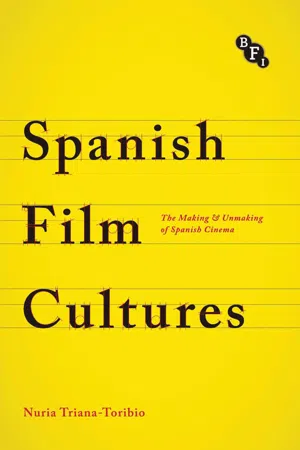
The past four decades have seen the Spanish film industry rise from isolation in the 1970s to international recognition within European and World Cinema today. Exploring the cultural and political imperatives that governed this success, this book shows how Spanish film culture was deliberately and strategically shaped into its current form.
Information
1
The House Is Built of the Stones That Were Available1
The Academy of the Cinema Arts and Sciences of Spain, founded on the 8th of January 1986, is a private law institution, of inclusive and democratic character. According to its statutes it is a non-for-profit association of professionals involved in the different specialties of film creation, with its own juridical status, constituted for an indefinite period and ruled by the principles of democracy, pluralism, transparency and participation.2
THE VALUES AND THEIR ORIGINS
The Academia declares itself on its website to be an inclusive, transparent and democratic institution. This declaration departs from the boilerplate text of its Academia counterparts such as BAFTA and the French Académie des Arts et Techniques du Cinéma. Where the homepage of BAFTA satisfies itself with stating simply that its mission is to ‘support, promote and defend’ its nations’ films, the Academia feels the need to provide details about its ethos that in most European professional organisations would be taken for granted. Some words are emphasised, most notably: democratic, democracy, pluralism, participation. Its style is somewhat outmoded. It reads like a text from the time when Spain was a very young democracy and these concepts needed to be spelled out.3 Yet, this is the text that opens the Academia’s online site forty years after Franco’s death, and it reveals much about the institution’s priorities. Foremost among these has been putting cinema at the service of the political process of democratisation, and educating audiences in a specific type of film culture.
This affirmation may appear polemical – is not the Spanish Academia, like all the other academies, preoccupied with film culture, beyond the political slant of the films themselves? The answer is that there is no outside of party politics when it comes to hegemonic Spanish culture. The cultural environment that was created in the transition principally by the two major parties, the Spanish Socialist Party and the Partido Popular (henceforth PP), monopolised the institutional discourse during the period of this study. The Academia emerged as part of a process of modernisation which started in the 1970s and was fully developed in the 80s, a process intended to transform the conditions of production, dissemination and exhibition of Spanish cinema to make it fit for the wider European democracy it was about to join. The existing cinema was the mainstream cinema, sometimes derisively called the Old Spanish Cinema, paraphrasing critics Hernández and Revuelta, who named it thus in allusion to the New Spanish Cinema (Nuevo Cine Español [henceforth NCE]), Spain’s answer to the New Cinemas movement of the 1960s. (p. 76). The Old Spanish Cinema consisted mainly of genre films, dramas, comedies and musicals of the 1960s and 70s, which transmitted the cultural backwardness and lack of freedom of expression fostered in the Franco era. Retrograde though it was, this was a strong and profitable cinema industry. ‘From 1960,’ explain José María Álvarez Monzoncillo and Juan Menor Sendra, ‘between 120 and 150 feature films per year were made in Spain, a high quantity if we consider the size of the market. The market share for Spanish films was well over 20 per 100’ (p. 24). That figure increased once more permissive legislation allowed some ‘freedoms’ and the possibility of embracing international models of film, and from 1977 the Old Spanish Cinema became an even greater source of embarrassment for choosing from among all the possible international models explicit horror and pornography.4
The men and women I will be introducing in this chapter had revisionist ambitions. In sum, that the ‘bad’ Old Cinema would be replaced with ‘good’ modern, auteur cinema or arthouse films of European standards. What is more, the modern films that the new system would produce would themselves be instruments for democracy and for educating audiences. Films would be vehicles for transmitting the all-important need for consensus, for accepting the position of the other side (pluralism) by teaching Spaniards about their past and showing them areas of the nation’s heritage and history that had remained hidden from them: the point of view of those who lost the Civil War. But this had to be done without endangering the possibility of living together. In other words, certain divisive topics had to be put aside in the 1980s (and for much of the 90s), such as the legitimacy of the monarchy or the role of the armed forces in the violence against the urban and rural working class during the Civil War and beyond. Moreover, these films would be fit for exportation to democratic audiences in Spain’s new partner countries. After all, Spain had been admitted to Europe in 1986. The films that would be created by the state and endorsed by the newly created Academia were destined to do all these jobs while remaining attractive as entertainment.5
Back in 1986, the emerging Academia fought to take everyone with it. Its actions were geared, to a great extent, towards being accepted as a large enough tent to house all cinema, and it fought to make Spanish film-making a concern of everyone, including those on the left and right of the political spectrum. Winning this battle was crucial if the Academia was going to function as the arbiter of taste, and endower of distinction and cultural value, a role enjoyed by its counterparts in other countries. Like everything else in the culture of the transition, institutions sought to be the embodiment of social and political consensus, of compromise. Consensus was the watchword of the 1980s, but it was an ongoing concern for the entire period studied here.
This chapter shows how the Academia developed its academicism, and became the key arbiter in matters of cinematic taste in Spain. It introduces the leading actors in the push to transform the ‘bad’ Old Cinema of the dictatorship into ‘good’ cinema for democracy, through their participation in an Academia that would police Spanish cinema.6 It will also take into account the class and gender dynamics of this group that agitated for a specific model of cinema. Among the young cinephiles who became part of the ‘emergent dissident intelligentsia’ (Jordan, Writing and Politics, p. 245), there were many disaffected offspring of the upper-middle-class victors of the Civil War. Pursuing a university education in the 1950s and 60s was the privilege of their class, but there were also many lower-middle-class and some working-class young men who aspired to join the upper classes by cultivating their taste and modes of consumption.
Belonging to a particular generation dictated the taste of the first cinephiles, who were young men in the late 1950s and into the 60s. Growing up at the same time as the generation of the French nouvelle vague affected them greatly. The young Spanish men who were in their twenties during the 1950s connected with the experiences and aspirations of other European youth and became the intellectual pioneers of Spain’s cinema, argues Cristina Pujol Ozonas (Fans, cinéfilos, p. 127). For them, as for their Scottish contemporary Peter Cowie, the period between 1958 and 1968 represents the golden years of European film-making (p. xvii).
They developed a long-standing attachment to a narrow conception of European cinema as cinéma engagé, based on films as a reflection on social reality (and passed this preference on to younger men and women in the 1990s and beyond). This preference directly connected them to the realist tradition of Italian neorealism (see, among others, Hernández and Revuelta, p. 74). But their attachment to this model put them out of step with their contemporaries in France and other European democracies, whose themes and styles had moved away from neorealism (Triana-Toribio, Spanish National Cinema, p. 57). Addressing reality was particularly pressing at a time when only part of the cultural production demonstrated engagement with society as a way of contesting Francoism. In one of their key public fora in the 1960s, the film magazine Nuestro Cine, members of this group declared that engaging with Spain’s reality (as much as they could) prevented them from adopting more styles that were less conducive to realist representation (Ángel Fernández-Santos, ‘Sobre un nuevo cine español’, p. 12), such as those of the nouvelle vague. Making films according to that European realist and engagé model was still an aspiration when the Academia was created.
This continued attachment to a particular model of engaged cinema goes some way to explaining why particularly politically conservative film professionals, whether members of the PP or not, did not feel part of or were not included in the creation of the Academia, which is firmly associated with the Socialist Party. At the same time, the defence of auteurist cinema alienated the Academia from other film professionals for reasons that cannot be simply ascribed to political differences. The following sections will examine the role of this generation and the implications of their endeavours.
ACADEMIC FOUNDATIONS
On the way to the transition we need to stop first at Francoism. The regime is a constant, recurrent and uncomfortable backdrop against which the specific qualities of Spanish film cultures are constructed. And when the Academia expresses its commitment to the principles of democracy, plurality, transparency and free participation, it declares its intention to make up for the decades in which the Spanish film industry was closely watched by the dictatorship. Francoism feared the power of cinema – as a main entertainment for the masses – and for this reason, its watch over it was very close indeed, as has been demonstrated in various influential studies (see Gubern, La censura; Labanyi, pp. 207–14).
The oldest Academia members can surely recall when Franco’s regime brought in legislation in 1942 forcing all cinema professionals to belong to vertical trade unions. These unions included everyone involved in making films, regardless of their role in the profession – whether they were studio set workers or powerful producers – or the fact that their interests often clashed. These sindicatos verticales (top-down trade unions) were ruled by regime-appointed civil servants, and were, obviously, undemocratic in their structure and aims. In order to access the film industry and be accepted as a member of the sindicato vertical, aspiring candidates served apprenticeships under experienced professionals who were already members, a further mechanism for screening and cultivating future generations. The men and women who eventually created the Academia were principally involved in the Sindicato Nacional del Espectáculo (National Entertainment Union) (SNE) and the Círculo de Escritores Cinematográficos (Circle of Writers for the Cinema) (CEC). The role of these non-unions of the dictatorship was crucial for the industry. Ramiro Gómez Bermúdez de Castro (pp. 24–5) has shown, for instance, how the SNE also controlled the financing of Spanish films, particularly until the end of the 1960s.
The Academia was born out of a desire to consign to oblivion the period in which every activity related to cinema was controlled by the dictatorship through these undemocratic non-unions. Censorship, another instrument of control in the hands of the regime, also had a central role in the inception of the Academia. Censorship was a constant backdrop but a protean one. As historian Román Gubern, witness of this time and member of this cinephile generation, explains, the censorship system evolved with the regime and was moulded differently by the different groups which were put in charge of the censorship apparatus: first Falange, and subsequently, the Church (La censura, pp. 91–171). A generation of film professionals developed in opposition to censorship and determined to banish it as soon as the time was right.
To understand, then, why the founding group of the Academia fought so hard to uphold democratic values, and why they felt that a narrow model of auteurist cinema was the best weapon to do this, requires looking into two aspects of their background. The first is how they came into contact with cinema and which type of cinema became their love object. The second is how all their experiences as spectators, as critics and as film-makers were mediated by censorship. These two things are intimately connected and constitute the formative experiences of the Academia.
The future academicians encountered censorship first as young cinephiles in the late 1950s when they were only permitted partial access to neorealism, along with other key European movements and discussions about cinema, initially through university film clubs and occasional special events such as those held at the Italian embassy in Madrid (see Hopewell, Out of the Past, p. 51; Monterde, ‘Continuismo’, pp. 278–81). Like their European counterparts (such as François Truffaut, Jean-Luc Godard and Michelangelo Antonioni), they were keen to read and write about films, and were doing so (under the watchful eye of the state) in cinema magazines affiliated to these film clubs (for instance, Cinema Universitario, Índice and Film Ideal).
The censors may have been watching these young men, but obviously not carefully enough. As Gubern admits, he never needed to resort to forging permits to show censored films in the Cine-club Universitario de Barcelona he ran (quoted in Gracia, p. 97). The curiosity of these privileged young men – mostly bourgeois sons of the victors – and their yearning to keep up with modern film trends and the European avant-garde perhaps did not rank as a high priority for the censors compared with ensuring that mainstream audiences were protected from watching the wrong films. As Jordan observes, ‘penalties for student dissent were nothing compared to the punishment meted out to those clandestine opposition party workers and militants unfortunate enough to be arrested’ (Writing and Politics, p. 254). Some did serve time in prison for their political affiliations, particularly around the mid-1950s when student culture became part of a significant wider culture of dissidence which the regime ‘tolerated and repressed in turn’ (Monterde, ‘Continuismo’, p. 241). For instance, the producer and critic Ricardo Muñoz Suay, who, in the late 1960s, championed the New Cinemas movement in Catalonia, Escuela de Barcelona, spent time in prison (see Riambau and Torreiro, p. 69). So did Juan Antonio Bardem (see his memoir, Y todavía sigue, p. 104). Some future film-makers were fined for their transgressions, while others had their passports confiscated and were unable to travel, as in the case of the film student Pere Portabella, director and producer of some of the Escuela work. But their class and gender gave them access to special conditions within which their love of cinema took hold. For the Escuela film-makers, class and the benefits of a private education, including knowledge of French, coupled with the proximity of Catalonia to France, enabled them to travel to see banned films in easily accessible Perpignan, and thereby develop a taste for the foreign and cosmopolitan in their own cinema (see Riambau and Torreiro, p. 85). For those based in or around Madrid, for instance in the old university town of Salamanca nearby, the Sindicato de Estudiantes Universitarios (University Students’ Union) (SEU) hosted a film club. Film clubs created the conditions for an enthusiastic kindling of cinephilia among university students.
Reflecting on the formative years of this generation of cultural actors in the Franco era, historian Jordi Gracia argues that the SEU film clubs made a significant contribution to the vibrancy of film cultures in the 1950s. These student-run organisations, he claims, were instrumental in disseminating knowledge of past and present cinema avant-gardes. Modern film culture came back to life through film clubs and film magazines and journals that supplemented th...
Table of contents
- Cover
- Title Page
- Contents
- Acknowledgments
- Introduction
- Why academies?
- Film cultures
- Academicism: an authority over film cultures
- What does academicism want?
- When the Academia?
- 1. The House Is Built of the Stones That Were Available
- 2. And the Winner Is
- 3. Being Different: Almodóvar and the Academia
- 4. Rogue Males, ‘Bad’ Films and ‘Bad’ Loyalties: Santiago Segura andÁlex de la Iglesia
- 5. There Is No Such Thing as a Weak Enemy
- 6. Transatlantic Academia
- Epilogue
- Notes
- Bibliography
- Index
- eCopyright
Trusted by 375,005 students
Access to over 1.5 million titles for a fair monthly price.
Study more efficiently using our study tools.
Frequently asked questions
Yes, you can cancel anytime from the Subscription tab in your account settings on the Perlego website. Your subscription will stay active until the end of your current billing period. Learn how to cancel your subscription
No, books cannot be downloaded as external files, such as PDFs, for use outside of Perlego. However, you can download books within the Perlego app for offline reading on mobile or tablet. Learn how to download books offline
Perlego offers two plans: Essential and Complete
- Essential is ideal for learners and professionals who enjoy exploring a wide range of subjects. Access the Essential Library with 800,000+ trusted titles and best-sellers across business, personal growth, and the humanities. Includes unlimited reading time and Standard Read Aloud voice.
- Complete: Perfect for advanced learners and researchers needing full, unrestricted access. Unlock 1.5M+ books across hundreds of subjects, including academic and specialized titles. The Complete Plan also includes advanced features like Premium Read Aloud and Research Assistant.
We are an online textbook subscription service, where you can get access to an entire online library for less than the price of a single book per month. With over 1.5 million books across 990+ topics, we’ve got you covered! Learn about our mission
Look out for the read-aloud symbol on your next book to see if you can listen to it. The read-aloud tool reads text aloud for you, highlighting the text as it is being read. You can pause it, speed it up and slow it down. Learn more about Read Aloud
Yes! You can use the Perlego app on both iOS and Android devices to read anytime, anywhere — even offline. Perfect for commutes or when you’re on the go.
Please note we cannot support devices running on iOS 13 and Android 7 or earlier. Learn more about using the app
Please note we cannot support devices running on iOS 13 and Android 7 or earlier. Learn more about using the app
Yes, you can access Spanish Film Cultures by Núria Triana-Toribio in PDF and/or ePUB format, as well as other popular books in Media & Performing Arts & Film & Video. We have over 1.5 million books available in our catalogue for you to explore.