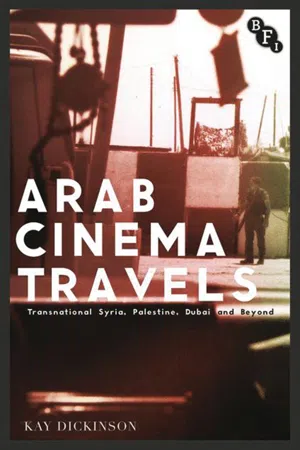
- 232 pages
- English
- ePUB (mobile friendly)
- Available on iOS & Android
eBook - ePub
About this book
Exploring the impact of travel on Arab cinema, Kay Dickinson reveals how the cinemas of Syria, Palestine and Dubai have been shaped by the history and politics of international circulation. This compelling book offers fresh insights into film, mobility and the Middle East.
Information
1
Fellow Travellers: Approaches To and Through the Journey
Here is where we left off: cinema, as an institution and set of commodities, comes into being through movement, as part of its processes of exchange and exploitation. Cinema can also focus a critical gaze upon how supremacy is exerted through the management of these flows. More specifically, travel has vigorously shaped the film cultures of the ‘Arab world’. Like anything else deemed to be a ‘regional cinema’, its make-up crystallises overseas training, input from Arab migrants and diverse non-Arab personnel; it also bears the pockmarks of transnational trade. My title, Arab Cinema Travels, foregrounding travels-as-a-noun, frames this book as one dedicated to chronicling these various journeys, remaining vigilant about their political stimuli. Travels-as-a-verb alerts us to how these movements happen, inviting also a figuring of our own tracking processes into a methodo-logy for their study. In this chapter, I endeavour to concoct ways to cross paths with and spend some time learning about and from Arab cinema’s concurrent journeys among the more comprehensive global passages of people, objects and ideas. Not simply to analyse experiences and literatures of travel, but to mobilise them as a means of analysis. If I stray far from a narrowly constrained conception of Arab cinema, this is because it also does so. Its sense of ‘home’ (and ours also) may be too cross-fertilised to tolerate such insecure insistences, as has been the case for the region more broadly since well before cinema entered it.
To wit, writing in the fourteenth century, Arab travel literature’s most colourful figure, Morocco’s Ibn Battuta, catalogued Chinese porcelain in Damascus, Syrian rose water in Mogadishu, Maldivian cord in Yemen, an Egyptian sheikh in Afghanistan and foreign communities and diplomats everywhere to be found.1 Trade, pilgrimage and conquest routes were so clearly established across the Muslim-majority world by the fourteenth century as to enable these thirty-odd-year rovings of Ibn Battuta around the region and beyond, a journey that covered three times the distance of Marco Polo’s voyages. The exchanges that Ibn Battuta documents and benefits from put paid to any erroneous image of the Arab world as a quiet backwater untouched by foreign influence, lacking in curiosity, trade ambitions, or expansionist aspirations.
More than 600 years ago, global flux prompted Tunisian proto-sociologist Ibn Khaldun’s celebrated thesis that:
the conditions of the world, and of the nations, with their customs and modes of occupation, do not persist in one unchanging state or stable pattern, but are transformed with the passage of time and move from one condition to another … Differences between groups are cultural, not innate.2
Community and faith groups still register for Ibn Khaldun, he simply attributes their composition to social mixing rather than isolated development. Moreover, he sets his detailed historical analysis of his region in motion through a dynamic comparison between sedentary and nomadic societies.3 We thus find nothing particularly new in the much more recent claims of people like Trinh T. Minh-ha, who welcome how travel narratives ‘speak to the problem of the impossibility of packaging a culture, or of defining an authentic cultural identity’.4 For Ibn Khaldun and Trinh, ‘self’ and ‘other’ categories persist in transit, but they also mutate along the way, meeting, merging or deflecting, regrouping or finding themselves rehabilitated as implausible holistic ciphers. The material encountered within the following three chapters, like The Dupes, has been indelibly shaped by these currents. Such mutability also arbitrates who and what can be or is studied, sold, owned or shared globally.
And so travel, I wish to stress, is not merely the silent conveyor of the matter of life, but indivisible from its very composition. In his influential book Routes: Travel and Translation in the Late Twentieth Century, the anthropologist James Clifford underscores how travel must be thought of as ‘constitutive of cultural meanings rather than as their simple transfer or extension [emphasis in the original]’.5 Moving beyond Clifford’s observations, I will also contend that the ways in which travel has been recounted, experienced, profited from, controlled and hosted (sections on each of which follow below) can greatly stimulate and politicise academic enquiry. There is much to be gained from warming to the various positions, attitudes and metaphors that travel can summon culturally. Speaking from elsewhere, Roxanne L. Euben and Georges Van Den Abbeele corroborate the catalysis of European philosophy by perspectives on travel, from Herodotus’ witness-claims to Descartes’ metaphors of mobilisation. As Janet Wolff remarked some time ago, contemporary theory has greatly expanded its repertoire through recourse to travel: ‘nomadic criticism, traveling theory, critic-as-tourist (and vice versa), maps, billboards, hotels and motels’.6 And film theory has shared this fascination too.
However, as postcolonial thinker Walter D. Mignolo warns us, ‘traveling theories may be perceived as new forms of colonisation, rather than as new tools to enlighten … what is the ratio between geohistorical location and knowledge production?’7 In sum, travel helps establish the places to visit, to learn from and about, to send things to, to buy from, to conquer, and all this, in turn, establishes patterns of domination. Consequently, theorising through travel will always clearly voice imbalances, their forcefulness less evident in concepts such as ‘diaspora’ or ‘hybridity’. Like James Clifford, then, I do not wish to erase the harm that travel has done, or neutralise the overtones of how it has typically been narrated, ‘precisely because of [travel’s] historical taintedness, its associations with gendered, racial bodies, class privilege, specific means of conveyance, beaten paths, agents, frontiers, documents, and the like’.8 The types of travel I discuss are not always pleasant. Travel has been, and so often still is, opportunist, exoticising, accumulative, greedily selfish, survivalist, at the end of a gun. There are a host of alternative categories through which I could have fed this study, ones bearing similar histories, but which render their impacts less visible. The often violent actions of tourism, expatriation and exile surge through how cinema and travel align, but the dubious politics at work within global movements are less readily acknowledged, less historically implicated, when scholars huddle under framing terms like ‘diaspora’ or ‘hybridity’. Keeping an eye on the diverse machinations and interchanges of travel animates an invigorated understanding of how power flows, including through cinema.
This fact that travel and its literatures carry a sullied pedigree, riven with colonial intent, is old news to be revisited soon enough by this chapter. Yet other accounts and experiences still have much to offer and not all of them are so flagrantly conquistadorial. For instance, journeys of and for the mind traverse the Arab literary canon and therefore inform Chapter 2’s enquiries into the journeys of aspirant directors to Eastern European film schools. Historically, these accounts have often been inspired by the spiritual illumination promised after completing the rituals in Mecca (hajj and, out of season, ‘umra): a return to source, rather than a ravenous expansion. Before the epochs of steam and air travel, this trip could take up to nine months, its fusions, transpositions and convenings spurring intellectual debate en route and at destination point. The spread of Arabic rides the coattails of Islam’s growth, a religion for which hijra (migration) holds considerable weight. Not simply on account of the Prophet Muhammad’s own relocation from Mecca to Medina, but also because Islam beseeches its followers to up sticks if they find themselves in places intolerant of their practices. Petitions to venture forth pepper the religious texts. The hadith ‘He who follows a road seeking knowledge, God will make the path to heaven easy for him’9 underscores the impulsion towards talab al-‘ilm (the search for [religious] knowledge) which Arab-Islamic travelogue scholar Roxanne L. Euben stresses ‘is more than merely a recurrent theme in Islam or an occasional practice of Muslims. It is, rather, an ethos.’10
I do not raise these particularities of Islamic tradition in order to wrong-headedly essentialise the study of Arab cinema, a largely secular industry with contributors of many creeds. Instead, I wish simply to coax English-language Film Studies towards dimensions like these (particularly in Chapter 3, which converses with literatures of pilgrimage to the ‘Holy Land’) to see how they might usefully stretch our purviews. What would it mean to refigure some of the journeys from the Global North (including my own for this book) according to what Ian Richard Netton terms the ‘pilgrim paradigm’, premised upon the commonality of a voyage shared by people coming from many different directions and converging on one geographical point (in this instance, as a spiritual duty)?11 Anything but travel for escapism or as an expression of individualised freedom. As a non-Muslim (and there are plenty of other pilgrim types too, as Palestine will surely attest), I wonder what it would be like to think of travel without an implied estrangement, be that the excitement of ogling exotic sights or the critical distance that academic enquiry so often demands. Something closer to the pilgrim paradigm allows scholarship to strive for shared goals over and above competitiveness, the types of unity also encouraged by the barbed critique of self-serving Arab leadership allegorised within The Dupes and further discussed in Chapter 3’s involvement with collective Palestinian struggle through cinema. After all, when one sets oneself at a remove, it is easier to accept the global division of labour in travel, cultural production and academia alike and to situate its exploitation out of sight.
WANDERING AND WONDERING
There is no denying that travelogues indulge a fill of heroic posturing and that publishing is something of an exclusive privilege. We shall arrive at their critique in good time. But, amid its more objectionable politics, travel writing also tenders a sustained examination into how to fabricate, sell, describe, compare, engage with, learn from, be inspired by, or annul formulations of ‘foreignness’ conducted by travellers coming from all corners. The interconnectedness-amid-difference that fuels the genre, that drew Ibn Battuta out of Morocco – offering up enough social oddity and exoticism to warrant the effort of recording – is one of the hinges upon which this book swings. For this reason, such writing provides valuable exemplars for the study of cinemas that are not ‘our own’, as Arab film history isn’t (and also is) to me. As most cinema (if not all of it), I need to stress, will be to every one of us.
Travel writing can engorge our Film Studies vocabularies, registers and scopes of imagination. It is this belief that drives Arab Cinema Travels and why travel writing deliberately features more prominently in how I analyse than any other type of ‘theory’. Central for me here is the pre-eminent Arabic travelogue genre, the rihla (or journey narrative), which merges what we might, from here and now, call autobiography, social ethnography, geography, poetry, history and sheer lies, spinning fantastical yarns, some borrowed from mythology, in order to entertain the readership. Cinema shares so many of these dimensions, meaning the rihla genre can contribute much to its study, if we first stop to think beyond any initial incompatibilities we perceive, routinised by the persistence of other investigatory models.
Let us see … What of Ibn Battuta, who spices up his descriptions of foreign lands with rumours, portents and details from his dreams, bursting out of the regimes of truth that might elsewhere box in recorded travel? Can we really gain something from this approach? Among other conceits, Muhammad al-Muwaylihi’s A Period of Time advances a fictitious dialogue about Egypt between an attentive early twentieth-century recorder (‘Isa) and a local informant (a Pasha from the Muhammad ‘Ali period in the nineteenth century), who has risen from the grave to guide ‘Isa while he is dreaming. Framing the book as a travelogue, its Egyptian author depicts his own country as if it were a foreign land. At the simplest level, these caprices of delivery might discourage shyness about digressing from scholarly discourse’s limited stylistic palette.
Wheedling out a delightful diversification of writerly aesthetics is one thing, and a venture that might just stretch the limits of current thinking. But the rihla’s dissolution of genre-as-we-know-it can also offer up, for contemporary scholarship, a political challenge to the way information is commandingly dispatched in academic writing. In those realms, subject areas are guarded, unequally funded, pitched against each other, asked to justify themselves via the incapacitating terms of managerial economics, as anyone struggling to research Arab rather than, say, Hollywood cinema will testify.
The rihla’s disciplinary combinations, in themselves, question strict epistemological delineations, just as the interjection of documentary material in The Dupes’ narrative did. Both ask us to probe how knowledge is structured, what is proclaimed to belong together and what is invested (quite literally) in keeping ideas apart. As Mignolo remonstrates with respect to the imperative for interdisciplinary intellectual labour and with central reference to the geopolitics of learning:
Remapping new world order implies remapping cultures of scholarship and the scholarly loci of enunciation from where the world has been mapped. The crisis of ‘area studies’ is the crisis of old borders, be they national borders or civilization borders. It is also the crisis of the distinction between hegemonic (discipline-based knowledges) and subaltern (area-based knowledges), as if discipline-based knowledges are geographically disincorporated. Border thinking allows us to remap cultures of scholarship in terms of ‘area-based disciplinary knowledge,’ bringing together and erasing the borders between knowing about and knowing from. Border gnosis will help in imagining a world without rigid frontiers (national or civilizational) or a world in which civilizations will have to defend their unity and their purity; that knowledge, in the last analysis, did not begin with the Greeks but simply with life.12
As is perhaps obvious, but will be substantiated later in relation to Arab cinema a...
Table of contents
- Cover
- Title Page
- Contents
- Acknowledgments
- Setting Off
- 1. Fellow Travellers: Approaches To and Through the Journey
- 2. Red and Green Stars in Broad Daylight: A Socialist Talab al-‘Ilm for Syrian State Cinema
- 3. The Road of Most Resistance: Film-making of the Second Palestinian Intifada
- 4. ‘Travel and Profit from It’: Dubai’s Forays into Film
- Outgoing Cargo
- Notes
- Bibliography
- Index
- List of Illustrations
- eCopyright
Trusted by 375,005 students
Access to over 1.5 million titles for a fair monthly price.
Study more efficiently using our study tools.
Frequently asked questions
Yes, you can cancel anytime from the Subscription tab in your account settings on the Perlego website. Your subscription will stay active until the end of your current billing period. Learn how to cancel your subscription
No, books cannot be downloaded as external files, such as PDFs, for use outside of Perlego. However, you can download books within the Perlego app for offline reading on mobile or tablet. Learn how to download books offline
Perlego offers two plans: Essential and Complete
- Essential is ideal for learners and professionals who enjoy exploring a wide range of subjects. Access the Essential Library with 800,000+ trusted titles and best-sellers across business, personal growth, and the humanities. Includes unlimited reading time and Standard Read Aloud voice.
- Complete: Perfect for advanced learners and researchers needing full, unrestricted access. Unlock 1.5M+ books across hundreds of subjects, including academic and specialized titles. The Complete Plan also includes advanced features like Premium Read Aloud and Research Assistant.
We are an online textbook subscription service, where you can get access to an entire online library for less than the price of a single book per month. With over 1.5 million books across 990+ topics, we’ve got you covered! Learn about our mission
Look out for the read-aloud symbol on your next book to see if you can listen to it. The read-aloud tool reads text aloud for you, highlighting the text as it is being read. You can pause it, speed it up and slow it down. Learn more about Read Aloud
Yes! You can use the Perlego app on both iOS and Android devices to read anytime, anywhere — even offline. Perfect for commutes or when you’re on the go.
Please note we cannot support devices running on iOS 13 and Android 7 or earlier. Learn more about using the app
Please note we cannot support devices running on iOS 13 and Android 7 or earlier. Learn more about using the app
Yes, you can access Arab Cinema Travels by Kay Dickinson in PDF and/or ePUB format, as well as other popular books in Media & Performing Arts & Film History & Criticism. We have over 1.5 million books available in our catalogue for you to explore.