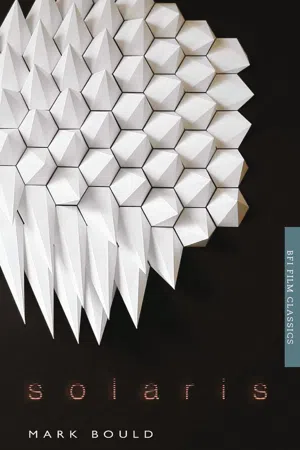
Despite being one of Andrei Tarkovsky's most successful films, Solaris (1972) was the one he most disliked. This dismissal of his most generically marked film has often been accepted by those quick to embrace the image of Tarkovsky as a transcendent artist rising above the politics of the Soviet film industry and the trappings of genre to produce personal works of art.
Going against such currents, Mark Bould instead treats Solaris as the product of a genre as well as the work of a skilled film-maker. He teases out Tarkovsky's fascination with Stanislaw Lem, on whose novel the film was based, and also considers Steven Soderbergh's 2002 adaptation.
Lively and revealing, Bould's examination situates Solaris within the Russian and global cultures of the fantastic, to which Tarkovsky contributed three major science fiction films.
This special edition features original cover artwork by Matthew Shlian.
eBook - ePub
Solaris
About this book
Information
1 Sf, Tarkovsky and Lem
In Tempo di Viaggio (1980), Tarkovsky’s documentary about preparing to make Nostalgia (1983), he is asked, ‘Is science fiction a world you feel passionate about, or is it a way to escape reality?’ His reply – ‘I don’t like science fiction, as I don’t like to escape life’ – identifies the genre with a specific inherent quality. However, when he makes sf films he makes this supposedly essential nature disappear just by not ‘think[ing] of them as science fiction’. Furthermore, for him, ‘genre in cinema always indicates a commercial movie’ and although he is not opposed to ‘popularity’, he is ‘against commercial movies’. Elsewhere he states
I can’t, like Spielberg, make a film for the general public – I’d be mortified if I discovered I could. If you want to reach a general audience, you have to make films like Star Wars and Superman, which have nothing to do with art.10
A similarly impoverished view of genre and naive belief in the auteur’s magical powers are shared by those critics who treat Tarkovsky’s films as if they ‘transcend’ genre, often displaying profound ignorance of genre films in the process. (Dip into Zona, Geoff Dyer’s book about Stalker, for an almost camp performance of critical incomprehension in the face of genre; his befuddlement when confronted by horror or sf or romantic comedy is very nearly endearing.)
Tarkovsky goes on to dismiss Solaris as ‘not so good, because [he] could not escape from the genre, from the fantastic details’, unlike Stalker, in which he ‘managed to get rid of all “science fiction” signs completely’ (provided one ignores the opening exposition, aspects of the setting and dialogue, and the closing act of telekinesis). The Sacrifice is even more successful in suppressing its science-fictionality, which is only ever suggested by sounds and oneiric images signalling an imminent nuclear apocalypse. However, as these traces suggest, genre is not so easy to escape. Indeed, it might be better understood not as a quality possessed by a film, or a pigeonhole into which the film can be slotted, but as a discursive phenomenon, a fluid, continually shape-shifting and ultimately irresolvable product of claims made at different times for different reasons in different contexts by different people with differing degrees of influence. The director is just one of them.
‘Anyway’, Tarkovksy concludes, ‘I am not a fan’ of sf. He would always speak highly of Lem – ‘I like his works very much. I read them whenever I can, everything I can, I read and I like his prose’11 – but often disparage the genre, even though he was clearly conversant with fantasy traditions, including sf. This is unsurprising, given the significance to Russian culture of nauchnaia fantastika or ‘scientific fantasy’ through the late nineteenth and early twentieth centuries: ‘much more than a by-product of the consciousness that science and technology had become the primary driving forces of modern life’, it ‘evolved into an important participant in the formation of that consciousness’.12Moreover, the Khrushchev de-Stalinisation ‘thaw’, from the mid-1950s to the early 1960s, witnessed a boom in sf translations, including Lem, Isaac Asimov, Ray Bradbury, Arthur C. Clarke and Robert Sheckley. Among Tarkovsky’s unfilmed scripts are Hoffmanniana, a film about E. T. A. Hoffmann incorporating fantastical elements derived from his fiction, and an adaptation of Alexander Beliaev’s Ariel (1941). He wrote an original sf radio play, The White Crow, that also went unproduced, and contemplated adaptations of Fyodor Dostoevsky’s The Double (1846), Thomas Mann’s Doctor Faustus (1947), Mikhail Bulgakov’s The Master and Margarita (written 1928–40) and Ivan Yefremov’s Razor’s Edge (1963). His diaries discuss Jorge Luis Borges, Franz Kafka, H. G. Wells, Jonathan Swift’s Gulliver’s Travels (1726), Bulgakov’s Heart of a Dog (written 1925), Albert Camus’ The Plague (1947) and Kurt Vonnegut’s Slaughterhouse-Five (1969), as well as Peter Weir’s The Last Wave (1977). He hated Yevgeny Zamyatin’s We (1924), calling it ‘feeble and pretentious … a nasty little book’, but considered Herman Hesse’s The Glass Bead Game (1943) a ‘novel of genius’.13 He was sufficiently ‘indignant’ at the bowdlerisation of Clarke’s 2001: A Space Odyssey (1968), which ‘breaks off before the end’, that he complained to the publisher.14 In 1982, he came up with an idea for an sf screenplay, partly inspired by Lem’s Return from the Stars (1961),
About someone landing on another planet, where he can’t understand anything of the atmosphere of this other civilization. … The activities of other beings, what they look like, the objects, the phenomena – everything. What an absurd notion! The embodiment of the absurd! Very frightening at the same time. The point is to create a new real world in a kind of agnostic sense. Perhaps I should do it as a kind of hypercommercial gesture.15
Quite why he considered this a money-making proposition is unclear. It is unlikely that such an effect could be achieved without the performances becoming unspeakably mannered, since every alien word and gesture would simultaneously have to signify an inner coherence and occlude its specific meaning. The varieties of sf narrative primarily concerned with this kind of encounter – utopias, such as Ursula Le Guin’s The Dispossessed (1974), which demonstrate the superiority of an alternative way of life; satires, such as Gwyneth Jones’s Aleutian trilogy (1991–7), in which aliens bring terrestrial absurdities into sharp focus; planetary romances, in which the world is a puzzle to be solved, as in Eleanor Arnason’s A Woman of the Iron People (1991) – are rare among cinematic sf. Tarkovsky’s variant seems unlikely to have succeeded when David Lynch’s rather straightforward Dune (1984) was widely considered ‘incomprehensible’.16
The fact that Tarkovsky entertained this idea at all, however fleetingly, suggests two things. With Solaris and Stalker his most commercially successful films, he thought of sf as a safe option, and he valued the genre’s potential for staging the encounter with an otherness that both demands and defies interpretation. However, his sense of this encounter is a long way from Lem’s materialist rationality. Writing in 1970, Tarkovsky sounds closer to the more metaphysically inclined Dick:
By virtue of the infinite laws, or the laws of infinity that lie beyond what we can reach, God cannot but exist. For man, who is unable to grasp the essence of what lies beyond, the unknown – the unknowable – is GOD. And in a moral sense, God is love. … Where there is no morality, ethical precepts hold sway – bankrupt and worthless. Where morality exists there is no call for precepts.17
Why, then, was Tarkovsky drawn to Lem?

US poster
Born in 1921 Lwów, which was then in Poland, Lem was first published in the mid-1940s, and wrote prolifically until his 2006 death, but abandoned fiction in the late 1980s. He has been translated into forty languages, selling over 27 million books, and is rumoured to have been considered as a Nobel Prize nominee. In the 1950s, he generally wrote utopian space adventures, often concerned with discovering and communicating with alien life, such as Astronauci (1951) and Oblok Magellana (1954), both of which were made into films – Kurt Maetzig’s Der schweigende Stern (1959) and Jindrich Polák’s Ikarie XB-1 (1963), butchered and dubbed by US distributors as First Spaceship on Venus and Voyage to the End of the Universe. Lem also wrote a series of satirical short stories featuring the philosophical slapstick adventures of Ijon Tichy, whose wanderings through space and, occasionally, time frequently trap him in absurd social systems. (Another series of short stories, written between the late 1950s and early 1970s, follows the rather ordinary and unheroic Pirx – cadet, pilot and eventually spaceship captain – through a series of extraordinary situations as Earth slowly colonises the Solar System; ‘The Inquest’ (1968) was adapted as Marek Piestrak’s Test pilota Pirxa (1978).) The 1960s saw a major shift of emphasis from communicating with the alien to the discovery – in Solaris and The Invincible (1964) – that man is not the measure of the universe. The last traces of utopianism disappeared as Lem’s concern with contemporary sociopolitical realities grew. Memoirs Found in a Bathtub (1961) offers a Kafka-esque take on the irrational logics of the Cold War, while His Master’s Voice (1968) depicts escalating militarism as the most probable response to a message from outer space. The 1970s were a more experimental period. A Perfect Vacuum (1971) collects reviews of nonexistent works of fiction, beginning with a review of a very slightly different version of A Perfect Vacuum, and Imaginary Magnitude (1973) contains introductions to nonexistent scholarly works. His final, despairing novels, Fiasco (1986) and Peace on Earth (1987), return to space, but only to demonstrate that there is no guarantee humans will survive our irrational economic, social and political systems.
On the surface, this all sounds like unpromising material for Tarkovksy, but a clue to its appeal can be found in his description of a pair of Lem’s novels. Eden (1959), which follows the crew of a crash-landed spaceship, combines a Robinsonade with a planetary romance. Originating in Daniel Defoe’s Robinson Crusoe (1719) and Jules Verne’s The Mysterious Island (1874), the Robinsonade describes the efforts of castaways to build a new life from salvage and local resources, while also often seeking a way home. The planetary romance, derived from such colonial adventure sf as Edgar Rice Burroughs’s A Princess of Mars (1912) and The Land That Time Forgot (1918), concerns the attempt to make sense of an alien environment by interrogating mysteriously interconnected physical, biological and social phenomena. Eden, however, refuses to offer clues for the reader to solve, instead demonstrating that terrestrial preconceptions unavoidably produce misinterpretations. Return from the Stars reiterates this point: an astronaut returns from a mission that lasted a decade subjectively but, because of relativistic time-dilation effects, 127 years have passed at home, making Earth the alien planet. Of these novels, Tarkovsky says, respectively
the expedition encounter[s] a reality, the developmental laws of which they cannot comprehend. These laws slip away from understanding, like thoughts just forgotten. The air is filled with guesses and analogies … [Lem] describes what it is the people see, while not understanding what it means. … The astronaut walks through the city and doesn’t understand anything. … we don’t understand anything either. … These emotionally tense pieces express, for me, the quintessence of the author’s personal experience projected into the future.18
This resonates with Tarkovsky’s films, which repeatedly present the viewer with meaning-laden images whose meanings are elusive.
Just as Tarkovksy publicly decried sf, some writers disavow the genre. Whenever Margaret Atwood publishes an sf novel, she brandishes an incredibly crude caricature of the genre so as to distinguish...
Table of contents
- Cover Page
- Title Page
- Contents
- Acknowledgments
- Introduction
- 1. Sf, Tarkovsky and Lem
- 2. Solarises
- 3. Tarkovsky’s Solaris
- Notes
- Credits
- eCopyright
Trusted by 375,005 students
Access to over 1.5 million titles for a fair monthly price.
Study more efficiently using our study tools.
Frequently asked questions
Yes, you can cancel anytime from the Subscription tab in your account settings on the Perlego website. Your subscription will stay active until the end of your current billing period. Learn how to cancel your subscription
No, books cannot be downloaded as external files, such as PDFs, for use outside of Perlego. However, you can download books within the Perlego app for offline reading on mobile or tablet. Learn how to download books offline
Perlego offers two plans: Essential and Complete
- Essential is ideal for learners and professionals who enjoy exploring a wide range of subjects. Access the Essential Library with 800,000+ trusted titles and best-sellers across business, personal growth, and the humanities. Includes unlimited reading time and Standard Read Aloud voice.
- Complete: Perfect for advanced learners and researchers needing full, unrestricted access. Unlock 1.5M+ books across hundreds of subjects, including academic and specialized titles. The Complete Plan also includes advanced features like Premium Read Aloud and Research Assistant.
We are an online textbook subscription service, where you can get access to an entire online library for less than the price of a single book per month. With over 1.5 million books across 990+ topics, we’ve got you covered! Learn about our mission
Look out for the read-aloud symbol on your next book to see if you can listen to it. The read-aloud tool reads text aloud for you, highlighting the text as it is being read. You can pause it, speed it up and slow it down. Learn more about Read Aloud
Yes! You can use the Perlego app on both iOS and Android devices to read anytime, anywhere — even offline. Perfect for commutes or when you’re on the go.
Please note we cannot support devices running on iOS 13 and Android 7 or earlier. Learn more about using the app
Please note we cannot support devices running on iOS 13 and Android 7 or earlier. Learn more about using the app
Yes, you can access Solaris by Mark Bould in PDF and/or ePUB format, as well as other popular books in Media & Performing Arts & Film & Video. We have over 1.5 million books available in our catalogue for you to explore.