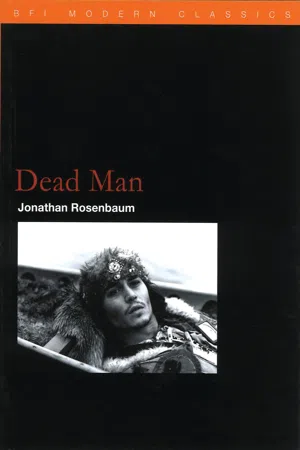
When it was released in 1995, Dead Man puzzled many audiences and critics. Jim Jarmusch's reputation was for directing slick, hip contemporary films. And Dead Man was a black-and-white Western. As time has passed, though, the number of its admirers has grown rapidly. Indeed Dead Man, with its dark and unconventional treatment of violence, racism and capitalism, may be Jarmusch's finest work to date.
This is Jonathan Rosenbaum's view. For him, Dead Man is both a quantum leap and a logical next step in Jarmusch's career. Starring Johnny Depp as the uprooted accountant William Blake and Gary Farmer as his enigmatic Native American companion, Nobody, and with startling cameos from Robert Mitchum, John Hurt and Iggy Pop, Dead Man is by turns shocking, comic and deeply moving. This book explorers and celebrates a masterpiece of 1990s American cinema.
- 96 pages
- English
- ePUB (mobile friendly)
- Available on iOS & Android
eBook - ePub
Dead Man
About this book
Information
1 Jim Jarmusch as American Independent, Dead Man as Deal-breaker
I
There isn’t much agreement about when the post-Western succeeded the Western in American movies. Some might date the end of the traditional Western around 1962, the year in which both The Man Who Shot Liberty Valance and Ride the High Country appeared; others might think of 1969 (The Wild Bunch), 1970 (Little Big Man and El topo), 1971 (McCabe and Mrs. Miller and The Last Movie), 1972 (Ulzana’s Raid), or 1973 (Pat Garrett and Billy the Kid). The point at which the post-Western sprang into being is even more difficult to determine. There are virtually as many dates as there are entries in this subgenre, because no two commentators can agree on what a post-Western is or should be.
So it shouldn’t be too surprising that a post-Western as important as Dead Man had a fairly mixed as well as puzzled reception in the US when it came out in 1996, among critics as well as general audiences. One good friend, an academic who loves Westerns, told me that as an anti-Western along the lines of Little Big Man, Jim Jarmusch’s film seemed all too familiar. Another esteemed colleague, a mainstream critic, told me that after an interesting opening sequence, the movie bored him to distraction. Roger Ebert, probably the most influential film reviewer in the US, accorded Dead Man one and a half stars in his review and concluded, ‘Jim Jarmusch is trying to get at something here, and I don’t have a clue what it is.’ His review began, ‘I once traveled for two days from Windhoek to Swakopmund through the Kalahari Desert, on a train without air conditioning, sleeping at night on a hard leather bench that swung down from the ceiling. That journey seemed a little shorter than the one that opens Dead Man.’1
The train journey opening Dead Man actually runs a little less than eight and a half minutes. In fairness to Ebert, this stretch is more aggressively eccentric and abrasive – in terms of pacing, rhythm, narrative discontinuity, behaviour and dialogue – than anything preceding it in Jarmusch’s work, offering fair warning that viewers expecting the writer-director to behave on this occasion like a charming and lightweight raconteur will be in for a bumpy ride. Among the more unnerving aspects are the opening epigraph from Henri Michaux (‘It is preferable not to travel with a dead man’),2 and an anything-but-tuneful employment of Neil Young’s guitar that is closer to a rhythmic sound effect than to any sort of recognisable melody. Then there is a sinister shift in passengers over various time breaks marked by fade-outs and fade-ins from city slickness to barbarism as mid-western accountant William Blake (Johnny Depp) proceeds west, and escalating examples of meanness over the same evolution. When the train’s fireman (Crispin Glover) suddenly seats himself across from Blake and assertively engages him in conversation, he begins with a surrealist monologue (reproduced at the beginning of the Appendix) that comes out of left field, then starts firing personal questions and comments at Blake about his destination and background that include the suggestion that he’s heading both for hell and his own grave, culminating in this stretch of gratuitous unpleasantness:
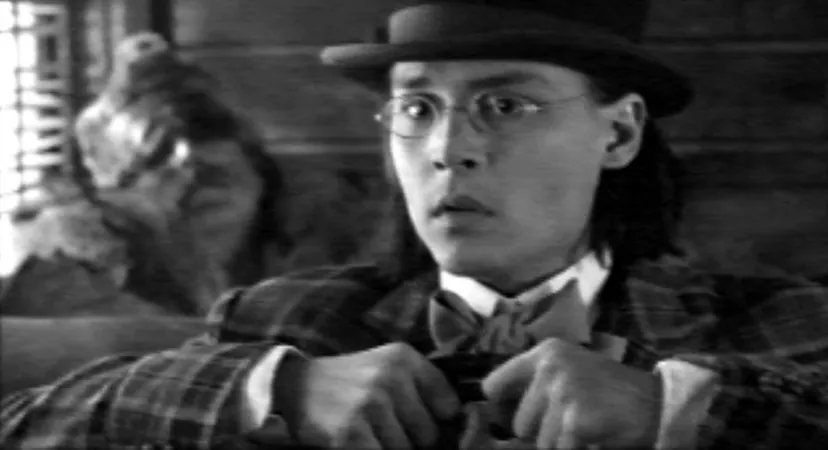
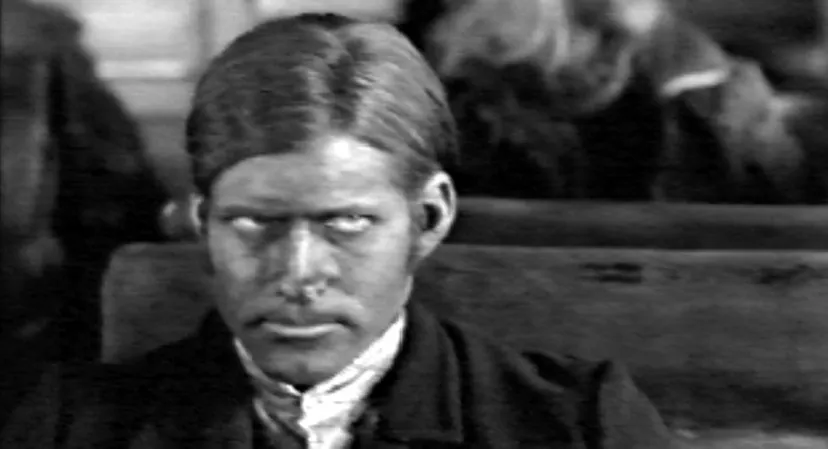
Blake and the fireman
FIREMAN
Wife?
BLAKE
No.
FIREMAN
Fiancée?
BLAKE
I had one of those, but she changed her mind.
FIREMAN
(speculating)
She found herself somebody else.
BLAKE
(defensively)
No.
FIREMAN
(gruffly insisting, as if to himself)
She did.
This exchange is succeeded by explosions of gunfire as many of Blake’s fellow passengers start firing out the train windows at buffaloes; over a million of them, the fireman informs us, were slaughtered in the previous year. And once Blake arrives at the town of Machine, immediately after the opening credits, things only get creepier, more ornery and disorienting. The following detail from the script, just after Blake steps off the train, probably derived from Jarmusch’s research, isn’t in the film. But it wouldn’t have been out of place if Jarmusch had managed to include it, because it sets the tone of literal contrariness that characterises the film as a whole:
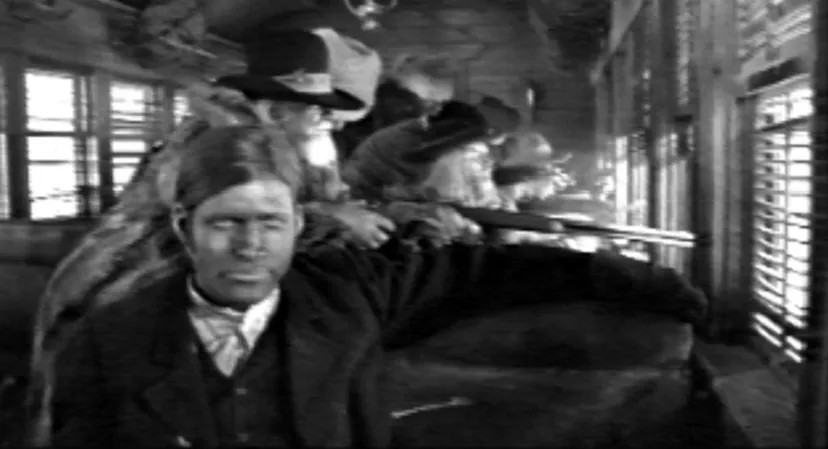
Shooting buffalo
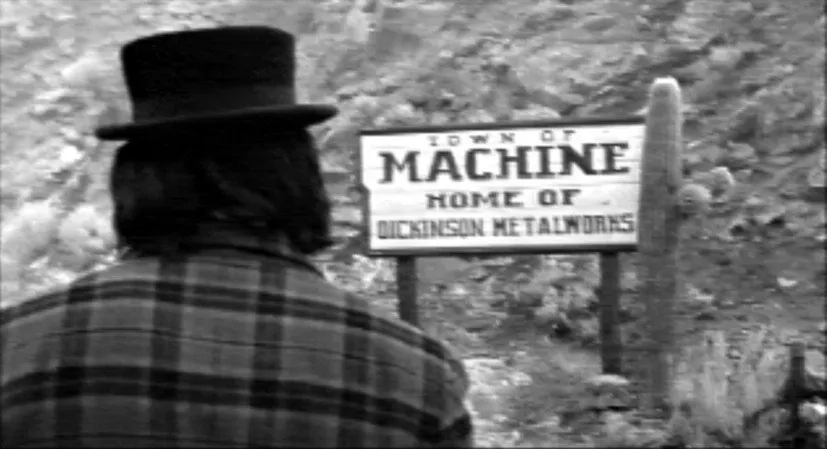
Arriving in Machine
BLAKE looks around him in a daze. The town has no train depot, but instead a strange wooden platform; a crude wooden turntable with railroad tracks across it.
As soon as BLAKE is several yards away from the train, scruffy, drunken-looking men appear out of nowhere, and begin to turn the train platform around, pointing the locomotive in the opposite direction.
II
In the interests of full disclosure, I should note that I’ve been friends with Jarmusch for the past seventeen years, though I haven’t been an unqualified supporter of his work as a whole. I published a brief and somewhat mixed review of Permanent Vacation (1980) in a New York weekly (the long-defunct Soho News) before we ever met, and when I first got to know him, his main identity for me was as the boyfriend of Sara Driver, a film-maker I was writing a chapter about for a survey of independent and experimental cinema called Film: The Front Line 1983. Once Jarmusch began to become famous with Stranger Than Paradise (1984), I followed his career with sympathetic interest, and when I was asked to interview him about his third feature, Down by Law (1986), for Cahiers du Cinéma, I was happy to oblige. But over the course of his next two features, Mystery Train (1989) and Night on Earth (1992), my growing fascination with some of his formal and thematic preoccupations was somewhat qualified by an overall sense that he was coasting, adopting the role of a sophisticated urban entertainer without significantly expanding his talents or in some cases adequately exploring his territory. (I was bothered, for instance, by the way some of the black Memphis characters in Mystery Train sounded more like New Yorkers to me than southerners.) Although I respected him for the ways in which he fiercely maintained his independence – despite numerous offers and opportunities to work for the Hollywood studios and join the mainstream – he seemed to have etched out a narrow if comfortable niche for himself that didn’t suggest many surprises or provocative future developments.
Dead Man changed all that. It represented both a quantum leap and, at the same time, a logical step in relation to Jarmusch’s earlier work. That is, without fundamentally betraying the thrust of his previous features, he also offered a series of new challenges to his audience in relation to form as well as content. Without quite contradicting the minimalism that had informed his style in the previous films, he had broadened his canvas to take in a lot more.
Part of this undoubtedly came from a radical change in tone; as Greil Marcus overstates it somewhat in his rousing defence of the film in the online magazine Salon, ‘There is no hint in Jim Jarmusch’s previous work that he was interested in anything but irony, and this movie has no irony.’3 And more recently, Jarmusch’s subsequent feature, Ghost Dog: The Way of the Samurai (1999), has shown that Dead Man brought about a substantial shift in his overall ambitions. An overall sense of tragedy permeating Ghost Dog is part of what might be termed the Dead Man legacy, along with a deeply felt relationship between the present and the historical past. More specifically, there’s the brief reappearance of Gary Farmer as Nobody, saying ‘Stupid fucking white man’, and another scene involving the hero’s retribution against a pair of deer hunters – a scene that Jarmusch himself admitted to me could easily have turned up in Dead Man.
One reason why I’ve chosen to include a lot of interview material in this book is that Jarmusch is unusually articulate about his positions and strategies, and in most respects his views of Dead Man are compatible with my own. But in some cases our views are different, and I’ve also wanted to juxtapose and challenge some of my own pet theories about the film (such as my reading of its treatment of violence) with his own somewhat different responses – not because I necessarily think that he’s right and I’m wrong, or vice versa (‘writing’ and ‘reading’ strategies aren’t always identical, in any case, nor should they be), but because I’d like to offer the reader certain choices.
III
Y’now, it’s funny. You come to someplace new and everything looks just the same.
Eddie (Richard Edson) in Stranger Than Paradise
After his second feature, Stranger Than Paradise, made him an international name, Jarmusch seemed at the height of arthouse fashion. Having already slightly known him, I could tell that the extent to which he suddenly became a figurehead for the American independent cinema bemused him in certain ways. Given the aura of hip, glamorous downtown Manhattan culture that seemed to follow him everywhere he went, how could it not? I can still recall a New York Times profile several years ago that was so entranced by his romantic image that it suggested that, simply because Jarmusch chose to live in the Bowery, that neighbourhood automatically took on magical, transcendent properties. In contrast to a much more embattled and political American independent such as Jon Jost, Jarmusch had (partly unwittingly) become the chief means of the media in glamorising and indeed ‘selling’ the American independent cinema from the mid-80s onward.
Consistently rejecting all Hollywood offers (echoed in the response of Los Angeles taxi driver Winona Ryder to showbiz agent Gena Rowlands in the first episode of Night on Earth), Jarmusch cultivated a stylish international arthouse reputation by acting in the films of such friends as Alex Cox, Robert Frank, Raúl Ruiz, the Kaurismaki brothers and Billy Bob Thornton – creating a certain model for independence that combined the conviviality of the French New Wave with some of the down-home brashness of storefront theatre. The combination of his white hair and his all-black clothes made him immediately recognisable as a figure. And thanks in part to the influence of New York minimalism, his career has managed an exemplary combination of experimentation and repetition, striking an even balance between business savvy and artistic self-preservation. Moreover, he’s spiced the spare decorum of New York minimalism with the unruly, diverse charm of various ‘foreign’ and ethnic points of view. Investing most of his energy in character rather than story, he returns repeatedly to the notion of looking at the same thing in different ways – or looking at different things the same way.
Permanent Vacation, Stranger Than Paradise and Down by Law are all ‘road movies’ of a sort, featuring music by John Lurie and strategic pauses in the dialogue. Yet each is a different form of road...
Table of contents
- Cover
- Title Page
- Contents
- Acknowledgments
- 1. Jim Jarmusch as American Independent, Dead Man as Deal-breaker
- 2. The Story
- 3. On Tobacco
- 4. On Violence
- 5. On Music
- 6. On the Acid Western
- 7. Frontier Poetry
- 8. Closure
- Appendix: Aside on Authorship and Methods of Composition
- Notes
- Credits
- Bibliography
- eCopyright
Trusted by 375,005 students
Access to over 1.5 million titles for a fair monthly price.
Study more efficiently using our study tools.
Frequently asked questions
Yes, you can cancel anytime from the Subscription tab in your account settings on the Perlego website. Your subscription will stay active until the end of your current billing period. Learn how to cancel your subscription
No, books cannot be downloaded as external files, such as PDFs, for use outside of Perlego. However, you can download books within the Perlego app for offline reading on mobile or tablet. Learn how to download books offline
Perlego offers two plans: Essential and Complete
- Essential is ideal for learners and professionals who enjoy exploring a wide range of subjects. Access the Essential Library with 800,000+ trusted titles and best-sellers across business, personal growth, and the humanities. Includes unlimited reading time and Standard Read Aloud voice.
- Complete: Perfect for advanced learners and researchers needing full, unrestricted access. Unlock 1.5M+ books across hundreds of subjects, including academic and specialized titles. The Complete Plan also includes advanced features like Premium Read Aloud and Research Assistant.
We are an online textbook subscription service, where you can get access to an entire online library for less than the price of a single book per month. With over 1.5 million books across 990+ topics, we’ve got you covered! Learn about our mission
Look out for the read-aloud symbol on your next book to see if you can listen to it. The read-aloud tool reads text aloud for you, highlighting the text as it is being read. You can pause it, speed it up and slow it down. Learn more about Read Aloud
Yes! You can use the Perlego app on both iOS and Android devices to read anytime, anywhere — even offline. Perfect for commutes or when you’re on the go.
Please note we cannot support devices running on iOS 13 and Android 7 or earlier. Learn more about using the app
Please note we cannot support devices running on iOS 13 and Android 7 or earlier. Learn more about using the app
Yes, you can access Dead Man by Jonathan Rosenbaum in PDF and/or ePUB format, as well as other popular books in Media & Performing Arts & Film & Video. We have over 1.5 million books available in our catalogue for you to explore.