- 96 pages
- English
- ePUB (mobile friendly)
- Available on iOS & Android
eBook - ePub
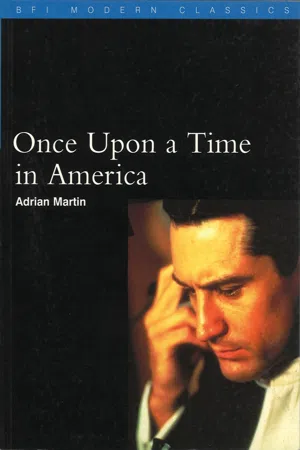
Once Upon a Time in America
About this book
Detailing the genesis, production history and different versions of 'Once Upon a Time in America', this study considers the film within the context of Leone's evolution as a grand cinema stylist. It illuminates his themes, method and aesthetic, and judges his impact upon subsequent filmmakers.
Information
1 Once Upon a Time, Leone
I never thought much about becoming a part of the history of cinema.
Sergio Leone, 19821
Death has a knack of turning the final work of an artist into his or her 'testament' – simultaneously the summation and apotheosis of everything that preceded it. Once Upon a Time in America (1983) was a movie that Sergio Leone spent some sixteen years of his life developing, and the only one he completed after Giu la Testa in 1971. For admirers of the director it has a special, trembling place in his oeuvre – all the more poignant in that death happens to be one of its central themes.
Once Upon a Time in America tells the epic story of four Jewish gangsters – Noodles (Robert De Niro), Max (James Woods), Patsy (James Hayden) and Cockeye (William Forsythe). Beginning as childhood friends in a squalid district of New York in 1922, they rapidly learn the rules of the street. By 1933 and the end of Prohibition, they have become reasonably glamorous criminals with their own speakeasy, and a secure power network. However, the gang's growing involvement with Jimmy (Treat Williams) and the corrupt union movement slowly drives a wedge between the idealistic Noodles and his more ruthless 'soul brother' Max. Noodles decides to betray the increasingly megalomaniacal Max to the police on the eve of a potentially suicidal Federal Bank robbery – and later sees what appears to be the evidence of all three of his friends murdered in the street.
Stricken with guilt and grief, Noodles decides to exile himself from New York for good – pausing only to claim for himself the gang's reserve of money stashed since childhood, which he finds mysteriously missing. Over thirty years later, in the 1960s, Noodles as an old man is summoned back to his home city. He follows an enigmatic series of commands and clues which lead him eventually to the realisation that Max is still alive – that he had faked his death in 1934 in order to resurrect himself as Bailey, a politician now deeply implicated in the criminal world. Finally, called to Bailey's mansion, Noodles is beseeched by Max to kill him. When Noodles refuses and leaves, Max appears to kill himself by stepping into the back of a garbage truck.
There are many more characters, episodes and tangents in the plot – most significantly, Noodles' disastrous adult relationship with his childhood sweetheart Deborah (Elizabeth McGovern) – and they will be unravelled in the course of this book. The content of the film is inextricably bound up with its peculiar narrative form: a scattered chronology with two framing devices. The bulk of the film is presented in the form of large-scale flashbacks cued by moments in old Noodles' journey in 1968: a long childhood section set in the 20s, and then two sections devoted to the 30s. The 1968 thread is itself framed by scenes from 1934, centred on Noodles' visit to an opium den.
What kind of film is this? Leone is often – and with some justice – circumscribed within a particular global tradition within cinema history. This lineage has attracted many kinds of descriptions and labels: mannerist, baroque, spectacular, exhibitionist, performative, carnivalesque, camp, cartoonish, 'pop formalist' – a cinema of 'effects' rather than meanings, of playful excess rather than classical expressivity. Whatever we choose to call the artistic impulse, there can be no doubt that Leone, beginning with A Fistful of Dollars (Per un pugno di dollari) in 1964, galvanised this tradition for the modern era more than any other single film-maker.

Little gangsters making a money pact

Cockeye, Max and Patsy celebrate good times
Bill Krohn has remarked upon the 'tone of defensiveness and grudging approval' evident in even the best scholarly studies since the 60s of Sergio Leone's oeuvre – a defensiveness 'where euphoria and liberating laughter would seem more appropriate'.2 Why should there be this note of equivocation or special pleading in relation to the critical valuation of Leone? The palpable material thrill, the 'exhilaration of the artist in his own invention'3 we experience watching his movies is often described as something pure – as 'pure film', or pure cinema. Yet the purity tag can be a curse in film culture, a backhanded compliment which hides a dourer evaluation. Literary standards of artistic worth die hard in most 'educated' cultures; a film that is all style and little content, all surface and no depth, risks being cast out politely as trivial, or of minor significance at best. film leaves its sad hero, Peachment concludes: 'It's not a new observation, but cinema is no more than this.'4
Once Upon a Time in America has been celebrated, perhaps more so than any of Leone's previous films, as an example of pure cinema, pure style. Chris Peachment's review in Sight and Sound, for example, ends with just such a cinephiliac epiphany: noting the 'memory of an opium-tinted smile at the shadows of puppets on a wall' with which the
Yet Once Upon a Time in America, finally, does not sit so easily within such a purist context. The film is a special case within the director's oeuvre. It is obviously still exhibitionistic and operatic like all of Leone's previous work, yet it is not as purely comic book-like as the Westerns. Rather, the more traditional material in Once Upon a Time in America – grand themes of literary inspiration, complex emotional structures related to the characters, careful patterning of image and sound motifs, a true 'art film' structure – brought to the fore a side of Leone's cinema that continues to be often obscured or misrecognised. Krohn helps spell out the true lesson: 'After Once Upon a Time in America ... there were no grounds for misunderstanding: with the death of Sergio Leone the cinema has lost one of its great Romantic poets.'5
However, to argue that, with Once Upon a Time in America, Leone got beyond an obsession with pure film and made a perfectly 'organic' work would also constitute a defensive betrayal of Leone, and of his true place in cinema history. I think we must see this film, and Leone's career as a whole, as existing in an impure space where different artistic impulses and cultural traditions interlace. Leone is ultimately not a practitioner of pure cinema, in my view, but rather a richly impure, hybrid cinema. And there is no film of his more impure in its concoction of drives and elements than Once Upon a Time in America.
The very title of the film announces and prefigures its unusual mixture of moods and styles. Once upon a time: Leone often referred to the film as a 'fairy tale for adults';6 oneiric, unreal, almost magical elements fill the work. But this fairy tale is collided, contradicted, grounded in a brutal historical reality: in America. For Leone, the fairy tale dimension was essentially cinematic in its substance and its references; time and again he emphasised in interviews and articles that his film could well have been titled 'once upon a time there was a certain kind of cinema'.7
So the stake in this tale is a grand, romantic memory of cinema – a lost, classical, generic cinema which forms a mythic 'world apart', marvellous and sufficient unto itself. And of course this cinema, for Leone as for many of us, is essentially American in origin. Just as Leone had previously recreated for himself, in his own feverish way, the mythic world of American Westerns, now he turned to the gangster genre. And, once again – this is the surest sign of Leone's modernity, even his nascent post-modernity – he abstracted the memory of this genre, minimising its conventional plot logic and maximising its 'attractions', its purely spectacular elements.
In Leone's hands, the classic genres become not only Pop Art friezes of iconographic signs and indices, but also a ritual procession of dramatic or 'scenographic' highpoints: 'clinches', charged looks and gestures, moments of recognition. 'Neither a revival nor a disfiguring of the model of reference', writes Michel Sineux, but a 'ritual choreography' returning us to the 'very origins of spectacle' in a primal 'game of masks'.8 It was as if, for Leone, such disembodied 'quotations' – if they could be made to retain their mythic intensity and potency – might provide a kind of catharsis or ecstasy for modern-day cinephiles pining over their precious 'lost object'. That is why, finally, form can never be 'pure' in Leone's work: at stake in it is a psychic investment, a whole elaborate machine of selfhood, culture and longing ...
But, although misty evocations of a golden age loom – the cinema's golden age as much as the characters' carefree, lawless youth – it would be wrong to consider Once Upon a Time in America an exercise in nostalgia. There is a wrenching duality in the film: towards epic enchantment on the one hand, and massive disenchantment on the other; the imaginary, movie-made America pitted against the real, historical America. The great 'cinema machine' – and all it means for us as cinephiles – is revved up, but the ultimate destination of this euphoric mental voyage is an extremely black one. Indeed, a melancholic disillusionment is the key emotional note of Leone's testament.

Old Noodles seemingly back from the dead
2 A Dream and a Map
It has always been one of the special pleasures of movies that they dream worlds and map them at the same time.
Richard Jameson, 19909
The first, bold movement of Once Upon a Time in America maps the world of the film – its co-ordinates of time and space, its web of character intrigues – in a gradual, tantalising, poetically allusive way. An aura of enigma hangs over this section like a thick fog. The extreme and quite confronting strangeness of the introduction – certainly the most overt deployment of classic European art cinema devices and mannerisms in Leone's career – undoubtedly exacerbated its distribution troubles in America (outlined in Chapter 8).
One of the most strongly showbiz or 'performative' elements of Leone's approach to cinema is his very theatrical sense of how to introduce the key elements of a film's 'matrix'. This extends not only to the characters – whose stage entrances are always striking and memorable – but also to stylistic elements, such as dialogue, music, even light itself. Once Leone has painstakingly orchestrated the initial appearance of an element, he then sets to combining and interweaving it with the other elements in the ensemble.
There is almost a minute of silence under the opening credits before the first sound appears – diegetic sound of barely distinct revellers, and a performance, over a radio, by Kate Smith of the song 'God Bless America'. This background track continues, almost imperceptibly, throughout the first scene. As the credits draw to a...
Table of contents
- Cover Page
- Title Page
- Contents
- Acknowledgments
- 1 Once Upon a Time, Leone
- 2 A Dream and a Map
- 3 The Mummy's Curse
- 4 A Pulp Fiction
- 5 Gangster Without Glory
- 6 A Violent Night
- 7 'Been Goin' to Bed Early'
- 8 For a Few Minutes More (Or Less)
- 9 Pillar of Salt
- 10 I Say It Here and I Deny It Here
- Postscript: Ashes of Time
- Notes
- Credits
- Bibliography
- eCopyright
Trusted by 375,005 students
Access to over 1.5 million titles for a fair monthly price.
Study more efficiently using our study tools.
Frequently asked questions
Yes, you can cancel anytime from the Subscription tab in your account settings on the Perlego website. Your subscription will stay active until the end of your current billing period. Learn how to cancel your subscription
No, books cannot be downloaded as external files, such as PDFs, for use outside of Perlego. However, you can download books within the Perlego app for offline reading on mobile or tablet. Learn how to download books offline
Perlego offers two plans: Essential and Complete
- Essential is ideal for learners and professionals who enjoy exploring a wide range of subjects. Access the Essential Library with 800,000+ trusted titles and best-sellers across business, personal growth, and the humanities. Includes unlimited reading time and Standard Read Aloud voice.
- Complete: Perfect for advanced learners and researchers needing full, unrestricted access. Unlock 1.5M+ books across hundreds of subjects, including academic and specialized titles. The Complete Plan also includes advanced features like Premium Read Aloud and Research Assistant.
We are an online textbook subscription service, where you can get access to an entire online library for less than the price of a single book per month. With over 1.5 million books across 990+ topics, we’ve got you covered! Learn about our mission
Look out for the read-aloud symbol on your next book to see if you can listen to it. The read-aloud tool reads text aloud for you, highlighting the text as it is being read. You can pause it, speed it up and slow it down. Learn more about Read Aloud
Yes! You can use the Perlego app on both iOS and Android devices to read anytime, anywhere — even offline. Perfect for commutes or when you’re on the go.
Please note we cannot support devices running on iOS 13 and Android 7 or earlier. Learn more about using the app
Please note we cannot support devices running on iOS 13 and Android 7 or earlier. Learn more about using the app
Yes, you can access Once Upon a Time in America by Adrian Martin in PDF and/or ePUB format, as well as other popular books in Media & Performing Arts & Film History & Criticism. We have over 1.5 million books available in our catalogue for you to explore.