- 360 pages
- English
- ePUB (mobile friendly)
- Available on iOS & Android
eBook - ePub
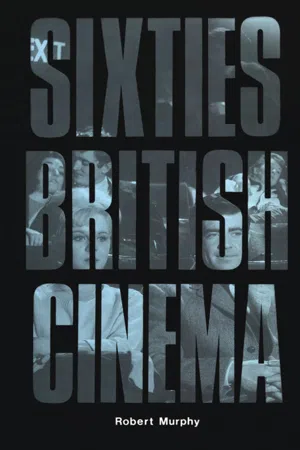
Sixties British Cinema
About this book
British films of the 1960s are undervalued. Their search for realism has often been dismissed as drabness and their more frivolous efforts can now appear just empty-headed. Robert Murphy's Sixties British Cinema is the first study to challenge this view. He shows that the realist tradition of the late 50s and early 60s was anything but dreary and depressing, and gave birth to a clutch of films remarkable for their confidence and vitality: Saturday Night and Sunday Morning, A Kind of Loving, and A Taste of Honey are only the better known titles. Sixties British Cinema revalues key genres of the period - horror, crime and comedy - and takes a fresh look at the 'swinging London' films, finding disturbing undertones that reflect the cultural changes of the decade. Now that our cinematic past is constantly recycled on television, Murphy's informative, engaging and perceptive review of these films and their cultural and industrial context offers an invaluable guide to this neglected era of British cinema.
Information
1
A SAVAGE STORY OF LUST AND AMBITION
Though, as always, there were long thin tendrils, reaching to the war, reaching to the Movement, reaching to the slow rise of living standards and the abolition of rationing in the earlier fifties, reaching to the crisis of Suez, the critical point of change, as near as one can ever get to these things, hinges on the year 1959. (Arthur Marwick, Journal of Contemporary History, 1984)1
Stagnant Cinema
British cinema of the 1950s has a reputation for stagnant complacency which is not entirely undeserved. The war films are solid and serious, the comedies funny, and the substratum of crime and horror B movies a treasure trove of cinematic delights; but as Lindsay Anderson complained in 1957:
To counterbalance the rather tepid humanism of our cinema, it must also be said that it is snobbish, anti-intelligent, emotionally inhibited, wilfully blind to the conditions and problems of the present, dedicated to an out-of-date, exhausted national ideal.2
It is easy to sympathise with Anderson's anger and frustration. He had helped launch Sequence, a lively, adventurous film journal, in 1947 when there were still legitimate expectations that British cinema would become internationally significant, expectations that were firmly squashed two years later when the Rank Organisation abandoned its attempt to crack the American market and concentrated its resources on safe, innocuous films at Pinewood. Entry into the industry as a director was difficult, particularly for an intellectual like Anderson. Apart from the little band of liberals and ex-documentary film-makers who sheltered under the umbrella of John Baxter and John Grierson's Group Three, most of the directors who made their breakthrough between 1950 and 1959 were pragmatically commercial and had generally served a long apprenticeship in other branches of the industry.3 Anderson, along with two other young, ambitious film-makers he became associated with – Karel Reisz and Tony Richardson – was too uncompromising to fit into the cosily conformist environs of Elstree, Ealing and Pinewood and too highbrow to seek a career in the film factories of Twickenham, Bray and Merton Park.4
In February 1956, Anderson, Reisz and Richardson launched Free Cinema. Between 1956 and 1959 six programmes of films were shown under the Free Cinema banner at the National Film Theatre, three of them remarkably prescient examples of 'New Wave' film-making in Poland, France and the United States, three made up of low-budget films made in Britain. All the British films, except for Lorenza Mazzetti's Together, were documentaries, but documentaries different in spirit, technique and context from the mainstream of British documentary. Free Cinema was accepted as a movement because, despite their disparity, most of the film-makers involved shared a common outlook and common interests. As Alan Lovell argues:
. . . the views of the world which emerge from Free Cinema films are recognisable, the result of preoccupations common among intellectuals in the second half of the 1950s. Broadly, these preoccupations were: a sympathetic interest in communities, whether they were the traditional industrial one of Wakefield Express or the new, improvised one of the jazz club in Momma Don't Allow; fascination with the newly emerging youth culture (Momma Don't Allow, We Are the Lambeth Boys, Nice Time); unease about the quality of leisure in an urban society (Nice Time, O Dreamland); and respect for the traditional working class (Enginemen, Every Day Except Christmas).5
Anderson's Free Cinema manifesto, the film programmes, and the articles written by Karel Reisz and other members of the Free Cinema group (such as the cameraman Walter Lassally) created considerable media interest, but their intellectual preoccupations had not yet permeated the film business and doors into the commercial film industry remained jealously closed. Ironically, the breakthrough into a new kind of cinema came from within.
Room at the Top
John and James Woolf, the producers, and Jack Clayton, the director of Room at the Top, were not the sort of people one would envisage starting a cinematic revolution. Clayton had served a traditional apprenticeship in the commercial cinema, beginning as a tea-boy at Denham studios in 1936, rising to become an editor and then a producer, and proving his ability to direct with a short fiction film, The Bespoke Overcoat, in 1955. The Woolf brothers were the sons of C. M. Woolf, a key figure of the pre-war film industry. He died in 1942, leaving his sons financially well-endowed but with the family firm, General Film Distributors, tightly ensconced within the Rank empire (GFD'S symbol was a muscle-man striking a gong). John Woolf worked for Rank when he came out of the army, but was less than happy as an organisation man and left in 1948 to join his brother in setting up their own distribution and production company.6
In contrast to the increasingly staid and conventional Rank Organisation, the Woolfs were prepared to take risks. The investigations of the House of Representatives Un-American Activities Committee had made it difficult, unpleasant or impossible for left-wing film-makers to continue working in Hollywood. Britain, though not immune from its own anti-Communist hysterics, provided a more congenial climate. In 1950 the Woolfs brought over Ava Gardner, James Mason and Albert Lewin to make the wildly exotic Pandora and the Flying Dutchman, and despite its disappointing box-office performance, persisted with their experiment in Anglo-American production and scored a big success with The African Queen. Several more Anglo-American co-productions followed. By the mid-50s the Woolfs were financially secure enough to bail out Sir Alexander Korda and help him set up his last four films – A Kid for Two Farthings, Richard III, Summer Madness and Storm Over the Nile – prestige British films which turned out to be uncharacteristically profitable.
What distinguished the Woolfs from other entrepreneurial partnerships was their combination of financial acumen with artistic flair. John Woolf, born and brought up in the film industry and married to the daughter of producer/director Victor Saville, had strong views about what sort of films he wanted to make as well as a canny perception of what would be commercially successful. But it was James, despite his shyness and poor health, who inherited Korda's ability to recognise and foster talent.7 Among his protégés was the Lithuanianborn actor Lauruska Mischa Skikne, better known as Laurence Harvey. Harvey's biggest film part had been as the vaguely asexual hero of I Am a Camera (1955), an adaptation of Christopher Isherwood's Berlin stories (which would later be re-made as Cabaret). Despite his reputation as 'an exotic butterfly', the Woolfs cast him as the working-class hero of Room at the Top.8
John Braine's novel Room at the Top, published in 1957, was a best-seller. It combined the realism of situation, character and setting of earlier 50s novels like John Wain's Hurry On Down and Kingsley Amis's Lucky Jim with the bitterness and aggression of John Osborne's play Look Back in Anger. Braine's hero is working-class but he has had a grammar school education and he works in the Borough Treasurer's office, and as Braine pointed out:
Most ambitious working-class boys want to get to hell out of the working class. That was a simple truth that had never been stated before. The English working classes are the least politically-minded in the world; they always have been. Give the English working-class man half a chance and he becomes a bourgeois.9
Such a viewpoint chimed well with 'never had it so good' attitudes in the late 50s, and the novel was serialised in the Daily Express.10 But the book was no complacent celebration of affluence: its story of a young man who uses his charm and good looks to gain advancement in a class-bound society expressed the resentment of that first generation of working-class children to benefit from the 1944 Education Act, when they emerged into a world far removed from the classless, populist utopia they had been promised.
Joe Lampton moves from the grim northern industrial town of Dufton to take up a job in the much cleaner and more prosperous town of Warnley. He joins an amateur dramatics society and resolves to win the hand of fellow thespian Susan Brown, the pretty daughter of a local industrialist, partly because he is genuinely attracted to her, partly because he sees her as a passport to a better way of life. Though he makes some slow progress towards his goal, he also drifts into a fulfilling love affair with an older woman, Alice Aisgill. Ironically, the social pressures which make his relationship with Susan seem impossible conspire, after he has realised his destiny lies with Alice, in forcing him into marriage with Susan. Alice commits suicide and Joe looks forward to a loveless marriage for which material rewards and a promising career seem insufficient compensations.
Unlike literary predecessors such as Julian Sorel in Stendhal's Le Rouge et le Noir or Clyde Griffiths in Dreiser's An American. Tragedy, whose refusal to accept their humble situation in society provokes bloody retribution by the forces of order, Joe Lampton is congratulated on his success. In 1950s British society his ambitions – a sports car, a glamorous girlfriend, a job with an expense account – are reasonable and legitimate, but Room at the Top implies that they are realisable at a high cost in honesty and integrity. Alexander Walker complains that 'what one feels most strongly in Room at the Top isn't anger – but envy – the envy of a have-not for what he wants to acquire.'11 This is misleading. Braine is very specific about Joe's attitude: 'I tasted the sourness of envy. Then I rejected it. Not on moral grounds, but because I felt then, and still do, that envy's a small and squalid vice . . . This didn't abate the fierceness of my longing. I wanted an Aston-Martin, I wanted a three-guinea linen shirt, I wanted a girl with a Riviera suntan – these were my rights, I felt, a signed and sealed legacy.'12 Joe has a sense of his own value which makes envy irrelevant, and in the film the casting of Laurence Harvey – a prince very thinly disguised as a frog – reinforced the feeling that Joe has a right to the good things in life.

A fulfilling love affair with an older woman: Simone Signoret and Laurence. Harvey, Room at the Top
John Braine – a Bradford librarian – identifies with his hero, but he maintains a certain critical distance. In the film, this disappears. Implicit approval is given to Joe's transgression of class boundaries: his aunt and uncle in Dufton who warn him of the dangers of not sticking to his own kind seem like relics from a past age, and the upper-crust characters – Alice's husband, Susan's mother and her chinless wonder of a boyfriend – who are vaguely unpleasant in the book, assume a nightmarish awfulness.13 The film's morality is tied up in the relationship Joe forms with Alice Aisgill. In the novel the reader is invited to share Joe's reservations about his ageing lover and his attraction to the young and desirable Susan, but by making Alice a foreigner the film-makers put her outside the English class system and change her into a symbol of honesty and true love.14 It is not second thoughts on Joe's part but external circumstances which make him break off the relationship: Alice's husband refuses to divorce her and threatens to lose Joe his job; Susan gets pregnant and her father makes Joe an offer he cannot refuse. Alice dies, horribly, and Joe is congratulated on achieving his ambitions, his tears on his wedding day mistaken by his young wife for tears of happiness. A radical novel flawed by cynicism and sentimentality is transformed into a film which displays the tragedy of a man stuck in a rigid hierarchical society where ambition and enterprise are turned into self-destructive weap...
Table of contents
- Cover Page
- Title Page
- Contents
- Acknowledgments
- Introduction
- 1 A Savage Story of Lust and Ambition
- 2 80,000 Problems
- 3 Critical Debates
- 4 Art and Commerce
- 5 When Dinosaurs Ruled the Earth
- 6 Brave New World
- 7 Swinging London
- 8 Other Worlds
- 9 Exploring the Underworld
- 10 Frying Tonight
- 11 Hollywood's England
- Conclusion
- Appendix: A Guide To The 1960s In Britain
- Notes
- Bibliography
- Index
- eCopyright
Trusted by 375,005 students
Access to over 1.5 million titles for a fair monthly price.
Study more efficiently using our study tools.
Frequently asked questions
Yes, you can cancel anytime from the Subscription tab in your account settings on the Perlego website. Your subscription will stay active until the end of your current billing period. Learn how to cancel your subscription
No, books cannot be downloaded as external files, such as PDFs, for use outside of Perlego. However, you can download books within the Perlego app for offline reading on mobile or tablet. Learn how to download books offline
Perlego offers two plans: Essential and Complete
- Essential is ideal for learners and professionals who enjoy exploring a wide range of subjects. Access the Essential Library with 800,000+ trusted titles and best-sellers across business, personal growth, and the humanities. Includes unlimited reading time and Standard Read Aloud voice.
- Complete: Perfect for advanced learners and researchers needing full, unrestricted access. Unlock 1.5M+ books across hundreds of subjects, including academic and specialized titles. The Complete Plan also includes advanced features like Premium Read Aloud and Research Assistant.
We are an online textbook subscription service, where you can get access to an entire online library for less than the price of a single book per month. With over 1.5 million books across 990+ topics, we’ve got you covered! Learn about our mission
Look out for the read-aloud symbol on your next book to see if you can listen to it. The read-aloud tool reads text aloud for you, highlighting the text as it is being read. You can pause it, speed it up and slow it down. Learn more about Read Aloud
Yes! You can use the Perlego app on both iOS and Android devices to read anytime, anywhere — even offline. Perfect for commutes or when you’re on the go.
Please note we cannot support devices running on iOS 13 and Android 7 or earlier. Learn more about using the app
Please note we cannot support devices running on iOS 13 and Android 7 or earlier. Learn more about using the app
Yes, you can access Sixties British Cinema by Robert Murphy in PDF and/or ePUB format, as well as other popular books in Media & Performing Arts & Film History & Criticism. We have over 1.5 million books available in our catalogue for you to explore.