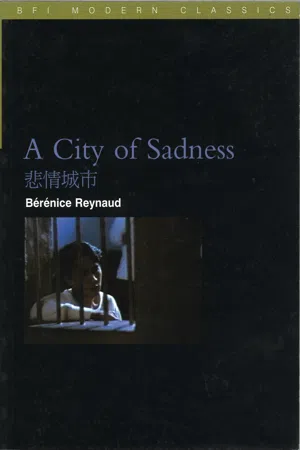
- 96 pages
- English
- ePUB (mobile friendly)
- Available on iOS & Android
eBook - ePub
A City of Sadness
About this book
Winner of the Golden Lion in Venice in 1989, A City of Sadness introduced Western audiences to the richness of New Taiwanese Cinema. Its director, Hou Hsiao-hsien is now recognised as one of the most profoundly original auteurs in contemporary cinema. A City of Sadness revisits a painful episode in recent Taiwanese history, creating an elliptical and impressionistic picture of Chiang Kai-shek's takeover of the island after the defeat of his Kuomintang army by Mao Zedong. Taiwan's politics and the suffering of her inhabitants are invoked by Hou in the story of an extended family of four brothers. The first Taiwanese film shot in direct sound, A City of Sadness echoes the forgotten voices of ordinary people facing political repression. Berenice Reynaud deciphers the complex social and historical threads that combine in the film while analysing its aesthetics in the context of Hou's entire career. His journey from being a commercial director to becoming the famed master of long takes and painterly compositions is referred to the history of Taiwanese cinema and the philosophy of forms in Chinese art.
Information
1 Chinese History Is Made at Night
In Beijing, during the night of 4 June 1989, the troops of the People’s Liberation Army (PLA) entered Tiananmen Square, broadcasting an order for the students gathered there to evacuate. By 5.40 am, the square was cleared. Killing continued in the streets throughout the morning. This was followed by an intense crackdown on the democracy movement. A few months later, on 15 September, A City of Sadness, by the Taiwanese director Hou Hsiao-hsien, was awarded the Golden Lion at the 46th Venice International Film Festival – one of the first contemporary Chinese movies to receive such a prestigious international prize1 Yet, in December, at Taipei’s Golden Horse Awards, A City of Sadness lost out to a Hong Kong film, Stanley Kwan’s Full Moon in New York2 – a shock to many, considering the upsurge of national pride generated by the Venice award and the tremendous box-office success achieved by the film in Taiwan. Made possible by the 1987 lifting of a 40-year-old martial law, A City of Sadness was released in the sorrowful aftermath of the 4 June incident and greeted with suspicion by the Taiwanese establishment. It is a film haunted by the intricacies of recent Chinese history.
Born in 1947 in the mainland province of Guangdong, Hou Hsiaohsien had lived in Taiwan since infancy, and, while totally Chinese, his film had a distinct Taiwanese flavour and atmosphere and created a world quite different from the ‘China’ that Western audiences had been introduced to by Fifth Generation mainland film-makers such as Zhang Yimou and Chen Kaige. The ‘sadness’ of the title alluded to the troubled years between the end of the Japanese occupation of Taiwan in 1945 and the official takeover by the Nationalist Party (Kuomintang) of Chiang Kai-shek in 1949. Yet this ‘sadness’ has even more distant causes – the division of China and Taiwan’s progressive alienation from the mainland since the nineteenth century. And, as fate would have it, A City of Sadness reached the world at a moment when, once again, the Chinese psyche was hurting. As he was working on the editing in the spring and summer of 1989, Hou ‘immediately sensed the connection between Tiananmen and the massacres alluded to in the film, wondering “Why do such tragedies keep befalling the Chinese people?” and hoping that his film would evoke the same pain and anger in its audience’.3 So, while it is because of its mise en scène that A City of Sadness has been hailed as ‘one of the supreme masterworks of the contemporary cinema’,4 the role played by the historical context in the conception and reception of the film should not be overlooked.
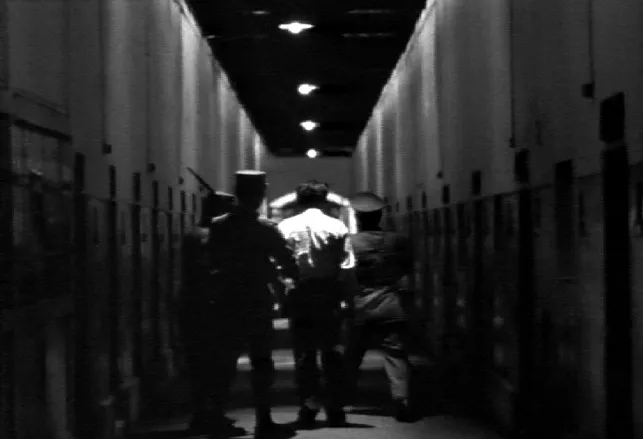
Soldiers taking Wen-ching to court
To recreate a portion of Taiwanese history that until then had been shrouded in darkness, Hou follows, then subverts, the genre of the ‘family saga’, recounting the intertwining lives of an extended family in a small town on the northern coast of Taiwan: four brothers, their relatives, associates and friends. They become victims of the increasing violence that befalls the island. His ninth feature,5 A City of Sadness was an aesthetic breakthrough for Hou – not only did he use sync sound for the first time (becoming the first Taiwanese film-maker to do so), but he combined his characteristic long shots with a more atmospheric, less linear type of montage. Through his minimalist imagery, complex framing, elliptic rendering of interpersonal relationships, and the disruptions created by his storytelling techniques (breaks in continuity editing, flashbacks-within-flashbacks), Hou involves the spectator emotionally, while leaving him or her intellectually responsible for reconstructing the multiple layers of the plot.
Hou describes how he structured the story with his screenwriters, Chu Tien-wen and Wu Nien-jen:
We laid the basis [of the narrative structure] by reconstructing the feelings and emotions of that time … creating an atmosphere … therefore producing a subjective view towards this whole period of time … Then they built up the characters, and depending on their importance, they poured details gathered through their historical research into them – then re-started all over again … Since so many things happen in the background, we’d rather use flashbacks than a linear structure, and introduce [the spectator to the story] through a multiplicity of details. In the editing process, it became unimportant to define what was reality and what was flashback; I like to blur the line between the two.6
Already present in Hou’s earlier films, this ‘subjective view’ of history can be defined as a form of Impressionism7 – but never had it been brought to such a level of shimmering complexity as in A City, due to the number of the characters involved, the length of the film (159 minutes) and the poignant historical significance of the events recounted. Overall, A City defines a vertiginous, elliptical arc, which goes from one feeling of loss – the loss of Taiwan by the Japanese – to another – the loss of the mainland by the Kuomintang.
Weaving History with Multiple Threads
It is on the voice of a broken, yet mythical Japanese man, that Hou starts A City of Sadness. On 15 August 1945, Emperor Hirohito spoke directly to his people for the first time. He used a modern medium, the radio, while uttering a language that most of his subjects could not understand: classical Japanese. The bombings of Hiroshima and Nagasaki had forced him to concede defeat. His voice resonated through all Japanese territories and possessions, as far as the small, distant island of Taiwan. As the credits roll, we hear his speech and it continues over a few seconds of black frames, then is heard in the warm chiaroscuro of a private house. A middle-aged, heavyset man, Lin Wen-heung, lights incense with the flames of two candles, smoking and looking worried. In the background, one perceives the shady presence of another man, Ah-ga, the brother of Wen-heung’s mistress. As suggested by the off-screen muffled cries of a woman, a baby is about to be born. In another room, the expectant mother is lying on a bed, surrounded by a young nurse and an older midwife, who speaks to her in a gentle but firm tone. A third cut brings back Wen-heung, this time facing us; in the background, the midwife appears like a ‘Chinese shadow’ behind a red-pink curtain. The nurse is already out of the room, announcing she’s going to get some warm water. After the two women have left the field, a panning shot follows Wen-heung, who joins them as they are scooping hot water, and tells them, helplessly but curtly, to ‘hurry’. The nurse’s body is seen as a silhouette against a window, while the midwife is kept in the dark.
Wen-heung returns to his previous spot, on the right of the screen, and drinks out of a little white teacup, while, suddenly, on his right, a ceiling lamp lights up. ‘Fuck, now it’s coming,’ says Wen-heung – alluding both to the return of the electricity, often cut during wartime, and to the arrival of the baby. He pulls up the cloth that had been put over the bulb, undoubtedly to avoid attracting attention in the event of an air-raid. Hirohito’s voice has gradually grown weaker and weaker, while the woman’s moaning suddenly becomes louder. A few seconds later, Hirohito has completely vanished and is replaced by the theme music. Wen-heung goes to the bedroom on the right, leaving the frame empty. A big cry is heard, then the voice of the midwife: ‘It’s a boy. Congratulations!’ On the image, Chinese titles appear, then their translation in English:
August 15, 1945.
The Japanese Emperor announced unconditional surrender.
Taiwan was free after 51 years of Japanese rule.
Lin Wen-heung’s woman in Badouzi bore him a son.
They named him Lin Kang-ming (‘Light’).
After the disappearance of the titles, the camera stays on the empty field, lit on the right with the hanging bulb, in the centre by a lone, flickering candle and on the left by the window, through which we can barely discern the first light of dawn. The low droning gives way to the film’s musical theme, then, over black frames, the title appears. The next cut shows the long shot of a landscape still drowned in darkness.
In this masterful opening sequence – lasting a little over four minutes – Hou introduces the diegetic and formal themes of the film. First, he elegantly weaves the notion of an extended Chinese family into the narrative structure, presenting Wen-heung’s relationship with his mistress (unnamed in the rest of the story) and second family as the casual, common occurrence it was in Chinese society at the time.8 His wife (Mio), children and ‘first’ family never allude to the relationship, and we see Wen-heung commuting between the Lin family home, his concubine’s house and his business without much fuss. From the onset, Hou anchors the fiction in the body language of Chen Sown-yung (who plays Wen-heung, the ‘Big Brother’ of the Lin family, and the expectant dad), a film and TV actor well-known to Taiwanese spectators. Even Western audiences cannot fail to relate to Chen’s powerful physical presence, his arresting mixture of masterly impatience and childish greediness (later in the film, Mio scolds him for drinking, again, out of a teapot) – of imperial command of the space and sloppiness (we hear his sandals dragging on the floor as he goes to speak to the nurse and midwife) – of ‘manly’ chain-smoking and helplessness when faced with the mysteries of the female body.
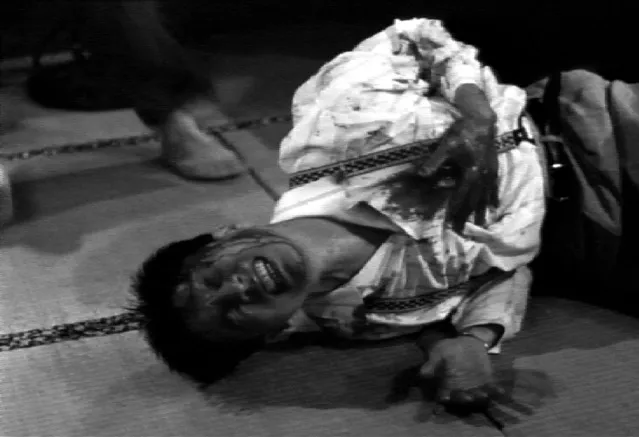
Ah-ga attacked by the Shanghaiese gangsters
Second, Hou sets up a series of formal and dramatic tensions that outlines the parameters of the narrative structure. On the soundtrack the main opposition is between the voice of history (here represented by Hirohito) and the voices coming from this private, intimate sphere that are, in Hou’s films as well, usually entrusted to women. However, since A City unfolds a polyphony of accents, dialects and utterances, it presents a more complex reality than a mere male/female counterpoint. At the level of the image, a major source of tension – and dynamism – is the constant interplay between emptiness and fullness, darkness and colour, light and darkness – how light is born out of the dark, colour out of the black and the void out of things themselves. These tensions spring, on the one hand, from Hou’s aesthetic choices as they have been informed by Chinese and Japanese traditions and, on the other, from the opposition the film is drawing between the warmth of family life and the harshness of historical events. Later, Wen-heung will accurately describe the place and time the protagonists live in: ‘How pitiful we are living on this island! First it is the Japanese, then the Chinese. Eaten by everyone, ridden by everyone, sympathized by no-one.’9
Taiwan’s ‘tragedy’ lies in its uneasy relationship with the mainland, defined from the onset by fascination, hope, exile, invasion, civil war and estrangement. A small but lush island off the south-east coast of China, facing Fujian province, Taiwan was originally populated with South Pacific (Malay) aborigines. In the fifteenth century, Chinese immigration started, composed mainly of Hakka (a population of immigrants from the north, speaking their own dialect, which had fled to the provinces of Guangdong and Fujian to escape persecution) and Fujianese (whose dialect, slightly corrupted, became the Taiwanese language). In 1517 Portuguese sailors landed on the island, and called her ‘Formosa’ (‘the beautiful one’). In 1624 the Dutch occupied it, but were ousted by the young general Cheng Chengkun (Koxinga) in 1661. A partisan of the Ming Dynasty, Cheng had been forced to retreat by the Manchu army and was hoping to use Taiwan as a strategic base to regroup his forces. Instead, he died a year later; in 1682, the Manchu captured the island, and turned it into a province of the Middle Empire in 1887.
In 1894, the (in)famous Dowager Empress CiXi started – and lost – a war against Japan and, a year later, signed the treaty of Shimonoseki, which included among its terms the surrender of Taiwan to Japan. In the next 50 years, Taiwan underwent a rigorous occupation. Thousands of Japanese settlers – soldiers, administrators, businessmen – arrived on the island, where they imposed the Japanese language. While mercilessly suppressing any hint of an uprising, the occupying forces attempted to ‘Japanise’ the inhabitants, forcibly but efficiently developing the economy, spreading literacy through a government-supported school system – thereby creating a situation of colonial hybridity, love–hate and interdependency whose effects are still felt today. Feeling abandoned by a distant Chinese power, many Taiwanese found a new identity in the culture of the occupying forces; Japanese became the lingua franca for at least three generations, and elements of Japanese architecture can be found throughout the island.
In the first half-hour of A City, Hou delicately suggests the traces left by the Japanese occupation in staging an encounter between the young nurse Hinomi and her Japanese friend Shisuko, as the latter is waiting to be repatriated back to Japan with her elderly father, Mr Ogawa, the former principal of the Japanese school. The episode, which contains the first flashback of the film, is bracketed within two similar shots showing, in a wide angle and from the inside of the building, the entrance of the Miners’ Hospital where Hinomi works. As discussed later (see Chapter Four), these images, which recur regularly throughout the film, belong to the category of visual motif shots.
At the beginning of the sequence, Shisuko is seen walking through the centre of the hospital gate, carrying a sword and a package wrapped in a saffron cloth; in that space, due to the protruding shape of the sword on both sides of her body, her silhouette suggests the shape of a cross. This striking image marks a sharp contrast with the visual motif shot closing the sequence, in which four men, most of them gangsters, c...
Table of contents
- Cover Page
- Title Page
- Contents
- Acknowledgments
- Note on Chinese Names
- 1. Chinese History Is Made at Night
- 2. A Family in the Wind of History
- 3. A Polyphony of Voices
- 4. Lost Spaces
- 5. An Aesthetic of the Fleeting Moment
- Appendix 1: The Lin Family Genealogy
- Appendix 2: Filmography
- Notes
- Credits
- eCopyright
Trusted by 375,005 students
Access to over 1.5 million titles for a fair monthly price.
Study more efficiently using our study tools.
Frequently asked questions
Yes, you can cancel anytime from the Subscription tab in your account settings on the Perlego website. Your subscription will stay active until the end of your current billing period. Learn how to cancel your subscription
No, books cannot be downloaded as external files, such as PDFs, for use outside of Perlego. However, you can download books within the Perlego app for offline reading on mobile or tablet. Learn how to download books offline
Perlego offers two plans: Essential and Complete
- Essential is ideal for learners and professionals who enjoy exploring a wide range of subjects. Access the Essential Library with 800,000+ trusted titles and best-sellers across business, personal growth, and the humanities. Includes unlimited reading time and Standard Read Aloud voice.
- Complete: Perfect for advanced learners and researchers needing full, unrestricted access. Unlock 1.5M+ books across hundreds of subjects, including academic and specialized titles. The Complete Plan also includes advanced features like Premium Read Aloud and Research Assistant.
We are an online textbook subscription service, where you can get access to an entire online library for less than the price of a single book per month. With over 1.5 million books across 990+ topics, we’ve got you covered! Learn about our mission
Look out for the read-aloud symbol on your next book to see if you can listen to it. The read-aloud tool reads text aloud for you, highlighting the text as it is being read. You can pause it, speed it up and slow it down. Learn more about Read Aloud
Yes! You can use the Perlego app on both iOS and Android devices to read anytime, anywhere — even offline. Perfect for commutes or when you’re on the go.
Please note we cannot support devices running on iOS 13 and Android 7 or earlier. Learn more about using the app
Please note we cannot support devices running on iOS 13 and Android 7 or earlier. Learn more about using the app
Yes, you can access A City of Sadness by Berenice Reynaud in PDF and/or ePUB format, as well as other popular books in Media & Performing Arts & Film History & Criticism. We have over 1.5 million books available in our catalogue for you to explore.