- 216 pages
- English
- ePUB (mobile friendly)
- Available on iOS & Android
eBook - ePub
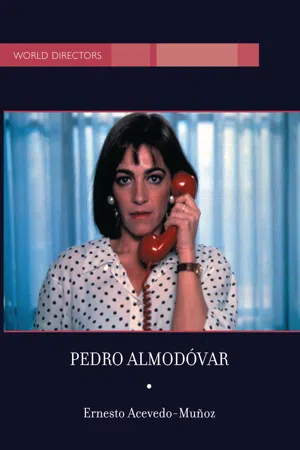
Pedro Almodovar
About this book
The book provides a detailed introduction to the essential themes, style, and aesthetics of Pedro Almodovar's films, put in the context of Spain's profound cultural transitions since 1980. With precise and close analysis, the book covers the major concerns of the most successful of all Spanish film directors and makes direct, clear connections to the logic of Almodovar's aesthetic and stylistic choices. By spanning the entirety of Pedro Almodovar's feature making career, the book emphasizes the director's sensibility to make the outrageous believable and to always give a unique spin to the issues Spanish history, culture and identity. A detailed and comprehensive approach to all of Pedro Almodovar's feature films from the outrageous 1980 'Pepi, Luci, Bom and Other Girls on the Heap' to the sophisticated 2004 'Bad Education', this book provides more than an introduction an intimate look at the topics, style, aesthetics and cultural sensibilities of Spain's most distinguished and celebrated film director since Luis Bunuel. By focusing on a film-by-film, and often scene-by-scene analysis, this book offers a meticulous interpretation of characters, situations, allusions and cultural intersections, as well as emphasizing the meaning and weight of cultural, historical and social contexts. The book traces the evolution of Almodovar's career, from the perspective of aesthetic, narrative and stylistic concerns and places those changes in the logical context of Spain's historical trajectory from the end of Franco's dictatorship to the transition to democracy, exploring Almodovar's interest on issues of identity, sexuality, and nationalism.
Information
One
The Aesthetics of Bad Taste
‘In this country, with so much democracy, I don’t know where we are going to end . . .’
Pepi, Luci, Bom and Other Girls on the Heap (1980)
Pedro Almodóvar’s exploration of identity, sexuality and politics in Spain began with the outrageous, underground midnight show hit Pepi, Luci, Bom y otras chicas del montón (1980) which translates better as“. . . and other ordinary girls”. The movie’s plot was based on one of Almodóvar’s own comic books about Madrid’s self-proclaimed punk avant-gardemovement, ‘la movida’. Influenced by 1960s’ British youth culture, la movida was a coincidence of interests in punk fashion and music, in conspicuous consumption of drugs and alcohol (aided by laws allowing private and public consumption of soft drugs), and the opening and popularisation of many venues, recording labels and radio stations catering to the wants and tastes of youth and its music. Described by Mark Allinson as a youth culture ‘frenzy’, la movida was based on the possibility of heretofore repressed means of expression in music and fashion, that eventually led to the adoption of its ‘playfully transgressive’ practices by photography, painting, theatre and films.1 Thus, the period between 1980 and 1984 saw the rise of punk bands such as Radio Futura, Tos (Cough) and Alaska y Los Pegamoides, and the musical act of Almodóvar and McNamara, later seen in Labyrinth of Passion. As Allinson concludes,
The early films of Pedro Almodóvar are products of this artisan culture of production . . . . But they are also a mirror of their times, portraying an era in which everyone had multiple creative projects, lots of free time, no responsibilities and few political convictions, as well as generous helpings of sex, alcohol and drugs.2
However, even this early in his feature-making career Almodóvar’s themes appear to be firmly in place: the fictional universe that traverses his films from Pepi, Luci, Bom to Bad Education and Volver has shifted in form and in structure, but is consistent, even logical in its content. Almodóvar’s first feature film opens with a credit sequence in which we see hand-drawn ‘likenesses’ of the principal characters that express the director’s early attempt at elaborating a true aesthetics of bad taste, based on Almodóvar’s own comics. Almodóvar’s characters and dramatic situations are introduced as caricatures: exaggerating features, narrative plausibility and emphasising marginality. From its opening shot Pepi, Luci, Bom reveals its deceptively simple yet irreverent approach to making meaning and to film-making itself. The first image is a badly framed and over-exposed shot of an ordinary apartment building which jerkily tilts down into the same room from which it is being shot, in the process revealing a large number of marijuana plants by the sill. The take continues as the camera moves into the bedroom to show Pepi (Carmen Maura) lying on a rug as she glues magazine pictures into a scrapbook. Pepi listens to a loud women’s rock-and-roll band (Little Nell) while flipping through a movie magazine: a picture of Christopher Reeve as Superman in mid-flight catching her attention. The shot, with all its apparent clumsiness and simplicity is surprisingly interesting; it establishes the strident visual style of the movie, introduces the protagonist and presents Almodóvar’s first media intersections in the forms of the Little Nell song and the magazine pictures of an American movie star. Aman ringing the doorbell and knocking at the door impatiently interrupts Pepi. When she opens the door the man, who is in street clothes, flashes a police badge, turning her smile into a look of concern. The policeman (Félix Rotaeta) lives across the patio and is angry about the clearly visible marijuana plants. An incongruous high-angle shot of Pepi displays her naivety. ‘Lonely, aren’t they?’, she asks with a flashy smile. This shot is then juxtaposed with the reverse shot of the policeman from a low angle, their power relation literalised. Angered by her evasiveness, he barks out: ‘Do you think I suck my thumb?’ Pepi lifts her skirt, exposes her crotch and asks: ‘Speaking of sucking what do you think of this little rabbit stew?’ Pepi (who is eighteen years old) and the policeman agree to the exchange of sexual favours if she moves her plants away from the window. But the deal soon sours. Pepi only agrees to anal intercourse because ‘I’m still a virgin and I don’t want to lose my honour just yet’. But the man refuses and violently penetrates her vaginally, while they both still have their clothes on. She screams and unsuccessfully tries to fight off the rapist-policeman, to no avail. Thus, five minutes into his feature-making career Almodóvar introduces rape to his repertoire of narrative tools: the trauma of sexual violence paired with a masculine figure of authority.
In Almodóvar’s films sexual violence is often treated as an allegory of Franco’s repressive regime and state apparatus. While one can argue that Almodóvar’s characters act as if Franco had never existed, in 1980, when Pepi was released, Spain’s young democracy was historically too close to the preceding forty years of a Fascist regime. Pepi’s rage about her rape, like the sexual violence traumas of so many characters in Almodóvar’s films, appears at the beginning and at the centre of Pepi’s narrative arc as a character; it conditions and mediates all her actions in the movie. The second sequence of the movie opens with a hand-drawn cartoon intertitle, accompanied by Rimsky-Korsakov’s ‘Capriccio Español’ in the soundtrack, stating, ‘Pepi was thirsting with revenge’. Although playful and funny, the title page, setting up the comic book motif, is significant in establishing the themes of authority and sexual violence at the centre of the story, and the character’s recovery from that trauma as the narrative pretext. The pattern established in Almodóvar’s first feature of treating traumatic sexual encounters, abuse and repressive authority figures as partially analogous to Spain’s troubled past under Franco evolves visibly throughout his career, as we will see in the rest of this book, but the essential elements remain constant in Labyrinth of Passion, Dark Habits, What Have I Done to Deserve This!? and all his films up to All About My Mother, Talk to Her and Bad Education. In its own clumsy, kind of naive way, in Pepi Almodóvar treats the topic literally, which is consistent with the idea of ‘the aesthetics of bad taste’ that his films of the first half of the 1980s continually pursue. While Almodóvar’s style and aesthetics became increasingly sophisticated in the following two decades, the core themes remain visible from Pepi, Luci, Bom to Bad Education.
In the next sequence, temporally displaced, Pepi paces her apartment, flamboyantly dressed, nervously smoking a cigarette. She looks out of the window and her action is followed by a jerky panning shot across the apartment building’s interior court, suggesting that she is looking for the rapist’s apartment. But the shot is clearly disengaged from her point of view or angle of vision, violating the continuity of time and space essential to classical film narrative and editing. The shot then incongruously cuts to Pepi on the street, pacing in front of the apartment building, apparently stalking the rapist neighbour. Violating again classical relations of time and space, we see Pepi walking down the street, screen left to right (although she had just been seen looking right to left) and entering a building with a hand-painted number on the entrance. Inside the dark, dirty building Pepi enters an apartment where a punk band are rehearsing a song. Pepi’s friend Bom (Olvido Gara ‘Alaska’) plays the second guitar and gives Pepi an acknowledging wave. The scene is poorly lit, with harsh shadows on the walls and over the actors. In the course of the scene Pepi proposes to the band that they beat up the rapist neighbour in exchange for her marijuana plants. The lead man/bass player agrees to the deal in a thick central-Madrid, working-class accent. The attack takes place at night, on the street, and Pepi curiously wears a sort of faux flamenco outfit consisting of a long, loose skirt, polka-dotted blouse and a white silken stole. The band of attackers is dressed in chulapo costumes, a ‘typical’ popular Madrid style, with grey pants, black vests and white ascots. The significance of the disguises is that they suggest Spanish clichés of rebellion against the authority figure while he repeatedly screams ‘Not on the balls!’. Continuing the folkloric theme, during the beating, two of the attackers sing a zarzuela song, the popular Spanish style of operetta. Pepi is sexually aroused by watching the beating and begins rubbing herself against the corner of a building. Ultimately the scene of brutal violence is undermined by the comic use of Spanish clichés and the open threat to patriarchal authority in the reference to the victim’s testicles. Almodóvar’s career is full of such cultural appropriations of kitsch Spanish themes, which are often subverted, ridiculed or rescued from their folkloric function.3
In an improbable plot twist we soon learn that the presumed rapist of the previous scene is actually the policeman’s twin brother. Identity games, confusions, flexibility and crises are common in Almodóvar’s films, and the plots of several of his early movies, including Labyrinth of Passion and What Have I Done to Deserve This!? turn around such concerns. The innocent twin complains about how he always ends up paying for his brother’s wrongdoings. The guilty brother replies with a telling non sequitur: ‘In this country, with so much democracy, I don’t know where we are going to end. If that had happened to me, I’d have taken out my gun and shoot them dead.’ The policeman’s statement is both harrowing and hysterical: the fragility of Spain’s newfound democracy in this transitional phase, while the wounds of Franco’s regime were still open and bleeding, the country’s frenetic rush into democracy was accompanied by the relaxation of formerly repressive laws governing social and political relations and strictly censoring all forms of media. In the mid-1970s, films, magazines, books and television were suddenly thrust into a permissive phase where violence and sexual content was gradually allowed. The policeman’s remark then, has a dual meaning. On the one hand, it refers directly to his Fascist past and his resentment of the political and expressive freedoms championed by King Juan Carlos and instituted by the cortes soon after Franco’s death in late 1975.4 On the other hand, it also touches upon the novelty of democracy itself, the uncertainty of the country’s political, social and economic future that was still quite fragile and unpredictable in 1980. This Fascist, pro-Franco, anti-democratic character is also criminal, misogynistic and abusive, verbally and physically, to his wife, the title character Luci (Eva Siva.) The policeman is the first of a long line of such patriarchal figures in Almodóvar’s career, appearing to varying degrees in almost all his films. In Pepi, Luci, Bom however, the sadistic male character is paired with a masochistic wife. After Luci and Pepi meet each other on the street and become friends, Luci confesses that she married the policeman because she thought that he would ‘treat [her] like a bitch’.
Pepi’s search for revenge against her rapist is the trigger for her unexpected friendship with his wife, Luci. Under the pretext of knitting lessons, Pepi and Luci meet. Almodóvar introduces a new cartoon title card reading: ‘The next morning Pepi gets her next lesson’. The title card is accompanied this time by a few bars from Bernard Herrmann’s musical score for Hitchcock’s Psycho (1960): the first of many Hitchcock references in Almodóvar films that reach their peak in Women on the Verge of a Nervous Breakdown. Nearly all the social and sexual relationships portrayed in Pepi, Luci, Bom aremediated by violence whether it be physical, sexual or psychological. In fact, Pepi and Luci’s blossoming friendship over the knitting lessons and their mutual hatred of the husband-rapist also involves an agreement that Pepi will physically beat Luci every time she drops a stitch, which in turn reveals Luci’s deep rooted masochism; the physical violence results in sexual arousal. ‘That’s why I married him’ Luci confesses, ‘I though that him being a cop, he’d treat me like a bitch. But he respects me as if I were his mother.’ Pepi, who was a virgin hoping to sell her virginity for 60,000 pesetas is infuriated because the rape has spoiled her plans. Meanwhile Luci becomes fast friends with the bandleader Bom, the sixteen-year-old lesbian who woos her with a beating and a golden shower.

‘Treat me like a bitch’: ‘Alaska’ and Eva Siva in Pepi, Luci, Bom and Other Girls on the Heap
In this early stage of his feature-making career bodily fluids, excrement (in Labyrinth of Passion) and later semen (in Kika) are all clearly shown in Almodóvar’s movies. It was all part of Almodóvar’s aesthetics of bad taste, which responded directly to Spanish cinema’s newfound freedom of expression after the abolition of the strict censorship laws in place under Franco. Bom, the tough girl with the butch side talks dirty to Luci who sincerely appreciates it. The three women’s relationships are based on sexual power, ‘perversion’ and an apparent shared hatred of men. By comparison, Luci’s policeman husband is a devout misogynist with a ‘Franquista’ past with a particular distaste for ‘independent women’. Almodóvar presents us with a cast of characters who represent opposing political extremes: on the one hand, a caricature of Spain’s recent past under Franco and on the other hand, an exaggerated portrait of what ‘freedom’ and ‘so much democracy’ meant for his generation, whose members grew up traumatically repressed yet were to attain all sorts of personal and public freedoms. The transition itself seems traumatic for the characters in Pepi, Luci, Bom and his other films made between 1980 and 1986. Part of Almodóvar’s strategy is to take the ‘underground’ characters of his earlier career as a magazine illustrator and columnist (such as Bom’s world of musicians, southern immigrants and loud music) and transfer them from the margins to the centre, placing them ‘over ground’.
The world of Pepi, Luci, Bom and Other Girls on the Heap emphasises the potentially traumatic transition from an authoritarian regime to democracy, and from marginality to centrality, while presenting us with one of Almodóvar’s most consistent themes and one that ultimately has emerged as the most recurring of his authorial arch: the reconstitution of ‘the family’. The characters of Pepi, Luci, Bom are organised as a type of underground microcosm where ‘paper-thin’ types of characters are offered as representations of a number of sectors of Madrid society, as they go about their business in-and-out of ‘marginality’. Thus for instance, the large complex of buildings where Pepi’s flat is found offers us ‘an inside look’ (as we see in the first scene when the rapist-policeman is spying into Luci’s apartment from the opposite side of the building) into assorted segments of the city and its people. For instance, across the central yard lives a married couple composed of a drunken, falsetto-voiced, mustachioed woman and her closet homosexual husband. Paradoxically, the woman constantly nags her husband for his drunkenness, his homophobia and for not having sex with her ‘for forty days and forty nights’, a clear reference to the Catholic period of Lent. But in a parallel sequence, some of the other neighbours already know the closeted man and refer to him as ‘an old queen with money’ (carroza) who customarily engages young men as prostitutes. There is a whole sexual underground contained within this compact neighbourhood and the parallel sequences, bridged by audible party music coming from the central yard, emphasise their similarities, despite appearances.
The sequence thus maintains simultaneity of time and space underscoring the contrast of ‘in–out’ betweenthe closeted, married man with bourgeois pretensions, and the ‘out’male prostitute making a living on the margins of society. In spite of their ‘average’ lives, it is the married couple that come out looking like the ‘weird’ ones in the world of Pepi, Luci, Bom. The couple’s unbearable life and non-stop bickering are contrasted sharply with the party outside where Bom and Luci reach a relationship landmark: Bom extracts a booger fromLuci’s nose and orders her to eat it, which she does submissively. As a pattern, submission, violence and the centralisation of formerly marginal characters and situations seem to mediate all relationships in Pepi, Luci, Bom. Allusions to Spain’s cultural ‘past’ however, constantly emphasise ...
Table of contents
- Cover
- Title Page
- Dedication
- Contents
- Acknowledgments
- Introduction: Almodóvar’s Cinema in Context
- 1: The Aesthetics of Bad Taste
- 2: Memory, Identity and Style
- 3: Figures of Desire: The Melodrama of Longing
- 4: The Body and the Nation
- Conclusion: Bad Bodies, Good Hearts
- Notes
- Bibliography
- Filmography
- List of Illustrations
- Index
- eCopyright
Trusted by 375,005 students
Access to over 1.5 million titles for a fair monthly price.
Study more efficiently using our study tools.
Frequently asked questions
Yes, you can cancel anytime from the Subscription tab in your account settings on the Perlego website. Your subscription will stay active until the end of your current billing period. Learn how to cancel your subscription
No, books cannot be downloaded as external files, such as PDFs, for use outside of Perlego. However, you can download books within the Perlego app for offline reading on mobile or tablet. Learn how to download books offline
Perlego offers two plans: Essential and Complete
- Essential is ideal for learners and professionals who enjoy exploring a wide range of subjects. Access the Essential Library with 800,000+ trusted titles and best-sellers across business, personal growth, and the humanities. Includes unlimited reading time and Standard Read Aloud voice.
- Complete: Perfect for advanced learners and researchers needing full, unrestricted access. Unlock 1.5M+ books across hundreds of subjects, including academic and specialized titles. The Complete Plan also includes advanced features like Premium Read Aloud and Research Assistant.
We are an online textbook subscription service, where you can get access to an entire online library for less than the price of a single book per month. With over 1.5 million books across 990+ topics, we’ve got you covered! Learn about our mission
Look out for the read-aloud symbol on your next book to see if you can listen to it. The read-aloud tool reads text aloud for you, highlighting the text as it is being read. You can pause it, speed it up and slow it down. Learn more about Read Aloud
Yes! You can use the Perlego app on both iOS and Android devices to read anytime, anywhere — even offline. Perfect for commutes or when you’re on the go.
Please note we cannot support devices running on iOS 13 and Android 7 or earlier. Learn more about using the app
Please note we cannot support devices running on iOS 13 and Android 7 or earlier. Learn more about using the app
Yes, you can access Pedro Almodovar by Ernesto R. Acevedo-Munoz in PDF and/or ePUB format, as well as other popular books in Media & Performing Arts & Film History & Criticism. We have over 1.5 million books available in our catalogue for you to explore.