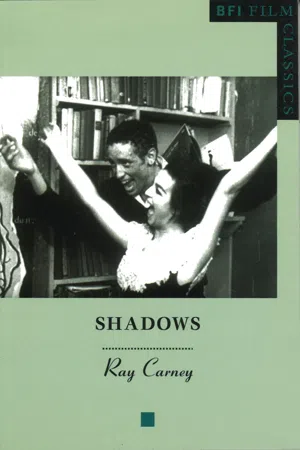
Shadows (1959), John Cassavetes' first film as director, ends with the title card - 'The film you have just seen was an improvisation'. Just before his death, however, Cassavetes confessed to Ray Carney something he had never before revealed - that much of his so-called 'masterpiece of improvisation' was actually written by him and Robert Alan Aurthur, a professional Hollywood screenwriter.
In the ten years that followed Carney tracked down all of the surviving members of the cast and crew in order to piece together the true story of the making of Shadows. This book is the result of that research. Carney takes the reader behind the scenes to follow every step in the creation of the film - chronicling the hopes and dreams, the struggles and frustrations, and the ultimate triumph of their collaboration on one of the seminal masterworks of American independent film-making.
eBook - ePub
Shadows
About this book
Information
‘SHADOWS’
. . . . . . . . . . . . . . . . . . . . . . . . . . .
‘The film you have just seen was an improvisation’
In the spring of 1960, John Cassavetes was a young actor who had played a series of undistinguished roles in a string of low-budget B-movies and television shows. Six months later, he was being hailed as one of the most promising directors in the world. In July, his first film, Shadows, played to standing-room-only audiences at the National Film Theatre’s ‘Beat, Square and Cool Festival’. In August, it played out of competition at the Venice Film Festival and received a special critics’ citation. In September, it played at a special screening at the Cinémathèque Française in Paris, where approximately a thousand people were turned away from the box office. In early October, it played in the London Film Festival, to rave reviews and a sustained ovation from the audience. And a week later, on 14 October, it opened at London’s Academy Cinema, playing to capacity crowds and taking in more money than any film in the theatre’s twenty-five year history.
Cassavetes attended the opening with members of the cast and crew, and was over the moon with delight. His 16mm movie, made for $40,000 with unknown actors (none of whom had ever played an important film role before) was hailed by one critic as ‘a major breakthrough in the art of the cinema’. Another wrote: ‘I unhesitatingly pronounce Shadows the most artistically satisfying and exciting film I have seen in a decade’. Newspapers from The Times and Observer to the Daily Mirror and Daily Express ran laudatory reviews, and the most important film magazine of the era, Sight and Sound, devoted sections of three successive issues (autumn 1960, winter 1960–1, and spring 1961) to discussions of the film and an interview with the film-maker.

What most captivated the critics was the spontaneity and speed with which the movie had been made. Shadows itself ended with the declaration: ‘The film you have just seen was an improvisation’, and the press pack proudly proclaimed: ‘Not one word of [the] dialogue was written. Not one scene was detailed in script.’ It described how the crew had ‘grabbed’ most of the footage on New York streets: ‘They concealed their camera in subway entrances, restaurant windows, the backs of trucks.’ When interviewers asked Cassavetes to tell them more, he not only bragged that the whole project had been accomplished in forty-two days and nights, but said that it could have been done even more quickly if he had not occasionally had to suspend work while his young actors went off to appear in other projects to earn money. He told them the sound was a little rough because it was completely ‘live’ – unlike a typical studio production, nothing had been looped or ‘faked’. Then he regaled them with stories like the one about how the police had tried to shut down the ‘outlaw’ production – at one point firing a gun over the actors’ heads to stop a scene.
What no one suspected was that it was a pack of lies. Most of Shadows was not shot on ‘location’ or on the streets of New York, but on a stage. No policeman had ever fired a gun at the actors – or over their heads. More than half of the sound was not ‘live’, but had been dubbed, looped or otherwise manipulated during the editing process. And, far from being a six-weeks’ wonder, Shadows had taken almost three years to make. Finally, notwithstanding the final title card, at least two-thirds of the film was not an improvisation, but was written by Cassavetes in collaboration with a professional Hollywood screenwriter. Every one of the scenes the critics praised in his ‘masterpiece of improvisation’ had been scripted.
‘I used to walk around angry all the time’ 1
To tell the true story of Shadows one must go back a decade before the London events, to March 1950 when Cassavetes graduated from the American Academy of Dramatic Arts (AADA). It was the beginning of years of unhappiness. The aspiring actor was completely unable to get meaningful work, spending his days futilely making the rounds of casting offices and his evenings hanging out with his two roommates, going to bars, and picking up women. It was a time of deep frustration and simmering anger. Cassavetes drifted, bar-hopped, and grew ever more bitter. As the fourth anniversary of his graduation approached, he had not played a single role with more than five lines of dialogue.
It wasn’t until the spring of 1954 that he got his first important job. His life radically changed in the next three years. His salary sky-rocketed to around $25,000 a year (equivalent to at least ten times that amount in contemporary dollars), he moved into an upper East Side penthouse, and by mid-1956 his acting career was successful beyond his wildest dreams of a few years before. But he was still angry and disillusioned. He felt the roles offered to him were clichés. Then there were the creative conditions – particularly in film. The entire production seemed to be arranged more for the convenience of the cameraman, the lighting technicians, and the focus pullers, than to allow the actor to give a decent performance. Scenes were broken up into short takes and close-ups, during which the other actors with whom Cassavetes would be nominally interacting might not even be present. Actors’ movements were constrained to hit lighting and focus ‘marks’. Finally, and most stifling of all, at least in Hollywood, was the size and bureaucratic sprawl of the production. When so many people were involved, it was impossible for any one individual to have very much creative input. The actor became a cog in a well-oiled machine.
At a point at which other actors might have been counting their blessings and dabbling in the stock market, Cassavetes looked at the future with dread. He dreamed of doing something freer, more creative and more daring; but he had no idea how to make it happen.
‘I found other people it drove crazy too’
As an actor you don’t get the freedom to function the way you’d like to. I know I never got the lines I wanted under other directors. I couldn’t stand the idea of sitting around for a couple of years waiting for the phone to ring. It drove me crazy. So I found other people that it drove crazy too, and we started working together. It saved me from going off the deep end.
In late 1955, Cassavetes and another unemployed AADA graduate named Burt Lane began a series of impromptu gatherings with actor friends to read scenes a couple evenings a week. It was fun and the two men got the idea to rent a regular space to meet. After a little shopping around, they settled on the Variety Arts building, which was located in a low-rent section of Manhattan between Broadway and 8th Avenue at 225 West 46th Street. Though the space is now a parking lot, at the time it was a dilapidated four-storey building given over to rehearsal rooms. Cassavetes and Lane started in a couple of rooms on an upper floor, but shortly afterwards moved down to the ground floor, which was empty and available for around $800 a month. In the spring of 1956, they moved in and announced the opening of the ‘Cassavetes-Lane Drama Workshop’.
A personal event conspired to push Cassavetes into the project. In October 1955, his wife, Gena Rowlands, began preparing for her Broadway début playing opposite Edward G. Robinson in Paddy Chayefsky’s The Middle of the Night. From December on, she was absolutely consumed with preparations, and from February 1956 on, was on stage almost every single evening and several afternoons a week.2 Cassavetes got tired of sitting home alone or in bars. The workshop would be something to do in the evenings.
There was a lot of work to be done. When they moved into the ground floor, it was a complete wreck. Lane and a handful of so-called ‘students’ (who were mainly just friends and other hangers-on) spent months cleaning up the space, erecting walls to divide it into smaller units, and building a raised rehearsal stage in the newly created front room. It was all extremely small, dirty and dingy – ‘a real New York space!’ in the words of one of the actors from California. The stage was tiny, interrupted at one end by a stanchion that supported the floor above, had a ceiling only 15 ft. high (meaning there were no flies for scenery or curtains to be drawn up into), and was illuminated by a single spotlight hanging from the ceiling. Lane arranged four rows of folding chairs in front to seat a maximum audience of approximately thirty, which was at that point at least twenty more than they needed. By erecting interior walls, Lane and his helpers created three or four smaller rooms, which would eventually be used as a second classroom, a front office and an editing suite once Shadows got underway. Nothing was soundproofed, so the thumps of dance classes on the floors above reverberated throughout the workshop all day long.
Workshop meetings were extremely informal. Cassavetes, Lane and the young actors got together only a few evenings a week, with many hiatuses: for example, in the spring of 1956, when both Cassavetes and Lane went to Cuba to work on Affair in Havana for six weeks, and in the summer of 1956, when Cassavetes went off to act in regional theatre in Connecticut, the workshop simply shut down. The understanding was that as a ‘name’ actor and a draw, Cassavetes would teach a ‘professional’ class and Lane the ‘intermediate’ and ‘beginner’ classes. Although the two men did their best to drum up students, and practically begged everyone they knew to attend, only a few friends took them up on the offer – so that the initial groups consisted of only about ten members each, none of whom had very much prior experience. Even those in Cassavetes’ ‘professional’ group, who would later become the nucleus of Shadows’ cast, were not really ‘professionals’.

A Cassavetean joke from Staccato. At 6 minutes and 45 seconds into Shadows, Ben walks exactly where Cassavetes does here
Cassavetes did everything he could to build up membership of his group, and was not above a certain amount of deceit to do it. He was full of vague promises about getting his students agents and work. He attempted to entice friends to join his group by suspending tuition fees and telling them that he wanted them to be teachers, not students. Hugh Hurd and Tony Ray both told me they came in believing that they could offer acting classes. Lelia Goldoni, who had studied with Lester Horton, was told she could teach dance and movement. Cassavetes told a recent graduate of Sanford Meisner’s Neighborhood Playhouse, Tom Gilson, that he would pay him to fill in for him when he too busy acting to teach. The promises were conveniently forgotten once everyone showed up. But if it came down to who was using whom, it worked both ways. The members of Cassavetes’ group joined more out of a hope that the connection with him might lead to a paying job than out of a desire to take classes with him.
Cassavetes saw no conflict between the two goals. Personal development and professional advancement could go hand in hand. His idea was periodically to showcase his young actors’ talents in front of invited groups of agents, producers and directors. The Actors Studio did it; but unfortunately when he and Lane tried to do the same thing, it was a complete flop. Phone calls were made; letters were written; but no one showed up but the actors. Cassavetes discovered he simply did not have the drawing power that Strasberg did. The Actors Studio had nothing to fear from the Variety Arts workshop.
Madness and the Method
The contrast with the Studio stung Cassavetes all the more, since he had both personal and intellectual differences with Strasberg. He was resentful about the power the Studio exerted over New York casting directors and was convinced that his not being an alumnus was what had prevented him from being hired early in his career. He was also scornful of what he called the ‘guru’ aspects of the Studio, and despised the cult of personality that had grown up around Strasberg (scorning it as only someone half envious of it would). Cassavetes and Lane pointedly described their own approach to students as being ‘anti-guru’. Cassavetes believed that although figures like Clift, Brando and Dean had had a salutary influence on acting in the late 1940s and early 50s, by the middle of the decade the Method had hardened into a received style that was as rigid, unimaginative and boring as the styles it had replaced ten years earlier. The slouch, shuffle, furrow and stammer had been turned into recipes for profundity.
Acting as Playing
As luck would have it, shortly after the workshop got underway, Cassavetes was invited to audition for the Actors Studio.3 But instead of being flattered, he was irritated, since he felt that when he had needed the Studio five years earlier, it would not talk to him, but now that he was successful it was suddenly interested. He decided to play a trick on Strasberg. He brought Lane along to the audition and told Strasberg the two men were going to do a scene from a new play entitled Bill Bower’s Boys about two black siblings ‘passing’ for white. But there was no play. Cassavetes and Lane simply improvised a scene on the spot (after having done a single quick run-through earlier that morning).
To Cassavetes’ delight and Lane’s amazement, Strasberg fell for the ruse. He believed the story, loved the piece and performance, and offered Cassavetes immediate admission to the Studio. Cassavetes then sprang the second part of the trap. He told Strasberg a sob story about how little money he had and that he could not afford to attend. When Strasberg agreed to give him a scholarship, Cassavetes gleefully revealed it all, and told Strasberg that he was not interested in studying under someone who obviously knew nothing about acting, since he couldn’t see through any of the lies that had been inflicted on him.
It was a typical Cassavetes prank, but it also summed up the philosophical difference between his approach to acting and Strasberg’s. The Studio’s sense of acting was that it was something serious, laboured and earnest. Cassavetes’ understanding was that acting was a form of play. It could be zany, comical and madcap. In Strasberg’s vision, the theatre was a church; in Cassavetes’, it was a playground. While the Actors Studio specialised in moody, broody anguish, Cassavetes felt that acting was fundamentally an expression of joy and exuberance.
The Mask of Personality
There was another difference between Strasberg on the one hand and Lane and Cassavetes on the other. As Lane told an interviewer in 1958, the problem with the Method was that:
In focusing on core emotions, it removed the masks of the characters and deprived them of personalities. In real life, we rarely act directly from our emotions. Feeling is simply the first link in a chain. It is followed by an adjustment of the individual to the situation and to the other people...
Table of contents
- Cover Page
- Title Page
- Contents
- Acknowledgments
- ‘Shadows’
- Appendix: A Comparison of the Two Versions of ‘Shadows’
- Notes
- Credits
- eCopyright
Trusted by 375,005 students
Access to over 1.5 million titles for a fair monthly price.
Study more efficiently using our study tools.
Frequently asked questions
Yes, you can cancel anytime from the Subscription tab in your account settings on the Perlego website. Your subscription will stay active until the end of your current billing period. Learn how to cancel your subscription
No, books cannot be downloaded as external files, such as PDFs, for use outside of Perlego. However, you can download books within the Perlego app for offline reading on mobile or tablet. Learn how to download books offline
Perlego offers two plans: Essential and Complete
- Essential is ideal for learners and professionals who enjoy exploring a wide range of subjects. Access the Essential Library with 800,000+ trusted titles and best-sellers across business, personal growth, and the humanities. Includes unlimited reading time and Standard Read Aloud voice.
- Complete: Perfect for advanced learners and researchers needing full, unrestricted access. Unlock 1.5M+ books across hundreds of subjects, including academic and specialized titles. The Complete Plan also includes advanced features like Premium Read Aloud and Research Assistant.
We are an online textbook subscription service, where you can get access to an entire online library for less than the price of a single book per month. With over 1.5 million books across 990+ topics, we’ve got you covered! Learn about our mission
Look out for the read-aloud symbol on your next book to see if you can listen to it. The read-aloud tool reads text aloud for you, highlighting the text as it is being read. You can pause it, speed it up and slow it down. Learn more about Read Aloud
Yes! You can use the Perlego app on both iOS and Android devices to read anytime, anywhere — even offline. Perfect for commutes or when you’re on the go.
Please note we cannot support devices running on iOS 13 and Android 7 or earlier. Learn more about using the app
Please note we cannot support devices running on iOS 13 and Android 7 or earlier. Learn more about using the app
Yes, you can access Shadows by Raymond Carney in PDF and/or ePUB format, as well as other popular books in Media & Performing Arts & Film & Video. We have over 1.5 million books available in our catalogue for you to explore.