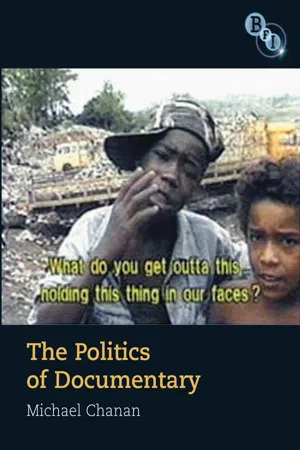
- 240 pages
- English
- ePUB (mobile friendly)
- Available on iOS & Android
eBook - ePub
Politics of Documentary
About this book
This wide-ranging study traces the history of the documentary from the first Lumiere films to Michael Moore's 'Fahrenheit 9/11'. Chanan argues that documentary makes a vital contribution to the public sphere - where ideas are debated, opinion formed and those in authority are held to account.
Information
1 The New Documentary Wave
On the return of documentary to the big screen in the times of digital video
I
The most unexpected turn in cinema over the last ten to fifteen years has been the return of documentary to the big screen. No one predicted it, but a stream of new feature documentaries has entered the cinema in small but growing number. Suddenly it seemed that documentary didn’t just belong on television any longer, and that documentaries in the cinema weren’t just oddities any more, and they didn’t only consist of nature spectaculars or ‘rockumentaries’, but a whole range of subjects: America’s predilection for gun violence (Bowling for Columbine), the practices of gleaners in France (Les Glaneurs et la Glaneuse), the portrait of a philosopher (Derrida), a children’s spelling competition (Spellbound); a rural French primary school (Être et avoir), a bus hijacking in Rio de Janeiro (Bus 174), a dysfunctional family in New York (Capturing the Friedmans); a game between two Danish film-makers (The Five Obstructions), a story of British mountain climbers in the Andes (Touching the Void).1 The different countries these titles come from – the USA, France, Brazil, Denmark and the UK – point to the international character of this new wave of films, and the phenomenon is even wider than this, with many films, through no fault of their own, failing to attain international distribution. Spain is a case in point, because here, for more than a decade, there has been a wave of documentaries entering the cinema which only achieve foreign distribution very selectively, but nonetheless include some of the finest and most interesting examples of the new documentary anywhere in the world – like El sol del membrillo (The Quince Tree Sun), the study of a painter at work on a canvas; Monos como Becky (Monkeys Like Becky), about the treatment of psychiatric disorders; and En construcción (Under Construction) about urban redevelopment in Barcelona.2
The re-emergence of documentary can be traced in the press. In Britain, for example, notwithstanding the success over the preceding few years of films like The Thin Blue Line, Roger and Me, In Bed with Madonna and Hoop Dreams,3 the leftwing weekly New Statesman was still writing back in 1996 about documentary as a ‘fringe pursuit for a few consenting adults’.4 Two years later, the liberal daily the Guardian was reporting that documentaries were emerging into cinema.5 Jump forward another five years and in 2003 a writer in the Telegraph, a rightwing daily, is asking ‘Why Truth Is Stronger Than Fiction’; and a year later, an editorial in the Guardian concludes that ‘Real Life Doesn’t Need a Script, Just Good Editing’.6 This is a real change in attitude, since not long earlier, in the first flush of postmodernist thought, sceptics and doubters were widely given to disparaging documentary on the grounds that its claims to authenticity rested on what was no more than an illusion of objectivity – and objectivity, it seemed, was no longer what it used to be, but rather another form of subjectivity. Hence it was said that documentary was actually biased and manipulative, and really just another form of fiction.
But this won’t do – it’s much too simple. First, because the reality effect of documentary is not just an illusion (or only in the trivial sense which is true of all cinema – the play of light on a screen). The documentary image has a quality or dimension that is different from fiction, because it carries a determinable link with the historical world. Fiction we know to be invented and set up for the camera, whereas documentary consists of scenes drawn from the social and physical world that exists independently of the camera – that is to say, the same world that the viewer moves around in and belongs to, not its imaginary double. In semiotic terms, the afilmic world. This, of course, is too schematic, because what you see in documentary is often contrived. Nevertheless, you can go and visit Michael Moore’s Flint, Michigan, but not Charles Foster Kane’s Xanadu; and indeed you can encounter Michael Moore, but Citizen Kane you could never meet face to face even when Orson Welles was alive. The Michael Moore you meet in the flesh may not be quite the same as the one on the screen – perhaps better for you if he isn’t – but if you visited the studio when Welles was on set, you would not be meeting Kane but Welles dressed up as Kane, who only exists on the screen. As Walter Benjamin wrote in ‘The Work of Art in the Age of Mechanical Reproduction’, in the studio, the ‘equipment-free aspect of reality . . . has become the height of artifice; the sight of immediate reality has become an orchid in the land of technology’.7 The camera is a mechanical (or now electronic) eye which automatically records whatever it’s exposed to – the profilmic scene – but in itself it cannot distinguish between a profilmic scene that is fictional and one that isn’t, a scene specially prepared or already existing. Certain documentary techniques depend on this lack of discrimination, which allows the practice of various forms and degrees of staging or reconstruction, and yet the referentiality of documentary is still of another order to fiction: it has historical reference. When you stage a fiction, in the studio or on location, you are suspending time and day and entering a temporality belonging to the narrative to which the scene belongs. When you film a documentary, what you capture in the camera is a moment grabbed from the day and time given by the calendar and the clock. Although it’s true that this is frequently manipulated and often obscured in the course of editing to fit the temporality demanded by the argument of the film.
Of course the documentary representation is imbued with all sorts of filmic qualities brought to it by the film-maker. It is always already subject to the film-maker’s angle, perspective and artistry, which is to say that John Grierson, founder of the British documentary movement, wasn’t wrong to call it ‘the creative treatment of actuality’. But to discount the automatic function of the camera altogether and emphasise only the subjective part – the film-maker’s conscious and unconscious choices – is to fall into error. For one thing, in semiotic terms, this opposition between objective and subjective is false. The photographic image (we’ll come back to this) is both index and icon at the same time: an automatic rendering of the scene and a pictorial resemblance full of associations and connotations.
The documentary idiom, in the view of Dai Vaughan – a film editor reflecting on his medium – encourages us to believe that the fact one is seeing something amounts to evidence that it must have existed in the first place.8 In the case of fiction, this ‘existed in the first place’ is of the second order: it’s been placed there in order for the camera to capture it and make what it will of it. We know this as we enter the cinema, or wherever we nowadays settle down and invite the illusionism of the screen to envelop us. But with documentary, this illusionism is unstable. The scene spills out beyond the frame, it has no fixed place from which it has to be pictured, the camera jumps around, the editing displays little respect for continuous action and, worst of all, the film often insists on reminding us of the outside world we just left behind. It is partly a question of who and what is in front of the camera and how they behave – in fiction, an actor playing a character in a prepared setting according to a script; in documentary, social actors as themselves, generally in an unprepared environment and situations which are preferably unrehearsed.
The viewer can usually tell the difference pretty easily, but again it’s not quite as simple as that, and this is not a definition but a generalisation – and an expression of the documentarist’s desire. A watertight definition of documentary is effectively impossible – many people have tried to provide one and they all come unstuck, often because a film comes along which breaks the rules while clearly remaining documentary. It would be better to think of documentary in the same way that Wittgenstein taught us to think of forms of life like games, which come in families and are related by family resemblance. In one of the key concepts of the Philosophical Investigations, Wittgenstein urges us to look at how the members of a family share their features in various ways, yet none of these features is the single defining characteristic of family resemblance. Any two members of a family may share features with a third member – two grandchildren of different parents, say, who both have the same nose as their common grand- father – without looking anything like each other. What makes them members of the same family is their common genealogy. Wittgenstein applies the analogy to games, showing that there need be nothing in common between a cardgame, say, and a game in the playground. As you move from one type of game to another their attributes shift: ‘In ball games there is winning and losing; but when a child throws [a] ball at the wall and catches it again, this feature has disappeared.’ As we go through different examples, he says, we see how similarities crop up and disappear, ‘[a]nd the result of this examination is: we see a complicated network of similarities overlapping and criss-crossing: sometimes overall similarities, sometimes similarities of detail’. There is ‘no better expression’, he concludes, to characterise these similarities than ‘family resemblances’, ‘for the various resemblances between members of a family: build, features, colour of eyes, gait, temperament, etc. etc. overlap and criss-cross in the same way’.9 It needs only a moment’s reflection to see that the same can be said of artistic genres. A genre doesn’t consist of a set of rules but a family of works, some of which are treated as models or paradigms of the genre in question. But different examples of the genre may follow the same or different features in the same paradigm, and like the children of the same parents, they may not always resemble each other. Documentary, on this reading, comprises an extended family with its own different branches, where the films can be quite unlike each other – as different, for example, as the patient and impeccable observation of a Nicolas Philibert (Être et avoir) from the association of ideas which governs the montage in a characteristic film by Chris Marker, like Sans Soleil (Sunless, 1984), with its essayistic narration, or the performative political buffoonery of a Michael Moore (Roger and Me). Yet clearly none of these films is fictitious, and we readily call them all documentary.
In any case, the sceptic’s disparagement of documentary as peddling false objectivity is nowadays off target, because documentary has shifted its ground and become more individual and personal. There are still film-makers who practise rather strict forms of observational filming or third-person narrative – Être et avoir and En construcción are both examples – but many new-wave documentarists are given to flouting the traditional documentary stance of impersonality, and frequently insert themselves into their own films in a whole variety of ways, from Moore’s buffoonery, by way of the voice asking questions from behind the camera of Molly Dineen, to Varda’s pensive self-reflexivity. Consequently the truth they insist on telling no longer pretends to omniscience as it used to, and is no longer delivered as if from on high, but is told from an individual or personal point of view – which if anything makes them not less, but more persuasive.
The move towards subjectivity has been a growing trend since the 1970s, at any rate among the ‘consenting adults’ of the independent documentary movement which was mostly marginalised by television and rarely impinged on the working film critic except occasionally at film festivals. It is almost a mystery how this independent movement survived, since documentary was never at home in the major cinema circuits, and even shorts disappeared from the art-house circuit after the 1960s. Commercial interests generally regarded the form as either a filler or an interloper, best left to little alternative distributors who serviced the film-club minorities. Television, after initial hesitancy, had adopted documentary eagerly but imposed its own codes of compliance, especially in the matter of political ‘balance’, a code word for not upsetting the applecart of an assumed consensus. And yet, although mostly excluded from both cinema and television, works of artistic experiment and political agitation circulated through alternative distribution in 16mm throughout the...
Table of contents
- Cover
- Title Page
- Dedication
- Contents
- Preface and Acknowledgments
- Part I – Mapping the Field
- Part II – Historical Moments
- Part III – Contemporary Themes
- Index
- List of Illustrations
- eCopyright
Trusted by 375,005 students
Access to over 1.5 million titles for a fair monthly price.
Study more efficiently using our study tools.
Frequently asked questions
Yes, you can cancel anytime from the Subscription tab in your account settings on the Perlego website. Your subscription will stay active until the end of your current billing period. Learn how to cancel your subscription
No, books cannot be downloaded as external files, such as PDFs, for use outside of Perlego. However, you can download books within the Perlego app for offline reading on mobile or tablet. Learn how to download books offline
Perlego offers two plans: Essential and Complete
- Essential is ideal for learners and professionals who enjoy exploring a wide range of subjects. Access the Essential Library with 800,000+ trusted titles and best-sellers across business, personal growth, and the humanities. Includes unlimited reading time and Standard Read Aloud voice.
- Complete: Perfect for advanced learners and researchers needing full, unrestricted access. Unlock 1.5M+ books across hundreds of subjects, including academic and specialized titles. The Complete Plan also includes advanced features like Premium Read Aloud and Research Assistant.
We are an online textbook subscription service, where you can get access to an entire online library for less than the price of a single book per month. With over 1.5 million books across 990+ topics, we’ve got you covered! Learn about our mission
Look out for the read-aloud symbol on your next book to see if you can listen to it. The read-aloud tool reads text aloud for you, highlighting the text as it is being read. You can pause it, speed it up and slow it down. Learn more about Read Aloud
Yes! You can use the Perlego app on both iOS and Android devices to read anytime, anywhere — even offline. Perfect for commutes or when you’re on the go.
Please note we cannot support devices running on iOS 13 and Android 7 or earlier. Learn more about using the app
Please note we cannot support devices running on iOS 13 and Android 7 or earlier. Learn more about using the app
Yes, you can access Politics of Documentary by Michael Chanan in PDF and/or ePUB format, as well as other popular books in Media & Performing Arts & Film History & Criticism. We have over 1.5 million books available in our catalogue for you to explore.