- 329 pages
- English
- ePUB (mobile friendly)
- Available on iOS & Android
eBook - ePub
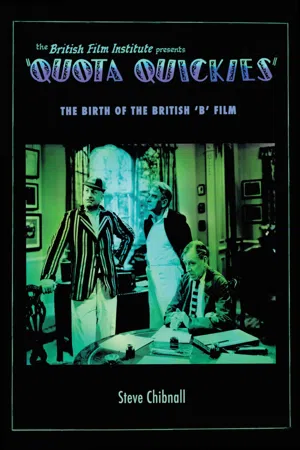
Quota Quickies
About this book
This book, the first of two volumes, will provide a major new history of the British B film, tracing the development of the low-budget supporting feature from the 1927 Films Act (which introduced a quota system for the distribution and exhibition of indigenous product) to the age of television, when B film producers channelled their energies into making TV programmes. Along the way, the authors will address leading producers and studios, B film stars, distributors, the genres and themes that tended to dominate B film production (comedy, horror, crime and fantasy). 'Quota Quickies' will include a case study of the B films of Michael Powell. The authors' argument is that the B film was hugely important in British cinema history in offering an opportunity for British actors and technicians to develop their careers, and that the films themselves provided an outlet for the exploration of peculiarly British cultural concerns in an industry traditionally dominated by Hollywood output. They also contend that some of the films stand up well to contemporary viewing and are deserving of critical re-evaluation.
Trusted by 375,005 students
Access to over 1.5 million titles for a fair monthly price.
Study more efficiently using our study tools.
Information
1
Protective Measures: The Quota Act
There appears to be a misguided opinion about this industry that there is a wish on the part of the producers to make greater and better films. We have not found that. What we have found is the wish to make money in this business.
T. H. Fligelstone, President of the CEA1
In the years that followed World War I, the once prominent British film industry was progressively displaced by foreign competition. By 1926, when English studios turned out just thirty-seven pictures, British films accounted for less than 5 per cent of screenings in UK cinemas. Stoll and Butcher's, the leading British distributors, could offer only seven indigenous pictures.2 When a Joint Trade Committee for British Films, representing producers, distributors and exhibitors, failed to agree a plan to rescue the home industry, the government was obliged to introduce legislation. The resulting Cinematograph Films Act of 1927 is popularly known as the Quota Act because it required that a certain proportion of films distributed and exhibited in Britain had to be British in origin.
Thought of as a protectionist measure to create employment within a hard-pressed industry, the Act also addressed less tangible social and cultural concerns. At home, there were fears about the waywardness of youth and, particularly, the fate of young women (a prominent part of the cinema audience) exposed to the unadulterated influence of Hollywood decadence. Marek Kohn has documented the frequently overt racism and xenophobia among the press and politicians of the period, and the way in which foreign influences were regularly blamed for British social ills.3 Xenophobic and anti-Semitic discourses were given legitimacy by an ultraconservative Home Secretary, William Joynson-Hicks, who would readily accept the idea that the internationally dominant American film industry was controlled by a cabal of Jews. As far as the British Empire was concerned, fears were expressed at the 1926 Imperial Conference that the Hollywood film, with its attendant ideologies of independence, individualism and consumption, would not only make the colonies and dominions more difficult to govern, but would also undermine the lucrative trade relations with the 'Mother Country'. The imperial lobby, with its belief that 'trade follows the film', provided a vital impetus to the Quota Act.4
Thus, the 1927 Act should be seen as an attempt to protect and promote both British economic and cultural interests, at home and abroad. In symbolic terms, the Act opened the gates for the brave St George to venture out to slay the mighty dragon of Hollywood and restore British enlightenment. However, effective propaganda for the British way of life and British political interests depended on the national cinema attaining a quality of production that would reflect favourably on the country. Unfortunately, the Act failed to provide guarantees of quality, not least because the Board of Trade was loath to accept criteria that were not amenable to simple and unequivocal measurement techniques.
Like all legislation, the 1927 Act was a compromise between competing interest groups. The British producer/renters saw an opportunity to expand both their film-making and their access to desirable American films for distribution. Unsurprisingly, the cartel of American companies that dominated British film distribution was motivated by the desire to maintain its share of an overseas market that had become a vital source of profitability. To this end, they operated the advantageous practices of block and blind (advance) booking, which obliged exhibitors to hire inferior, or as yet unmade, films in order to obtain proven American successes. But, in spite of exploitative contracts, the thousands of British exhibitors who had founded profitable businesses on popular Hollywood product maintained an allegiance to the American companies. The exhibitors, most of whom managed a single picture house or small chain of cinemas, were ambivalent or hostile towards a growth of British films of unproven public appeal.5 There were also sceptical voices among the primary group that the Act was designed to help: the established independent British film producers. T.A.Welsh of the Welsh Pearson Company pointed to the way in which quota legislation in Germany had led to the production of 'junk films in large quantities'.6 Welsh certainly anticipated the advent of the cheap quota films that John Maxwell later claimed came as a complete surprise to distributors and 'quality' film-makers. Similarly, the film producer Herbert Wilcox described the Quota Bill as 'inept, fatuous, and suicidal', an opinion shared rather more diplomatically by the impartial journal The Economist.7
In the end, the Act was forced through by the Conservative government against the opposition of the Labour and Liberal parties and most sections of the film industry that it professed to assist. The Bioscope was the only one of the half dozen trade papers to give its unequivocal support. There was to be a quota of British films – films made by a British subject, or a company based in the British Empire, with all studio scenes shot within the Empire – for both exhibitors and distributors, the latter being a higher percentage than the former so that exhibitors would be guaranteed choice in their selection of films.8 This quota was to rise incrementally over the next ten years from 5–20 per cent for exhibitors, and 7.5–20 per cent for distributors. The Act also sought to regulate the booking practices of distribution companies in the interests of protecting and promoting indigenous production.
The value of the Act has been a bone of contention in British film historiography. Those in the Rachael Low camp believed the Act was a failure because it led to the mass production of inferior films that exhibitors were forced to show; while revisionist historians have argued that the legislation produced films that competed successfully with American films in the domestic market, or that Low's 'inferior' films were not without merit or significance.9 The Quota Act may not have succeeded in ensuring that the lofty goals of cultural dissemination across the globe were achieved, or even that British audiences were protected from the excesses of Americanisation. It may have failed to guarantee that the quality of indigenous pictures would be universally high. However, it did unlock American finance for the uncertain business of British film production and stimulate a mushroom growth of indigenous film companies. By 1936 it had helped to almost quadruple the number of stages in film studios, produce a sixfold increase in the number of picture...
Table of contents
- Cover Page
- Title Page
- Contents
- Acknowledgments
- Introduction: The Cuckoos in the Nest
- 1 Protective Measures: The Quota Act
- 2 The Pound-a-foot Merchants
- 3 Mere Footage?: Criticising the Quickie
- 4 Quota Entertainments
- 5 Cuts to the Quickies
- 6 Also Showing
- 7 Case Study: Film Exhibition
- 8 Case Study: Film-making
- 9 The Quickie and the Dead: Casualties of the Second Quota Act
- Conclusion: The Pointing Finger
- Filmography: British Supporting/Second Features 1928–39
- Index
- eCopyright
Frequently asked questions
Yes, you can cancel anytime from the Subscription tab in your account settings on the Perlego website. Your subscription will stay active until the end of your current billing period. Learn how to cancel your subscription
No, books cannot be downloaded as external files, such as PDFs, for use outside of Perlego. However, you can download books within the Perlego app for offline reading on mobile or tablet. Learn how to download books offline
Perlego offers two plans: Essential and Complete
- Essential is ideal for learners and professionals who enjoy exploring a wide range of subjects. Access the Essential Library with 800,000+ trusted titles and best-sellers across business, personal growth, and the humanities. Includes unlimited reading time and Standard Read Aloud voice.
- Complete: Perfect for advanced learners and researchers needing full, unrestricted access. Unlock 1.5M+ books across hundreds of subjects, including academic and specialized titles. The Complete Plan also includes advanced features like Premium Read Aloud and Research Assistant.
We are an online textbook subscription service, where you can get access to an entire online library for less than the price of a single book per month. With over 1.5 million books across 990+ topics, we’ve got you covered! Learn about our mission
Look out for the read-aloud symbol on your next book to see if you can listen to it. The read-aloud tool reads text aloud for you, highlighting the text as it is being read. You can pause it, speed it up and slow it down. Learn more about Read Aloud
Yes! You can use the Perlego app on both iOS and Android devices to read anytime, anywhere — even offline. Perfect for commutes or when you’re on the go.
Please note we cannot support devices running on iOS 13 and Android 7 or earlier. Learn more about using the app
Please note we cannot support devices running on iOS 13 and Android 7 or earlier. Learn more about using the app
Yes, you can access Quota Quickies by Steve Chibnall in PDF and/or ePUB format, as well as other popular books in Media & Performing Arts & Film History & Criticism. We have over 1.5 million books available in our catalogue for you to explore.