- 72 pages
- English
- ePUB (mobile friendly)
- Available on iOS & Android
eBook - ePub
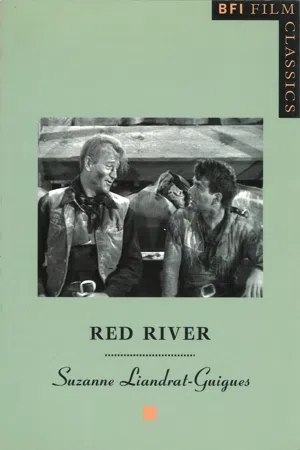
Red River
About this book
Red River (1947) is one of Howard Hawks' near-perfect films. A sweeping, fast-moving Western, it's stunningly shot and stars John Wayne and Montgomery Clift in complex roles set off by typically fine ensemble acting. In her study, Suzanne Liandrat-Guigues explores the thematic complexity of 'Red River' as well as its historical resonances and its place in film history. She focuses particular attention on the actors' contributions and on 'Red River''s relationship to other Hawks classics.
Information
1
. . . . . . . . . . . . . . . . . . . . . . . . . . .
A HOWARD HAWKS WESTERN
Howard Winchester Hawks (1896–1977), following studies at Cornell which had earned him a degree in industrial mechanical engineering, left for Hollywood in the summer of 1917 where he took a job as property man with Famous Players-Lasky. A fan of racing-cars, horses and planes, he joined the US Air Force in autumn 1917. He was demobilised in 1919. From 1923, with the support of Jesse L. Lasky, he started work in the story department of the future Paramount, contributing to the writing of around forty films. In 1926 he signed a contract as director with William Fox and directed his first film, The Road to Glory, which has not survived. This was also the period where he and John Ford were experimenting with anamorphic photography. An eclectic film-maker, he flirted with the most diverse of genres and, as has often been pointed out, produced in each one if not a masterpiece, then at least a great film. To cite just a few well-known examples: detective films such as Scarface (1932) or The Big Sleep (1946); comedies such as Monkey Business (1952) or Bringing Up Baby (1938); adventure films such as Only Angels Have Wings (1939) or Hatari! (1962); war films such as Today We Live (1933) or Sergeant York (1941); Land of the Pharaohs (1955), a film set in antiquity; and sporting films such as Man’s Favourite Sport (1964).
Looking at his filmography, it is surprising to note that Howard Hawks was not a Western specialist. In fact it seems almost incredible that Red River came so late in his career. ‘After two decades of directing and nearly thirty films, this was his first Western.’7 Hawks himself said that he only directed five Westerns (or six, he adds, if you count Hatari!). Having said that, he fails to mention either Barbary Coast (1935) or Viva Villa (1934), where he was ousted after the on-location sequences in Mexico, to be replaced by Jack Conway, or The Outlaw (1940), the filming of which he abandoned after ten days to direct Sergeant York, offering Howard Hughes the job of finishing the production.8
Even so, the name of Howard Hawks, together with that of John Ford, immediately springs to mind when discussing truly excellent Westerns. This reputation is no doubt due to Red River as much as to Rio Bravo (1959), which some people consider to be his masterpiece. In his interviews with Joseph McBride, Hawks, comparing himself with Ford, made the following admission: ‘I don’t think I made better westerns. I don’t think Red River is better than his westerns.’9 Should one draw from this retrospective view the conclusion that Hawks considers Red River the only one of his films worthy of comparison with Ford’s Westerns? Is it a way of remembering that Ford came to watch the filming and of thanking the friend who gave him a hand with the editing? Whatever the truth, it is ultimately a great compliment to Red River as well as an indirect way of showing, in pure Hawksian style, the importance he attached to the film.
A ‘real western’
Hawks’ first two Westerns, Red River and The Big Sky, are generally held to be more firmly rooted in history than his last three, Rio Bravo, El Dorado (1967) and Rio Lobo (1970). This claim however rests on a deceptive appearance which Hawks had been at pains to put straight. Although, as the film-maker reminded us, the creation of the Chisholm Trail (Red River) and the exploration of the Missouri for the fur-trade (The Big Sky) are extremely well-known episodes in the history of the United States, ‘the story of a sheriff ’s struggle to keep law and order in a town also belongs to that history’.10 So much so that a filml ike El Dorado is ‘based on facts and legends that are not so well known in the schoolbooks, but very famous among those who know the West well’. This comment on the director’s part tends to underline the films’ common historical source despite their differences. Hawks continued his analysis by setting up a unique distinction. According to him, all Westerns fall into one of two types:
One is the history of the beginning of the West, the story of the pioneers, which was the story of Red River. Then there ’s the phase where law and order comes. You’ve got a sheriff – sometimes you had a bad sheriff; sometimes you had a good one. There are only a few forms.11
This division between the presence and absence of law is confirmed within the five Westerns directed by Hawks. The two films released in 1948 and 1952 belong to the first type whereas the last three are illustrations of the second. In Red River it is clear that whatever the crimes committed during the course of the adventure, no sheriff or man of law ever intervenes to establish a notion of culpability or to pass judgement. The loneliness of the individual who plays the leading role of Tom Dunson (John Wayne) therefore arises from the fact that he is accountable to no one for a large part of his existence. If anything changes at the end of the film it is the implicit appearance of law through the organisation of a group which historically is not yet a society, but which is beginning to develop the idea of a distinction between what is and is not permitted. It is remarkable that the formation of this law should appear, in the logic of this film, after the fracture which the American Civil War constituted. Even though this war is only alluded to in a conversation and does not appear to affect the members of the community, with the exception of the young Matthew Garth (Montgomery Clift), the men’s new relations with each other seem to emerge as a result of it. The violence of this armed conflict has banished the violence of the first pioneers and engendered new forms of social success.
A Tale of the Far West
Having himself started out as a script-writer, Hawks always attached great interest to this stage of his films’ conception and frequently took an active role in it. Over the course of his career he surrounded himself with prestigious writers such as Faulkner and Hemingway or personalities like Jules Furthman (who wrote Rio Bravo) and Ben Hecht. For Red River he worked with Charles Schnee12 on a new version of the screenplay which Borden Chase13 had adapted from his own novel entitled The Chisholm Trail. ‘The Chisholm Trail was serialised in The Saturday Evening Post in 1946, but when it was published as a hardback it was inappropriately retitled Blazing Guns on the Chisholm Trail (1947), which made it sound like a hackneyed formula western.’14 The film departs from Chase ’s story even though most of the dialogue is taken directly from it. There are three principal transformations. At the beginning of the film Hawks invents the existence of a fiancée, Fen (Colleen Gray), one of the people travelling with Dunson in the convoy of pioneer wagons bound for California. Secondly, the relationship with Tess Millay (Joanne Dru) is modified by the suppression of previous events, principally an episode where Tess and Matthew Garth had met in Memphis. Lastly, the ending of the film differs completely from that of the novel. Tom Dunson is not mortally wounded, nor is he taken back to Texas by Tess and Matt to die there. A large number of critics deplored the lack of plausibility of this new ending and criticised Tess’s character as unconvincing. ‘What is amazing is that the film retains so much power despite the weak ending.’15 This simple statement says more about Hawks’ finale than any other analysis and suggests that the director made a deliberate decision to make fun of the conventions of narrative verisimilitude against which people would try to measure it. These various rearrangements were met with considerable discontent on the part of Borden Chase, however. Hawks had severe words to say concerning the collaboration with Chase, whose name would later be associated with that of Anthony Mann: ‘Borden Chase wasn’t content with writing a story; he wanted to tell you how to do it. I wouldn’t say that he was the greatest judge of how to do it.’16
Apart from the story by Borden Chase mentioned in the credits, the film draws on another source, mentioned in one of the first intertitles, namely the literature of the American Far West. Starting with what one might call ‘the raw materials of Texas’, then, Hawks elaborates a new tale of the old days of cowboys and the history of cattle. Michel Pérez emphasises this when he says that ‘we should not refer to European values’ when considering the work of Hawks, but rather to ‘a literary tradition scarcely a century old in which the names of Mark Twain and Stephen Crane, but especially those of O. Henry and Bret Harte take pride of place ’.17 To this one would have to add the names of many other writers who chose the West as setting for their stories.18
The novelist O. Henry (real name William Sidney Porter, 1862–1910) lived in the Far West, a place which fascinated him and inspired his books The Heart of the West (1907) and Four Million (1906). For him it contained a mixture of strangeness, tenderness and nostalgia where hints of cruelty and bitterness also surface. He states that ‘in Texas conversation is rarely unbroken. You can insert a kilometer, a meal and an assassination between two speeches without losing the thread of the argument’. This is reminiscent of the characteristic structure of an Andy Adams19 story such as ‘Why The Chisholm Trail Forks’; here one Stubb recounts horrifying stories to a ‘tenderfoot’ who wants to know why the Chisholm Trail forks just north of the Cimarron River, only to form a single path seven miles later where it rejoins the old track. The real explanation is that this alternative route provides a better terrain for cattle to pass, but Stubb launches into a long story – interspersed with pauses necessitated by the cowboy’s work – about a quarrel leading to a bloody gunfight which results in roadside tombs springing up. Slow pacing, digression and comic exaggeration are essential to the storytelling, resulting in a particular kind of narrative which may well have been an inspiration to Hawks. The ‘obsession with continuity’ pointed out by Jacques Rivette, cannot be reduced to the themes of the path and of cattle-transport.20 One can sense, beneath the formal necessity of linearity, a style which is associated first with forking complexity before things can resume their peaceful course. This structure is at work in Red River as it is in most of Hawks’ stories where professional commitment forms the core theme and onto which anecdotes, witticisms and variations, always directed with great attention to detail, are grafted. It is these profoundly human details, combined with an overbearing compulsion or an almost obsessive determination, which constitute the unique character of a Hawks film.
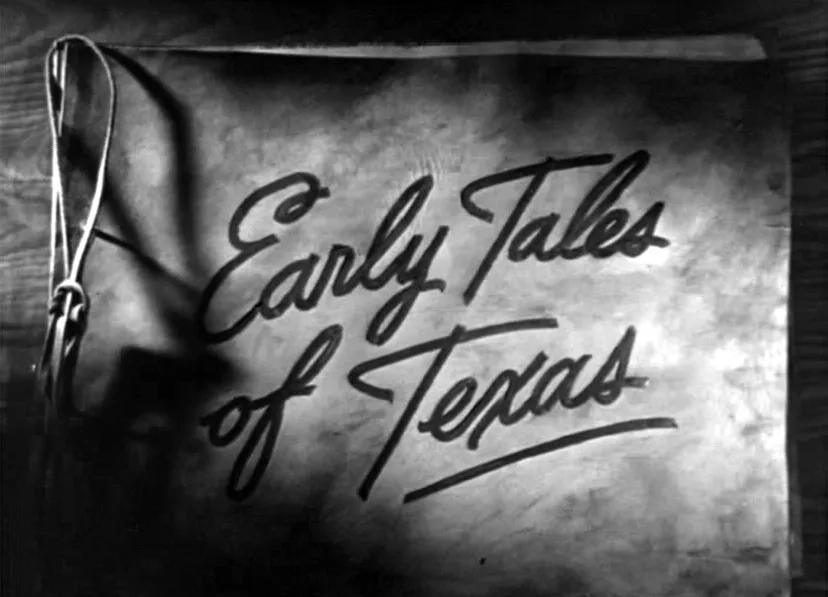
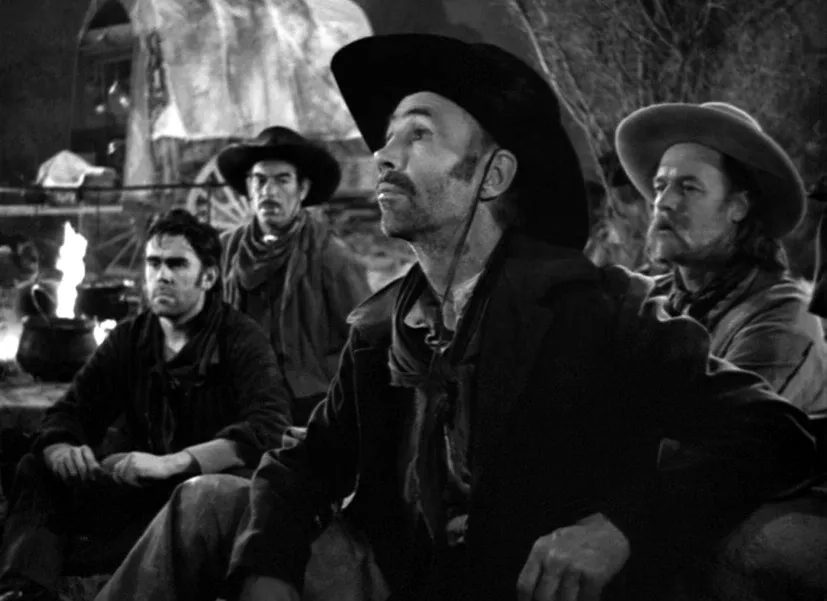
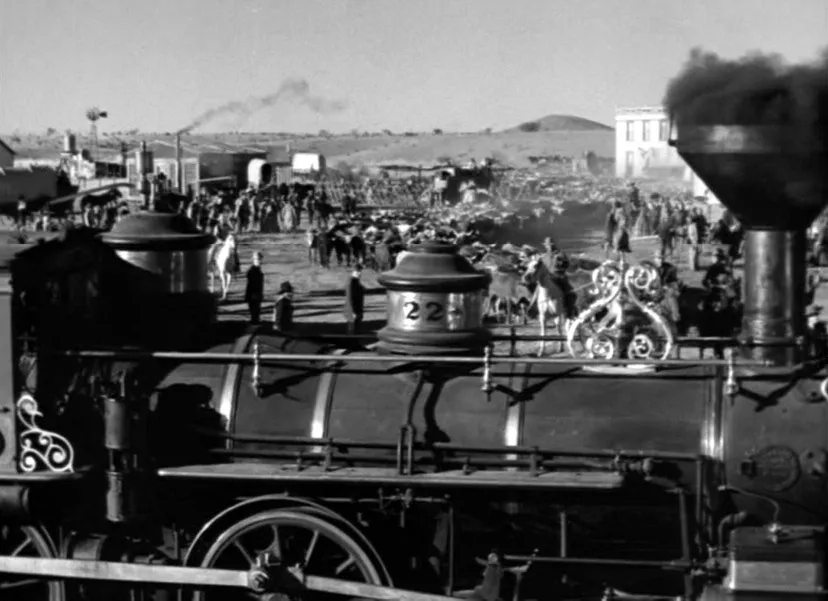
Signs of history and the West: the opening intertitle, campfire tales, the railroad at Abilene
Through the evocation of those ‘Early Tales of Texas’ positioned at the film’s opening (which echo J. Frank Dobie ’s very real Tales of the Old Texas)21 together with the campfire talks, during the course of which the cowboys in Red River tell their version of dramatic stampedes and other trail incidents, Hawks alludes to the culture of the West. However, in the same way as Hawks can be seen to displace the...
Table of contents
- Cover
- Title Page
- Contents
- Dedication
- Introduction
- 1. A Howard Hawks Western
- 2. Three-cushion Dialogue
- 3. Beneath the Cloak of Ink
- 4. Virtual Colour
- 5. Hawks’ Genius
- Notes
- Credits
- eCopyright
Trusted by 375,005 students
Access to over 1.5 million titles for a fair monthly price.
Study more efficiently using our study tools.
Frequently asked questions
Yes, you can cancel anytime from the Subscription tab in your account settings on the Perlego website. Your subscription will stay active until the end of your current billing period. Learn how to cancel your subscription
No, books cannot be downloaded as external files, such as PDFs, for use outside of Perlego. However, you can download books within the Perlego app for offline reading on mobile or tablet. Learn how to download books offline
Perlego offers two plans: Essential and Complete
- Essential is ideal for learners and professionals who enjoy exploring a wide range of subjects. Access the Essential Library with 800,000+ trusted titles and best-sellers across business, personal growth, and the humanities. Includes unlimited reading time and Standard Read Aloud voice.
- Complete: Perfect for advanced learners and researchers needing full, unrestricted access. Unlock 1.5M+ books across hundreds of subjects, including academic and specialized titles. The Complete Plan also includes advanced features like Premium Read Aloud and Research Assistant.
We are an online textbook subscription service, where you can get access to an entire online library for less than the price of a single book per month. With over 1.5 million books across 990+ topics, we’ve got you covered! Learn about our mission
Look out for the read-aloud symbol on your next book to see if you can listen to it. The read-aloud tool reads text aloud for you, highlighting the text as it is being read. You can pause it, speed it up and slow it down. Learn more about Read Aloud
Yes! You can use the Perlego app on both iOS and Android devices to read anytime, anywhere — even offline. Perfect for commutes or when you’re on the go.
Please note we cannot support devices running on iOS 13 and Android 7 or earlier. Learn more about using the app
Please note we cannot support devices running on iOS 13 and Android 7 or earlier. Learn more about using the app
Yes, you can access Red River by Suzanne Liandrat-Guigues in PDF and/or ePUB format, as well as other popular books in Media & Performing Arts & Film & Video. We have over 1.5 million books available in our catalogue for you to explore.