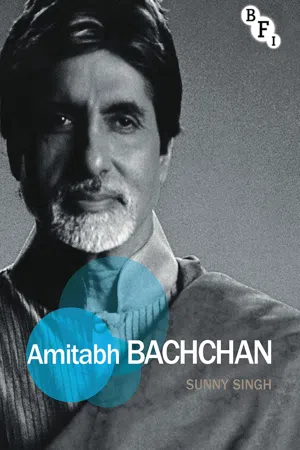
In this unique study of the star, Sunny Singh examines Amitabh Bachchan's film performances and his star persona, locating them in the context of cultural phenomena and global branding, and explores the reasons behind the longevity of his stardom. This illuminating analysis assesses the full range of Bachchan's work, personality and influence - political, social, economic and technological. With in-depth analyses of key films and their wide-ranging social contexts, Singh offers a provocative and in-depth study of the superstar, his extensive career to date as well as the nature of Indian, Asian, and global stardom.
An ideal resource for undergraduate and postgraduate students of film and television studies, this fascinating guide will also appeal to film lovers and anyone interested in this famed actor's transnational career.
- 192 pages
- English
- ePUB (mobile friendly)
- Available on iOS & Android
eBook - ePub
Amitabh Bachchan
About this book
Information
1 INTRODUCTION
When an acquaintance’s email showed up, frantically urging ‘every Indian to vote’ in a BBC online poll to determine the ‘star of the millennium’, the internet was relatively new to India, and online activism was unheard of. However, prompted by a combination of patriotism, cinephilia, and postcolonial urgency, I dutifully voted and was pleasantly surprised when the Indian superstar Amitabh Bachchan topped the poll, comfortably edging out Western screen idols such as Laurence Olivier, Alec Guinness, and Charlie Chaplin.1 The BBC noted that ‘Many people in the western world will not have heard of Amitabh Bachchan, 56, but he remains one of Bollywood’s biggest stars, having appeared in more than 100 films in three decades.’ (1999)
The BBC’s explanation remains an inadequate summation of the star’s trajectory over nearly half a century. Bachchan’s career is also unique in terms of its longevity, impact, and reach, extending far beyond enduring cinematic success, and including a short-lived foray into electoral politics, a damaging but prescient entry into the corporate world in the 1990s, and a smooth, trailblazing switch to television and game shows.
However, despite the reams of film press and acres of celluloid devoted to Bachchan’s professional and personal life, there are few comprehensive academic considerations of his star persona, the ways in which this serves as an expression of the zeitgeist, or the ways his filmic and parallel texts influence high and popular culture. Although scholars have considered Bachchan’s star persona in specific phases (Mishra 2002; Prasad 1998; Sharma 1993) or examined specific social aspects (Poduval 2012; Rao 2000; Mazumdar 2010), there is no study of the full period of his stardom or of his effect on Indian cinema and culture.2 There are no critical examinations of the ways in which Bachchan’s star persona has been constructed and reconstructed through this entire time, serving at once as a site for locating contemporary Indian nationalism, a symbol of national aspirations, an object of sexual desire, an evolving model of postcolonial masculinity(-ies), as well as subverting and resisting multiple dominant narratives.
This book attempts to address this gap in scholarship by examining the complete span of Bachchan’s stardom to date through the star’s biography, screen persona, film texts, and secondary materials. His longevity as a star over nearly five decades of film-making, and the use of multiple media platforms, including film, pop videos, television, and digital media, make Bachchan’s career and performances, as well as their reception, complex and unique. At the same time, his continuing career also renders this study – as any other without the benefit of chronological distance – necessarily incomplete. With Bachchan extending his career in different directions, including a television miniseries in 2014, there can be few conclusions about the ways his star persona will evolve, or the impact of his more recent work. This study attempts to examine Bachchan’s stardom to date, and with full awareness that it shall inevitably be unfinished.
Before embarking on an examination of Bachchan’s stardom, it would be useful to state my own location as a cinephile, fan, and scholar. As for many Indians of my generation, Bachchan has been a ubiquitous presence in my life. His first film, Saat Hindustani (Seven Indians, 1969), was released months after my birth. My first memories of my cinephile family include vivid albeit confused flashes of scenes from Anand (Bliss, 1971) and Reshma aur Shera (1971). Both films also blend seamlessly in my mind with memories of the 1971 Indo-Pakistan war and the subsequent formation of Bangladesh.

A star bigger than the industry, Kaalia (1981)
For me, as for many who grew up with Bachchan’s films, 1971 is only the first of many historic events linked in our memories with his films. India’s first nuclear tests stood in stark contrast to his roles in Majboor (Under Duress, 1974) and Roti Kapda Aur Makaan (Bread, Clothes, Housing, 1974), with their themes of individual frustration and defeat in the face of structural oppression. The Emergency tallies with Sholay (Flames, 1975) and Deewar (Wall, 1975), and as tragic songs of resistance, perceived perhaps very differently through the lens of childhood than they were by adults. His films also suggested ways to confront socio-economic changes with Trishul (Trident, 1978), and narratives for dimly understood catastrophes such the Chasnala mine disaster with Kaala Patthar (Black Stone, 1979). His cathartic but increasingly narratively unstable, dystopic films of the 1980s, including Inquilaab (Freedom, 1984), Main Azaad Hoon (I Am Free, 1989), and Agneepath (Path of Fire, 1990) encapsulated tumultuous and seemingly catastrophic times. In retrospect, Khuda Gawah (God as Witness, 1993) seems not only a cry for 1970s-style secularism and co-existence but also a lament for an Afghanistan that had all but disappeared due to prolonged armed conflict.
By the end of the millennium though, Bachchan had reinvented himself as the successful entrepreneurial pater familias, and gave a generation of aspirational consumers his stamp of approval with Mohabbatein (Many Kinds of Love, 2000) and Kaun Banega Crorepati (Who Wants to Be a Millionaire, 2001, hereafter KBC). His innings in the new millennium defies logic with roles as varied as that of a married man in love with his daughter’s friend in Nishabd (Without Words, 2007), a special needs teacher suffering from Alzheimer’s in Black (2005), a Coppola-esque godfather in Sarkar (Ruler, 2005), and an ageing Shakespearean actor who must play one last great part in The Last Lear (2007). In addition, he has hosted multiple seasons of the television quiz show KBC, sold products ranging from shampoo to cars, controversially appeared in a television advertisement for Gujarat state tourism,3 and developed a presence on social media, including Twitter.
For the generations who have grown up with Bachchan, his films – regardless of box-office success – provide a semblance of stability amidst dramatic change, help us explain and understand our world, and link real-life incidents, phenomena, aspirations, and desires to celluloid narratives. As a scholar, this life-long intimacy with Bachchan’s film texts and stardom places me in an unusual situation. My study of Bachchan’s stardom is simultaneously that of a scholar, a fan, and an individual whose key life experiences have been framed, shaped, and coloured by interactions with his star text and his overwhelming presence in the familial, social, and public spaces of my life.
At the same time, my position lies outside the two clear streams that dominate film scholarship on Hindi – and indeed, Indian cinema. Most Indian film scholars are located in urban, metropolitan centres with early access to technologies such as television, and non-Indian cultural products. A second set of scholars are part of the Indian diaspora with specific experiences of migration(s) and dislocations(s).4 My childhood in small towns in northern India and remote border outposts means my experience as a spectator, fan, and scholar, places me on the margins of both these locations.
Unlike India’s metropolitan centres, people in small towns continued watching films in cinema halls right through the 1980s and the 1990s, and televisions only arrived in the late 1980s, a corollary of Rajiv Gandhi’s ‘technocratic’ policies. Economic constraints also meant that video cassette recorders were a late arrival, and even after they gained ubiquity, watching a film ‘in the picture hall’ remained an important social and familial ritual.
Confusingly, my father was posted to Islamabad, Pakistan during the early 1980s where Hindi cinema was passionately followed but officially banned. However video cassettes circulated abundantly and new films were available within hours of, or before, their release in India, allegedly through a complicated piracy network routed via the Gulf states.
In 1985, my family moved to New York, again as part of my father’s job, and Hindi movies became a connection with India, a counterbalance to American television, films, and pop videos, and an assertion of a non-American identity. As members of the diplomatic community, we weren’t ‘diaspora’ and were removed from some experiences of migration. Although the dislocation(s) of distance, language, and culture remained, they were diligently and assiduously addressed. However, one aspect of the dislocation was made more acute by both a scarcity of Bachchan films as his career began to wane, and the wave of new pretenders who hoped to inherit his crown. In some ways, Bachchan’s wilderness years of the late 1980s and early 1990s reflect my own travels to far-flung parts of the globe, to corners where his name held little significance. Fortuitously, my return to India also coincided with the start of Bachchan’s new innings in the public eye, first as the head of the film production and event management company, Amitabh Bachchan Corporation Limited (ABCL) and, after a few false starts, as the patriarch of Hindi cinema. As such, my own location – first as a small-town spectator and then as a marginal member of the Indian diaspora – informs my view of films and of Bachchan’s stardom, but also positions me outside the two dominant streams of Indian film scholarship. At the same time, my location also replicates, in large measures, the demographics of Bachchan’s primary – non-urban and north Indian, as well as international diaspora fandom.5 In some ways, I believe, this particular location of simultaneous proximity and distance informs both the scholar and the cinephile in examining Bachchan’s stardom.
Moreover, many of the key writings on cinema – and indeed, Bachchan – are by people closely connected to the industry. While this bestows the advantages of access, they also often lack a scholarly distance. This recognition guided my decision to focus on film texts and scholarship rather than on personal and biographical material. Moreover, an understanding of Bachchan’s tightly controlled media persona means that I chose not to interview the star, as he has given ample interviews over his career and I doubted that another interview would deliver any new insights. At the same time, many studies of the star rely on a combination of reviews and interviews and often fall into fandom. Thus my focus on Bachchan’s oeuvre is also guided by a need to clearly distinguish the fan from the scholar.
Prior to discussing Bachchan’s stardom, it must be noted that while he is not Indian cinema’s first star, he is its longest lasting one, occupying nearly half a century of India’s hundred years of film-making. His longevity and predominance are also unique on a global level as his career has neither precedence nor parallel. Thus, any consideration of his stardom requires locating his personality, his films, as well as the secondary texts generated about him in a historical framework, especially as Bachchan’s work is deeply imbricated with the national narratives and postcolonial imaginaries in and beyond Indian borders.
Bachchan enters cinema just over half a century after Dadasaheb Phalke’s seminal Raja Harishchandra (1913). The intervening decades had established a tradition of film stars and fandom in the country. Moreover, Indian cinema had already benefited from technological advances, including early conversion to sound, as well as developing key themes, ideas, aesthetic and narrative conventions, and stars. Song books, records of music, playing cards, fanzines, and multiple other forms of secondary circulation had resulted in a sophisticated cinephile culture that responded and participated knowledgeably in the construction and maintenance of star texts, extending film viewing to a host of other cultural activities including dance, music, and fashion, and feeding into further films of particular stars.6
From early days, a range of male and female stars including Devika Rani, Nadia, Sulochana and PC Barua7 provided the locus of on-screen glamour, desire, and aspirations.8 A sophisticated audience consumed multiple film texts, often devised as star vehicles, and other media, cherishing film stars as ‘national icons of beauty, desire and utopian beings’ (Dwyer 2000: 118–19). Indeed, pre-independence India was dominated by female stars, its cinema organised around ‘the female star as the primary attraction’ (Prasad 2004: 106). Post-independence India saw a burgeoning of the film industry, and with it, a range of new stars, including the male ‘triumvirate’ of Raj Kapoor, Dilip Kumar, and Dev Anand who dominated the screens throughout the 1950s and much of the 1960s.9 They represented three different types of heroes: ‘Dilip Kumar arguably played the tragic hero who would rather lose his love than forsake his duty to his friend; Raj Kapoor was the romantic tramp who, like Chaplin, displayed strong melodramatic characteristics; Dev Anand was the consummate urban hero, a kind of postcolonial dandy, keeping up with whatever was the current aspiration of the Indian middle classes’ (Mishra 2002: xiii). There were other stars too, especially in the tumultuous 1960s, including the boisterous Shammi Kapoor, the classically handsome Dharmendra, Sunil Dutt, and, Bachchan’s immediate forerunner, Rajesh Khanna.
Between 1969 and 1972, Rajesh Khanna dominated the screen with his version of the tragic, romantic hero. A sensitive, romantic masculinity marked his roles, as did playback singer Kishore Kumar’s melodious voice, which played a large part in Khanna’s stardom. Khanna was dubbed the country’s first superstar and inspired Beatles-like fan hysteria. He played the lead in Bachchan’s early films, Anand and Namak Haram (Disloyal, 1973). But after Bachchan’s Zanjeer (Chain, 1973), the national mood shifted dramatically against Khanna’s gentle, tragic hero. ‘After that the nature of the hero began to be defined in terms of the angry hero in rebellion...’ (Mishra 2002: xiv). Moreover,
Bachchan in many ways brought the tradition of the classic Bombay triumvirate (Dilip Kumar, Raj Kapoor, Dev Anand) to an end as he combined in his own cinema personality all the characteristics for which the 1950s triumvirate were famous: quiet melancholy, comic self-reflection, and urbanity’ (ibid: xiv–xv).
If Prasad’s ‘birth of a new nation’ marks a historical transition to the rise of the male star in India (2004: 107), the 1971 war was also pivotal in establishing ‘the idea of the hero in total control of his destiny’ (ibid: xiv), with Bachchan as its embodiment.
The ‘history’ of Hindi cinema is often located within a ‘nationalist/postcolonial’ discourse with a special emphasis on the films as a ‘representation of the biography of the nation-state’ (Chapman 2003: 323).10 This – in turn – has led to the formation of a ‘historiography’ that links commercial11 Indian cinema to the nationalist project and the nation-building exercise. Indeed, commercial Indian cinema inherits and circulates ‘notions of national identity, negotiating conflicts experienced by the imagined community, producing new representations of the nation, and constructing a collective consciousness of nationhood through special cultural referents’ (Virdi 2003: 7). Furthermore, cinema in India has often been coupled with the revival and regeneration of other art forms, and linked to an overarching nationalist project, although cinema ‘of course deploys a unique apparatus that relies heavily on the other cultural forms imbricated in the nation-making process’ (ibid.: 31). Bachchan’s continued ubiquity in this filmic and extra-filmic history thus also becomes an overarching narrative, both on and off screen, for the nation.
Alongside this national ‘historiography’ it is necessary to take into account the formulations of postcoloniality(-ies) in filmic texts, and their reception both in and outside India. Indeed, commercial Indian cinema is ‘a hugely successful global media form that has been strikingly successful in competing with, and sometimes dislodging, Hollywood in the global arena…’ (Larkin 2003: 172). Most often analysed with regard to its popularity within the global South Asian diaspora, a closer look at Indian film’s popularity amongst ‘Arabic, Indonesian, Senegalese or Nigerian youth’ reveals the ‘extraordinary global reach of Bollywood – a cinema that has successfully ...
Table of contents
- Cover
- Title Page
- Dedication
- Contents
- Acknowledgments
- 1. Introduction
- 2. Birth – and Rebirth – of A Star
- 3. A Star Greater than the Industry
- 4. Creation and Re-Creation of A Super Star
- 5. Impact on Contemporary Cultural Production
- 6. Conclusion
- Notes
- References
- Filmography
- Index
- eCopyright
Trusted by 375,005 students
Access to over 1.5 million titles for a fair monthly price.
Study more efficiently using our study tools.
Frequently asked questions
Yes, you can cancel anytime from the Subscription tab in your account settings on the Perlego website. Your subscription will stay active until the end of your current billing period. Learn how to cancel your subscription
No, books cannot be downloaded as external files, such as PDFs, for use outside of Perlego. However, you can download books within the Perlego app for offline reading on mobile or tablet. Learn how to download books offline
Perlego offers two plans: Essential and Complete
- Essential is ideal for learners and professionals who enjoy exploring a wide range of subjects. Access the Essential Library with 800,000+ trusted titles and best-sellers across business, personal growth, and the humanities. Includes unlimited reading time and Standard Read Aloud voice.
- Complete: Perfect for advanced learners and researchers needing full, unrestricted access. Unlock 1.5M+ books across hundreds of subjects, including academic and specialized titles. The Complete Plan also includes advanced features like Premium Read Aloud and Research Assistant.
We are an online textbook subscription service, where you can get access to an entire online library for less than the price of a single book per month. With over 1.5 million books across 990+ topics, we’ve got you covered! Learn about our mission
Look out for the read-aloud symbol on your next book to see if you can listen to it. The read-aloud tool reads text aloud for you, highlighting the text as it is being read. You can pause it, speed it up and slow it down. Learn more about Read Aloud
Yes! You can use the Perlego app on both iOS and Android devices to read anytime, anywhere — even offline. Perfect for commutes or when you’re on the go.
Please note we cannot support devices running on iOS 13 and Android 7 or earlier. Learn more about using the app
Please note we cannot support devices running on iOS 13 and Android 7 or earlier. Learn more about using the app
Yes, you can access Amitabh Bachchan by Sunny Singh in PDF and/or ePUB format, as well as other popular books in Media & Performing Arts & Film History & Criticism. We have over 1.5 million books available in our catalogue for you to explore.