- 192 pages
- English
- ePUB (mobile friendly)
- Available on iOS & Android
eBook - ePub
About this book
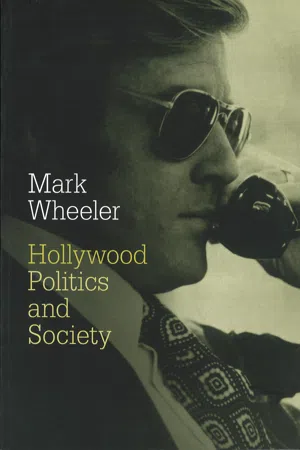
At the beginning of the 21st century, the US film industry had overtaken aeronautics and car industries to become one of the highest exporters of American products. Mark Wheeler's important new book provides both a political history of Hollywood and a reflection on the relationship between cinema and politics in America, from 1900 to the present day. Wheeler considers the interplay between the movies studios, state and national government and cultural policy and legislation, with case studies of the censorship that followed in the wake of the Hays Code 1930 and the investigations of the House Committee of Un-American Activities (HUAC) in the 1950s that led to the notorious blacklisting of alleged or known Communist sympathisers. His history of political constituencies within Hollywood ranges from the conservative right to the liberal and the communist left, from trades unionists to movie moguls. The book concludes with a look at the politics of show business, addressing links between Hollywood and political activism, films such as 'The Candidate' and 'Bulworth' that have themselves engaged with the political process, and considering the irony that despite the fact that Hollywood is perceived as a bastion of liberalism the two most famous actors-turned-politicians have been Ronald Reagan and Arnold Schwarzenegger.
Information
1
‘Trade Follows Film’: The History of the US Film Trade from 1900 to 1950
Introduction
Throughout the first half of the 20th century, Washington became increasingly interested in the value of the American film industry both locally and internationally to the economy. As a result, the studios formed an alliance with the United States’(US) Department of Commerce, which supported Hollywood through its Bureau of Foreign and Domestic Commerce (BFDC). And American presidents, from Woodrow Wilson on, realised the economic and cultural worth of Hollywood not only as a vibrant national industry, but also in its international distribution of US film product.
For American governments there were many advantages in the international exploitation of film. At one level, the export of film product aided the balance of payments figures in the US economy. It was also appreciated by US governments that ‘Trade follows film’(Woodrow Wilson) and films provided an international means through which to advertise products. The ideological worth of films became apparent to politicians when America entered World War I in 1917, as pictures were used to propagate the war effort and to project US values into occupied countries.
The realisation of the economic, political and ideological worth of the US film industry within governing circles established the context for the emergence of effective trade representation. In 1922, the major studios jointly backed the creation of the Motion Picture Producers and Distributors of America (MPPDA) which was headed by former Postmaster General Will H. Hays. While the body was established in response to those organisations campaigning for the state censorship of films (see Chapter 3), it proved to be a potent trade body by gaining the ear of government (Jarvie, 1992: 279). Such access would be useful, as the studios sought to maintain an iron grip over the distribution and exhibition of films in the North American and international marketplace. This was effected through block- and blind-bidding practices and the chain ownership of first-run movie theatres.
However, this cartelism sat uneasily with US principles of competition. From the 1920s, the Justice Department pursued a series of anti-trust investigations which culminated in the dismantling of the studios’ control over production, distribution and exhibition in the 1948 Paramount Decrees. Also, despite attaining its status as America’s fifth largest business by 1929, the film industry was treated with suspicion by White Anglo-Saxon Protestant (WASP) political elites because of the predominantly Jewish complexion of its talent base, ranging from the moguls to the stars (Horne, 2001: 26).
This chapter will consider the contradictory history which emerged between Hollywood and Washington from 1900 to 1950. It will focus on the economic and political factors that allowed Hollywood to establish itself as the world’s premier film industry, while its value to American political elites was complicated by the industry’s anti-competitive practices.
The characteristics of the Hollywood film industry: 1900 to 1948
From the 1910s to 1948, the US film industry was defined through the development of vertically integrated major film studios who controlled the production, distribution and exhibition of product both domestically and internationally. To supply cinemas with the requisite amount of films, the studios employed ‘Fordist’ industrial practices in which a workforce held on a series of long-term contracts produced features. They were run by moguls who controlled their domains from their front offices. Yet these showmen initially had to battle for their ascendancy in the embryonic film industry.
ORIGINS
At its inception, the US cinema was dominated by the Edison Company’s exclusivity over film production through its patent on motion picture cameras. This control was extended by the establishment of the Motion Pictures Patents Company (MPPC), known as the ‘trust’, in 1909, wherein a patents pooling agreement was adopted between the major industry players: Armat, Biograph, Edison and Vitagraph. Each MPPC member retained an exclusive arrangement with the Patents Company concerning the use of film stock and cameras in return for a royalty payment (Allen, 1976: 120–4). Exhibitors were also licensed projection machinery for a fee.
The trust often employed violent goon squads to enforce its control of the patent. In particular, it tried to exclude the immigrant Jewish showmen who had seen opportunities for profit in the film industry. In 1905, Pittsburgh-based vaudeville tycoon, Harry Davis, happened upon a profitable idea: the Nickelodeon. This was a tiny theatre made up of 199 seats, which charged cinemagoers a nickel a time to watch a short, single-reel film. This simple innovation spread throughout the immigrant, slum districts in the Eastern cities. It attracted other Jewish entrepreneurs, such as Carl Laemmle, who set up his film exchange for distributors so audience demand could be catered for in 1906. By 1907, the number of film exchanges had mushroomed to over one hundred across thirty-five cities.
However, with the establishment of the MPPC, both the small-time exhibitors and the owners of the film exchanges were forced to sign a patent trust document or face a lawsuit. They demonstrated their opposition when Laemmle employed advertising agent Robert Cochrane to campaign against the trust through satirical cartoons in the trade press. Furthermore, when the MPPC created its General Film Company to control the independent film exchanges in 1910, it inadvertently forced distributors, including Laemmle, William Fox and Adolph Zukor, to establish a rival exchange and move into film production. These entrepreneurs stole audiences from the MPPC when Zukor produced, marketed and exhibited feature films, thereby superseding the trust companies who were still producing one-reelers. He reasoned that films shown in the comfort of a movie theatre would attract a wider range of American audiences (Kerrigan and Culking, 1999: 5–8).
In 1912 the MPPC lost a vital court case to the studio IMP, which was judged free to use non-patented movie cameras to film its productions. The trust was dismantled when the Supreme Court found in favour of the US government’s anti-competitive suit against it in 1915. This was a significant victory for the showmen, who now included Samuel Goldfish (later Goldwyn), Louis B. Mayer, Marcus Loew and Jesse L. Lasky.
The court case was accompanied by the Jewish showmen’s decision to relocate the production centre of US film from New York to the small farming community of Hollywood in Southern California to circumvent the influence of the trust in the first half of the 1910s. Their success inculcated in the embryonic studio chiefs the belief that a ‘monopoly . . . was a terrible thing [unless] you had one of your own’ (Puttnam, 1997: 73).
THE MOVE WEST TO HOLLYWOOD
The move to Hollywood occurred by accident when Samuel Goldwyn developed a partnership with his brother-in-law Jesse Lasky and Cecil B. De Mille to produce feature films for their Famous Players Company. The first production was The Squaw Man which was directed by De Mille in 1913. When seeking locations, De Mille looked at Flagstaff in Arizona, but deemed it unsuitable for his purposes. Having heard that several film crews had used California as a location, he moved the production to the Hollywood hills.
In the wake of De Mille, it became apparent to the infant film studios that the westward shift to Hollywood would have many advantages. First, the climate proved ideal for filming outdoors and meant costs could be kept to a minimum. Los Angeles’ geographical basin, with its range of landscapes, provided the pioneers with ideal locations to shoot films. Second, the companies were attracted to Southern California due to the ‘open shop’ labour rules, meaning workers could be employed at half the rate of their New York counterparts (Sklar, 1975: 68). Third, for the immigrant entrepreneurs, the westward move held a tremendous symbolic value. The physical and intellectual remoteness of Los Angeles from the Eastern seaboard enabled them to bypass the traditional arbiters of American culture and taste (Puttnam, 1997: 79). Finally, the Hollywood farmland provided another vital resource for the fledgling industry – a vast amount of acreage for the new tycoons to establish a studio system.
THE STUDIO SYSTEM
In 1914 Carl Laemmle purchased a 230-acre ranch in the San Fernando Valley and on 15 March 1915 opened the first studio complex, entitled Universal City. This included a front office for the management and a backlot with several interior stages and outdoor sets. By the 1920s, four major studios with large backlots existed – Paramount (incorporating Famous Players/Lasky), Metro-Goldwyn-Mayer (MGM), Warner Bros. and Radio-Keith-Orpheum (RKO), alongside smaller companies such as Universal, Columbia Pictures and United Artists.1 In 1935, a further studio was added to the majors when Fox merged with Darryl F. Zanuck’s Twentieth Century, to create 20th Century-Fox.
The classic studio system, which defined the US film industry from the 1920s to 1940s, followed a Fordist model of production in which a dedicated workforce made movies. Stars, writers, directors and technicians would be held on binding seven-year contracts. The Jewish entrepreneurs, showmen and risktakers who had established the US film industry, transformed themselves into moguls. The power of the front office was non-negotiable as the studio chiefs dominated their businesses and were only answerable to their holding companies on the Eastern seaboard.
The star system meant studios built up stars in their vehicles, which were easily marketable to home and international audiences, and placed them in recognisable genres (musicals, Westerns, gangster films, comedies and costume dramas). Each studio was known for a certain type of product. For instance, the poorer studios such as Universal and Columbia became associated with horror films and the work of directors such as Frank Capra respectively, while MGM’s Louis B. Mayer boasted that his studio held on to more stars than there were in the heavens!
The other major factor to dramatically shape the studio system concerned the introduction of sound in films with Warner Bros.’ production of The Jazz Singer in 1927. The change from silent to talking pictures had major ramifications for stars, technicians, directors, producers and moguls alike. Initially the revolution heightened costs and ruined the careers of such performers as John Gilbert and Vilma Banky whose voices were considered unsuitable. As the technology was improved, the system settled down but according to Jesse L. Lasky:
. . . With many more craftsmen and auxiliary mechanical devices, less teamwork, more complex organisation, less pioneering spirit, more expense, less inspiration, more talent, less glamour, more predatory competition, less hospitality, more doing, less joy in doing . . . Hollywood would never be the same again (Lasky, 1957).
VERTICAL INTEGRATION: CONGLOMERATION BLOCK-BOOKING AND BLIND-BIDDING
The studios developed a monopolistic control of the production, distribution and exhibition of their features in cinemas across the US. This occurred when Zukor merged Famous Players and Lasky in 1916. He then renamed the conglomerate studio, Paramount, when it combined with a dozen other companies in 1917. Through this amalgamation, Zukor controlled the first vertically integrated motion picture studio, which produced over 100 feature films per annum. With this aggregate number of films, Zukor realised he could sell films to exhibitors in packages. This meant that when a cinema chain wanted to show an expensive A-picture, it would be required to purchase several inferior B-pictures.
Zukor originated the practice of block-booking, which guaranteed a market for even the most mediocre movie, as exhibitors had to buy all the films offered sight-unseen. Over time the practice became more sophisticated, as the blocks not only included features but short subjects, cartoons and newsreels. This mature form of block-booking, called full-line forcing, gave the studios a pre-sold market for their pictures, and kept the production departments working at capacity. Since the films were usually blocked before they were produced, theatre chains had to book movies on the barest of information provided by the distributor. This practice became known as blind-bidding and forced exhibitors to buy films knowing no more than the title, cast and tagline.
The studios insulated their profits by fixing admission prices, developing unfair runs and clearances of their films, and determining the pricing and purchasing arrangements to favour the movie chains that they owned. Again, Zukor was at the forefront of these developments, by buying out the pool of exhibitors and by developing a consortium which bought the first-run theatres in the downtown areas in major American cities. These cinemas were well appointed and the right size to showcase new productions at inflated prices.
FOREIGN MARKETS AND INTERNATIONAL TRADE
During the 1920s and 1930s, the costs of production escalated as the studios competed for audiences with more lavish movies. This led them to look be...
Table of contents
- Cover
- Title Page
- Contents
- Acknowledgments
- Introduction
- 1. ‘Trade Follows Film’: The History of the US Film Trade from 1900 to 1950
- 2. The US Film Industry and Trade from 1950 to the Present Day
- 3. The MPPDA, the Production Code and the Ratings System
- 4. The Political History of Classical Hollywood: Moguls, Liberals and Radicals
- 5. The Politics of Hollywood Labour
- 6. Contemporary Hollywood Trade Unionism and the Rights of a Diverse Workforce
- 7. Campaign Politics, Activism and Hollywood Showbiz
- Conclusion
- Bibliography
- Index
- eCopyright
Trusted by 375,005 students
Access to over 1.5 million titles for a fair monthly price.
Study more efficiently using our study tools.
Frequently asked questions
Yes, you can cancel anytime from the Subscription tab in your account settings on the Perlego website. Your subscription will stay active until the end of your current billing period. Learn how to cancel your subscription
No, books cannot be downloaded as external files, such as PDFs, for use outside of Perlego. However, you can download books within the Perlego app for offline reading on mobile or tablet. Learn how to download books offline
Perlego offers two plans: Essential and Complete
- Essential is ideal for learners and professionals who enjoy exploring a wide range of subjects. Access the Essential Library with 800,000+ trusted titles and best-sellers across business, personal growth, and the humanities. Includes unlimited reading time and Standard Read Aloud voice.
- Complete: Perfect for advanced learners and researchers needing full, unrestricted access. Unlock 1.5M+ books across hundreds of subjects, including academic and specialized titles. The Complete Plan also includes advanced features like Premium Read Aloud and Research Assistant.
We are an online textbook subscription service, where you can get access to an entire online library for less than the price of a single book per month. With over 1.5 million books across 990+ topics, we’ve got you covered! Learn about our mission
Look out for the read-aloud symbol on your next book to see if you can listen to it. The read-aloud tool reads text aloud for you, highlighting the text as it is being read. You can pause it, speed it up and slow it down. Learn more about Read Aloud
Yes! You can use the Perlego app on both iOS and Android devices to read anytime, anywhere — even offline. Perfect for commutes or when you’re on the go.
Please note we cannot support devices running on iOS 13 and Android 7 or earlier. Learn more about using the app
Please note we cannot support devices running on iOS 13 and Android 7 or earlier. Learn more about using the app
Yes, you can access Hollywood by Mark Wheeler in PDF and/or ePUB format, as well as other popular books in Médias et arts de la scène & Histoire et critique du cinéma. We have over 1.5 million books available in our catalogue for you to explore.