- 184 pages
- English
- ePUB (mobile friendly)
- Available on iOS & Android
eBook - ePub
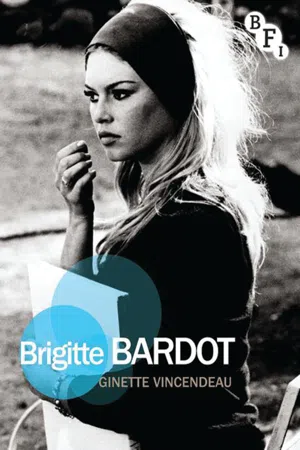
Brigitte Bardot
About this book
Ginette Vincendeau analyses Bardot's rise to fame as a highly-acclaimed French international film star and fashion icon from her early days as a fashion model and ballet dancer to her period of 'high stardom' between 1956 and 1960.
Information
1 FASHION MODEL, PIN-UP, STARLET: HOW BARDOT WAS ‘CREATED’
To be fair, if Vadim discovered and manufactured me, I created Vadim.
(Brigitte Bardot)1
Brigitte Bardot did not emerge as a star fully formed. There was a long build-up to Et Dieu … créa la femme, the pivot of her career, when she worked as a fashion model and others, including her husband Roger Vadim, worked to propagate her image, in her films and elsewhere. In other words, the subject of this chapter is the ‘creation’ of Bardot before she was B.B. the global celebrity, looking at the cultural and media conditions in contemporary France that made her extraordinary rise possible, the image of young femininity that she projected in fashion and photographs and the uses to which that image was put in her early films.
The building blocks of stardom
Daughter of the bourgeoisie
The elder of two sisters, Brigitte Bardot was born under that name (not as ‘Camille Javal’, as a tenacious legend would have it)2 on 28 September 1934 into a wealthy Parisian family. Her father, Louis (‘Pilou’) Bardot, was an industrialist. Her youth was spent between the family’s Paris flat in rue de la Pompe, in the affluent 16th arrondissement, their weekend cottage in Louveciennes, west of Paris and the holiday destinations of the well heeled at the time: La Baule and Saint-Tropez in the summer, Megève in the winter. The sisters’ upbringing was typical of their class and era: their parents taught them strict bourgeois manners, refused to let them stay out late and made Brigitte wait until she was eighteen to marry Vadim.
Were Bardot’s later notoriously chaotic private life and extreme passion for animals indicators of an unhappy childhood, as some have argued? I think such claims should be treated with caution. By Bardot’s own account, the family was a tight-knit unit, as their fondness for childish nicknames suggests (Brigitte was ‘Bri-Bri’). Bardot has remained close to, and financially supported, her younger sister Marie-Jeanne (‘Mijanou’), who made a brief attempt at a film career in the 1960s.3 As she details in her autobiography (Bardot 1996 and 1999),4 she was devastated by the loss of each successive grandparent and parent, being especially affected by the death of her mother Anne-Marie (‘Toty’). While they belonged to the traditional bourgeoisie, Bardot’s parents had bohemian leanings. A spare-time poet as well as a keen photographer and amateur film-maker, Louis delighted in taking pictures of his attractive daughters and rubbed shoulders with film-industry types, while the beautiful and elegant Anne-Marie would have loved to dance and was well connected in the world of fashion and ballet. These contacts would be crucial in launching Brigitte’s career. Leaving aside their biological role, the first in a long line of those who had a hand in ‘creating’ Brigitte Bardot were her parents.
Like many young women of her milieu, Bardot studied ballet, from which she gained a grounding in dance that was exploited in a few films as well as her distinctive gait, poised, graceful and sexy in equal measure. At the Conservatoire she was a gifted pupil, winning a prize in 1948. One of her teachers, Boris Kniaseff, was credited with devising special leg and posture exercises for dancers, and Vadim was allegedly ‘impressed with the way he had modelled her body. Brigitte’s true discoverer, B.B.’s first Pygmalion was this Russian from St-Petersburg’ (Bernet 1972: 245). So Kniaseff too has a claim to be a Bardot ‘creator’. However, after landing one engagement as a dancer on the transatlantic liner ‘De Grasse’ in 1950, Bardot abandoned the ballet. For one thing she had met Vadim by then and did not enjoy the long separations this kind of assignment entailed. But it is as likely that the fierce ballet discipline was at odds with her somewhat indolent nature. Instead, she continued to capitalise on her stunning looks and slender silhouette in fashion where, thanks to her mother, she already had a budding career.
Madame Bardot knew her way around the world of Parisian couture and for a short while owned her own boutique; she worked hard to push Brigitte into modelling (Rihoit 1986; Bardot 1996). Back in 1948, she had convinced her friend Jean Barthet, a reputed hat designer, to employ the fourteen-year-old Brigitte to model his hats to music from Swan Lake. Barthet’s successful show led to photo assignments first for traditional women’s magazines such as Les Cahiers du Jardin des Modes, Les Veillées des chaumières and Modes et Tricots and then the more modern and high-profile Elle, which was launched in 1945. Bardot’s first cover for Elle was no. 179, 2 May 1949, when she was fifteen. Many others would follow. One of these (no. 232, 8 May 1950) attracted the attention of Marc Allégret, a film-maker with a reputation for discovering actresses, among them Simone Simon and Michèle Morgan. Allégret reportedly asked, ‘Who is the smiling young woman? I would like her address, she has the face of one of the heroines of my next film’,5 although according to Marie-Dominique Lelièvre, it was producer Pierre Braunberger who spotted Bardot first (Lelièvre 2012: 35). What is not in doubt is that Allégret sent his young assistant, the aspiring journalist and photographer Roger Vadim, to contact Bardot as a candidate for a role in a film based on a script by Vadim, entitled Les Lauriers sont coupés. Although Bardot did not pass the audition (and the film was never made), the encounter had far-reaching consequences for all concerned – and especially for Bardot, on personal and professional levels. Before moving on to the next phase in her career, however, we need to look briefly at Bardot’s experience as a model.
Young Bardot as fashion model: the perfect jeune fille
Beyond their strategic importance as a stepping-stone to acting and film, modelling and fashion were crucial for Bardot.6 They fixed some of the parameters of her visual representation of young femininity, and established her presence and influence in a key area of popular culture, which was then in the full throes of expansion.
Epitomised by Christian Dior’s New Look of 1947, French fashion of the late 1940s and early 1950s, when Bardot began her modelling career, was glamorous in a feminised, mature and structured way. It featured tailored jackets pinched at the waist with full skirts and petticoats (Dior’s so-called femme-fleur) or more sober, long, fitted skirts, making up what Elle called the ‘ultra-perfect feminised suit’,7 and highly structured evening gowns. Hair was short and waved, clothes matched by hats, bags and high-heeled shoes. These were the clothes that Brigitte’s mother and her mother’s friends wore, and their declension of rigidly set tasks and times of the day implied a repertoire of appropriate roles for bourgeois femininity.
The fashions Brigitte started out modelling were broadly speaking the same thing but younger. One of her early Elle covers (24 March 1952) shows this graphically as she poses behind a middle-aged woman, both of them wearing identical dresses. On 29 December 1952, a two-page Elle spread entitled ‘Jeunes filles of 1953: this is your fashion’, elevates Bardot to juvenile role model: ‘Brigitte opens her door. She shows you “her” fashion, which is also yours.’ There was some irony in this, since jeune fille suggests virgin, and Bardot had married Vadim on 20 December, a few days before. Nevertheless, this was the image projected in the spread.

Futures vedettes (1955): Bardot (front, left) among other hopefuls she would rapidly eclipse in and out of the film, including Isabelle Pia (front, right) and Mylène Demongeot (back, left)
Photographed in her apartment, she wears flat ballet shoes and her long light-brown hair is neatly done up in a ponytail, with a set wavy fringe. Two profile shots show her pouting at herself in the mirror or gazing at toy animals. These early fashion pictures project young Bardot as the perfect well-brought-up jeune fille. Yet, at the same time her wasp waist and curvaceous figure are always emphasised, her plump lips enhanced by lipstick and a distinctive pout. In the December 1952 Elle spread, the corner of the page shows, as a mise en abyme Brigitte’s first Elle cover while the background of the main shot is adorned with her portraits, one of them, the reader learns, drawn by Vadim. Apart from the relentless image building and the early public projection of her private life all this entails, the sexy ballgown she wears highlights her slim, hourglass figure: the woman is about to leave the jeune fille behind.
In these early years, Bardot as fashion model thus already displays the combination of youth and sexiness that became her trademark, prefiguring the ‘sex kitten’ label that would soon attach to her. It also established an association with fashion that would characterise her for decades to come. From follower of fashion, however, she was about to graduate to trailblazer and, in this respect, the most imitated star in the world. For this to take place, though, she had to leave the pages of women’s magazines and take flight into the wider world of mainstream French media.
Paris Match, Cannes and the paparazzi: the budding celebrity
In the three years that followed Bardot’s first meeting with Vadim and Allégret, the rakish, bohemian Vadim swept Brigitte off her feet, married her and took over Madame Bardot’s role of career-builder-in-chief – his as well as hers. A tireless networker, he used his journalist contacts to place her picture in Elle, Jours de France and other key outlets, in particular Paris Match. Vadim is often presented as Bardot’s Svengali on the basis of his role as director of Et Dieu … créa la femme; but with hindsight his most important quality may well have been the shrewd understanding of the emerging power of the mass media that allowed him to orchestrate this crucial build-up. Bardot’s initial construction as a star through the press and in particular photography anticipated the celebrity phenomenon by several decades. She therefore straddles both classic film stardom, whose heyday in France precisely coincided with the time of her full emergence in the mid-1950s, and the celebrity culture of today.
Bardot’s emergence as a public persona coincided exactly with that of the modern French mass media. The year 1949 saw the debuts of both the photojournalism weekly Paris Match and Bardot’s career as a model.8 If, as noted, fashion was strategically important in propelling Bardot towards a film career, her appearances in Paris Match would prove to be landmarks. Modelled on the American news media, Paris Match, a former sports magazine, constructed a politically complex image of French modernity, anti-Communist and anti-American, attached to both new French technological achievement and traditional values, and technically advanced in its use of photography.9 Bardot appeared on the magazine’s cover twice very early on in her career, on 10 February 1951, before she had appeared on screen, and on 7 June 1952 when, although in the first year of her film career, she was still virtually unknown. This was an extraordinary favour usually granted only to major figures such as Clark Gable or Michèle Morgan, and even then rarely, the magazine preferring to focus on politicians, royalty, sports and adventure heroes rather than movie stars. As well as the covers, Match ran a two-page spread on her wedding to Vadim at the end of 1952 proclaiming, ‘Brigitte found her husband at Paris Match.’10 The 10 February 1951 cover does not name her, and inside she is used to illustrate a Gaylord Hauser diet. By 7 June 1952, however, still five months before her first film (Le Trou normand) was released, she was billed on the cover as ‘the new Leslie Caron’. Linking her to the ‘fairy tale’ that propelled Caron to Hollywood, the text inside shows her at home with her family and as a ballet dancer, and somewhat melodramatically predicts that ‘This young woman will be famous within the year.’ On both of these covers, her look is still that of the jeune fille of her fashion pictures. On the 7 June cover, her hair is plaited, her lips red, as in the February image, but her expression already less demure than in the February issue. The sex kitten has begun to emerge: while her simple blue-and-pink gingham ensemble is in tune with the wild flowers that she clutches and that surround her (she appears to be in the middle of a field), she looks askance at the camera, lips parted and with a sparkle in her eyes. At the same time, the article inside (page 36) invests in a discourse of ordinariness and intimacy, with talk of her ‘model’ family and their weekend country house in Louveciennes.
Bardot recently confirmed the close connection between the couple and the magazine. ‘The Paris Match building became my second home. I knew every nook and cranny in it. I was welcome as Vadim’s wife but I was also the friend who shares all the reporters’ little secrets’, she is quoted as saying (Brincourt 2009). But contacts, while crucial, are not everything; we must look beyond to understand why she was so favoured. Bardot’s elfin beauty was not just good for displaying clothes. It was a perfect fit for the immediate post-war ideology of youth, female innocence and renewal. Looking at the range of Paris Match covers for 1952, the only other starlet accorded similar prominence was Brigitte Fossey, the child star of the very successful Jeux interdits, released in May. Fossey was the subject of no fewer than two covers and three features during the year. Strikingly, she is the one who takes the limelight rather than director René Clément or male co-star Georges Poujouly. What is going on here? The post-war era was a period of gender realignment in France. Women were demonised by some as scapegoats for the trauma of the German occupation, and conservative fears over their emancipation in 1944 seemed to be confirmed when Simone de Beauvoir published her seminal The Second Sex in 1949. In a complementary, parallel trend, youthful, submissive femininity was clearly fetishised. For Paris Match, a culturally and technically modern magazine yet an ideologically conservative one, the angelic Fossey,...
Table of contents
- Cover
- Title Page
- Contents
- Acknowledgments
- Introduction
- 1. Fashion Model, Pin-Up, Starlet: How Bardot was ‘Created’
- 2. The Turning Point: Et Dieu … Crea La Femme
- 3. Bardolatrie, Bardology, Bardography, Bardomania : The Full Force of the Bardot Myth
- 4. Stardom Recycled, Exploited, Analysed
- 5. Post-Cinematic Bardot: French Woman, International Icon
- Notes
- Bibliography
- Filmography
- Index
- List of illustrations
- eCopyright
Trusted by 375,005 students
Access to over 1.5 million titles for a fair monthly price.
Study more efficiently using our study tools.
Frequently asked questions
Yes, you can cancel anytime from the Subscription tab in your account settings on the Perlego website. Your subscription will stay active until the end of your current billing period. Learn how to cancel your subscription
No, books cannot be downloaded as external files, such as PDFs, for use outside of Perlego. However, you can download books within the Perlego app for offline reading on mobile or tablet. Learn how to download books offline
Perlego offers two plans: Essential and Complete
- Essential is ideal for learners and professionals who enjoy exploring a wide range of subjects. Access the Essential Library with 800,000+ trusted titles and best-sellers across business, personal growth, and the humanities. Includes unlimited reading time and Standard Read Aloud voice.
- Complete: Perfect for advanced learners and researchers needing full, unrestricted access. Unlock 1.5M+ books across hundreds of subjects, including academic and specialized titles. The Complete Plan also includes advanced features like Premium Read Aloud and Research Assistant.
We are an online textbook subscription service, where you can get access to an entire online library for less than the price of a single book per month. With over 1.5 million books across 990+ topics, we’ve got you covered! Learn about our mission
Look out for the read-aloud symbol on your next book to see if you can listen to it. The read-aloud tool reads text aloud for you, highlighting the text as it is being read. You can pause it, speed it up and slow it down. Learn more about Read Aloud
Yes! You can use the Perlego app on both iOS and Android devices to read anytime, anywhere — even offline. Perfect for commutes or when you’re on the go.
Please note we cannot support devices running on iOS 13 and Android 7 or earlier. Learn more about using the app
Please note we cannot support devices running on iOS 13 and Android 7 or earlier. Learn more about using the app
Yes, you can access Brigitte Bardot by Ginette Vincendeau in PDF and/or ePUB format, as well as other popular books in Media & Performing Arts & Film & Video. We have over 1.5 million books available in our catalogue for you to explore.