'This important new volume reconstructs the forms of production, distribution and exhibition of films made in and about the colonies. It then ties them to wider theoretical issues about film and liberalism, spectacle and political economy, representation and rule. The result is one of the first volumes to examine how imperial rule is intimately tied to the emergence of documentary as a form and, indeed, how the history of cinema is at the same time the history of Empire.'
BRIAN LARKIN, Barnard College
'This superb collection of new scholarship shows how cinema both communicated and aided the imperialist agenda throughout the twentieth century. In doing so, it shows film can be understood as one of the tools of empire, as much as the technology of weaponry or modes of administration: a means of education and indoctrination in the colonies and at home.'
TOM GUNNING, University of Chicago
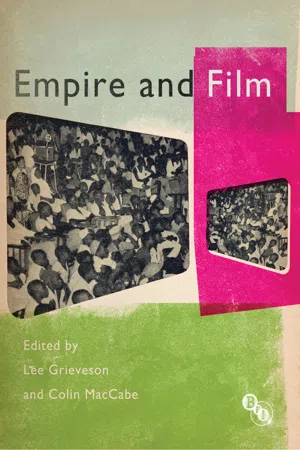
At its height in 1919, the British Empire claimed 58 countries, 400 million subjects, and 14 million square miles of ground. Empire and Film brings together leading international scholars to examine the integral role cinema played in the control, organisation, and governance of this diverse geopolitical space. The essays reveal the complex interplay between the political and economic control essential to imperialism and the emergence and development of cinema in the late nineteenth and first half of the twentieth century.
Contributors address how the production, distribution and exhibition of film were utilised by state and industrial and philanthropic institutions to shape the subject positions of coloniser and colonised; to demarcate between 'civilised' and 'primitive' and codify difference; and to foster a political economy of imperialism that was predicated on distinctions between core and periphery. The generic forms of colonial cinema were, consequently, varied: travelogues mapped colonial spaces; actuality films re-presented spectacles of royal authority and imperial conquest and conflict; home movies rendered colonial self-representation; state-financed newsreels and documentaries fostered political and economic control and the 'education' of British and colonial subjects; philanthropic and industrial organisations sponsored films to expand Western models of capitalism; British and American film companies made films of imperial adventure. These films circulated widely in Britain and the empire, and were sustained through the establishment of imperial networks of distribution and exhibition, including in particular innovative mobile exhibition circuits and non-theatrical spaces like schools, museums and civic centres. Empire and Film is a significant revision to the historical and conceptual frameworks of British cinema history, and is a major contribution to the history of cinema as a global form that emerged amid, and in dialogue with, the global flows of imperialism.
The book is produced in conjunction with a major website housing freely available digitised archival films and materials relating to British colonial cinema, www.colonialfilm.org.uk, and a companion volume entitled Film and the End of Empire.
- 304 pages
- English
- ePUB (mobile friendly)
- Available on iOS & Android
eBook - ePub
Empire and Film
About this book
Information
1
‘To take ship to India and see a naked man spearing fish in blue water’: Watching Films to Mourn the End of Empire
Colin MacCabe
I might have called this introductory essay ‘Never Apologise, Never Explain’. That was the advice offered by the late nineteenth-century Master of Balliol, Benjamin Jowett, to the young men whose education he oversaw, when the time came for them to leave the college and sally forth to rule the empire.1 I must confess to a sneaking regard for the maxim. In an era where apologetic confession has become a dominant genre across domestic and public life, I prefer as a virtue the Stoic recognition of error. And as for explanation, there is so much of our lives to which T. S. Eliot’s words about the impossibility of explanation apply: ‘I can’t tell you, not because I don’t want to but because I cannot find the words to express it.’2 And yet if it is possible to construe Jowett’s maxim in positive fashion, it must also be admitted there is no more concise summary of the certainty that is perhaps the most seductive of imperialism’s pleasures – to always be right, to be transported to a realm in which doubt is impossible. However, that pleasure should always be trumped by the even greater intellectual pleasure of getting it wrong, by the tremendously exciting possibility of failure. No intellectual inquiry is of much interest if its outcome is known in advance.
The research project of which this book Empire and Film and its companion volume Film and the End of Empire are a part risked failure at three very different levels. The initial task was to provide a catalogue for the films representing British colonies held in three different institutions: the British Film Institute, the Imperial War Museum and the British and Empire Commonwealth Museum. This catalogue was dependent on getting academics and archivists to work together. This, at least in principle, is about as advisable as throwing a set of cats into a sack. Archivists famously hate academics and academics despise archivists. Academics tend to regard archivists as dim troglodytes difficult to tempt from the underground dungeons in which they hoard treasures that they do not fully appreciate. Archivists tend to regard academics as arrogant ignoramuses; parochial in their intellectual interests, and incapable of understanding the long-term value of the material they are studying. It has to be said that both are, of course, right. Archivists conserve material so that future generations can find in it meanings which are not yet apparent to us, academics are concerned to interpret that material in terms of the meanings that are pressingly evident to them. My decade as Head of Research at the British Film Institute from 1989 to 1998 had given me a good understanding of both perspectives and I felt that it was of importance for the future of film studies to show that genuine collaboration between these two fundamentally different approaches was possible. June Givanni’s work at the BFI for Africa 95 had also made me aware of a rich corpus of colonial films that had not been fully catalogued and whose very existence was known to only a handful of scholars. When it became possible to add the complementary holdings of the Imperial War Museum and the British Empire and Commonwealth Museum, it seemed clear that we had a perfect example of a corpus that needed collaboration between academics and archivists to make it available for wider study both by academics and by a more general public.
The primary task was to prepare a catalogue and one thing that a catalogue promises is completeness. Let us be clear that such completeness is always misleading for it promises a sufficiency that it cannot deliver. You probably don’t have to be a pupil of Derrida or of Godel to appreciate the theoretical point. If one promises a catalogue raisonnée of Picasso, and it should be said that just such an art-historical genre was one of the models that the research team considered at the beginning of its work, one is assuming an importance for the individual artist that may be very misleading. Would a catalogue raisonnée of Picasso, Matisse and Braque 1906–14 not be more complete, or one that linked Picasso’s work to the African art that was so powerful an influence and so on literally, if we talk theoretically, to infinity.
However, in committing itself to a catalogue the project had to opt for the vernacular of empiricism and to eschew the more complex questions of theoretical tongues. If we were to compile a catalogue then our first job was to establish a corpus. Our initial parameter was given by the holdings of the three archives with which we were working. First, the British Film Institute, which held many of the state-funded policy and educational films shot in the colonies. Then the Imperial War Museum with its unparalleled holdings in the field of conflict. These included, most importantly, footage from World War I that ruined for ever any claims of the superiority of European civilisation and World War II when the empire rallied to the anti-fascist flag on the explicit understanding that it was assisting at the end of empire. But it also included a wealth of material from, to take merely two examples, Palestine at the time of the mandate and Malaya during the Emergency, which illustrated the centrality of conflict to the empire throughout the twentieth century. Finally, the holdings of the British Empire and Commonwealth Museum completed these largely public holdings with some 800 home movies shot by those who administered Britain’s colonies – a domestic record of empire.
The first definition of the corpus was thus given institutionally – we were looking at films held in these three institutions as the research project started at the beginning of October 2007. The institutions were determined by funding. It would of course make much more sense for this project to have been an international one. But, despite what the papers tell you, globalisation is not a recent event. It begins more than 500 years ago with Da Gama’s rounding of the Cape and Columbus’s crossing of the Atlantic. Indeed my dear dead colleague Paul Hirst used to argue that the international capital flows in the period leading up to World War I were a much more significant form of financial globalisation than more recent developments.3 Certainly the distribution of film was much more globalised in this decade than at any time later in the twentieth century.4 Hirst also argued very persuasively that the power of national governments has not been significantly weakened by the most recent wave of globalisations. What is certain is that our research was funded nationally and the most important definition of the corpus was determined by the national institutions that were our partners in the bid. It should be stressed that at every stage we were more than conscious of the international dimensions of our work and that we made every effort that we could to internationalise the perspectives on our research. Indeed, the two concluding conferences in London and Pittsburgh in July and September 2010 represented a major element in this effort. Even more crucial to that effort is the publication of the proceedings of those conferences. However, it is important to stress the national nature of our funding and the extent to which that determined our corpus. To develop fully the work begun with the catalogue and website will require the full participation of former colonies. The fact that the primary outcome of this research will be a globally available website, one with access to thirty hours of digitised film, removes some if not all of the material obstacles to such participation and one can hope it will stimulate interest across the full range of the former colonies. From another perspective the research would benefit from complementary work with the other former European empires. The Portuguese, the Dutch, the French, the Belgian, the German (I cite them in chronological order) all have similar archives and a comparative study would, I think, prove both fascinating and illuminating. But if the national nature of the corpus was given, there were further choices that were, more consciously, ours.
The two most important deliberate choices were the following: 1) to limit ourselves to celluloid rather than video; and 2) to opt for a juridical definition of the colonies in the definition of the films that we would catalogue. The choice of film rather than television was centrally governed by the research time at our disposal. Almost all significant colonies had achieved independence by 1965 and the video record was meagre. Both the war over the Malvinas/Falklands in 1982 and Hong Kong in the period leading up to China’s resumption of sovereignty in 1997 had left a huge video archive that was beyond our resources to catalogue properly. Second was the vexed question of whether we should include the Dominions within our corpus. The decision against was again partly dictated by available resources, but just as the post-65 colonies fell outside the clear period of colonialism and de-colonisation, so the Dominions with their very different relations both to Britain and their own indigenous populations seemed to constitute a different set of political and cultural relations.
If these two axes of selection combined economic necessity and cultural analysis, two further choices seem much less justified. By opting for a juridical definition of a colony, we excluded all of South America apart from Guyana and yet on both economic and cultural grounds, it might be argued that a country like Argentina was just as closely bound to Britain as colonies in other parts of the globe. Perhaps even more serious: why accept the formal achievement of independence as a crucial break in the filmic record? Surely it is just as interesting to see what transformations attend these political changes. Here, most importantly, resources and funding were determining: our designated archives held almost no post-independence films and with only two postdoctoral researchers and effectively no travel budget we felt that this research would be dependent on inter-archival co-operation. When we started we had optimistic views of similar research projects running concurrently with our own. These hopes proved unrealistic but it cannot be stressed too strongly that our project marks only the first stage of what must be an international process if it is to achieve its most ambitious intellectual goals. The establishment of the website and the publication of these volumes is simply the first stage in a work that must involve the archives of the former colonies and further reflection from former colonies if it is to achieve genuine fruition.
These conscious decisions did produce the first requirement of a catalogue, that is a defined corpus: more than 6,200 films from over fifty colonies with 2,900 titles at the IWM, including a large number of rushes, 2,500 at the British Film Institute and 800 at the British Empire and Commonwealth Museum. The corpus constituted, we now had to fulfil our most precise intellectual aim and here I quote from the original Arts and Humanities Research Council (AHRC) bid: ‘to offer a model of collaboration between archives and universities integrating international standards of cataloguing with production of academic knowledge at the highest level’. It is worth noting, in this context, that it was a conscious aim of the project to recruit researchers who were not only versed in film studies but who had qualifications and competences across the range of the humanities and social sciences: history, anthropology, art history, cultural studies, music studies and more.
The decisions on the constitution of the corpus occupied some two weeks, but it took us a further three months to settle on the form of the catalogue. In addition to the basic cataloguing that was intended for all titles, we wished to produce a form of enhanced catalogue entry that would guide any future researchers or teachers and that would open up a relatively closed and specialised collection to much wider audiences.
We did not aim to provide enhanced entries for all titles both because of the labour involved and because the archivists, who at that stage knew the collection better than anyone, felt that there was a great deal of repetition of date, region and genre. It was decided initially that we would attempt to produce enhanced entries for 10 per cent of the collection that we then calculated at 6,000 films. In fact, as we began to explore the corpus, we discovered that it was slightly larger than we thought but more repetitive. It also became clear that there were a number of institutions that warranted completely separate and much longer entries (the Colonial Film Unit and the multiple national film units that it spawned; the Empire Marketing Board and the Central Office of Information would be three such examples). We therefore in the second year, in consultation with the AHRC, revised our target of enhanced entries to 5 per cent or 350 (in fact, the figure is slightly higher) and added some twenty plus topic entries to our targets.
It should be said that these enhanced entries remain the core of the research project and it is probably worth saying something about their structure. Each film has, in addition to the basic cataloguing information, a 1,000-word entry, the length determined both by the time and labour of writing and the time and labour of reading. The entry is divided into two parts: context and analysis. The context section is itself divided into two; the first providing an account of the film’s context in terms of the film institutions that produced it; and the second concentrating on the political, social and historical backdrop. The analysis that follows focuses on the film’s form and genre to produce a preliminary reading of the film. Theoretically, of course, such divisions are suspect. It is an axiom of film theory that the frame is an integral part of the image and thus to divorce the context from the analysis is already to operate a spurious distinction. Further to attempt to divide the specifics of film history from the wider industrial, economic, political and ideological history of capitalism is to misunderstand how film is woven into the fabric of imperialism. From the Hays Code to the Blum Byrnes agreement – what might seem discrete events in an industrial history rapidly reveal themselves, on any serious inspection, as key moments in wider social, political and economic developments.5 Notwithstanding these arguments, we felt that, to make the catalogue of more practical use, a division should be observed between discrete industrial history and wider historical processes, which future users could deconstruct in more complex analyses. While perhaps even more conscious of the provisionality of the line between context and text, we felt again, within the limits of the catalogue, that it was valuable to include a discrete analysis of each chosen film although we were well aware that the analysis section was of necessity more personal than the context. That is one of the reasons all entries have initials to identify their author. Let me take one such film, District Officer (1945), and consider its entry both as example and to lead us into more complex arguments about the value of this collection and to consider more difficult questions of success and failure.6
CONTEXT
District Officer was ...
Table of contents
- Cover
- Title Page
- Contents
- Notes on Contributors
- Acknowledgments
- 1. ‘To take ship to India and see a naked man spearing fish in blue water’: Watching Films to Mourn the End of Empire
- Early Cinematic Encounters with Empire
- The State and the Origins of Documentary
- Colonialism and the Representation of Space
- African Experiments
- Index
- eCopyright
Trusted by 375,005 students
Access to over 1.5 million titles for a fair monthly price.
Study more efficiently using our study tools.
Frequently asked questions
Yes, you can cancel anytime from the Subscription tab in your account settings on the Perlego website. Your subscription will stay active until the end of your current billing period. Learn how to cancel your subscription
No, books cannot be downloaded as external files, such as PDFs, for use outside of Perlego. However, you can download books within the Perlego app for offline reading on mobile or tablet. Learn how to download books offline
We are an online textbook subscription service, where you can get access to an entire online library for less than the price of a single book per month. With over 1.5 million books across 990+ topics, we’ve got you covered! Learn about our mission
Look out for the read-aloud symbol on your next book to see if you can listen to it. The read-aloud tool reads text aloud for you, highlighting the text as it is being read. You can pause it, speed it up and slow it down. Learn more about Read Aloud
Yes! You can use the Perlego app on both iOS and Android devices to read anytime, anywhere — even offline. Perfect for commutes or when you’re on the go.
Please note we cannot support devices running on iOS 13 and Android 7 or earlier. Learn more about using the app
Please note we cannot support devices running on iOS 13 and Android 7 or earlier. Learn more about using the app
Yes, you can access Empire and Film by Lee Grieveson, Colin MacCabe, Lee Grieveson,Colin MacCabe in PDF and/or ePUB format, as well as other popular books in Mezzi di comunicazione e arti performative & Storia e critica del cinema. We have over 1.5 million books available in our catalogue for you to explore.