eBook - ePub
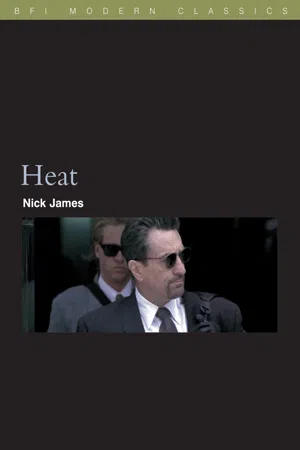
Heat
About this book
Robert de Niro and Al Pacino have acted opposite each other once, and that was in Heat, Michael Mann's operatic 1995 heist thriller. De Niro is Neil McCauley, a skilled professional thief at the centre of a tight-knit criminal team; Pacino is Vincent Hanna, the haunted, driven cop determined to hunt him down. Boasting a series of meticulously orchestrated setpieces that underline Mann's sense of scale and architecture, Heat is also a rhapsody to Los Angeles as Hanna closes in on his prey. For Nick James, the pleasures and virtues of Heat are mixed and complex. Its precise compositions and minimalist style are entangled with a particular kind of extravagant bombast. And while its vision of male teamwork is richly compelling it comes close to glorifying machismo. But these complexities only add to the interest of this hugely ambitious and accomplished film, which confirmed Mann's place in the front rank of American film-makers.
Information
1 Heat – A Bully of a Film
I’d like to know what’s behind that grim look on your face.
Diane Venora’s Justine to Al Pacino’s Vincent Hanna
It was in 1996, at the Warner West End cinema (now the Warner Village) on Leicester Square, that Heat was previewed for the UK magazine press and I saw it for the first time. I want to recall the circumstances of that screening because Heat, as one of its characters might say, ‘goes deep with me’. Its treatment of work, destiny and male identity – themes rehearsed with fierce solemnity by its two stars Robert De Niro and Al Pacino – moves me to a stronger degree than anything in most of the art-house films of the 1990s. Yet this admiration for Heat is not easy to justify, not so much because the film is a violent portrait of a criminal crew and their relentless cop pursuer, one that celebrates machismo when I hope I’m usually looking for a cinema of sensitivity and maturity, but more because, in its ambition to be a tragic crime epic of the plazas, back lots and intersections of L.A., it often comes close to overkill.
Writer-director Michael Mann’s script uses a rhetoric of existential motivation that’s sometimes so hectoring it’s like being prodded incessantly in the chest. Yet this threatening up-closeness is all of a piece with the mood of troubled masculinity. You’re meant to be uncomfortable with these men because their directness is defensive, and you can tell that underneath their bravado they are twitchily uncomfortable with themselves. Pomposity and self-righteousness are as much a part of their armoury as automatic weapons.

Night train in the mist
Another obstacle to Heat’s claims to be a modern classic is the script’s earlier manifestation in the television movie L.A. Takedown (1989). At times, reminders of this network television progenitor – a gaudy come-on to the epic movie’s sombre pleasures – make it hard to revere Heat as more than an exaggerated heist movie.
But, as I hope I will show, Heat is much more than that and in 1996 it thrilled me (and not for the last time). Waiting for the film to start, many of the male reviewers around me were anxious to be impressed. Mann had by then become a respected figure for action buffs, with such cult successes as Thief (1981), Manhunter (1986) and The Last of the Mohicans (1992). The film cognoscenti were also present at the screening: archivists, historians and BBC programmers. As the film started, the high brightness of the projection made it hard to forget those around me. (A friend hadn’t shown up. The tension of waiting jangled with the mood of submission.) You could almost hear the fans in black T-shirts muttering, ‘Michael, please don’t fuck it up.’
I admit, I had a similar predisposition and it may be that an indulgent atmosphere aids the enjoyment of such a grim-faced film, because it helps the viewer to go along with the strident insistence of its two protagonists, the thief and the thief-taker, on the purity of their lethal trades. By five minutes in, the film’s dazzling craft had banished all my peripheral anxiety. The bombastic dialogue seemed only appropriate to the single-minded élan of the project. Heat’s opening scenes are so exactly composed, yet so riven with suspense, they envelop the viewer, sealing absolute attention. They are worth describing in detail.
Through flurries of steam a night train glides towards us. It has three headlights like the dots on dice, one above two below, and it bears the legend ‘Los Angeles’. The keening string music we hear over the credits and throughout this scene is set at such a low volume it feels as if there’s a sound level problem. Then the train brakes screech loud.
The wide-angle reverse shot that succeeds the opening shot reveals an elevated station of elegant recent design, with the train now squeezing away from us to a halt. The shot treats the track lines and the station’s contours – pierced from below by a stake-like escalator well – as near-abstract elements. These shots set such a high standard of pictorial quality that already the viewer is confident of watching an exquisitely designed film. (Any sudden foreground sound throughout this hushed opening sequence has that heightened, intrusive quality experienced in the murmur of early morning.) And symbolically we might be aware that we are about to watch a film about two characters who run along set rails through the night, unable to deviate.
Alighting from the train is Neil McCauley (played by Robert De Niro). Wary but determined, dark hair neat and sleek, goatee beard trimmed very close, he is wearing a grey boiler suit with the collar turned up. We see him descend the escalator, which seems unusually steep, his eyes flicking left and right, a folder in his left hand. As he heads for the hospital across the street, an overhead shot registers another abstract element – a road marking in the form of a stubby curved arrow placed centre screen and pointing towards the top right – which McCauley crosses diagonally in the opposite direction. With casual assurance he strides past a statue in the courtyard (a pietà, which prefigures the film’s ending), through the ER unit, past computer banks and gory surgical scenes in side rooms, and out to the parking bay, where he steals an ambulance. Immense self-control and efficiency are expressed by his every move. His precision mirrors that of the film itself when in its procedural mode: simple, pared-down, Mellevillian action.
In a construction goods yard in bright morning sunlight, a shrewd-looking elderly sales clerk in a crash helmet and pebble-thick glasses lays a casket marked ‘explosives’ on a desk for his young pony-tailed customer. The customer, Chris Shiherlis (Val Kilmer), shows him an Arizona driving licence and the deal is done.
Vincent and Justine, a well-preserved middle-aged couple (we recognise Al Pacino as Vincent and maybe Diane Venora as Justine), make tentative early morning love in bed in a modern, hi-tech house. Vincent showers and then Justine, enjoying a post-coital cigarette, asks if he’s taking her somewhere for breakfast – he can’t, he says, because he’s meeting ‘Bosko’. Justine’s pre-teen daughter Lauren (Natalie Portman) is near hysterical because her natural father is half an hour late to pick her up and she can’t find her barrettes. Justine tries to calm her, having herself already swallowed a handful of Prozac.
A muscular, long-haired man wearing wrap-around shades and a grubby black T-shirt (Kevin Gage) exits the toilet of a Mexican café and asks at the counter for a drink refill. Seeing a huge green Persill recovery truck pull up, he runs towards it and clambers up to the door. The tough-looking driver blocks him and asks him his name. ‘Waingro’, he says and is let in. He asks the driver, Michael Cheritto (Tom Sizemore), about the ‘real tight crew’ he’s working with today. Cheritto says, ‘Stop talking would you slick?’ Waingro removes his shades and stares at him as if answering a challenge, but Cheritto doesn’t notice.
We see McCauley waiting in the ambulance with Shiherlis beside him. A moustachioed Latino man, Trejo (Danny Trejo), calls on a walkie-talkie from his car: he’s tailing the target armoured truck, giving a precise run-down as to when it will appear at the chosen spot. It is seconds away. McCauley switches on the ambulance siren and pulls in front of the truck. Cheritto guns his recovery truck into life. It builds up speed as it runs beneath the freeway. Cheritto’s rig slams into the armoured truck with such force it upsets the truck onto its side, shoving a whole row of dealer cars several feet back. There’s a moment’s pause as a severed strip of the dealer’s blue bunting gently descends.
The crew, in metal ice-hockey masks, bulletproof vests and carrying automatic weapons, run to surround the truck, waiting to put a stopwatch on as soon as they hear the police alarm call given out on the radio. Shiherlis (the only one wearing a black mask instead of white) positions an explosive shape charge on the door, stands back and sets it off. The impact shatters the windscreens of the dealer cars. McCauley goes inside and hustles out the three guards whose ears are leaking blood and wax. Waingro guards them while Shiherlis rifles through the packages. Trejo runs a line of tyre-slashers across the street.
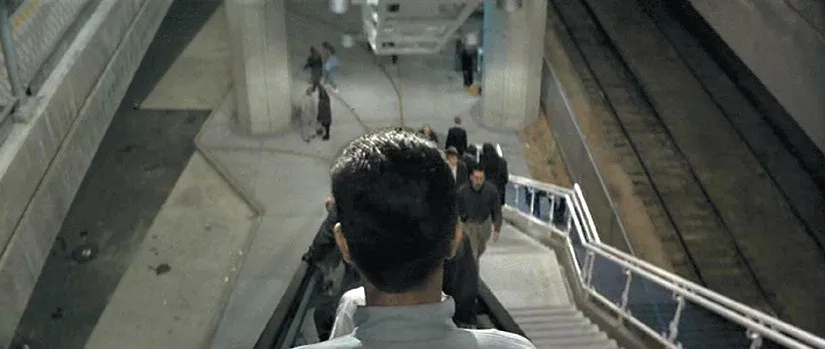
McCauley descending
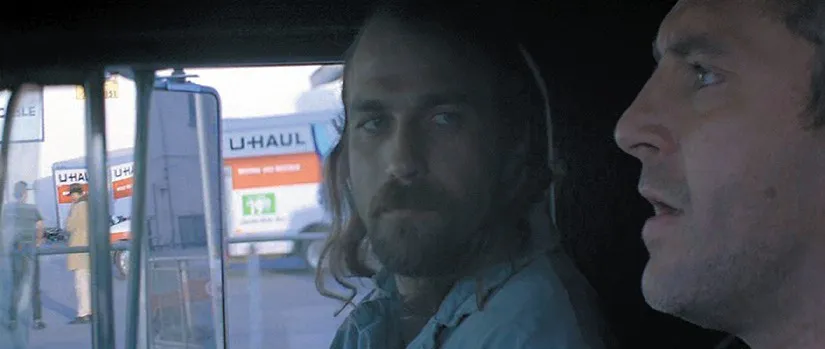
Waingro stares at Cherrito
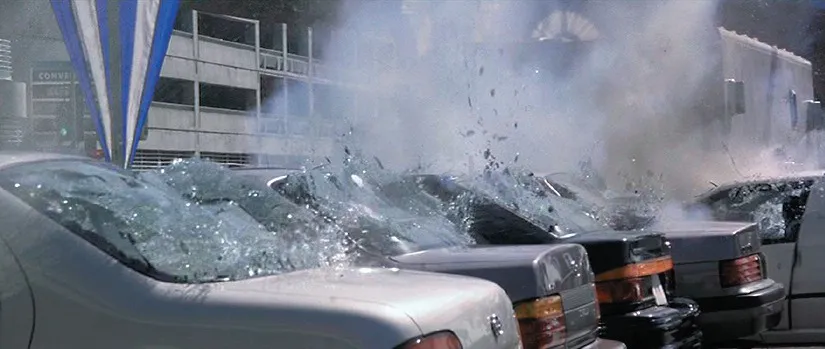
The windscreens shatter
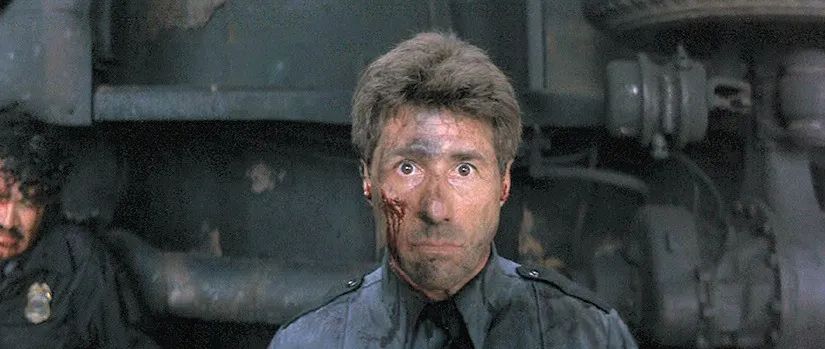
The staring guard
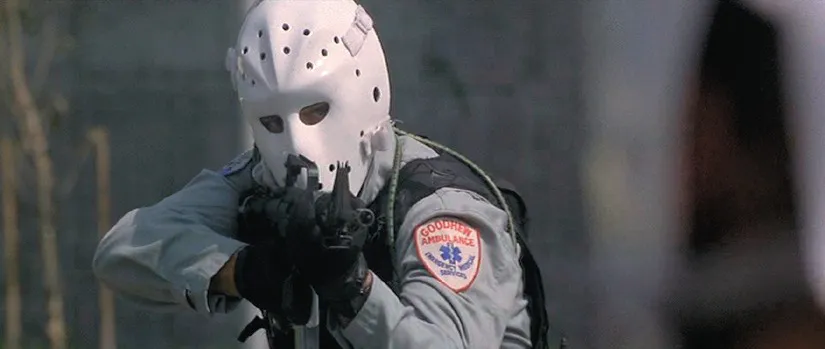
McCauley orders the execution
Waingro, irritated by the wide-eyed stare of one of the guards, pistol-whips him. ‘Cut that out would you slick,’ Cheritto tells him, pointing out that the guards can’t hear him because their eardrums have burst. As soon as Shiherlis finds the package he runs to the ambulance; the others are about to do the same when Waingro, still spooked by the guard’s stare, shoots him dead. A second guard then goes for a concealed pistol and is gunned down. Cheritto has the third unarmed guard in his sights, McCauley nods and Cheritto executes him.
As the crew take off their overalls in the ambulance, McCauley disarms Waingro and demands to know what happened. The tyre shredders take out patrol cars arriving at the scene. A few blocks away the crew abandon the ambulance. Shiherlis sets fire to it with all the costumes, weapons and equipment inside.
What was so remarkable about this in 1996? I was immediately impressed by how seriously Mann took this genre subject and by the expense lavished on the film’s look of heightened realism. The criminal crew here seems as efficient and well resourced as a Special Forces military unit but the illusion of plausibility holds. Despite the automatic rifles, bulletproof vests, steel masks and the like, you never feel as if you’re watching a James Bond film. The criminals give off an air of businesslike neatness (the psychopathic Waingro excepted). They are yuppie villains, whose tidy approach to armed robbery seems to match the 1990s idea of minimalist chic. None of them displays the overt muscularity common to action-movie heroes and villains of the time. Their use of explosives is discreet: designed expressly to avoid the great orange cinematic explosions that are such a signature in the films of Mann’s producer contemporaries such as Don Simpson, Jerry Bruckheimer and Joel Silver. The shape charge on the truck is felt as pressure, shattering eardrums and windscreens, not seen as pyrotechnics – even the torched ambulance belches flame without disintegrating.
There’s time amid the finger-snapping rush of a suspenseful heist for Mann to include that one moment of calm when the bunting drifts down.
The sound, movement and e...
Table of contents
- Cover Page
- Title Page
- Dedication
- Contents
- Acknowledgments
- 1. Heat – A Bully of a Film
- 2. Michael Mann – Styling the Real Thing
- 3. ‘The action is the juice’
- 4. Blue Interlude
- 5. Drinking in the Dark
- 6. Face to Face
- 7. Concrete Canyons
- 8. Los Angeles
- Appendix – L.A. Takedown
- Notes
- Credits
- eCopyright
Trusted by 375,005 students
Access to over 1.5 million titles for a fair monthly price.
Study more efficiently using our study tools.
Frequently asked questions
Yes, you can cancel anytime from the Subscription tab in your account settings on the Perlego website. Your subscription will stay active until the end of your current billing period. Learn how to cancel your subscription
No, books cannot be downloaded as external files, such as PDFs, for use outside of Perlego. However, you can download books within the Perlego app for offline reading on mobile or tablet. Learn how to download books offline
Perlego offers two plans: Essential and Complete
- Essential is ideal for learners and professionals who enjoy exploring a wide range of subjects. Access the Essential Library with 800,000+ trusted titles and best-sellers across business, personal growth, and the humanities. Includes unlimited reading time and Standard Read Aloud voice.
- Complete: Perfect for advanced learners and researchers needing full, unrestricted access. Unlock 1.5M+ books across hundreds of subjects, including academic and specialized titles. The Complete Plan also includes advanced features like Premium Read Aloud and Research Assistant.
We are an online textbook subscription service, where you can get access to an entire online library for less than the price of a single book per month. With over 1.5 million books across 990+ topics, we’ve got you covered! Learn about our mission
Look out for the read-aloud symbol on your next book to see if you can listen to it. The read-aloud tool reads text aloud for you, highlighting the text as it is being read. You can pause it, speed it up and slow it down. Learn more about Read Aloud
Yes! You can use the Perlego app on both iOS and Android devices to read anytime, anywhere — even offline. Perfect for commutes or when you’re on the go.
Please note we cannot support devices running on iOS 13 and Android 7 or earlier. Learn more about using the app
Please note we cannot support devices running on iOS 13 and Android 7 or earlier. Learn more about using the app
Yes, you can access Heat by Nick James in PDF and/or ePUB format, as well as other popular books in Media & Performing Arts & Film & Video. We have over 1.5 million books available in our catalogue for you to explore.