- 190 pages
- English
- ePUB (mobile friendly)
- Available on iOS & Android
eBook - ePub
About this book
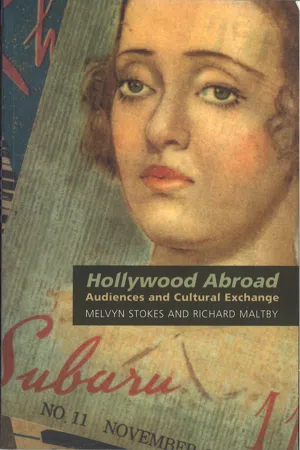
Hollywood Abroad is the first book to examine the reception of Hollywood movies by non-American audiences. Although numerous books on film history have analyzed the ways in which American films came to dominate world markets, there has so far been very little published work on how audiences outside the United States have responded to Hollywood-produced films. Hollywood Abroad explores the reception of U.S. films in Britain, France, Belgium, Turkey, Australia, India, Japan, and Central Africa. The book covers topics from the first major penetration of American films into France, Britain, and Australia to the impact of such films as The Best Years of Our Lives to the response of Belgian young people in the age of the multiplex. It demonstrates that the story of the reception of American films overseas is less one of domination than of a complex adoption of Hollywood into various cultures.
Information
1
The Reception of American Films in France, c. 1910–20
Raphaëlle Costa de Beauregard and Melvyn Stokes
In a recent study of how Hollywood films first came to dominate the French market, Jens Ulff-Møller listed four crucial factors: the failure of the French film industry to develop the same kind of strong vertical integration as its American competitors; the more restrictive application of cinema law in France compared to the US; the aggressive nature of American export trade policy and legislation after World War I; and the active support of the American government during the 1920s in helping encourage the export of Hollywood films.1 The first three factors had already been explored by numerous scholars.2 Ulff-Møller’s own work was dedicated to an examination of the fourth. Concentrating on economics, law, politics and diplomacy, these studies did not, however, directly address the key questions of how and why French audiences responded as favourably as they did to American films. The chapter which follows attempts to provide answers to these questions.
Any attempt to ‘bring the audience back in’ does, of course, require some discussion of the nature of the evidence available. Sadly, there is no French equivalent of Emilie Altenloh’s groundbreaking Sociology of the Cinema (1914), which gave much detailed information on contemporary German cinemagoing.3 In studying early French moviegoing, there are three principal sources of evidence. Newspapers catering to distinct sections of the reading public, such as Le Temps and Le Figaro, contain movie advertisements and, later, reviews. Trade journals such as Ciné-Journal and Le Courrier Cinématographique, directed mainly at film distributors and exhibitors, provide a second source of information, while specialist film journals such as the Le Film supply a third. Writers for these periodicals, such as Louis Delluc,4 played a major role in the exploration of the reasons why French audiences had developed a taste for American films.5 This chapter is based on the analysis of these varying sources.
It is by no means clear when American films first began to dominate the French market. Susan Hayward comments that it was partially because films originating in America ‘had garnered the popular cinema market’ that Charles Pathé switched in 1908 to making the more upmarket film d’art, based on productions by legitimate theatre and thus intended to appeal to a more middle-class audience.6 Other scholars have suggested that it was during the course of World War I – the early stages of which saw the virtual collapse of the French film industry – that American cinema established its hegemony. Examining newspapers and journals such as L’Illustration and Ciné-Journal, however, indicates that the true beginnings of the popularity of American film in France was during the period between 1910 and 1913.
Early French Cinema Audiences
Since French moving pictures were initially shown in vaudeville theatres, music halls (caf’conc’) and tents at local fairs, their spectators were mainly the working-class audiences drawn to such entertainments.7 By 1906, however, film was playing an increasingly significant role in live theatres and halls devoted only to showing films were appearing in larger numbers. ‘Every day a new movie theatre opens’, commented the Photo-Ciné-Gazette in April 1907.8Writing a few months later on the situation in Paris, novelist and critic Rémy de Gourmont underlined cinema’s growing ubiquity as an inexpensive form of entertainment:
the biggest theaters have now opened their doors. The Chatelet, the Variétés, and the Gymnase all now include cinema programs, and one can queue up at the small boulevard cinemas that specialize in them. The price is still reasonable everywhere. For two francs, you can have an orchestra seat, and for a franc you can still get a seat which in the theater would cost five or six times as much.9
Nearly five years later, ‘Yhcam’ (a pseudonym) also emphasised cinema’s appeal to the lower classes because of its cost and accessibility:
The cinema has allowed a huge number of people to satisfy their taste for the theater, a taste which they already had, but which the meagerness of their means did not allow them to satisfy.
Specifically, a person who could only go to the theater once on five francs can frequent the cinema five times, for the price of tickets is about five times less expensive.10
Jean-Jacques Meusy has commented on the appeal that the new cinema ‘palaces’ built after 1911 had for what was still an ‘essentially working-class’ clientele: ‘wasn’t it marvelous to be offered, for one franc or even less, entrance into a palace !’11 In 1913, Louis Haugmard, a journalist working for a Catholic weekly paper, deplored the fact that ‘many deconsecrated chapels are becoming cinema halls; and that is symbolic, if one realizes that, for an important segment of the working class, the cinema is already a “religion of the people” or, rather, “the irreligion of the future.”’12
Meusy has estimated that there were approximately 180 cinemas existing in Paris in 1913. Of these, many were located in such outlying working-class arrondissements as the 13th, the 14th, the 18th, the 19th and the 20th.13 The wealthier areas of western Paris had been much slower to acquire cinemas: the 16th acquired its first in December 1910 and the 8th only in 1913, when the Colisée opened on the Champs-Elysées.14 Yet, starting around 1906, Charles Pathé – followed by Léon Gaumont and others – had begun to open cinemas on the grands boulevards in Paris and later in provincial cities. These new halls attracted a more middle-class clientele – a process further encouraged by the emergence of a new kind of film: the so-called film d’art. Articulating ambition in their very name, these films were intended to appeal to a new middle-class audience by consciously associating themselves with forms of cultural expression already accepted by bourgeois opinion as legitimate forms of art: literature, theatre and music. The new type of film was to be based usually on literary adaptations (or historical reconstructions). It was to have its roots in the theatre, involving established stage directors (especially from the Comédie Française), writers, actors and scenic designers. It was also to involve music: L’assassinat du Duc de Guise (1908), the pioneering model for this new type of film, was released together with a musical score specially composed by Camille Saint-Saëns.15
The appearance of L’Assassinat du Duc de Guise was the signal for an attempt, on the part of some representatives of the French periodical and newspaper press, to construct two different kinds of audience: the popular one (‘la foule’), whose main aim was to be surprised and moved to tears of joy or sadness (often by family melodramas), and a more respectable, middle-class one that was thought to be able to appreciate more ‘artistic’ films. By 1910, the daily newspaper Le Figaro, catering for an upwardly mobile, mainly Paris-based readership, was making this distinction, at least implicitly. It printed only selective cinema programmes, recommending – usually with the description ‘artistique’ – films considered ‘high culture’ enough to be a suitable subject for intelligent conversation. More republican in its sentiments, the weekly L’Illustration celebrated – in its detailed account of L’Assassinat – the fact that this type of film was able to please ‘crowds where the most humble and the most refined people are jumbled together’.16
In some respects, this strategy of appealing to a wider audience through a new type of film worked well. In December 1911, George Dureau, editor of the trade magazine Ciné-Journal, noted that ‘the middle-bourgeoisie had become regular cinemagoers, attracted in particular by the various series of “artistic” films’.17 Looking back from the perspective of 1935, however, one writer saw the movement for the acquisition and acculturation of cinema by the educated classes as the true beginning of the downfall of French cinema. ‘People from the world of the Theatre and from the literary circles’, Robert de Beauplan alleged,
academicians such as Henri Lavedan, Le Bargy and a few others, had become aware that cinema was, or could be somewhat better than a mere vulgar entertainment and that ...
Table of contents
- Cover
- Title Page
- Contents
- Notes on Contributors
- Preface
- Introduction: ‘The Americanisation of the World’
- 1. The Reception of American Films in France, c. 1910–20
- 2. ‘A Great American Sensation’: Thomas Ince’s Civilization at the Palladium, Southampton, 1917
- 3. A Balanced Show: the Australian Picture Theatre Manager at Work in 1922
- 4. Cowboys, Jaffas and Pies: Researching Cinemagoing in the Illawarra
- 5. Hollywood and the Multiple Constituencies of Colonial India
- 6. ‘Home of American Movies’: The Marunouchi Subaruza and the Making of Hollywood’s Audiences in Occupied Tokyo, 1946–49
- 7. The Making of Our America: Hollywood in a Turkish Context
- 8. Popular Films and Colonial Audiences in Central Africa
- 9. ‘It’s the Language of Film!’: Young Film Audiences on Hollywood and Europe
- Index
- eCopyright
Trusted by 375,005 students
Access to over 1.5 million titles for a fair monthly price.
Study more efficiently using our study tools.
Frequently asked questions
Yes, you can cancel anytime from the Subscription tab in your account settings on the Perlego website. Your subscription will stay active until the end of your current billing period. Learn how to cancel your subscription
No, books cannot be downloaded as external files, such as PDFs, for use outside of Perlego. However, you can download books within the Perlego app for offline reading on mobile or tablet. Learn how to download books offline
Perlego offers two plans: Essential and Complete
- Essential is ideal for learners and professionals who enjoy exploring a wide range of subjects. Access the Essential Library with 800,000+ trusted titles and best-sellers across business, personal growth, and the humanities. Includes unlimited reading time and Standard Read Aloud voice.
- Complete: Perfect for advanced learners and researchers needing full, unrestricted access. Unlock 1.5M+ books across hundreds of subjects, including academic and specialized titles. The Complete Plan also includes advanced features like Premium Read Aloud and Research Assistant.
We are an online textbook subscription service, where you can get access to an entire online library for less than the price of a single book per month. With over 1.5 million books across 990+ topics, we’ve got you covered! Learn about our mission
Look out for the read-aloud symbol on your next book to see if you can listen to it. The read-aloud tool reads text aloud for you, highlighting the text as it is being read. You can pause it, speed it up and slow it down. Learn more about Read Aloud
Yes! You can use the Perlego app on both iOS and Android devices to read anytime, anywhere — even offline. Perfect for commutes or when you’re on the go.
Please note we cannot support devices running on iOS 13 and Android 7 or earlier. Learn more about using the app
Please note we cannot support devices running on iOS 13 and Android 7 or earlier. Learn more about using the app
Yes, you can access Hollywood Abroad by Melvyn Stokes,Richard Maltby in PDF and/or ePUB format, as well as other popular books in Media & Performing Arts & Film History & Criticism. We have over 1.5 million books available in our catalogue for you to explore.