- 208 pages
- English
- ePUB (mobile friendly)
- Available on iOS & Android
eBook - ePub
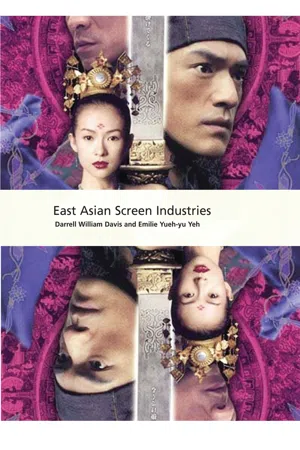
East Asian Screen Industries
About this book
East Asian Screen Industries is a guide to the film industries of Japan, South Korea, Taiwan, Hong Kong and the PRC. The authors examine how local production has responded to global trends and explore the effects of widespread de-regulation and China's accession to the World Trade Organisation.
Information
1
East Asian Benchmarks in Policy and Practice
The 1990s were times of deregulation and policies designed to prise open markets. In the global film industry, this process is particularly clear. In the past, East Asian countries imposed quotas and tax barriers to keep out foreign products under assumptions of economic and ideological protection. In 1965, South Korea’s military government introduced import limitations and a quota stipulating that exhibitors reserve at least sixty to ninety days per year for Korean films (Lee, 2000: 49). Taiwan limited foreign film exhibition to the circulation of only two prints at a time, until 1994. But East Asia’s long-term dependency on the US gave trade negotiators enough leverage to press South Korea, Taiwan and most recently China to open up. Asian protectionist measures were dismantled in the 1990s, bringing deregulation and relaxation toward imports. The shift created a window of opportunity (Curtin, 2003: 254), not only letting Hollywood access an enormous market, but also presenting a make-or-break chance for East Asian companies, based on wholesale restructuring of regional industries. This chapter describes the downfall of East Asian industries in the age of protectionism, followed by an account of specific attempts at redefinition and recovery.
If the downfall of protectionism was a boon for Hollywood, it brought confusion and disarray to the trade in Asian pictures. With strong competitive pressures, industrial mainstays – financing, stars, genres, distribution and marketing – faltered and once-viable national cinemas were in trouble. It would be mistaken to use an across-the-board diagnosis to explain why East Asian cinemas declined in their own territories. The reasons for their struggles vary, depending on specific political, economic and creative conditions in each industry. But we can offer three broad observations that frame an understanding of East Asia’s fall as a secure base for national cinemas.
First, there are always trade-offs in economic flows. East Asian national cinemas fell victim to overall high growth in the 1980s and 1990s. Trade negotiators used locally produced movies as a sector to balance huge surpluses with the US, on behalf of industry trade bodies like the Motion Picture Association of America (MPAA). US negotiators demanded that American pictures had an open portal to markets that had been protected by quotas, tariffs and levies imposed on foreign imports. Since 1990, Japan has been Hollywood’s largest foreign export market. This is not just because Japanese audiences love American pictures but also due to Japan’s maintenance of enormous trade surpluses. These have to be offset and managed for geopolitical as well as macroeconomic stability. Take Taiwan, for similar reasons. Since the late 1980s its economic engine has been driven by its electronics and information technology (IT) industries. To protect these, sectors such as agriculture, financial services and film production – areas in which Taiwan had been self-sufficient – were sacrificed. Trade barriers to these sectors were dismantled and since the 1993 General Agreement on Tariffs and Trade (GATT), Hollywood films enjoyed a steady 70–75 per cent share of the Taiwan market, and in recent years well over 90 per cent (Yeh, 2006: 159). Taiwan’s screens were deluged by Hollywood films partly because of the island’s success as a net exporter of IT hardware. Annual production averaged over 200 local films in the 1970s and over 100 in the 1980s. Table 1.1 shows the decimation of a once-robust national cinema.
| Year | Taiwan film releases | Non-Taiwan film releases (Hollywood, Hong Kong, Asian and European) |
| 1995 | 18 | 454 |
| 1996 | 23 | 230 |
| 1997 | 18 | 304 |
| 1998 | 15 | 309 |
| 1999 | 11 | 306 |
| 2000 | 19 | 273 |
| 2001 | 10 | 212 |
| 2002 | 16 | 250 |
| 2003 | 15 | 264 |
| 2004 | 23 | 236 |
| 2005 | 26 | 288 |
| 2006 | 17 | 294 |
Sources:
Data compiled from Cinema in the Republic of China Yearbook (1996–2006) and TPBO WRETCH (2006).
Table 1.1 Screen Share in Taiwan (1995–2006)
Second, if Asian high economic growth in the 1980s and 1990s primed the pump for foreign product, there was sluggish, often inept response to imports. As distributors and audiences embraced imports in a newly deregulated environment, local producers were unprepared, having sheltered under longstanding protectionism. Complacent film industries of East Asia were slow to cope with the aggressive entry of foreign marketing. Their structural rigidity made them incapable of handling new challenges, including aging theatres, antiquated publicity campaigns, accelerating piracy, poor production values, overproduction and – thanks to more liberal trade rules – the novelty of extravagant Hollywood blockbusters. American businessmen exploited Asian internal weaknesses while at the same time pressing for further access on grounds of deregulation and trade liberalisation.
From the postwar period through the 1980s, domestic Asian industries were sustained by fairly stable separation of locally made and foreign films. Distributors and exhibitors were consistently attached to large studios to ensure regular supplies of genre pictures, serials and occasional specials. Like any goods supplier, distributors for Asian genre pictures brought these to market on screens devoted to Asian films, while American films would play in separate venues. There was little crossover or overlap between distinct markets. Often, vertical integration let the same firms handle production, distribution, exhibition and marketing. As for audiences, a Japanese viewer of yakuza crime pictures in the 1960s was unlikely to go to see Bonnie and Clyde (Warner Bros., 1967). Chinese audiences for opera films were not in the habit of attending MGM musicals. In the 1990s, these boundaries between audiences for domestic films and those for imports collapsed. Imports by this time lost their foreignness, as mainstream audiences in East Asia acquired a taste for Western movies, multiplexes and marketing practices.
Also, East Asian genre systems have been poorly maintained. This is related to the depletion of established formulae needed to sustain individual industries. Genres specific to East Asian popular cinema such as Japanese yakuza, period pictures (jidai geki, samurai films), Hong Kong martial arts and Taiwan’s romantic melodramas (wenyi pian) were all industrial mainstays, but due to overproduction and competition from TV they lost ground in the 1990s. The difficulty of maintaining popular, local genres prevented the growing of new talent and shortened the lifespan of established stars reliant on genres. (Further discussion of East Asian genres follows in Chapter 5.) Worse, production and exhibition facilities were not sufficiently upgraded to make films with production values and showmanship comparable to imported movies. Furthermore, decades-old advertising schemes were incapable of keeping up with contemporary marketing campaigns characterised by tie-ins, merchandising and clever product placements. Even in mainland China, the state-run film industry was suffering. Production fell from a peak of 166 feature films in 1992 to only seventy-one in 2001. This was a drop of 57 per cent in less than ten years. This was due to poor management and co-ordination across different industry sectors. Deteriorating exhibition facilities and stale content turned the audience away and saw them opt for pirated videos of Hong Kong films over quality domestic production. See Table 1.2 for the fluctuating numbers.
| Year | Films Produced |
| 1991 | 124 |
| 1992 | 166 |
| 1993 | 154 |
| 1994 | 148 |
| 1995 | 146 |
| 1996 | 110 |
| 1997 | 85 |
| 1998 | 82 |
| 1999 | 99 |
| 2000 | 83 |
| 2001 | 71 |
| 2002 | 100 |
| 2003 | 140 |
| 2004 | 212 |
| 2005 | 260 |
| 2006 | 330 |
Sources:
China Film Yearbook (1991–2005) and China Film Market (Jan. 2006).
Table 1.2 China’s Annual Feature Film Production (1991–2006)
These industrial and structural problems, given the protected segregation of East Asian screen industries, were heightened when investment was disrupted by the 1997 Asian financial crisis. Capital for film production dried up, unavailable due to losses in the stock and currency markets. This caused a fall in numbers of films produced in Hong Kong, Taiwan and South Korea. The drop in Hong Kong production also hastened the collapse of Chinese-language markets in Taiwan and Southeast Asia that for years had depended on Hong Kong films. Late in 1997, Titanic (dir. James Cameron) was launched worldwide, swamping in its wake entire flotillas of once-popular local films. Even the People’s Republic of China, the ardent bulwark against ‘capitalist spiritual pollution’, was drawn into the sinking ship’s maelstrom. Former President Jiang Zeming openly praised the film for its promotion of a noble, uplifting spirit. Responding to Jiang’s endorsement, all work units ushered people to the decks of Titanic, on screens public or private. Since then, China succumbed to this cinematic onslaught, prompting calls to appropriate Hollywood business models and modes of production, with sporadic government backing. China, like the rest of East Asia, was inspired by the Hollywood mode, and by blockbusters such as Titanic. Indeed, debates about the concept and uses of blockbusters have arisen, not only in China but around the region. As Chris Berry notes:
In both the People’s Republic of China and the Republic of Korea, the rise of blockbuster consciousness is linked to dismantling trade protectionism under intense lobbying from the US and using levers such as ‘most favored nation’ trading status and access to the World Trade Organization. (Berry, 2003a: 218)
Despite this tremendous pressure, both internal and external, there are striking examples of using the opposition to reclaim lost national markets. These come from three very different practices. In South Korea, the state crafted a cinema boom resulting from capitalist incentives for commercial reinvention of national cinema. The second approach is more laissez-faire. It carefully structures international co-operation between Chinese cosmopolitans and Hollywood majors, exemplified by Ang Lee’s Crouching Tiger, Hidden Dragon. This pan-Chinese production set a standard and model for East Asian recovery of regional markets and success in the global film business. The third instance comes from Hong Kong, a local trilogy with unexpectedly high production values and regional influence. These three cases can be called ‘benchmarks’ because they have inspired numerous analyses and imitations. The benchmark idea is not just breaking box-office records, but establishing new patterns for further, long-term activity. Benchmark films may be blockbusters, but not every blockbuster is a benchmark. Executives in numerous East Asian industries take benchmarks as templates, or bearers of future possibility. They are not just economic possibilities but potential synergies, opportunities for new configurations of cultural and financial capital. East Asian benchmarks are outcomes of regional diversity and accommodation within international norms of production and consumption. Benchmarks are not simply Western franchises, ruthlessly homogenising indigenous film craft, but judicious appropriation, blending resistance and assimilation within the global distribution system. Some contemporary industries have successfully capitalised on benchmarks, establishing practical ways of building viable production lines. Three practices – South Korean, pan-Chinese and Hong Kong – provide an understanding of the axis of film policy, Hollywoo...
Table of contents
- Cover
- Title Page
- Contents
- Acknowledgments
- Introduction
- 1. East Asian Benchmarks in Policy and Practice
- 2. The New Localism: Alternatives to Blockbuster Benchmarks
- 3. The Power of Small Screens
- 4. Pan-Asian Cinema: Finance, Marketing, Distribution
- 5. Genre/Nation: Cultural Commerce and Signature Narratives
- 6. Festivals, Events and Players
- Epilogue: Problems and Prospects for East Asian Screens
- References
- Index
- List of Illustrations
- eCopyright
Trusted by 375,005 students
Access to over 1.5 million titles for a fair monthly price.
Study more efficiently using our study tools.
Frequently asked questions
Yes, you can cancel anytime from the Subscription tab in your account settings on the Perlego website. Your subscription will stay active until the end of your current billing period. Learn how to cancel your subscription
No, books cannot be downloaded as external files, such as PDFs, for use outside of Perlego. However, you can download books within the Perlego app for offline reading on mobile or tablet. Learn how to download books offline
Perlego offers two plans: Essential and Complete
- Essential is ideal for learners and professionals who enjoy exploring a wide range of subjects. Access the Essential Library with 800,000+ trusted titles and best-sellers across business, personal growth, and the humanities. Includes unlimited reading time and Standard Read Aloud voice.
- Complete: Perfect for advanced learners and researchers needing full, unrestricted access. Unlock 1.5M+ books across hundreds of subjects, including academic and specialized titles. The Complete Plan also includes advanced features like Premium Read Aloud and Research Assistant.
We are an online textbook subscription service, where you can get access to an entire online library for less than the price of a single book per month. With over 1.5 million books across 990+ topics, we’ve got you covered! Learn about our mission
Look out for the read-aloud symbol on your next book to see if you can listen to it. The read-aloud tool reads text aloud for you, highlighting the text as it is being read. You can pause it, speed it up and slow it down. Learn more about Read Aloud
Yes! You can use the Perlego app on both iOS and Android devices to read anytime, anywhere — even offline. Perfect for commutes or when you’re on the go.
Please note we cannot support devices running on iOS 13 and Android 7 or earlier. Learn more about using the app
Please note we cannot support devices running on iOS 13 and Android 7 or earlier. Learn more about using the app
Yes, you can access East Asian Screen Industries by Darrell Davis,Emilie Yueh-yu Yeh in PDF and/or ePUB format, as well as other popular books in Media & Performing Arts & Film History & Criticism. We have over 1.5 million books available in our catalogue for you to explore.