- 96 pages
- English
- ePUB (mobile friendly)
- Available on iOS & Android
eBook - ePub
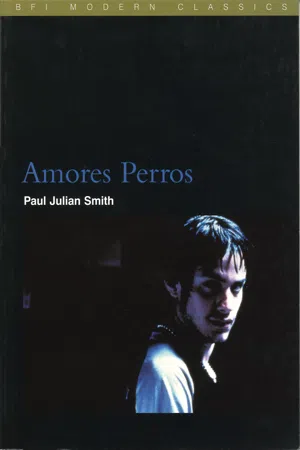
Amores Perros
About this book
Amores Perros (2000) speaks to an international audience while never oversimplifying its local culture. This study of this film opens up that culture, revealing the film's relationship to television soap operas, pop music and contemporary debates about what it means to be Mexican.
Information
1 Everything Changes …
3.– EXTERIOR STREET DAY
[Octavio] puts his foot down on the accelerator once more. The Topaz pulls alongside them. There are three men inside it. The man in the back takes out a gun and aims. Octavio swerves violently, passes a bus on the inside and leaves them behind. The traffic lights turn red. When it looks like the Caribe will get through, a golden Honda Accord comes out from a side street and smashes into them on the right-hand side. The Caribe spins around and starts to turn over. The Accord is shattered, continues straight ahead and smashes against the pavement. The Caribe is left with its tyres face up on the traffic island. FADE OUT1
One regular performer in the Zócalo square of Mexico City (‘D.F.’ to locals) is an old man, with long grey hair and unkempt beard, who marshals a troupe of performing dogs for the informal audience that gathers around him. Dogs are everywhere in D.F., or so it would seem. In the splendid museum of the Templo Mayor (the main Aztec temple) is a grotesque sculpture of Xolótl, dog-headed god of the double, the deformed and the monstrous. The black-eyed canine, known in Nahuatl as ‘itzcuintli’, also serves as one of the symbols in the Aztec calendar. Smooth-skinned domesticated dogs look out from Diego Rivera’s famous murals of the conquest in the Palacio Nacional. The most bizarre of the current crop of telenovelas (Cómplices al rescate del amor/Accomplices to the Rescue of Love) features not only the predictable premise of identical twins separated at birth, but also the unlikely device of a talking dog, who takes a bullet for its master. Televisa programmed a series of films with a canine theme under the banner ‘Amor es perros’ (‘Love is dogs’). ‘Amores perros’ is also used by a gossip magazine as a caption for a photo of a blonde star at a private party, caressing her retriever, as golden as its glamorous mistress.
Two years after its release in June 2000 Amores Perros, a title translating as both ‘lousy love affairs’ and, more literally, ‘dog loves’, has thus become proverbial in Mexico. The winner of over thirty awards (including the most successful film at the Mexican box office of its year), Amores Perros is widely credited with kick-starting a Mexican film industry which was in ruins and heralding a renaissance for the national audiovisual sector. Abroad, Amores Perros was sold to territories around the world and played for some six months in London, a city where Latin American cinema is scarcely seen. Yet this exceptional success was hardly to be expected and indeed took its creators by surprise. It was the first feature for young director Alejandro González Iñárritu, for the rising star of its ensemble cast, twenty-year-old Gael García Bernal, and for its executive producer Martha Sosa. As an autodidact who did not attend the national film school, González Iñárritu was outside the system of patronage traditional in the Mexican cultural field, as throughout society; and as new private companies his Zeta Films and Sosa’s Altavista received no government support. Moreover the brutal subject matter of dogfighting and the extended length of 153 minutes made commercial success seem implausible. A closer study of the history of Amores Perros’s production, promotion and reception reveals the secrets of its success, which relate to the vexed question of mexicanidad, or what it means to be Mexican.

The promotional sticker
A ‘case study’ of the production process, confirmed as accurate by producer Martha Sosa, appeared in trade journal Screen International.2 The pitch was simple: ‘the impact of a car crash on three disparate groups of people’. The first stage (mid-1997 to spring 1998) was the meeting between screenwriter and novelist Guillermo Arriaga and González Iñárritu (known to friends and colleagues familiarly as ‘El Negro’). Although González Iñárritu had made no feature he had considerable experience and success as a radio DJ and producer and as a director of TV commercials. He also had one TV pilot to his name. Arriaga and González Iñárritu teamed up with the intention of ‘exploring the theme of human frailty’, using dogs as a central motif. They were approached by Sosa, development executive of new Mexican mini-studio Altavista (also with a background in pop music promotion), who secured ‘first read’ on the eventual script. The second stage (July 1998) was the intense collaboration between writer, director and producers. A 170-page first draft of the script was trimmed and polished by Arriaga, González Iñárritu, Sosa and Francisco González Compeán, director general of Altavista, who would also be an executive producer. All agreed on the main issues:
The film will be structured around three loosely-connected stories linked by a car accident; it will use documentary-style camerawork, with the film stock processed with silver retention to create stronger contrasts and texture in colour; the dog fights will not be explicit and the dogs will be handled with extreme care; the cast will largely consist of unknowns; and there will be a strong soundtrack.3
In November 1998 the film was greenlit by Altavista’s powerful parent companies CIE and Sinca Inbrusa. Already it was seen as a ‘launch pad for Mexican talent’ into the world, setting a standard both in production values and film-making. The ‘visceral’ subject matter was worrying; but the film acquired in-house funding for its $2.4 million budget: 86 per cent from Altavista and 14 per cent from González Iñárritu’s own production company Zeta Films.
The ten-week shoot took place entirely on location in Mexico City from April to June 1999. The process was risky: at the opening car crash (a complex shot requiring nine cameras) one vehicle smashed into a parked taxi by mistake. In the dogfight scenes the dogs wore transparent braces inside their mouths so they could not bite each other. Anticipating controversy, the producers included footage on how these scenes were shot in the electronic press kit (EPK). Distribution in Mexico would be with Nu Visión, a sister company of Altavista; international distribution was acquired by Lion’s Gate, just after the film was selected for Critics’ Week at Cannes (June 1999–April 2000). Taking the top prize in its competition at Cannes, Amores Perros provoked a ‘buying frenzy’ and was sold to France, Italy, Spain and Israel. Opening in Mexico in June it would be the second highest-grossing domestic film ever, taking $10 million. González Iñárritu also won best new director at the Edinburgh festival, thus helping to ensure distribution in the UK, a notoriously tricky territory for non-English-language cinema (May–August 2000).

Alejandro G...
Table of contents
- Cover Page
- Title Page
- Contents
- Prologue: Mexico City, 2002
- 1. Everything Changes…
- 2. The Dictatorship of Tears
- 3. Love Is Sacrifice
- 4. Seismic City
- 5. A Two-hour Shout?
- 6. Slaves to the Image
- Epilogue: Mexico Cinema, 2002
- Notes
- Credits
- Bibliography
- eCopyright
Trusted by 375,005 students
Access to over 1.5 million titles for a fair monthly price.
Study more efficiently using our study tools.
Frequently asked questions
Yes, you can cancel anytime from the Subscription tab in your account settings on the Perlego website. Your subscription will stay active until the end of your current billing period. Learn how to cancel your subscription
No, books cannot be downloaded as external files, such as PDFs, for use outside of Perlego. However, you can download books within the Perlego app for offline reading on mobile or tablet. Learn how to download books offline
Perlego offers two plans: Essential and Complete
- Essential is ideal for learners and professionals who enjoy exploring a wide range of subjects. Access the Essential Library with 800,000+ trusted titles and best-sellers across business, personal growth, and the humanities. Includes unlimited reading time and Standard Read Aloud voice.
- Complete: Perfect for advanced learners and researchers needing full, unrestricted access. Unlock 1.5M+ books across hundreds of subjects, including academic and specialized titles. The Complete Plan also includes advanced features like Premium Read Aloud and Research Assistant.
We are an online textbook subscription service, where you can get access to an entire online library for less than the price of a single book per month. With over 1.5 million books across 990+ topics, we’ve got you covered! Learn about our mission
Look out for the read-aloud symbol on your next book to see if you can listen to it. The read-aloud tool reads text aloud for you, highlighting the text as it is being read. You can pause it, speed it up and slow it down. Learn more about Read Aloud
Yes! You can use the Perlego app on both iOS and Android devices to read anytime, anywhere — even offline. Perfect for commutes or when you’re on the go.
Please note we cannot support devices running on iOS 13 and Android 7 or earlier. Learn more about using the app
Please note we cannot support devices running on iOS 13 and Android 7 or earlier. Learn more about using the app
Yes, you can access Amores Perros by Paul Julian Smith in PDF and/or ePUB format, as well as other popular books in Media & Performing Arts & Film History & Criticism. We have over 1.5 million books available in our catalogue for you to explore.