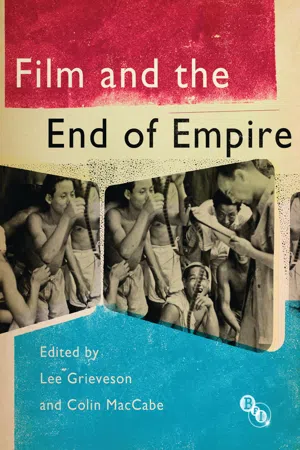
- 320 pages
- English
- ePUB (mobile friendly)
- Available on iOS & Android
eBook - ePub
Film and the End of Empire
About this book
In these two volumes of original essays, scholars from around the world address the history of British colonial cinema stretching from the emergence of cinema at the height of imperialism, to moments of decolonization andthe ending of formal imperialism in the post-Second World War.
Information
1
Introduction: Film and the End of Empire
Lee Grieveson
War marked, in many ways, the apotheosis of empire for Britain. The global conflict of 1939–45 was sustained by the material and economic resources gathered through extractive empire; by a mass imperial fighting force that automatically assumed belligerent status when Britain declared war; and by the control of territory and naval bases and consequently, the global circulation of materials and peoples.1 All of this was accompanied by a newly urgent rhetoric of unity in a proliferation of official and popular stories that portrayed the wartime empire pulling together across differences of race and ethnicity in a transnational and global anti-fascist conflict.2 Yet at the same time the flawed logic of this conception of the conflict and of empire ‘unity’ was apparent to many, not least to those colonised populations fighting fascism for the liberal rights of democracy, self-determination and freedom that were for them merely fictions. The biopolitical atrocities of fascism directed attention toward racism.3 And the disconnect between the rhetoric of unity and freedom and the reality of colonial governance grew ever more visible, as violence – and its threat – sustained imperial dominance (in, for example, the suppression of the 1942 Indian uprising, and the mass imprisonment of members of the Indian National Congress (INC); the occupations of Iraq, Syria and Iran; and the shooting by police and military of strikers in the economically essential region of the Northern Rhodesian Copper Belt in 1940). In August 1941 the widely publicised ‘Atlantic Charter’ affirmed the ‘rights of all peoples to choose the form of government under which they will live’, prompting the American Under-Secretary of State to declare that ‘the age of imperialism is dead’.4 Not quite. Liberalism had, after all, long lived with the contradictions between declarations of human rights and democratic rule and the realities of slavery and colonial expansion and exploitation.5 Even so, military losses in Asia in 1942 – including the loss of the crucial naval base at Singapore – undercut the fiction of racial supremacy upon which colonial governance relied.6 The certainty, and longevity, of colonial rule and the global colonial order was put into doubt, amid uncomfortable questions about the connections between liberalism, colonialism and fascism.
Alternative fictions were pressed into service to prop up the seemingly ailing age of imperialism and its distinctive formation of racialised governance and ordering of space and power. The rhetoric of unity was urgently supplemented with ideas of ‘development’ and ‘Commonwealth’, as the British colonial state accelerated trends visible in the interwar period to emphasise its benevolent trusteeship and its role in establishing economic self-sufficiency. In 1940 the Colonial Development and Welfare Act set in place structures of welfarism that were designed to forestall radical social and political action, preceding the establishment of the welfare state in the metropole in the post-war period.7 Education policies were developed to better integrate colonial subjects into a market economy.8 Alongside economic ‘development’, the colonial state began preparation for divesting governmental control, albeit haltingly and with no immediate end in sight. India, for example, was ‘offered’ Dominion status in 1942 (it is when leading members of the INC refused, and formed the Quit India movement, that they were imprisoned).9 In July 1943 the Secretary of State for the Colonies, Oliver Stanley, told Parliament that the British government was ‘pledged to guide Colonial people along the road to self-government within the framework of the British Empire’.10 Any such road would, it was imagined, be connected back to Britain, sustaining economic ties in the aptly named ‘Commonwealth’ and the objectives of geopolitical ‘security’.
At stake was the transition of colonial dominance to economic imperialism, guided in part by the model provided by the United States and indeed provoked also partly by the opposition of that country to colonial rule. This opposition was motivated in part by the British state’s earlier erection of a structure of economic protectionism that attempted to place the materials and markets of colonial states beyond the reach of American capital. US policy, particularly in the post-war settlement, would require that these barriers be removed (that this was fundamentally an economic question, and not a question of liberal ethics, was apparent in the US policy to help prop up the British empire when it served US Cold War agendas).11 At the end of the war, deeply in debt to the US and unable to re-establish the old balance of power, Britain was clearly a fading geopolitical force. The revelation of Britain’s financial and military weakness in the 1956 Suez Crisis made this clearer.12 At the same time, the rise of colonial nationalism – demanding the logical freedoms of liberalism – led to wars of decolonisation in Africa and Southeast Asia, and to what Paul Gilroy describes in his essay in this volume as the ‘slow, fractious, blood-soaked decomposition of the British empire’.13 Under pressure from subaltern populations, nationalist movements and newly established American global hegemony, Britain’s empire began to crumble: India became independent in 1947, followed later by rapid bursts of decolonisation in West Africa and Southeast Asia in 1956–7, and Western and Eastern Africa between 1960–5.14 The number of people living under British rule in the two decades after 1945 was cut from 700 million to 5 million; the largest and probably the most ambitious imperial venture in human history was reduced, as Francis Gooding reminds us in his contribution here, ‘to a mere rump, a far-flung global archipelago’.15
What roles did film play across the period 1939–65, in the face of these rapidly changing geopolitical strategies and realities? What were the varied ways in which film registered, and projected, colonial discourse? What do these films now reveal about the fantasies and realities of colonial rule? The essays in this collection offer varied answers to these questions, in dialogue with the materials assembled by the ‘Colonial Film’ project.16 At their broadest, the essays address the enmeshing of cultural representation and political and economic control. They examine the ways in which state and non-state actors harnessed film to instructional and pedagogical functions, putting media to work to shape the attitudes and conduct of populations to sustain colonial governmental order. The considerable investment in ‘colonial film’ by the British – the most sustained and extensive use of film for governmental purposes by a liberal state – was predicated on ideas both about film as a symbol of technological modernity that embodied and projected colonial authority and, relatedly, about its persuasive power over ‘unsophisticated’ populations. The specific work of film to supplement colonial governance in this period began, contributors here teach us, with efforts to generate loyalty to the colonial power and its geopolitical strategies; moved through the attempted elaboration of an ‘imagined community’ that transcended the nation-state and was properly transnational;17 and was cathected to the efforts to establish new economic relationships, to ‘develop’ the colonies in ways that supplemented the British economy and to educate colonial subjects about, principally, the market and its demands in the coming era of self-governance. These essays suggest new ways of conceptualising British cinema as a cinema of imperialism; and in turn propose new models for mapping the circulation of what we might call the visual regimes of geopolitics. Together, they urge us to resist the marginality of colonial history, and to more fully engage with the colonial ordering of the world and its articulation through the medium of cinema.
Various forms of film facilitated and visualised colonial rule and its mutation into ‘Commonwealth partnership’. Governments, educationalists, entrepreneurs, missionaries and the film industry all made films, and so inscribed in varying ways colonial discourse onto, and as, film. The essays here address the newsreels that were produced in different languages; state-produced ‘documentaries’; corporate-financed non-fiction films about economic relationships; and narrative fiction films telling stories about the history and present moment of imperialism and its ostensible dissolution (encompassing long-established fantasies of conquest and domination but also new rhetorics of ‘progress’ and development). Across these differing filmic forms, there emerged a set of related formal practices and tropes, belying any simple separation of the real and the imaginary. Time and time again in these films we see white characters central to the frame educating and guiding the marginal colonial subjects in learning about and using modern technology. Frequently the sound of an English upper-class voice embodies authority and directs our attention. Cruelty, hierarchy, domination are displayed, naturalised and justified. A common format shows the right and wrong way to accomplish various tasks, a ‘Mr Wise and Mr Foolish’ format that embodies a pedagogical and paternalistic logic. Trusteeship, benevolence even, is central to the colonial relationship, these films often propose. Yet other films offer a more unfiltered record of what Laura Mulvey calls ‘the gaze of the regime’.18 Amateur films made by military personnel and other colonial officials occasionally reveal truths about colonial attitudes and events suppressed in official films. Violence, rarely seen in the official record of empire, is glimpsed in the margins of these films, as, for example, in the films made by Major William Rhodes James discussed by Vron Ware, which show the British military clearing Chinese villagers away from their homes and into new camps during the Malayan Emergency.
Along the way, specific institutions were formed to foster colonial film, most notably the Colonial Film Unit (CFU), set up in 1939 under the auspices of the Ministry of Information (MOI) initially to mobilise colonial support for the war but remade in the post-war period to better reflect new projects of education and economic development. Local units were established in the Gold Coast, Nigeria, Central Africa, Jamaica and Malaya. The advent of filmic independence mirrored, and crossed over with, that of political independence – both fraught with similar complexities for the British state, and new independent states, in charting change and continuity.
The establishment of institutions to foster the production of didactic film was supplemented also by the elaboration and intensification of novel methods of distribution and theatrical and non-theatrical exhibition. Legislation at times ensured short didactic films would be shown in cinemas before fictional features. Elsewhere, mobile cinema vans were constructed, and equipped with projection equipment, and these circulated widely in remote areas, presenting films and so ‘projecting the State’, as Charles Ambler shows here, to largely illiterate audiences who probably confronted colonial propaganda for the first time lit up on screens in the night sky. Film itself as ‘shock and awe’, perhaps. The development of such a system was pioneered in the interwar years, but reached a wider audience in the post-war period when these new pathways of film distribution and exhibition facilitated the mobile economic relations that were so central to post-war colonial strategies.19 Across this period there developed infrastructures to deploy film as a medium of information and communication, accompanied by considerable discussion of the best ways to manage and orchestrate this.
All these efforts were predicated on ideas about the utility of cinema for engineering consent and managing the conduct of diverse populations. Often these proto-film theoretical arguments proposed that structures of ‘identification’ in film texts functioned to draw audiences into sharing the beliefs embodied in the films. The ideas about audiences and the effects of film embodied colonial logic, for it was based on the belief that colonial subjects would be more easily and profoundly influenced by media than Western subjects. Likewise, the efforts to harness film to the project of colonialism were predicated also on beliefs about the necessity and efficacy of ‘fictions’ to sustain colonial rule (even better when those fictions claim truth status, as, for example, documentaries and newsreels do). Film could supplement colonial rule carried out a distance. At the core of the elaboration of colonial film, and its infrastructures, were ideas about the efficacy of film and fiction for (colonial) government.

Film and the End of Empire begins with Paul Gilroy’s essay ‘Great Games: Film, History and Working-through Britain’s Colonial Legacy’. Gilroy’s widely, and justly, influential work has argued that the British empire is the crucial repression within contemporary national memory, and that the failure to think through the process by which Britain dominated one-quarter of the globe for the better part of two centuries significantly contributes to current traumas around race and religion.20 The film material assembled for the ‘Colonial Film’ project offers, Gilroy argues here, the possibility of re-engaging with that past, confronting the realities of the divisions and differences that have been so central to the British state. Working-through the ways cinema was deployed to elaborate an imperial mythography – as the cultural mandate, Gilroy argues, of white supremacy – is a crucial and urgent project to consolidate a liveable, convivial, multiculture. Gilroy argues that the social, political and economic upheavals that attended the end of European empires are epochal developments, heralding our post- and neocolonial world. The urge to understand those, and their refraction through the prism of cinema, is central to Gilroy’s project – and indeed to the essays gathered together here.
Gilroy reminds us also that colonialism is always war, and so requires, constantly, propaganda; ...
Table of contents
- Cover
- Title Page
- Contents
- Notes on Contributors
- Acknowledgments
- 1. Introduction: Film and the End of Empire
- 2. Great Games: Film, History and Working-through Britain’s Colonial Legacy
- Empire at War
- Film/Government/Development
- Projecting Africa
- Afterthoughts on Colonial Film
- Index
- eCopyright
Trusted by 375,005 students
Access to over 1.5 million titles for a fair monthly price.
Study more efficiently using our study tools.
Frequently asked questions
Yes, you can cancel anytime from the Subscription tab in your account settings on the Perlego website. Your subscription will stay active until the end of your current billing period. Learn how to cancel your subscription
No, books cannot be downloaded as external files, such as PDFs, for use outside of Perlego. However, you can download books within the Perlego app for offline reading on mobile or tablet. Learn how to download books offline
Perlego offers two plans: Essential and Complete
- Essential is ideal for learners and professionals who enjoy exploring a wide range of subjects. Access the Essential Library with 800,000+ trusted titles and best-sellers across business, personal growth, and the humanities. Includes unlimited reading time and Standard Read Aloud voice.
- Complete: Perfect for advanced learners and researchers needing full, unrestricted access. Unlock 1.5M+ books across hundreds of subjects, including academic and specialized titles. The Complete Plan also includes advanced features like Premium Read Aloud and Research Assistant.
We are an online textbook subscription service, where you can get access to an entire online library for less than the price of a single book per month. With over 1.5 million books across 990+ topics, we’ve got you covered! Learn about our mission
Look out for the read-aloud symbol on your next book to see if you can listen to it. The read-aloud tool reads text aloud for you, highlighting the text as it is being read. You can pause it, speed it up and slow it down. Learn more about Read Aloud
Yes! You can use the Perlego app on both iOS and Android devices to read anytime, anywhere — even offline. Perfect for commutes or when you’re on the go.
Please note we cannot support devices running on iOS 13 and Android 7 or earlier. Learn more about using the app
Please note we cannot support devices running on iOS 13 and Android 7 or earlier. Learn more about using the app
Yes, you can access Film and the End of Empire by Lee Grieveson, Colin MacCabe, Lee Grieveson,Colin MacCabe in PDF and/or ePUB format, as well as other popular books in Media & Performing Arts & Film History & Criticism. We have over 1.5 million books available in our catalogue for you to explore.