- 232 pages
- English
- ePUB (mobile friendly)
- Available on iOS & Android
eBook - ePub
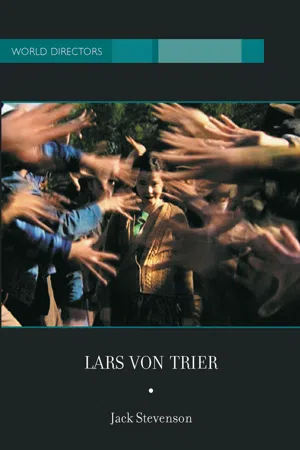
Lars Von Trier
About this book
With the international success of Breaking the Waves (1996) and Dancer in the Dark (2000), Lars von Trier has established himself as a one of the most provocative and daring film directors working today. The founding father of Dogma 95, he made the movement's most controversial film, The Idiots (1998), and has played a leading role in the recent resurgence of Danish cinema. Yet despite his success, von Trier remains something of an polarising and enigmatic figure hailed as the new Godard by some and a charlatan by others. In this new study, Jack Stevenson explores the achievements as well as the paradoxes of Lars von Trier, assessing his life, work, and critical reception. The book follows von Trier from his early life as a troubled son of 'Cultural Radical' parents through to his student days at the Danish Film School, diligently spent making films that were as innovative and disturbing as his later features have proved to be. These films (consisting of the Europa and Gold-Hearted trilogies) are fully examined together with considerations of his creative detours into other media and his current work in progress, Dogville. Based in Denmark, the author brings a unique perspective to Lars von Trier creating a multi-dimensional portrait of the director. Utilising sources heretofore unavailable in English, Stevenson's lively yet fact-filled narrative is accessible to students and film enthusiasts alike. The book is indispensable to anyone interested in Lars von Trier and the broader issues that surround modern Danish film and its current renaissance.
Information
Edition
1One
The Early Years
Childhood
The lives of Lars von Trier’s parents were, like most of those of their generation, deeply affected by World War II.
Denmark was occupied in 1940 by the Germans without a great deal of bloodshed, and thereafter, generally put, the country as a whole didn’t cover itself in glory in regards to its resistance to the Nazis. But there was a resistance movement, and Lars von Trier’s mother, Inger Høst, twenty-five years old when Denmark capitulated, was a member of it.
The daughter of civil servants, Inger became a member of the Danish Communist Party in her youth and during the Occupation became involved in the publishing and distribution of illegal periodicals. This earned her a place on the Germans’ list of those to be executed. She fled across the Øresund Strait to safety in neutral Sweden in the autumn of 1943, at the same time that Danish Jews were also secretly being evacuated en masse to the same destination.
It was in Sweden that she met her husband-to-be, Ulf Trier, a tall man with bushy eyebrows who was in his mid-thirties. Ulf, of partial Jewish heritage, had also been forced to escape to Sweden. They were married and returned to Denmark after Liberation Day, 4 May 1945.
In December 1945, they had a son whom they named Ole. At that point the family lived in Fuglebakke-Kvarteret, a middle-class neighbourhood of modest brick terraces on the outskirts of Copenhagen that Danes would term a suburb.
Ulf, a staunch social democrat, had received a Masters degree in political economics and would go on to spend his working life as a civil servant in the Social Ministry. Inger Høst, a self-confident and independent woman, who kept her maiden name after marriage – very rare at the time – also earned a Masters in the same field, and in 1951 found employment in the Social Ministry as an office supervisor.
On 30 April 1956, Ulf and Inger had their second son, and they named him Lars. Lars Trier.
By now they had moved to a rural, suburban village north of Copenhagen called Lundtofte, about three kilometres outside the market town of Lyngby. Their new home was a two-storey brick villa on Islandsvej (Iceland Street) in a nice, wooded residential quarter, literally a stone’s throw from Ørholm Station. It was not really a ‘station’ at all, but rather an open-air stop on the regional train service that served the more sparsely populated districts outside Copenhagen.
Across the tracks from Lars’ childhood home lay Ravneholm woods, a wilderness area laced with streams and ponds which had been nicknamed ‘little Switzerland’ in a fit of civic exaggeration. It was here in these leafy, pastoral environs – far removed from any hint of the grimy urban squalor that characterised the Vesterbro or Nørrebro neighbourhoods of Copenhagen, about forty minutes away by train – that Lars grew up. And it was here he would return later in life when seeking spiritual solace and creative inspiration. The area was not ‘old money’ but it did have upper-class insinuations and represented the better life that those with good jobs could expect in a still very much strapped postwar Denmark.
The Trier household was a typical civil servant’s home. It had books, art, a piano. The overall atmosphere was one of acquired progressiveness. A sense of liberalism and tolerance prevailed alongside a pronounced distaste for the sentimental or vulgar excesses of popular junk culture. Ulf was as far from an Orthodox or practising Jew as one could get, and the progressive-humanist philosophy both parents subscribed to was devoid of any religious overtones.
Lars unfailingly uses the term ‘cultural radicalism’ when he describes his upbringing, and it is a term with very specific inferences in the context of postwar Danish society. Cultural radicals were a certain kind of people. They went in for jazz and classical music, not schmaltzy, popular ballads or Sunday morning radio sing-alongs. They preferred to take their vacations in Paris rather than driving the autobahns of Europe with a camping trailer, a popular pursuit of ‘average’ Danes in the late 1950s and early 60s. They would go to the theatre, to the opera and to films, but only good films. Their favourite painters included the likes of Asger Jorn and Picasso. One would never find kitsch exotica or mass-produced paintings of clowns, babies or cute puppies hanging on their walls. In regard to literature, well-known Danish authors like Hans Scherfig, Otto Gelsted and Hans Kirk were read by cultural radicals; in fact, Inger knew these writers personally and they were occasional visitors to the Trier home. Solid Danish-design furniture was in, wall-to-wall carpeting and television was out (although they might deign to own the latter). Children were to be spared from the old-fashioned methods of discipline, and let in on the complexities of life. They were to be dealt with honestly. This was a new age.
It was people like Inger and Ulf, committed welfare-state bureaucrats, who in the 1950s would plan and implement the social reforms that set the liberal, progressive tone of Danish society in the 60s and 70s.
Ulf, forty-nine years of age when Lars was born, was an ‘old’ father and not the type to kick a football around with his son, yet Lars was very fond of him. Ulf was a practical joker and played the clown to entertain the boy. But it was his mother who dominated the atmosphere of the home. A strong-willed and self-assured woman, she was at the same time committedly laissez-faire when it came to disciplining or setting rules for young Lars. It was left to the boy to decide if he needed to go to the dentist, whether he should do his homework and when he ought to go to bed.
These extraordinary freedoms produced a child who felt anything but free, burdened as he was with the heavy responsibility of making all his own decisions, of having to instantly be a grown up. On top of it all, he felt a duty to the whole planet. ‘I was very much afraid of the atom bomb. Every single night before I went to sleep I would engage in a mass of rituals to save the world.’1
On a spiritual level, he was denied many of the fantasies young children take refuge in.
My parents were eager to tell me that Santa Claus didn’t exist. When everything must be so explainable and open, it is hard to be a child. It was only as an adult that I could permit myself the luxury of believing in Santa Claus. I was taught there was no deeper meaning to be found in existence. When one is dead, one is dead. A person is just a pile of molecules.2
To make matters worse, Lars was sent to Lundtofte School, a place that in his opinion was very strict and old-fashioned, even for that time. School routine consisted of standing in eternal lines, moving in lock-step and sitting down on cue. One needed to get permission for everything, even going to the toilet. He was fond of gazing out the window.
Every single day I sat there and hoped I would become a gardener, since I could usually see two gardeners out there weeding. I was convinced that it must be the luckiest thing in the world to be able to do that. They did exactly as they wanted while I sat there and suffered.3
This collision between a home-life with no borders and a school life with too many was fairly traumatic for him. On top of it he was often bullied and harassed at school. He was not into sports, he was not a physical boy in that sense. He attempted to be a Boy Scout but without success. Considered something of a ‘problem child’ as he progressed through the grades, he was sent to a psychologist on a number of occasions. A consensus emerged that he had ‘adjustment difficulties’.
As an adult, in the company of journalists, he would often speculate on the effects that such an angst-ridden childhood had on his personal and creative development. Lacking discipline at home and hating the type he got at school, he had to make his own games, form his own rules and create his own inner discipline. ‘This shows in the amazing work discipline I have,’ he would reflect. ‘I work the whole time … the positive thing I got from this situation was a strong belief in my own creativity – almost like a gift given to me at the cradle.’4
For her part, his mother did what she could to cultivate creative instincts in her son, praising him to the heavens every time he drew a line on a piece of paper. At the age of seven he even dictated a little crime novel which his parents transcribed.
Earliest film-making
At about ten, Lars got his hands on his mother’s little Elmo standard-8 movie camera. He was immediately fascinated by all the mechanical possibilities. It could run backwards and be adjusted to different speeds, and you could take single shots, and double-exposures by reversing the film and running it twice through the camera. It was a very basic mechanical challenge he took to eagerly. It was a fascinating play toy.
His uncle, Børge Høst, who was about forty at the time, played a more active role in encouraging his interest in film. Høst had, in 1945, co-founded the Copenhagen Filmstudio (film club), and in 1956 had helped to establish the Union of Danish Film Directors. By the mid-60s, he had directed a number of highly regarded documentaries and short films on topics as diverse as nuclear science, Islam and the historic Danish frigate, Jutland. He was involved in film on just about every level, as a teacher, a director, a technician and a bureaucrat.
He shared with Lars what enthusiasm and experience a ten year old could absorb, and he gave him some of the raw goods as well: an old film splicer and a stack of old 16mm prints that Lars could mess about with and cut up.
Lars converted a little shack in the garden into a makeshift film studio where he began to cut and edit and manipulate film and get a feel for its physical properties. He coloured black-and-white film by hand and experimented with colour dyes. When other boys his age dreamed of getting a bicycle or a BB gun, he wanted a real editing table. Instead of building a tree house, he dreamed of building a camera crane. Considering his natural affinity for mechanical tasks, given the component parts, he just might have done it.
One of his first films was a little found-footage item he constructed from some loose reels his uncle had given him. He took a documentary about cockroaches and some footage from Dreyer’s The Passion of Joan of Arc (1927) (the scene where she is being interrogated by the inquisitors) and spliced them together in a cross-cut montage, and then he hand-coloured some of the pictures.
At eleven he made a primitive 8mm animation film, entitled Turen Til Squashland (The Trip to Squashland). Made by stop-motion, the piece was barely two minutes in length but all considered was quite an accomplished piece of work.
In 1968, at twelve years of age, Lars answered a notice in a local paper that was advertising for child actors to participate in a youth-oriented TV series. ‘He presented himself and explained that he could do this and that,’ recalled the director, Thomas Winding, many years later.
He was small, frail, nervous and very ‘with it’ … he was grown in many of the ways that some children are, for both the good and bad. He was in control of his own life and didn’t trust anybody. He was not particularly charming, but a good and focused boy. He had an incredibly good feeling for pictures – where he should stand in the picture and how it would look. One of the requirements was that he must be able to ride a horse. All of it he could do well, he assured us.5
He got the part.
The four-part series, entitled Secret Summer, was a Danish-Swedish co-production shot in the Lyngby environs that summer. The plot dealt with two somewhat neglected kids who find themselves together on a boring summer vacation. The boy, Lars – played by Lars – is sullen and contrary, particularly towards his strict father, played by the twenty-eight-year-old Jens Okking. Then he meets Maria, a fanciful girl who tries to pull his leg by telling him that she is involved in a spy case. She was played by a Swedish girl named Maria Edström who coincidentally would go on to become one of Sweden’s top film critics.
The shooting went well enough, and Lars even filmed a bit on the set with his S-8 camera. But it quickly became clear that he could not ride a horse. In fact he was rather scared of them. That caused problems.
The day the first episode aired, on 4 January 1969, the Danish daily, Aktuelt, ran an article on the show which included a still from the series: a reticent looking Lars astride a bicycle. He wore a mop-top hairstyle, something akin to a Beatles cut. (No doubt getting a haircut was one of the last things his parents ever forced him to do.) Reporter, Lars Hoffman, wrote that his schoolmates teased him for becoming a ‘movie star’, but Lars claimed he didn’t care. ‘I’m the one who earned the money, and I got free from school for three weeks while we filmed.’6
He was paid 3,000 kroner for his work in Secret Summer. He spent the money on an electric organ that he planned to use for the music in his forthcoming films. Would this film-crazy kid become an actor, asked Hoffman? ‘That I don’t know, but surely I will have something to do with film.’
That same year (1968) he made a film entitled Nat, Skat about a bank robbery. The title is word play which translates both as Good Night,...
Table of contents
- Cover
- Title Page
- Dedication
- Contents
- Author’s Note
- Introduction
- 1. The Early Years
- 2. From The Element of Crime to Europa and Zentropa
- 3. The Kingdom and Breaking the Waves
- 4. The Birth of Dogma and The Idiots
- 5. Projects and Provocations
- 6. Dancer in the Dark
- 7. Dogma – the Next Generation and Dogville
- Notes
- Bibliography
- Filmography
- Index
- eCopyright
Trusted by 375,005 students
Access to over 1.5 million titles for a fair monthly price.
Study more efficiently using our study tools.
Frequently asked questions
Yes, you can cancel anytime from the Subscription tab in your account settings on the Perlego website. Your subscription will stay active until the end of your current billing period. Learn how to cancel your subscription
No, books cannot be downloaded as external files, such as PDFs, for use outside of Perlego. However, you can download books within the Perlego app for offline reading on mobile or tablet. Learn how to download books offline
Perlego offers two plans: Essential and Complete
- Essential is ideal for learners and professionals who enjoy exploring a wide range of subjects. Access the Essential Library with 800,000+ trusted titles and best-sellers across business, personal growth, and the humanities. Includes unlimited reading time and Standard Read Aloud voice.
- Complete: Perfect for advanced learners and researchers needing full, unrestricted access. Unlock 1.5M+ books across hundreds of subjects, including academic and specialized titles. The Complete Plan also includes advanced features like Premium Read Aloud and Research Assistant.
We are an online textbook subscription service, where you can get access to an entire online library for less than the price of a single book per month. With over 1.5 million books across 990+ topics, we’ve got you covered! Learn about our mission
Look out for the read-aloud symbol on your next book to see if you can listen to it. The read-aloud tool reads text aloud for you, highlighting the text as it is being read. You can pause it, speed it up and slow it down. Learn more about Read Aloud
Yes! You can use the Perlego app on both iOS and Android devices to read anytime, anywhere — even offline. Perfect for commutes or when you’re on the go.
Please note we cannot support devices running on iOS 13 and Android 7 or earlier. Learn more about using the app
Please note we cannot support devices running on iOS 13 and Android 7 or earlier. Learn more about using the app
Yes, you can access Lars Von Trier by Jack Stevenson in PDF and/or ePUB format. We have over 1.5 million books available in our catalogue for you to explore.