eBook - ePub
L'Atalante
About this book
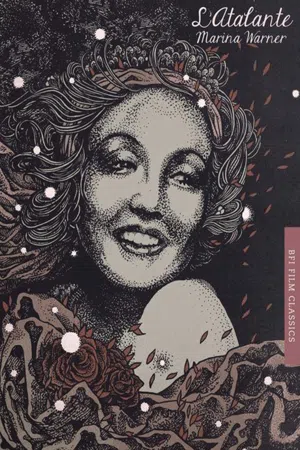
L'Atalante is the work of French director Jean Vigo. It is a study of romantic love, told in a style influenced by surrealism, but still Vigo's own. This text is part of the 'BFI Film Classics' series. Each volume in the series presents a personal commentary on the film, together with a brief production history and a detailed filmography, notes and bibliography.
Information
‘L’Atalante’
The wedding
The first shot shows the stern of the barge and ‘L’Atalante’, her name, painted on the hull. The barge is the film and they share a woman’s name. With spare economy this opening image sets the scene of struggle, about love and the place of women: where they choose to be, where they are contained. The viewer’s eye is then concentrated on a smaller point of visual interest: the reflection of water, winking on the rim. A precise eye for graphic beauty landed on that bead of dancing light – and it foreshadows L’Atalante’s imagery throughout. Boris Kaufman was Vigo’s lighting cameraman on all his films – he shared director’s credit for À propos de Nice – and his handling of shape through light and shadow clearly contributed in a major way to L’Atalante’s wonderful lucidity of image.
The first shot shows the stern of the barge and ‘L’Atalante’, her name, painted on the hull. The barge is the film and they share a woman’s name. With spare economy this opening image sets the scene of struggle, about love and the place of women: where they choose to be, where they are contained. The viewer’s eye is then concentrated on a smaller point of visual interest: the reflection of water, winking on the rim. A precise eye for graphic beauty landed on that bead of dancing light – and it foreshadows L’Atalante’s imagery throughout. Boris Kaufman was Vigo’s lighting cameraman on all his films – he shared director’s credit for À propos de Nice – and his handling of shape through light and shadow clearly contributed in a major way to L’Atalante’s wonderful lucidity of image.
The film never sentimentalises the working life of the bargees, but it presents their surroundings with unfailing respect, creating, out of the smoky, damp winter of the canals, a subtle geometry and a moody, austere aesthetic. The first shot also anticipates one of Vigo’s most characteristic artistic resources: the light bounces off the water, which itself doesn’t command the viewer’s attention, as it is eclipsed by the greater value of the hull and the name inscribed on it. Throughout the film, the four edges of the frame are always dissolved to suggest what is visible beyond them, to stimulate the viewer’s own powers of visualisation and bring into play the world the camera’s rectangular sights cannot encompass – here, the rest of the barge, the banks and the flow of the canal, where a boat glides by in the background. Because this style of framing implies the world beyond its borders, Vigo can approach his subjects obliquely, swiftly, suggestively, with pans passing the backs of heads, the set of a pair of shoulders, the motion of passing feet, a shadow in a corner.
The first shot of the film is held, unusually for Vigo, before it cuts to a view of the canal and the barge lying in it, but the screen soon fills up with a head of steam – exhaled from an undisclosed source lying beneath the whole baseline of the image. Only much later, and fleetingly in the background, do we see the sort of passing freight train which might have breathed out this great cloud. Significantly, Zéro de conduite (1933) opens with a cloud of steam rising behind the carriage window in the railway compartment. It’s a signal of departure, like the first letting out of pent-up excitement before entering the stage. The rising steam of L’Atalante’s second shot also indicates beginnings under pressure, and even hints at the release of passionate feelings. It is one of those images in-between, the marrow of montage, where the symbolic and the real coexist as enigma. It doesn’t linger, either, for Vigo’s way of telling makes quick, light footfalls – he isn’t a stickler for causal linkage.
A steeply raked view of a church next appears, to the continued dud tolling of a bell; the skew-whiff angle and the image’s still, impersonal vacancy introduce the first note of oddness, and this will gradually gather force as the first scene develops, showing the wedding procession making its way from the church to the barge. Le père Jules, the ship’s mate (Michel Simon), appears, scurrying through the church door; he’s holding the boy (Louis Lefebvre, from Zéro de conduite) by the hand, yanking him along. They’re dressed identically, with black bow ties and caps; the formal attire looks ill-fitting, unaccustomed. Suddenly, le père Jules lollops back to the church to cross himself with holy water. His simian gait matches his prognathous jaw, while a double shadow against the wall casts an uneasy question over his brutish behaviour. The married couple, Jean and Juliette, come out of church and turn in the direction the ship’s mate has taken. A crocodile of guests forms behind them, but not tidily enough for one of the men present, who later bosses them into regular pairs. Juliette’s mother, in front, is crying over her daughter’s departure with an outsider. ‘And to think she’s never left the village before,’ she whimpers. Someone complains there’s to be no wedding banquet; but another explains that the bridegroom is in a hurry to catch up on his delivery job for the canal freight company; another mentions that he’s a stranger and that Juliette didn’t consider a local man was good enough. The procession’s absurdity stirs echoes of social satire – the bowler hat, which the male guests are all wearing, was a favourite Surrealist symbol of stuffiness, of course, targeted not only in the art of Max Ernst and Magritte, but also in burlesque movies like Hans Richter’s Ghosts Before Breakfast (1928) where hats waft about in a solemn procession on their own. Though in L’Atalante the dialogue is barely audible, it helps set up an important theme: Juliette is leaving the familiar for the unfamiliar, her Heimat, as it were, for the unknown.
Human contact is peremptory, chilly; the mood perplexingly sombre for a wedding. Doubts about Jean are seeded in the viewer’s mind, anxiety about Juliette. The bridal pair move fast, arm in arm, mechanically advancing, looking straight ahead, stiff and unsmiling; they begin to gain ground over the wedding party, who seem almost to be shuffling along reluctantly, behind the newly-weds, in widow’s weeds and mourners’ headgear. The bell does not peal, but tolls arhythmically, as if the wind were taking it, under the squeezebox jollity of two guests, and later, on the soundtrack, a haunting, reedy tune, as Jean and Juliette, still like wind-up toys, walk briskly across a field; they’re seen alone, small, against hayricks, then again, closer, in tall weeds; then again, abruptly, against the furrows; still they make no eye or speech contact, and the only light glows from her satin wedding dress. Sally Potter, the director, chose L’Atalante as one of her top ten films in 1992, and she observes that Vigo creates ‘a metaphysical dimension’ by handling the depth of field in a manner he learned from Eisenstein. Figures move far and near through space in the film in an expressive way, in which their relation to the space itself becomes queered.10

The married couple
The oddness of the opening also springs from another factor that lies beyond the control of Vigo and his collaborators in 1934. The shot of the wedding pair in the distance against three conical haystacks possesses that clarity of formal arrangement associated with still photographers of the first part of the century of whom both Vigo and Kaufman were fully acquainted. It is one of the shots that was reintroduced into L’Atalante when the film was restored, in 1990, by Gaumont. It is, needless to say, a beautiful – and characteristic – shot which works for the scene’s meaning. The haystacks are pillowy, their sculpted contours sensuously textured, and the wedding pair look small and vulnerable against their strength and composure. The image of Jean and Juliette in tall grass which follows immediately is also one of the restored shots – kept ‘for the beauty of the images’, the Gaumont press brochure declares.11 Independently beautiful, sequentially jangling, the shots disrupt the narrative logic, implausibly prolonging the walk from the village to the barge over untrodden terrain. The effect is powerful, but it isn’t certain that in the original 1934 cut the sequence would have been so unsettling.
The wedding procession then cuts to the ship’s mate, who’s rehearsing the boy’s lines to welcome the bride. The boy’s nasal singsong, ‘Heureuse vie à bord de l’Atalante’, promises badly; he seems half-witted, pitching his performance nearer pathos than comedy. The peculiar, lugubrious sense of menace increases.
On the barge, the old man, a kitten riding clutched on his shoulders, botches his plan to present a bouquet when the boy kicks it overboard in the middle of a brief hornpipe – this first, small sign of joy ends in curses from the old salt Jules, and an ominous mutter that God isn’t on their side. The raw dialogue, filled with repetitions, and deliberately coarse in accent and phrasing (Michel Simon’s Vaudois brogue helps), strikes the ear as utterly different from any other film of the 1930s in its unrehearsed naturalism. When the boy runs off to pick some wild flowers instead, he returns, in a low-angle shot with delicately luminous lighting, haloed in a great mass of traveller’s joy against the banked clouds. He gives the bride, his new patronne, the scrawny, limp bouquet retrieved from the water, and Jean and Juliette smile – at him, but not at each other. Jean immediately leaves Juliette on her own as he leaps into action on the barge. Juliette stands alone, on land, below him, her lids heavy, her brow furrowed, to all appearances utterly forlorn.

‘Haloed in a great mass of traveller’s joy’
Le père Jules swings Juliette over the gap between the bank and the barge on the boom; her mother runs down the bank after her, but it is too late – she’s crossed over without a proper goodbye, and her mother finds herself in the arms of the old man instead, who thrusts the bunch of flowers at her. It could be a funny moment, but remains funny-peculiar, too. At the levers of the engine, Jean throws his cap in the air and shouts goodbye, leaping up and down. His gesture, given the overall feeling of foreboding, seems inappropriate, entirely insensitive to the mood of the gathering. On the shore, the mother stands apart in front of the crowd. Nobody on the bank responds; massed together, seen from the point of view of the barge from above, they observe Juliette’s departure without a smile or a cheer. At the bows, she stands alone – a shot of premonitory eeriness, as the sound of the engine gathers speed on the soundtrack.

Juliette: ‘shot of premonitory eeriness’
The entire atmosphere evokes a funeral, not a wedding – the shadowy lighting, the coffin-like box of the barge, the expressionless guests and the drowned bouquet. The inconsequent jumps from village to field to meadow give the wedding march a spooky, jumbled feel, and when the boy looms, wreathed in trailing wild flowers, the film touches not only on fairy tales in which the young bride is given to a dark and disturbing stranger, as in ‘Bluebeard’ or ‘Beauty and the Beast’, but on myths about spring brides and lords of the underworld. It’s overdetermining the imagery to interpret Juliette as Persephone and Jean as Pluto who carries her off – it’s tantamount to hauling Vigo on to Cocteau territory, where the symbols announce themselves by name and a heightened, learned aesthetic serves the mythic message. In L’Atalante, the mythic resonances sound much farther away: the material texture of ordinary contemporary existence occupies the foreground. Nevertheless, they do sound.
These illogical leaps in L’Atalante’s opening montage carry the audience out of rural Normandy into unpredictable territory, a closed kingdom where her companions will be this grim crew of joyless husband, ruffianly hand, and loutish boy. There’s also something sacrificial about Juliette as she stands, faltering, at the prow; she stirs memories of maidens offered up to the sea to appease monsters, of effigies fixed to bowsprits to protect the ship.
The title of the film comes from the original script. Atalanta was an Amazonian heroine who challenged her suitors to a footrace; unless they could outstrip her, she refused them (in some versions, she killed them) – until a certain Melanion trapped her by throwing down golden apples before her as she ran. Curiosity – so often the principle of fate in myths about women – was her undoing as she stopped to investigate them, and Melanion was able to pass her and win the race. In some tellings, he had already caught her fancy, so when she slowed to pick up the balls she only did so because she had relented from her celibacy and wanted him to win.

The skies are louring and Juliette fearful as she embarks on her new life with Jean on board ‘L’Atalante’
Jean Guinée had been inspired to write the script by the sight one day of a woman at the helm of a barge on the Seine – a kind of modern-day Amazon of sorts, perhaps. However, he had chosen to give the boat – and the film – this particular name because an ancestor in his family, the admiral de Guichen, had sailed in a frigate called ‘L’Atalante’ in the American War of Independence. It’s a grand pedigree for a freight barge, but it carries, interestingly, connotations that do linger on even in Vigo’s thorough recasting of Guinée’s script: themes of struggle, of courage and of female conflicts about dependence in love remain in the film. Guinée’s script actually makes the suggestion that when Juliette comes aboard and takes up her position at the bow, she should look like a traditional figurehead. He intended an overlap between the heroine of the Greek myth and the new wife of the bargee, and Vigo kept it.
The objection might be made that Vigo or his co-adaptor Albert Riéra are unlikely to have known Guinée’s private reasons for calling the script L’Atalante, and that the robust freshness of Vigo’s film-making arises from his complete disregard for such schoolroom style of thinking. But echoes that are not consciously intended and consequently are not controlled by the author are struck by works in all media in unison with the image store of its receivers. L’Atalante would be a different film under a different name – if it were called, for instance, ‘La Louis XVI’, which was the actu...
Table of contents
- Cover
- Title Page
- Contents
- Dedication
- Foreword
- Acknowledgments
- Prologue
- ‘L’Atalante’
- Notes
- Credits
- Bibliography
- eCopyright
Trusted by 375,005 students
Access to over 1.5 million titles for a fair monthly price.
Study more efficiently using our study tools.
Frequently asked questions
Yes, you can cancel anytime from the Subscription tab in your account settings on the Perlego website. Your subscription will stay active until the end of your current billing period. Learn how to cancel your subscription
No, books cannot be downloaded as external files, such as PDFs, for use outside of Perlego. However, you can download books within the Perlego app for offline reading on mobile or tablet. Learn how to download books offline
Perlego offers two plans: Essential and Complete
- Essential is ideal for learners and professionals who enjoy exploring a wide range of subjects. Access the Essential Library with 800,000+ trusted titles and best-sellers across business, personal growth, and the humanities. Includes unlimited reading time and Standard Read Aloud voice.
- Complete: Perfect for advanced learners and researchers needing full, unrestricted access. Unlock 1.5M+ books across hundreds of subjects, including academic and specialized titles. The Complete Plan also includes advanced features like Premium Read Aloud and Research Assistant.
We are an online textbook subscription service, where you can get access to an entire online library for less than the price of a single book per month. With over 1.5 million books across 990+ topics, we’ve got you covered! Learn about our mission
Look out for the read-aloud symbol on your next book to see if you can listen to it. The read-aloud tool reads text aloud for you, highlighting the text as it is being read. You can pause it, speed it up and slow it down. Learn more about Read Aloud
Yes! You can use the Perlego app on both iOS and Android devices to read anytime, anywhere — even offline. Perfect for commutes or when you’re on the go.
Please note we cannot support devices running on iOS 13 and Android 7 or earlier. Learn more about using the app
Please note we cannot support devices running on iOS 13 and Android 7 or earlier. Learn more about using the app
Yes, you can access L'Atalante by Marina Warner in PDF and/or ePUB format, as well as other popular books in Media & Performing Arts & Film & Video. We have over 1.5 million books available in our catalogue for you to explore.