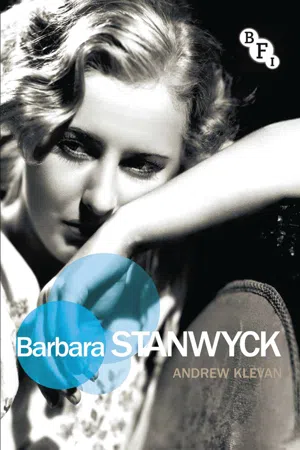
Barbara Stanwyck's illustrious career began in the 1920s and spanned sixty years. During that period she starred in major films of many genres and worked with some of the most distinguished Hollywood directors.
Devoting each chapter to a significant quality of Stanwyck's performances, Andrew Klevan foregrounds crucial scenes from her exemplary films, including Stella Dallas (1937), The Lady Eve (1941), and Double Indemnity (1944). Through the lens of her achievement, Klevan examines the wider concerns of these films while revisiting classic topics from Film Studies – psychoanalysis, medium reflexivity, and the representation of female roles such as the 'sacrificial mother' and the 'femme fatale'. In paying close attention to the various aspects of Barbara Stanwyck's skilfully executed performances, this book enhances familiar understandings and provides fresh illumination.
- 152 pages
- English
- ePUB (mobile friendly)
- Available on iOS & Android
eBook - ePub
Barbara Stanwyck
About this book
Information
1 RESPONSIVENESS
LADIES OF LEISURE (1930)
THE MIRACLE WOMAN (1931)
NIGHT NURSE (1931)
Independence is a trait commonly attributed to the Barbara Stanwyck film persona. In his classic text, Stars, Richard Dyer mentions her within a section entitled ‘The Independent Woman’ (1998 [1979]: 54–9), and David Thomson in his entry in A Biographical Dictionary of Film writes, ‘There is not a more credible portrait in the cinema of a worldly, attractive, and independent woman in a man’s world than Stanwyck’s career revealed’ (1995 [1975]: 712). This independence is noticeable even in her first appearance in her first significant film Ladies of Leisure (1930) (she appeared without credit as a dancer in 1927, and then in two unsuccessful films in 1929). It is the middle of the night, we are watching from the road, and she appears in the distance, beyond a stretch of water, arriving at a jetty in a rowing boat. When Jerry Strong (Ralph Graves) calls out to her and offers help, she says that he can – by looking the other way. She is a tiny figure in the frame, but we can see her kicking the boat away and standing on the jetty in a white evening dress, with her hands on her hips. Jerry looks round and warns that she will lose the boat but she shouts back (only faintly audible on the old print I am watching) ‘I wanna lose it. It ain’t mine’. Then she struts hastily around the jetty, and strides up a grassy verge to meet him. Her independence is established in a minute or so: her isolation (alone on a boat in the middle of night), her distance (from the camera), her self-sufficiency, her determination, her incongruity, her physicality, her stance, her defiance, her disregard, and her call for privacy.
Other aspects of the Stanwyck persona, much remarked upon, and associated with independence, are also in evidence in the opening few minutes: the ‘tough cookie’, ‘no-nonsense’ girl from the streets who has ‘been around’ and knows her mind. She speaks in Brooklynese, jaunty and raucous with elongated vowels, a bit sharp at the top of the range, and slangy with lots of ‘say … .’, ‘hey’, ‘oughta’, ‘oh gee’, ‘oh boy’ and ‘sure’ (pronounced ‘shaaw’). Her behaviour is ‘unladylike’: she freely gesticulates, for example, thumbing over to the ship on the water, vigorously squeezes her nose with his handkerchief before giving a sniff, and wiggles her bottom to get comfy as she sits in the car. It transpires that being a ‘party girl’ is her ‘racket’, and that she has sneaked out from a large disreputable party on a ship. ‘Party girl’ is a euphemism for the already euphemistic ‘call girl’ and a useful one for Hollywood to suggest illicit conduct in the guise of vivacity and merriment. Given, as she says, that it is ‘4 in the ay-em’, and that she has just been on a rowing boat, it is little wonder that her hair is bedraggled, her eye makeup has run, and one shoulder strap on her dress has snapped. At the same time, the film insinuates unfettered behaviour and manhandling.
Apart from providing the erotic whiff of clandestine and ‘immoral’ sex, by making Kay Arnold, Stanwyck’s character, a ‘call girl’, she is provided with a reason to be direct and indirect: the straight-talking, forthright girl who, nevertheless, cannot or will not always say it like it is. Stanwyck’s best characters often have a reason to be deceitful, a pretext enabling her to control the release of truth. Many good film performers explore and complicate the relationship between authenticity and artifice, a tension that is itself at the heart of the medium (with its equal propensities to record and design), or merge their performance with their character’s performances within the fiction. Yet, sincerity, in particular, is often at stake in Stanwyck’s performances. Dan Callahan describes her as ‘an actress who always makes “sincerity” seem a Byzantine concept’ (2012: 150). (The performing of sincerity is itself an intriguing paradox.) Kay’s jaunty explanation of her job to Jerry is as euphemistic as ‘party girl’ – ‘if you need a girl, I’m the one you call for, I’m the filler in’ – but is delivered as handy and helpful, an advertising slogan innocently appropriated. A few moments later, she secretly discovers Jerry’s fat wallet (he’s wealthy) in the inside pocket of his coat, and, after registering the import with a serious face, she breezily exclaims, ‘Lovely night, isn’t it?’ Her job requires her to create amenable environments (for men) without appearing to do so, while the prospect of pecuniary gain enhances the night’s loveliness for her, and Stanwyck’s exclamation conveys a little of both. Yet, her delivery of the line is not decisively cynical or dissembling, nor is it said with avaricious relish. The night really does now appear to Kay as lovely, and it matters that it does.
Frank Capra’s films show a director who was also interested in exploring the expression of sincerity. He made four with Stanwyck in the early 1930s (Ladies of Leisure, The Miracle Woman, Forbidden, The Bitter Tea of General Yen, all between 1930 and 1933). The appreciation of Capra’s later films has tended to overshadow this earlier work and the significance of his partnership with Stanwyck, but the recent interest in the pre-Code period of Hollywood (1930–4) has helped the rediscovery. Richard T. Jameson writes that, ‘viewed as collaborations between a gutsy star and gutsy director at a crucially formative stage in their careers, and in the sound cinema as well, all four films are extraordinarily exciting – indeed, almost indecently electrifying’ (1981: 37). Joseph McBride writes, ‘The intensity and lucidity of their work together … is one of the most fertile creative teamings of director and actress in cinema history’ (2010: 47).
Important though Stanwyck’s characters’ independence may be, the description possibly overlooks their willingness to interact. They are rarely detached or aloof (even Double Indemnity’s restrained Phyllis Dietrichson [1944]), and are mostly eager to engage. When Jerry says he too has ducked out of a party (which he has), Kay squirms in glee at the coincidence. She is restrained only by the realisation that her dress strap has fallen away, which forces her into a self-conscious and contrite pardon. He says it serves her right for attending that type of party, and she snaps indignantly at his self-righteousness (‘Heh, if ya gonna preach, I’ll waahlk’). Despite their diversity and proximity, each of these – the gleeful squirm, the self-conscious pardon, the indignant snap – is a striking, full-blooded reaction to which Kay (and Stanwyck) is equally committed. As Mick LaSalle writes, ‘Stanwyck inhabited [a] wide … emotional range … and she could access any of her emotions at a moment’s notice … with no inconsistency of character’ (2000: 136). Range, quite rightly, is commonly attributed to the performer, prompting Anthony Lane to describe her as the ‘Swiss Army knife of motion pictures. She could be used for anything – fighting, dancing, weeping, wailing, cracking wise’ (2007). Range and responsiveness go hand in hand: responding wholeheartedly to different activities, circumstances and people requires range. The achievement of range is especially impressive in Stanwyck’s case because she was not a character actor of the type who adopts a variety of conspicuous façades from film to film.
In Ladies of Leisure, her flexibility (of response) is contrasted with rigidity; inflexibility is a theme of the film, and a structuring feature. Convinced that she represents Hope, Jerry, an amateur painter (and not a particularly good one, judging by what we glimpse of his work), turns her into his model. Artists’ models were a favourite signifier of scandal in Hollywood’s pre-Code films (LaSalle: 83), but while friends and family see only disgrace, Jerry’s intentions are high-minded. Much of the film concerns Kay trying to break free of the static and restrictive poses she must adopt for the portraiture and – attracted by his lack of moves and social graces – getting him to notice her. Jerry is a stiff, unresponsive figure, the first in a long line of stolid leading men that Stanwyck would play against or, as Stephen Harvey wickedly describes them, ‘globs of unleavened dough’ (1981: 36). Even Fred MacMurray, a deceptively agile performer (and with whom she made a number of her best films), has a thickset frame, bulky, rectangular face and solid demeanour. While she spends her time alertly responding to their characters, they often fail to regard hers satisfactorily. Her lively receptivity is set against their insensitivity, the consequences of which vary depending on the genre.
Often the male performers are in control of their limitations, but in Ladies of Leisure, as Jameson writes, ‘[Ralph] Graves … an awkwardly grinning Varsity jock … comes across as a staggeringly unpolished player who scarcely knows what line-reading, let alone acting, is about. He earnestly wants to get it right, but more than once he starts to speak before he’s been given his proper cue; he waits good-naturedly for the other fellow to conclude his business, then proceeds as if no great harm had been done … this is coping, not deliberate stylization’ (38). Either way, this quality in her leading men provides a dramatic test for Stanwyck, one that might be less testing were she a performer (happy to be) left to her own devices. In his book ‘Star Acting’, Charles Affron compellingly examines Lillian Gish, Greta Garbo, and Bette Davis and argues that they have a plastic, malleable expressivity that borders on the fantastic (1977). Although they respond intensely to their surroundings, they then produce patterns of performance which are self-generating and self-justifying. In contrast, the performer who modulates and calibrates her response to other characters (and performers) is challenged to sustain interest in less flamboyant ways. Stanwyck, even when she is performing extreme aspects of character, keeps herself within reach, and maintains a manner that may be reciprocated. Many of the great female film performers endow their characters with distinctive, eloquent and complex responses to the failure of others to acknowledge them (Cavell: 1996). Stanwyck, however, seems to be the performer who, despite the obstacles, explores ways in which one might acknowledge others.
Graves’s performance is not the only stilted feature of Ladies of Leisure. As Jameson writes, ‘The stage origins remain conspicuous in much of the shooting … [and] [t]heatrical types dominate the supporting characterizations and, for that matter, the casting’ (37). Add to this the limitations on mobility faced by early sound films, and Pauline Kael is fair when she describes it as ‘a museum piece’. At the same time, for Kael, the archaic environment ‘emphasizes Stanwyck’s remarkable modernism’ (1993 [1982]: 403). The ‘modernism’ to which Kael refers might be Stanwyck’s lucid and undemonstrative naturalism that trusts to the camera’s observational power. Jerry is finding Kay a cigarette and something with which to light it, and this takes enough time to create a little in-between period as she waits. It is their first interaction on meeting and the first time we are close enough to see her face. Kay’s expressions are light, brief, and incomplete: her eyes follow his movements, the side of her mouth tightens and upturns a touch self-consciously, and she purses her lips before taking the cigarette. Her behaviour suggests, very faintly, something stirred or stirring – her eyes, for example, not simply watching but noticing – and yet, at the same time, it looks unexceptional, in keeping with the delay, and the awkwardness of strangers meeting. Stanwyck is capable of small and large-scale effects, but Terrence Rafferty captures the former well when he writes, ‘Her effects are small-scale, plain: a downturn at the corners of her mouth, a sudden softening in the tone of her voice, a flicker of self-doubt in her eyes. Such nearly imperceptible but always perfectly lucid shifts of emphasis were her basic arsenal of technical firepower’ (2007).

Her flexibility extends to the performance of extraneous actions. A cigarette painfully sticks to the skin of her lower lip and she fretfully stutters ‘agh, agh, agh’. Kay’s personality is revealed through an occurrence that is incidental and passing (indeed, it takes place whilst lighting one cigarette with another and passing it across to him). This flexibility includes idiosyncrasy. Buoyed by the thick wallet and the ‘lovely night’, she turns to him while he drives and sucks in her cheeks (as if she were impersonating a fish), and asks him whether he can do the same. Later, she starts posing for him in his apartment, where most of the action takes place, and he is exasperated that she cannot be what he wants her to be (he says, ‘I want you to be yourself’, to which she replies ‘then what the devil are you trying to change me for?’). Jerry rubs off her makeup and strips away her fake eyelashes (she lets out the strangest melodic yelp, like the sound of a small animal), exclaiming that he wants to see the ‘real’ her while at the same time demanding that she look up, see through the ceiling, imagine the sky, and appear as a vision of Hope! In response, Kay bursts out ‘goody – goody – goody – let’s fight’, opens her hands in front of her chest, and then says ‘boom’ as her fist meets her palm. Performed with childish glee, but speeded up and softened to give her exclamation a miniature and parodic form, it marks a sudden shift in tenor and tone. It is cheerfully surprising not simply as an impulsive piece of behaviour by Kay but as an unpredictable form of acting by Stanwyck. The idiosyncrasy of character is matched by that of performance, for just as Kay will not conform (to Jerry’s demands), Stanwyck does not conform to a particular acting style or method.
The detail and light touch of Stanwyck’s performance works in response to the starchy and stagy environment, not simply in spite of it. To tease him, Kay does a number of mocking impersonations of female stereotypes (girlish, adoring, coy), in the same vibrant and playful, but hemmed-in, style of the ‘goody, goody’ outburst. Most of them take place at some distance from the camera. Perhaps because it is an early sound film, the recording technology is not supportive, and there is a sense, even when the camera is relatively close to Stanwyck, of her being left, bereft, to draw our attention by herself. In Manny Farber’s terms, this would be a ‘termite’ performance, intricate and concise, proceeding with an honest, unpretentious vitality (2009 [1962]). Stanwyck may well be nibbling away at the wooden world of the film, but she reacts to what is at hand, and is not dispirited. She treats unprepossessing material in good faith, and the less than conducive context makes her treatment unexpectedly touching, and generous.
Stanwyck is not only responsive to other actors but to latent intensities in the material. She finds distinct ways of realising the script (even if screenwriter or director guided her). Bill Standish (Lowell Sherman), the drunken womaniser, is coming on to Kay when he asks, ‘Done any posing before?’, to which she replies, smiling while pushing her hair under her hat in the mirror, ‘I’m always posing’. He follows up with ‘How do you spend your nights?’ and she replies ‘Reposing!’ This retort is already succinctly witty, and an actor, and the film, could be forgiven for making sure the timing is right and letting the line punch for itself. Stanwyck does something more. Leaving the mirror, Kay comes right up to Standish, leans against the wall, cocks her head towards him, beams a large smile, and then, on finishing the word ‘reposing’, flicks her head straight. This straightening of the head, as she puts him straight, is confident but not too cocky. Her rebuff is almost warm-hearted, while pointedly putting an end to the matter. She does not take the more obvious opportunities presented in the dialogue to stand back, dry and aloof, nor does she lay on the sass, sardonic and sly. She approaches him, stands face to face, and addresses him directly. This is how she keeps her distance. Moreover, her response is appropriate – after all, this unhappy alcoholic is easily brushed aside and hardly requires ferocity – but equally it sets the standards for appropriateness, teaching us how to treat him. We learn about, assess, or reconsider character(s) thanks to the precise nature of her regard (for example, her behaviour with Jerry delivers a fuller account of him than Graves is capable of revealing).
Stanwyck’s characters can be audaciously forthright. This is forcefully exhibited in the opening scene of The Miracle Woman (1931), another of her films with Frank Capra, where she plays Florence Fallon, a preacher and faith healer. Florence walks out in front of a church congregation to read a sermon written by her father. Within a minute or so, she is delivering a searing critique of the congregation’s callousness. (Her father wanted to stay on as pastor until he died as reward for his devoted years of service, but was shunted aside in favour of a younger man.) As an occasion of passionate, public exhortation, in the context of losing innocence and finding a voice, it joins hands with those that appear in other Capra films (most notably, Mr Smith Goes to Washington [1939]). The scene is equally commanding but the achievement is more unusual. This is because it has a woman providing the persuasive rhetoric; because it initiates rath...
Table of contents
- Cover
- Title Page
- Dedication
- Contents
- Acknowledgments
- Introduction
- 1. Responsiveness
- 2. Multiplicity
- 3. Tonal Finesse
- 4. Restraint
- 5. Stillness
- A Final Word
- Bibliography
- Filmography
- Index
- List of Illustrations
- eCopyright
Trusted by 375,005 students
Access to over 1.5 million titles for a fair monthly price.
Study more efficiently using our study tools.
Frequently asked questions
Yes, you can cancel anytime from the Subscription tab in your account settings on the Perlego website. Your subscription will stay active until the end of your current billing period. Learn how to cancel your subscription
No, books cannot be downloaded as external files, such as PDFs, for use outside of Perlego. However, you can download books within the Perlego app for offline reading on mobile or tablet. Learn how to download books offline
Perlego offers two plans: Essential and Complete
- Essential is ideal for learners and professionals who enjoy exploring a wide range of subjects. Access the Essential Library with 800,000+ trusted titles and best-sellers across business, personal growth, and the humanities. Includes unlimited reading time and Standard Read Aloud voice.
- Complete: Perfect for advanced learners and researchers needing full, unrestricted access. Unlock 1.5M+ books across hundreds of subjects, including academic and specialized titles. The Complete Plan also includes advanced features like Premium Read Aloud and Research Assistant.
We are an online textbook subscription service, where you can get access to an entire online library for less than the price of a single book per month. With over 1.5 million books across 990+ topics, we’ve got you covered! Learn about our mission
Look out for the read-aloud symbol on your next book to see if you can listen to it. The read-aloud tool reads text aloud for you, highlighting the text as it is being read. You can pause it, speed it up and slow it down. Learn more about Read Aloud
Yes! You can use the Perlego app on both iOS and Android devices to read anytime, anywhere — even offline. Perfect for commutes or when you’re on the go.
Please note we cannot support devices running on iOS 13 and Android 7 or earlier. Learn more about using the app
Please note we cannot support devices running on iOS 13 and Android 7 or earlier. Learn more about using the app
Yes, you can access Barbara Stanwyck by Andrew Klevan in PDF and/or ePUB format, as well as other popular books in Media & Performing Arts & Social Science Biographies. We have over 1.5 million books available in our catalogue for you to explore.