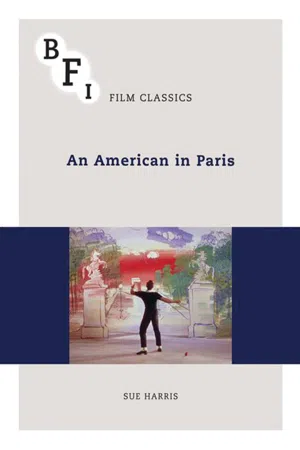
An American in Paris (1951) was a landmark film in the careers of Vincente Minnelli, Gene Kelly and Leslie Caron. A joyous celebration of George Gershwin's music, French art, the beauty of dance and the fabled City of Light, the film was heralded as a rare example of entertainment 'for mass and class alike'. Choreographed by Kelly at the height of his career, it gave new stature to the Hollywood musical, and showcased as never before the artistic ambition, technical skills, creative imagination and collaborative ethos of MGM's pioneering Arthur Freed Unit.
Sue Harris draws on archival material to trace the film's development from conception to screen. Offering new insights into the design process in particular, she shows how An American in Paris established the cinematic template for a city with which Hollywood would become increasingly infatuated in the decades to follow.
- 128 pages
- English
- ePUB (mobile friendly)
- Available on iOS & Android
eBook - ePub
An American in Paris
About this book
Information
1 'Who knows, it may even put Paris on the map ...'
Prologue
When producer Jesse L. Lasky opened the envelope that revealed the name of the 1951 Best Picture Academy Award, he could not hide his disappointment. 'Oh dear' he declared, 'the winner is An American in Paris'.1 Lasky's ungracious aside came at the end of an award ceremony in which the MGM film had been riding high, garnering a raft of Oscars in all the major technical categories: art direction (Preston Ames and Cedric Gibbons), cinematography (Alfred Gilks and John Alton), costume (Walter Plunkett, Orry-Kelly and Irene Sharaff), musical score (Saul Chaplin and Johnny Green) and screenplay (Alan Jay Lerner). The film's star and choreographer Gene Kelly had been singled out for an Honorary Academy Award that celebrated his career as a performer, director and choreographer, while the Irving Thalberg Award went to the legendary Louis B. Mayer for his achievements as a producer at MGM. The clean sweep was marred only by the Academy's apparent snub to Vincente Minnelli, who would have to wait another seven years to receive Best Director recognition for a second Paris film, Gigi (1958). Minnelli's omission may have been entirely within the norms for a contract director of the era - genre directors tended to be seen as helmsmen rather than talented artists in their own right - but the slight rankled: as Minnelli remarked many years later in his autobiography
Some erudite types point to An American in Paris as the perfect example of the studio-as-auteur theory. I disagree. Though I don't minimize anyone's contributions, one man was responsible for bringing it all together. That man was me.2
Lasky's shock at the outcome was perhaps less surprising then than it might appear now. In the 1940s, MGM was famed for its witty, colourful musical productions, many of which had been directed by Minnelli, and the genre was the particular forte of the MGM Arthur Freed Unit, an in-house production team with deep links to Broadway theatre. Hit films included The Wizard of Oz (1939), Meet Me in St Louis (1944), Easter Parade (1948) and On the Town (1949), and the unit's continued success into the 1950s would be assured by the likes of Singin' in the Rain (1952), The Band Wagon (1953), Brigadoon (1954) and Gigi.
The studio's reputation for quality and excellence was underpinned by two factors: vast technical resources (overseen by MGM's supervising art director Cedric Gibbons), and a roster of top stars ('more stars than there are in heaven' as the publicity boasted). Musicals were particularly resource- and time-intensive projects, harnessing the skill and craft of armies of artisans, artists and performers to create fleeting, magical worlds of pure escapism. But the finished product was rarely considered to amount to more than the sum of its parts. Few were ever critically acknowledged as having dramatic depth or narrative originality, and only two such films had ever previously taken the coveted Academy Best Picture prize: The Broadway Melody (1929) had been an early recipient of the award in the era when sound cinema was still a great novelty, while the sheer extravagance of The Great Ziegfeld (1936) merited three Oscars including Best Picture. In 1952, for the first time, an integrated, story-led musical was comprehensively acclaimed as accomplished and complex, and with the success of An American in Paris, the critical fortunes of the Hollywood musical were definitively remade.
An American in Paris was very much a pet project for Arthur Freed and his friend and frequent collaborator Minnelli. The film was structured entirely around the music of the composer George Gershwin, who had died of a brain tumour in 1937 at the age of only thirty-eight. The title rights to Gershwin's eponymous composition were acquired by Freed from Ira Gershwin, the late composer's brother, over a weekly poker game at the latter's home; the purchase price was $300,000, and the condition was that only music from the Gershwin back catalogue would be used in any film that would be made. In an era when successful Broadway shows were forensically mined for film adaptations, the success of the former offering a guarantee of the success of the latter, An American in Paris or Production 1507, represented something of a break with MGM practice: there was no pre-existing story to work with and no insistence that George Gershwin's life be the subject of the film. Indeed, the only certainties were those dictated by the title: the setting would be Paris, and the main character would be an American who lived there.
Although the film was a popular and commercial success on release (grossing over $8 million from a budget of $2.7 million), critical reactions to it, as hinted at in Lasky's reaction, were mixed. Many felt that while it was superbly crafted, the film was more memorable for its weaknesses than its strengths: the energetic Gene Kelly tied down to a painter's easel; a patently artificial Paris populated by Gallic stereotypes; a timid leading lady who doesn't sing; and a thin, at times quite cynical plot in which 'a kept man falls in love with a kept woman'.3 Its seventeen-minute ballet finale was widely admired, but was also criticised as an opportunistic imitation of the ballet in Powell and Pressburger's The Red Shoes, the British film which had dominated the American box office in 1948. Admittedly, the film offered a feast of George Gershwin's music, but this came hot on the heels of the Irving Rapper biopic Rhapsody in Blue (1945), and offered none of its insights - however inaccurate - into the composer's short life. The view of critic Bosley Crowther, writing in the New York Times, that the film was little more than 'a minor romantic compilation in the usual gaudy Hollywood gay Paree'4 was typical of many reactions.
That this film should be awarded the Best Picture Oscar, over such serious dramatic competition as Quo Vadis (1951), A Streetcar Named Desire (1951) and A Place in the Sun (1951) clearly riled many in the industry. But for others, its flaws notwithstanding, it stood as the apogee of the craft of musical production. Among its supporters was producer David O. Selznick, who wrote to Freed: 'My most sincere congratulations to you on An American in Paris. It is that rarity - a truly great film, and unquestionably the most distinguished musical ever made'.5
Its broad appeal to a wide cross-section of audiences was also noted, with one critic describing it as 'entertainment for mass and class alike',6 a reference to its ambitious amalgamation of diverse and seemingly incompatible cultural forms: French art, classic ballet, orchestral music and modern dance, all within the framework of a musical comedy. Sherwin Kane writing in Motion Picture Daily was effusive:
If any serious fault can be found with An American in Paris it must be that it gives the customers too much for their money. It would be embarrassing, experience would indicate, if they expected as much every time they entered a theatre. The picture is a credit to the industry as well as the people and the studio who made it. No intelligent showman can sit through its unreeling without feeling proud that he is part of the industry in which it was produced. An American in Paris is Entertainment with a capital E, and of the highest order.7
As Minnelli so eloquently put it in his memoirs 'just as no one sets out to make a bad picture, rarely under the studio system did anyone set out to make a classic. An American in Paris certainly wasn't designed as such'.8 The film may have begun life as just another commercial entertainment project, but what coalesced around Production 1507 was a remarkable amount of talent and creative vision in the form of skilled artists and craftspeople for whom this project was deeply personal: a director reputed to be Hollywood's most flamboyant stylist; the leading dancer-choreographer of his generation; a new screen star direct from the Paris ballet; family and friends of the late George Gershwin; musicians who had learned their craft from him; designers and technical advisors who had lived, worked and even trained in Paris. And the unparalleled creative infrastructure at Culver City, Los Angeles was entirely at their disposal: 'We had the stages, we had the tools, we had the savvy, we had the manpower, and we were geared to do this kind of thing' remembers art director Preston Ames.9 Seymour Peck, writing in Compass, was bowled over by the achievement, and understood immediately the impact the film would have with audiences: 'An American in Paris shoots the works [...] it is a lush, lavish, large scale, supercolossal, all out MGM lovesong to a city. Who knows, it may even put Paris on the map'.10

The film's legacy
In the 1940s, An American in Paris referred to a modern musical composition from the 1920s. After 1951, it came to signify the Hollywood musical at its most ambitious and refined. In the years since, the film has become iconic, offering a template for cinematic ideas of Paris as an enchanted space of pleasure, leisure and romance, as well as a title that remains easy shorthand for narratives of transformation experienced by Americans in Europe. From Stanley Donen's Funny Face (1957), to Woody Allen's comedies Everyone Says I Love You (1996) and Midnight in Paris (2011); from Billy Crystal's romcom Forget Paris (1995) to the Season 6 finale episodes of Sex and the City ('An American Girl in Paris Parts Un & Deux', 2004), the referential value of Paris as decor, destination and site of romantic fulfilment takes us back again and again to ideas and images of the city elaborated, celebrated and permanently fixed in the popular imagination by Minnelli's 1951 film.
More than sixty years later, the influence of the film is as strong as ever. In December 2014, the Châtelet Theatre in Paris was home to the world premiere of a multimillion-dollar stage adaptation, a French-American collaboration which played to packed houses over a forty-night run. In March 2015, it took up residence on Broadway, and became part of the permanent landscape of American musical theatre. The currency of the film thus remains high in contemporary culture: the story and characters still charm, the performances still dazzle, and as a historical document it offers compelling evidence of the artistic ambitions, technical mastery and creative imagination that informed musical production at MGM in the 1940s and 1950s. As much as many great works of literature by the likes of Ernest Hemingway, F. Scott Fitzgerald, Henry James and Edith Wharton, it testifies to an enduring affection for, and fascination with the city of Paris in American minds. An American in Paris did indeed put Paris on the map, fixing an image of the city in the global popular imagination even more acutely than films produced in France. And then as now, French audiences loved it every bit as much as much as those back home.
For Freed, Minnelli and Kelly - in different ways - An American in Paris marked the culmination and highest achievement of a decade of work in production, direction and choreography. While each brought singular talents and specific strengths to the project, their collaboration took place in a rare spirit of creative compatibility, founded on professional experience and close personal friendship. And it is precisely the pleasures of collaboration and mutual endeavour that are woven so deeply into the fabric of the film. The inclusivity of their 'Paris' - as a place of friendships, solidarities and communities - is insistently present at the level of story, music and dance, characterisation and design.
After An American in Paris, location shooting would become the norm for European-set films, and by the end of the following decade, films such as Moulin Rouge (1952), Around the World in Eighty Days (1956), Funny Face, Love in the Afternoon (1957), as well as Minnelli's own Lust for Life (1956) and Gigi, had been filmed wholly or partly in Paris. But with this lavish last hurrah, in the very last months of Louis B. Mayer's long tenure as studio boss, MGM embraced the art of artifice, and showed the world what it could do with ...
Table of contents
- Cover
- Title Page
- Contents
- Acknowledgments
- 1 'Who knows, it may even put Paris on the map ...'
- 2 The Building Blocks of Production 1507
- 3 Paris, Culver City
- 4 Camaraderie, Community and Romance
- 5 The Ballet
- 6 Promotion, Reception, Legacy
- Conclusion
- Notes
- Credits
- Bibliography
- Bm
- ecopyright
Trusted by 375,005 students
Access to over 1.5 million titles for a fair monthly price.
Study more efficiently using our study tools.
Frequently asked questions
Yes, you can cancel anytime from the Subscription tab in your account settings on the Perlego website. Your subscription will stay active until the end of your current billing period. Learn how to cancel your subscription
No, books cannot be downloaded as external files, such as PDFs, for use outside of Perlego. However, you can download books within the Perlego app for offline reading on mobile or tablet. Learn how to download books offline
Perlego offers two plans: Essential and Complete
- Essential is ideal for learners and professionals who enjoy exploring a wide range of subjects. Access the Essential Library with 800,000+ trusted titles and best-sellers across business, personal growth, and the humanities. Includes unlimited reading time and Standard Read Aloud voice.
- Complete: Perfect for advanced learners and researchers needing full, unrestricted access. Unlock 1.5M+ books across hundreds of subjects, including academic and specialized titles. The Complete Plan also includes advanced features like Premium Read Aloud and Research Assistant.
We are an online textbook subscription service, where you can get access to an entire online library for less than the price of a single book per month. With over 1.5 million books across 990+ topics, we’ve got you covered! Learn about our mission
Look out for the read-aloud symbol on your next book to see if you can listen to it. The read-aloud tool reads text aloud for you, highlighting the text as it is being read. You can pause it, speed it up and slow it down. Learn more about Read Aloud
Yes! You can use the Perlego app on both iOS and Android devices to read anytime, anywhere — even offline. Perfect for commutes or when you’re on the go.
Please note we cannot support devices running on iOS 13 and Android 7 or earlier. Learn more about using the app
Please note we cannot support devices running on iOS 13 and Android 7 or earlier. Learn more about using the app
Yes, you can access An American in Paris by Sue Harris in PDF and/or ePUB format, as well as other popular books in Media & Performing Arts & Performing Arts. We have over 1.5 million books available in our catalogue for you to explore.