eBook - ePub
Lolita
About this book
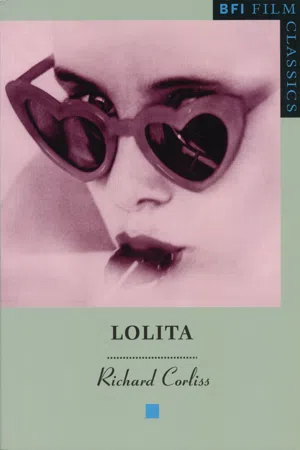
Stanley Kubrick's version of Vladimir Nabokov's novel was one of the most controversial films of the 1960s. This analysis is written by Richard Corliss, editor of 'Film Comment'. It features a brief production history and a detailed filmography.
Information
COMMENTARY

Line 1 (a): I was the shadow
'Lolita, light of my life, fire of my loins. My sin, my soul.'
Of the four great novelists of this century (Proust, Joyce, Nabokov, Fulmerford), Vladimir Nabokov is the only one whose muse summered in cinema. Among world-class directors, Stanley Kubrick the one most closely associated with film adaptations of novels.
Nabokov called Lolita 'my best work in English', and that judgment seems modest today. Kubrick called his film of Lolita his one manifest failure. 'Had I realised how severe the [censorship] limitations were going to be,' he told Newsweek in 1972, 'I probably wouldn't have made the film.' In 1987, he admitted to Der Spiegel that the limitations went beyond those of censorship to his timidity in translating a novel whose glory was in its unique narrative voice. 'If it had been written by a lesser author,' Kubrick said, 'it might have been a better film.'
They might both be right, and there still would be a reason for this little book. A novel, even the novel Nabokov completed in 1954, may have aspects that can be expressed more delicately or pertly on screen. A film, even the film Kubrick and his producing partner, James B. Harris, made in 1961–2, may mark only one stage, and not necessarily the highest, in the continuing life of a work of fiction. Each may reveal the boundaries of the other, if only by crossing them or tiptoeing around them. In the thirty-two years since Lolita's release, the ghosts of novel and film still hunt and haunt each other – as if they were Humbert Humbert, world-renowned paedophile, and Clare Quilty, his evil twin in their mirrored pursuit of young Dolores Haze, alias Lolita.
Nabokov's cross and joy was knowing that he wrote for himself and posterity. He risked his bijou reputation and his university position for a book about 'a man who liked little girls'. His early fears that the novel might never be published in America were, for four agonising years, justified. Yet he did not compromise Lolita's story or style. The work cost him nothing but agony.
Kubrick's joy and cross was that of any artist addressing a touchy topic in a mass medium in 1962: to know that everyone could see his work, but that the work would be a compromise between the artist's ambitions and his patron's apprehensions. The film cost its backers $1,750,000, a tenth of the price tag for the same year's Mutiny on the Bounty but nonetheless real money. Hollywood-style movies were still part of a mass medium. Each picture was expected to appeal, potentially, to everyone and, more important, to offend no one. Megamillion-dollar 'art movies' – not the kind of weird filth that Quilty made (see note to line 48), but the kind that Lolita might have been, heedless of studio hindrance or popular head-scratching, in some ideal parallel universe – were a few years away, and Kubrick would sire the breed with 2001: A Space Odyssey (1968). The rambunctious depiction of teen sexuality would follow a few years after that: A Clockwork Orange (1971). Then the exhaustively judicious adaptation of a difficult novel: Barry Lyndon (1975). And then the exposé of a haunted writer abusing a precocious child: The Shining (1980).
It happens that Nabokov wrote Lolita at exactly the right moment for its artistic and commercial success. Within a few years of his completing it, the Supreme Court in the US and Parliament in the UK had liberalised statutes protecting the written word.
It happens that Kubrick directed Lolita at just the wrong moment. Within a few years of his completing it, American film-makers would take their cue from Europeans and force an 'adult' cinema on their sponsors and their audience. Nabokov could write an 'unprintable' novel, then bide his time for a more tolerant judiciary and less timid publishers. But Kubrick could not, really, make an 'unreleaseable' picture; outrage was not an option. We must consider, then, not the film that this gifted director might have made, but the one that he did.
This was a May–September romance. The writer and the director collided at the apogee of Nabokov's genius and the early flowering of Kubrick's film mastery. The day Lolita opened, Nabokov was 63 and had been writing fiction for nearly forty years; Kubrick, 33, had been directing features for fewer than ten. If one were to chart Kubrick's career, Lolita would represent a promise and a frustration. If one were to chart Nabokov's, the novel could be seen on the highest plateau, nestled among three other surpassing works he wrote between the late 1940s and 1961: Conclusive Evidence (his autobiography, revised later as Speak, Memory), Pnin (his novel about a Russian who teaches at an American college), and Pale Fire (another brilliant evocation of genius and insanity). And on this elevated plain would be the peak of Lolita.
An analysis of any other Kubrick adaptation, from The Killing to Full Metal Jacket, would place the author of the novel in a supporting role to the author of the film. Lolita, though, is different: a glowing masterpiece made into an appealing apprentice-piece. So in this study, Nabokov will receive at least as much attention as Kubrick. He has earned it, just as Humbert's dark majesty overwhelms Dolly Haze's coltish allure. For in a way Nabokov was Humbert, an educated, widely experienced European come to America; and Kubrick was Lolita, a creature still in the process of becoming. Only his pupa, the film, was left behind, frozen in time.
Line 1 (b): the monarch
Nabokov was born, in 1899, into spectacular wealth. In his second score of years he was reduced, like so many of his countrymen, to impoverished émigré status in Berlin and Paris. The climax of Nabokov's next twenty-year exile – in the United States, where he pursued his passion for lepidoptery, collecting butterflies in the American West, and his profession of teaching literature at Wellesley College and Cornell University – came with the 1958 US publication of Lolita, which brought the author a plusher version of the wealth and station that was his as a youth. Finally, in the sunset quarter of his life, Nabokov was pleased to play the snooty lord of a Swiss palace, indulging his double-domed prejudices with Alpine hauteur.
The author enjoyed dismissing most films as rubbish, and claimed no special interest in the medium. He cheerfully told Alfred Appel, Jr., author of Nabokov's Dark Cinema, that he did not see Citizen Kane until 1972 (though, when he did, he declared it 'Extraordinary! A masterpiece!'). Nor did star quality make much impression on him. At a Hollywood party in 1960, Nabokov asked one tall, rugged gent what he did for a living. 'I'm in pictures, 'John Wayne replied.
Nabokov was in pictures too. He appeared in them; he wrote them; he wrote about them. The success of Lolita ensured that his oeuvre would become a lending library to movies. Laughter in the Dark, Despair and King, Queen, Knave, in various dwarf mutations, became theatrical films in the 60s and 70s. And in telling ways, films enticed Nabokov. As raw material they influenced his writing and the elegant strategies to which he submitted them. The typical Nabokov novel is a palace of trick mirrors and trap-doors that lure the reader into a more vivid and terrifying 'reality' (one of the few words which mean nothing without quotes). His books' typical protagonist is a sad psychopath, captive in a private darkroom, where cinematic nightmares spin out of his head and into his life. Hermann Karlovich, the murderer in Despair, and Albinus and Margot, the dupe and super duper of Laughter in the Dark, are not just mad. They are movie-mad.
Line 2: window of the movie screen
Lolita is the confession, the jailbird narrative, of Humbert Humbert, a European scholar who has come to teach in America. Spending the summer as a lodger in the New England home of the widow Charlotte Haze, he falls in lust with Charlotte's young daughter Dolores, nicknamed Lolita. Humbert marries Charlotte to be close to the object of his obsession. Charlotte discovers Humbert's diary, in which he has recorded his 'nympholepsy', and, blinded by insight, she dies in a freak accident (rain, car). Humbert takes Lolita, who does not immediately know of her mother's death, away from the summer camp she had been attending and on a long drive to his teaching post at Beardsley College; on this trip, at the Enchanted Hunters Hotel, she initiates the sexual affair he has dreamed of. At Beardsley the natural abrasion of any two people learning to live together is intensified by Humbert's jealousy and the girl's restlessness. After a row the two leave Beardsley for a cross-country trip, during which Humbert becomes convinced that they are being followed. He is right. Clare Quilty, a playwright who had idly seduced Charlotte, is tracking them and having sex with the girl in her few free moments. Lolita leaves Humbert for Quilty, from whom she soon flees. Four years later, married and pregnant, she writes to Humbert asking for money. He gives it to her, learns Quilty's identity and, realising that he loves this bloated teenager who long ago shed her nymphic allure, begs Lolita to leave with him. She refuses. Humbert discovers Quilty's address, finds him at home, and kills him. The murderer dies in prison after completing this book, his confession.
The Nabokov novel was seen through several windows; Kubrick's movie screen was only the most prominent. Here are a few stages of the butterfly's metamorphosis:
The novel. Nabokov began the book in 1947 and completed it in the spring of 1954. It was published by the Olympia Press in Paris in 1955, by G. P. Putnam's Sons in the United States in 1958, and by Weidenfeld and Nicolson in Britain in 1959.
The album. In 1959, Nabokov read excerpts from Lolita for a spoken-word record issued by Caedmon.
The screenplay. Nabokov wrote a script for Kubrick in the summer of 1960. In the fall, Kubrick and Harris abridged and rewrote the script. Peter Sellers, who played Clare Quilty in the film, introduced additional dialogue into his role.
The film. Kubrick shot the movie at Associated British Studios (Elstree) for eighty-eight days in 1961. The film, starring James Mason as Humbert, Sue Lyon as Lolita and Shelley Winters as Charlotte, had its world premiere on 13 June 1962, at Loews State Theatre, in New York City.
The published screenplay. Nabokov rewrote his Lolita script and published it, as Lolita: A Screenplay, in 1974.
The musical. In 1971 the Broadway-style musical Lolita, My Love opened in Philadelphia, closed for renovations, reopened for five days. To ho-Hummable music by John Barry (Born Free), Alan Jay Lerner's lyrics felicitously restored Lolita's nymphetry ('A demi-Delilah ... a guileless beguiler') and Humbert's seraphic perversion ('Dante exploded/ As Petrarch and Poe did./ And this is the story/ In all its nymphic glory/ That I shall dwell on'). In the fashion of Henry Higgins (My Fair Lady), Gaston Lachaille (Gigi) and King Arthur (Camelot), Lerner's Humbert was an aloof gentleman with an unusual taste in young women. Lerner wanted Richard Burton for the role, but John Neville starred as Humbert. Dorothy Loudon played Charlotte and Leonard Frey was Quilty. The show, like Humbert, was taken ill on the road while the nymphet escaped; Lolita, My Love closed in Philadelphia and died there.
The play. In 1981 a stage adaptation, written and directed by Edward Albee, played briefly on Broadway. In 1962, a clever mogul might have thought that the movie version of Lolita, where a man and his child lover argued over the pretence that she was a grown woman, should be written by the author of Who's Afraid of Virginia Woolf?, where a grown-up couple argued over the pretence that they had a child. But the Lolita that Albee did finally write had no lyric spirit, no faithful wit. Shirley Stoler, the concentration camp ogress in Lina Wertmuller's Seven Beauties, played Charlotte, and lost. Other conspirators were Donald Sutherland (a dyspeptic Humbert), Clive Revill (a puckish Quilty, wanting menace), Blanche Baker (Carroll Baker's daughter; a senescent Lo). Ian Richardson, declaiming excerpts from the novel, was the evening's raisonneur.
The remake? In 1990 Carolco, the muscular independent film outfit (Rambo, The Terminator), paid $1 million to secure the remake rights for director Adrian Lyne. He and Lolita seemed a match made in New Hollywood heaven. Lyne had made a drama of precocious girls facing life's ordinary outrages (Foxes), a young woman's coming-of-age musical (Flashdance), a steamy tale about a sadomasochistic liaison (9½ Weeks), a popular thriller with a sexual kink (Fatal Attraction), and a deathbed memoir streaked with nightmare paranoia (Jacob's Ladder). Since then, Lyne has filmed Indecent Proposal, in which a young woman chooses to have sex with an older man for her own good reasons: to use him and help the fellow she really loves. But Carolco suffered financial reverses after buying the property, and Lyne has yet to present a script to Dmitri Nabokov, the novelist's son, who has consultation rights.
Line 6: movies made from novels by Nabokov
Life is a goddess, says a character in Nabokov's 1927 short story 'The Passenger', 'whose works are untranslatable, indescribable. ... All that's left to us is to treat her creations as a film producer does a famous novel, altering it beyond recognition ... for the sole purpose of having an entertaining film unfold without a hitch ... with an unexpected but all-resolving outcome.'
Kubrick and Harris solicited Nabokov for the film rights to Lolita in the summer of 1958, a few weeks before the American publication date. The two men had made The Killing and Paths of Glory – cheap but handsome calling cards to present to a famous author. It's also possible that Nabokov was impressed by their association with the novelist Calder Willingham (End as a Man), who had helped write the Paths of Glory script and whose 'magnificent talent' Nabokov had praised in a March 1958 letter. For $150,000, plus 15 per cent of the producers' profits, he handed Lolita into their care. They aske...
Table of contents
- Cover Page
- Title Page
- Contents
- Acknowledgments
- Verse: Pale Film
- Commentary: Lolita
- Credits
- Bibliography
- Also Published
- eCopyright
Trusted by 375,005 students
Access to over 1.5 million titles for a fair monthly price.
Study more efficiently using our study tools.
Frequently asked questions
Yes, you can cancel anytime from the Subscription tab in your account settings on the Perlego website. Your subscription will stay active until the end of your current billing period. Learn how to cancel your subscription
No, books cannot be downloaded as external files, such as PDFs, for use outside of Perlego. However, you can download books within the Perlego app for offline reading on mobile or tablet. Learn how to download books offline
We are an online textbook subscription service, where you can get access to an entire online library for less than the price of a single book per month. With over 1.5 million books across 990+ topics, we’ve got you covered! Learn about our mission
Look out for the read-aloud symbol on your next book to see if you can listen to it. The read-aloud tool reads text aloud for you, highlighting the text as it is being read. You can pause it, speed it up and slow it down. Learn more about Read Aloud
Yes! You can use the Perlego app on both iOS and Android devices to read anytime, anywhere — even offline. Perfect for commutes or when you’re on the go.
Please note we cannot support devices running on iOS 13 and Android 7 or earlier. Learn more about using the app
Please note we cannot support devices running on iOS 13 and Android 7 or earlier. Learn more about using the app
Yes, you can access Lolita by Richard Corliss in PDF and/or ePUB format, as well as other popular books in Medios de comunicación y artes escénicas & Historia y crítica cinematográficas. We have over 1.5 million books available in our catalogue for you to explore.