- 88 pages
- English
- ePUB (mobile friendly)
- Available on iOS & Android
eBook - ePub
Ivan the Terrible
About this book
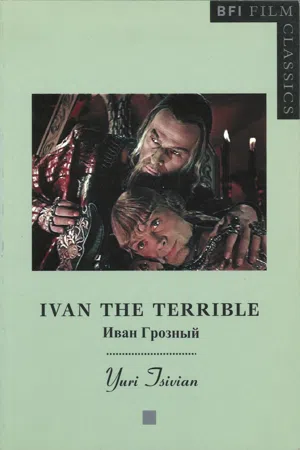
Ivan The Terrible (1944/46) was envisaged by its director, Sergei Eisenstein as a trilogy. But, Eisenstein died before begining the third part. Part One had been a resounding success, winning a Stalin prize, but Part Two met with the Kremlin's disfavour and was eventually banned until 1958. Using research gathered from Soviet archives, Yuri Tsivian offers an insight into Eisenstein's grand project. He reconstructs the director's 'mental film' that underlies the finished work. The book attempts to follow the train of thought that connect the aesthetic construction and visual design of the film to Eisenstein's knowldege of iconography and painting, psychoanalysis and philosophy, Shakespeare and Balzac - and much more.
Information
‘IVAN THE TERRIBLE’
Introduction: The Film and its Double
Ivan the Terrible is a complex movie – some people even think the most complex movie ever made – not in the sense that its plot is tangled or complicated, but because to embrace it we need to see beyond what the characters say and do. To begin with, Ivan is visually complex; then, it has Prokofiev’s complex music; and the way Eisenstein structures its story is closer to patterning than it is to narrative progression. It is this triple complexity that this book seeks to address – not to exhaust it, but rather to encourage the viewer to take over next time he or she decides to see the film.
To set the scene, I will start with Eisenstein’s political situation, but this book is not really about Ivan and history or Ivan and politics. Not that this is unimportant, but the quality of the work done in this area by Naum Kleiman1 and Leonid Kozlov2 means there is little my book can add to it. In addition, as I am writing this, another little book called Ivan the Terrible is being written by the excellent historian of Russia Joan Neuberger: the focus of that book is exactly on Eisenstein’s vision (indeed, version) of history. I do not want to make this sound like a tie-in offer, but put together, Neuberger’s book and mine cover twice the ground.
Nor am I doing a close analysis of the type found in another excellent book (Ivan is fortunate in having so many) written two decades ago by another colleague of mine, the film scholar Kristin Thompson.3 In the best Formalist tradition, Thompson’s enquiry is close to scientific. She begins by isolating her object: Ivan as an ensemble of artistic devices, and goes on from there to explain how these are intended to affect the viewer. I have opted for a different angle. My book, too, looks at Ivan through the prism of Eisenstein’s intentions, but whereas Thompson extracts those from the film’s final form, my object is more dispersed: I work chiefly from pre-production documents (notes, sketches, drawings). In other words, what interests me is not so much the film per se, but the film in the making, its evolution from scrawl to screen, as it were.
This interest, however, is not descriptive or biographical – I am not writing a biography of Eisenstein’s film – my plan is to analyse it in formation. Such an approach as I have attempted in this book can reveal some aspects of Ivan which are normally hard to perceive, but it also has its peculiarities. At one point I found myself in a quandary which I believe I managed to turn to an advantage. Not all artists’ intentions are equally viable; in the final film, many of Eisenstein’s initial ideas are either not found, or found transformed beyond recognition. I wound up with two films on my hands instead of one: one that exists plus its immaterial twin – the film that Eisenstein wanted to make. The question is: is this second, phantom movie relevant to our understanding of the first?
If it is, it is for three reasons. First, Eisenstein was not allowed to shoot Part Three, so keeping in view, for instance, how he intended Ivan to end is a legitimate attempt at a hypothetical reconstruction. Secondly, Eisenstein’s work has always been experimental, and, as it sometimes happens with experimental art, to appreciate the result we need to have at least a vague idea of what could have been the tasks the artist set himself in this or that scene. Finally, I do not think that what we experience when watching a film is impervious to what we know about it. If it is true that our experiences – emotional or visual – depend on our mental set-up, the latter depends on our knowledge. We may admire the child who called the Emperor naked, but a candid eye is of no use to art: the more we know the better we can see. I was eight when I first saw Ivan the Terrible (a shattering experience, of which more later), and I am convinced that my present knowledge of how this or that element was intended to work has only sharpened my eye and made that long-established connection with the film more immediate and intense. This gives me hope that this book can serve not only as a historical explanation of Eisenstein’s picture but also as a stimulant, an enhancement of viewing experience.
Which does not mean the viewer must read it first. On the contrary, this book reads best after the first viewing. This century made it easier than ever: in 2000 a well-compressed DVD version of Ivan the Terrible (complete with outtakes, screen tests and sundry scholarly supplements) became available from the Criterion Collection4 (beware of other DVD versions!) – the next best thing to a good 35mm film print. With the story of Ivan fresh in the reader’s mind it will be easier for me to get my point across.
On the other hand, brief priming should help those who wish or are impelled to begin with the book. The following summary is for readers taking the latter option; readers who have a good grasp of the film’s story and are familiar with the landmarks of Eisenstein’s career may wish to skip it and go straight to the section discussing Ivan, Stalin and Eisenstein.
Plot Summary
Sergei Eisenstein began writing the script for Ivan the Terrible in January 1941. This project (which occupied Eisenstein to the end of his life in 1948) was Eisenstein’s sixth feature-length movie. Before Ivan he made four silent films – one of them famous, three controversial; and a period drama called Alexander Nevsky, the popular and official success of which led to Ivan, another biographical picture from Russia’s past. Between Nevsky and Ivan, Eisenstein spent time directing a Moscow production of Die Walkuere.
Part One. Moscow, January 1547. Inside the Dormition Cathedral Ivan’s coronation is in progress. The new Tsar of Russia is seventeen years old. Ivan’s two friends, Kolychev and Kurbsky, are shown pouring gold on his head. In his coronation speech Ivan promises to unite the country and root out its enemies. Among those present we see Ivan’s aunt Yefrosinya and her son Vladimir; they listen to Ivan with enmity and fear.
In a dark corridor of the Tsar’s palace a foreign ambassador incites Kurbsky against his friend: Why is Ivan of Moscow master of Russia, and not Prince Kurbsky of Jaroslav?
In the vast banqueting hall of the Kremlin the Tsar’s wedding feast is taking place. The name of his bride is Anastasia. The feast is interrupted: a crowd of rioters (instigated by Yefrosinya and an anti-Tsar coalition of boyars) breaks into the palace. Their leader Maliuta – the Tsar’s close associate in the future–brings an ill omen: ‘Moscow is horribly bewitched! The bells are crashing down from the steeples!’ Ivan’s pat answer puts the riot down: ‘Witchcraft, you say? Bells falling without reason? A head which believes in witchcraft is itself like a bell – empty! And can a head fall off ... all by itself? In order to fall, it has to be cut ...’
This scene is, in turn, interrupted by a Tartar envoy from Kazan sent to defy the Tsar. Followed by the crowd of rioters-turned-patriots, Ivan sets out to besiege Kazan. The Russians win the battle.
Upon his return to Moscow, Ivan falls ill – or pretends to, in order to tempt those who aspire to take the throne to show themselves. In a dark corridor of the Tsar’s palace Yefrosinya attempts to persuade Kurbsky to take her son’s side: ‘He is worse than a child. He is moronic. With Vladimir on the throne it is you who will rule as a regent.’ Yet Kurbsky, who sees through Ivan’s game, swears allegiance to Dimitri, the son of Ivan and Anastasia. Reassured of the loyalty of his friend, Ivan appoints Kurbsky to lead Russian troops against Poland.
Ivan’s aggressive foreign policy requires more money to be requisitioned from the Church, and the boyar opposition consolidates around Archbishop Pimen. To weaken Ivan, Yefrosinya decides to poison Anastasia; as she fulfils her plan, the news reaches Ivan that Kurbsky and his troops have been beaten in the Baltics.
Dark interior of the Dormition Cathedral. Widowed and friendless (Ivan’s other friend Kolychev had obtained his permission to become a monk in a remote cloister), the Tsar mourns at Anastasia’s bier. More bad news is announced as he does so: Kurbsky has fled to King Sigismund of Poland; the boyars are rousing the people against the Tsar. Ivan takes a decision. He will assemble around him ‘a brotherhood of iron’, as he calls it – people whom he can trust and who are prepared to take an oath against his enemies. Three of them – Maliuta and the two Basmanovs, father and son–stand by as the Tsar keeps his vigil in the dark cathedral.
Ivan’s first step is to announce that he is abdicating the throne; this creates a vacuum of power; presently, a long procession of people carrying icons and gonfalons is seen approaching the small monastery where Ivan is now living. At the request of his people, Ivan, crowned the lawful Tsar of Russia at the begi...
Table of contents
- Cover page
- Front Matter
- Image
- Title Page
- Contents
- Acknowledgments
- ‘Ivan the Terrible’
- Notes
- Credits
- Bibliography and Sources
- ALSO PUBLISHED
- Backmatter1
- Backmatter2
- eCopyright Page
Trusted by 375,005 students
Access to over 1.5 million titles for a fair monthly price.
Study more efficiently using our study tools.
Frequently asked questions
Yes, you can cancel anytime from the Subscription tab in your account settings on the Perlego website. Your subscription will stay active until the end of your current billing period. Learn how to cancel your subscription
No, books cannot be downloaded as external files, such as PDFs, for use outside of Perlego. However, you can download books within the Perlego app for offline reading on mobile or tablet. Learn how to download books offline
Perlego offers two plans: Essential and Complete
- Essential is ideal for learners and professionals who enjoy exploring a wide range of subjects. Access the Essential Library with 800,000+ trusted titles and best-sellers across business, personal growth, and the humanities. Includes unlimited reading time and Standard Read Aloud voice.
- Complete: Perfect for advanced learners and researchers needing full, unrestricted access. Unlock 1.5M+ books across hundreds of subjects, including academic and specialized titles. The Complete Plan also includes advanced features like Premium Read Aloud and Research Assistant.
We are an online textbook subscription service, where you can get access to an entire online library for less than the price of a single book per month. With over 1.5 million books across 990+ topics, we’ve got you covered! Learn about our mission
Look out for the read-aloud symbol on your next book to see if you can listen to it. The read-aloud tool reads text aloud for you, highlighting the text as it is being read. You can pause it, speed it up and slow it down. Learn more about Read Aloud
Yes! You can use the Perlego app on both iOS and Android devices to read anytime, anywhere — even offline. Perfect for commutes or when you’re on the go.
Please note we cannot support devices running on iOS 13 and Android 7 or earlier. Learn more about using the app
Please note we cannot support devices running on iOS 13 and Android 7 or earlier. Learn more about using the app
Yes, you can access Ivan the Terrible by Yuri Tsivian in PDF and/or ePUB format, as well as other popular books in Media & Performing Arts & Film History & Criticism. We have over 1.5 million books available in our catalogue for you to explore.