eBook - ePub
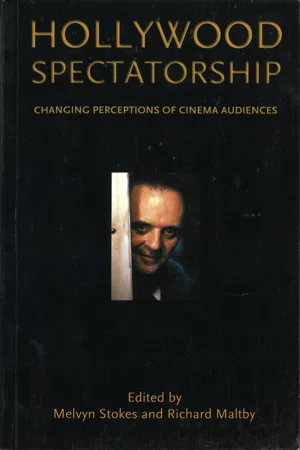
Hollywood Spectatorship
Changing Perceptions of Cinema Audiences
- 240 pages
- English
- ePUB (mobile friendly)
- Available on iOS & Android
eBook - ePub
Hollywood Spectatorship
Changing Perceptions of Cinema Audiences
About this book
This is an examination of the concepts of spectatorship in the light of historical accounts of audience reception. The book looks at how audiences have historically talked about Hollywood movies, and the ways in which 'word-of-mouth' responses have affected the reception of individual movies.
Information
PART ONE
Talking Pictures: The Reception of Hollywood
1
Writing the History of American Film Reception
Janet Staiger
This chapter is part of a sequence of reflections about theoretical and historiographical issues in writing the history of American film reception. In an essay entitled 'Modes of Reception', I have argued against a tendency in film studies to create two large categories of texts or exhibition situations, to pit those against each other, and then to make vast claims about spectator effect from that binary opposition.1 Although such broad generalisations may have had an initial schematic purpose in the study of American film, they do not hold up historically. Instead, the entire history of cinema in every period, and most likely in every place, witnesses several modes of cinematic address, several modes of exhibition and several modes of reception. Moreover, any individual viewer may engage even within the same theatre-going experience in these various modes of reception.
A second essay, 'The Perversity of Spectators', provides an alternative system for examining the modes of reception to the binary oppositions I am criticising.2 Based on the work of Russian formalists, Meir Sternberg, David Bordwell and Kristin Thompson, the system summarises and expands upon what these scholars have claimed to be the reception activities for a narrative film of the 'classical' type.
Research on actual viewers of classical films, however, suggests that they engage in an extensive variety of activities which do not conform to predictions postulated by formalist critics of spectators and readers. For example, film scholars often criticise The Big Sleep as having an incoherent plot. At the time of the film's release, reviewers also described the plot as confusing, but suggested that the violence (they tended to count the number of murders), sexual innuendo and their pleasure in watching Humphrey Bogart and Lauren Bacall provided more than adequate compensation. Some of these writers viewed the film's disconnected narrative positively, comparing its effects to experiences of nightmares or opium smoking.3 Research on viewers of romances and melodramas shows that consistency in characterisation does not matter to their audiences. Studies of gay viewers of Judy Garland movies or male adolescent viewers of horror films indicate that people do not always make same-sex identifications. Viewers ignore endings of films and fantasise alternative outcomes, or propel secondary characters into the focal points of the narration or choose to identify with the villain instead of the hero. Camp and 'paracinema'4 viewers have more interest in mise-en-scène and excessive acting than in verisimilitude. Instead, they enjoy the process of 'dishing'5 the text and reading in 'ironic detachment'.6 In summary, for nearly every expectation about normative readings of classical texts, a 'perversion' can be found.
The system, then, is useful for noting types of strategies in richer detail than the triad of preferred, negotiated and resistant readings. Additionally, one could also track the receptions of a film across a period of time. An example of such a tracking is contained in my book, Interpreting Films.7 One chapter analyses the political and aesthetic debates around The Birth of a Nation over a period of fifty years, describing how the debates surrounding the film in 1915 became transformed in the World War II era as the film continued to be shown despite protests.
Another angle on this system is its potential function in studying discourses around a culture event in which a film might participate. In 'Taboos and Totems', instead of studying a full set of discourses around the film The Silence of the Lambs, I explore how a segment of gay male readers used the film to try to 'out' its star, Jodie Foster, as a lesbian.8My interest here was not in surveying all the receptions of the film but in how the film could be appropriated by a specific group for a political act of resistance against what they perceived was the possibility of reading the serial killer as a homosexual.
In this chapter, I want to take up the broad problem of studying media reception. Most scholars of reception construct arguments that create boundaries around the reception experience, considering only the time a viewer is engaged with the text. Such a strategy regards the text as an artefact that determines the behaviour of the audience. If the film is a classical Hollywood narrative, then the viewer adopts a voyeuristic reception mode, becoming absorbed in the plot and identifying with the characters. If, however, the film is a text of spectacle and visual or aural stimulation, the viewer takes up an exhibitionist mode of reception and responds critically or with distraction. Some scholars go on to argue that the latter type of film is popular (of the people), modern or postmodern, with the classical film usually labelled 'bourgeois' or pre-modern.9 The boundaries constraining the audience in this theoretical framework are the stylistic practices of the text. This argument is, however, deeply problematic. If the text were, in fact, determining in the way suggested, all of the perversions, changes and appropriations described above would be impossible.
Even those film scholars who argue that the viewing context can improve the possibility of a wider range of readings or audience experiences themselves construct new boundaries, as I shall discuss below. The two boundaries constructed by contextual theorists on which I shall focus are historical time-periods (pre-sound, sound/classical, post-classical) and audience identities (class, race, ethnicity, age, sexual orientation, gender). In the concluding part of the chapter, I shall also consider a third boundary embedded in many contextual studies, which is constructed around the assumption that the time spent watching the film is the context of the event.
Talking in the Theatre
In an important and under-recognised essay published in 1982, Judith Mayne argues that the immigrant experience in the nickelodeon may have been more complex than scholars had previously understood. She posits that, while the immigrant was being familiarised with American culture and consumerism through the 'shopping window' of the screen, the collective experience within the theatre should also be considered as a potential force for promoting resistance to industrialisation and, for women, to the patriarchal home.10 The nickelodeons bestowed on immigrants an unprecedented status as worthy consumer. Moreover, the exhibition site functioned as a mediation between public and private spheres. Descriptions by contemporary writers such as Mary Heaton Vorse in 1911 indicate a lively exchange of audience commentary and debate at the exhibition site, and Mayne argues that such an exhibition context increases the complexity of the movies' reception.11
Miriam Hansen has developed Mayne's original idea by drawing on German theories of the public sphere, but she also combines Mayne's observations about the nickelodeon scene with binary text-determinant reception theories.12 This results in Hansen constructing a bifurcated history, in which exhibition situations that permit a 'public sphere' dialogue among the participants have some potential for contemplative, distractive viewing, while exhibition situations that close down this dialogue reduce spectators to an absorbed, identifying viewing position. Hansen places great weight on the effect of the arrival of mechanically synchronised sound, which permitted on-screen diegetic dialogue. The screen's commanding talk shuts down the audience's chat. That Hansen sees this as seminal is reinforced in her discussion of recent viewing situations, where she states that the effects of watching films in homes in 'institutionally less regulated viewing situations' has had some effect on increasing talk in ordinary movie the-atres.13 The question I want to ask is: is this claim about the effects of the ability to talk during a movie an appropriate dividing line in the theorisation of audiences and media reception? What do we know about talking in the American film theatre? Did the arrival of sound cut off talk? Were some audience groups who would like to have continued to chat constrained by other audience members who prohibited community dialogue? Were the contemplative, distractive opportunities shut down and reduced to an absorbed, identifying experience?
We do know that talk by minority groups has occurred during some types of screenings. A famous example of this phenomenon, the screenings of The Rocky Horror Picture Show, started during the transitional post-classical period, which Hansen describes as a time in which opportunities for a public-sphere experience were renewed. The Rocky Horror Picture Show opened in New York City in 1975. By 1976, 'counterpoint dialogue' had started. Although it still persists, The Rocky Horror Picture Show scene has come to serve a different minority group. Once a haven for urban gay men, the current audience is predominantly young adolescent males, and dialogue lines once extolling sexual freedom and gender-bending are less common while homophobic and misogynist remarks are common.14
The Rocky Horror Picture Show, however, came out of a wider party scene in the New York underground cinema movement of the 1960s. From the early 1960s, through the Warhol media events at the Dom in St Marks' Place in 1966 and beyond, the late-night taboo-breaking exhibition situation was an environment appealing to non-conformist but often white, and usually male, hipsters and sex...
Table of contents
- Cover page
- Title Page
- Contents
- Notes on Contributors
- Preface
- Introduction: Historical Hollywood Spectatorship
- Part One: Talking Pictures: The Reception Of Hollywood
- Part Two: The Spectator Reviewed
- Index
- eCopyright
Trusted by 375,005 students
Access to over 1.5 million titles for a fair monthly price.
Study more efficiently using our study tools.
Frequently asked questions
Yes, you can cancel anytime from the Subscription tab in your account settings on the Perlego website. Your subscription will stay active until the end of your current billing period. Learn how to cancel your subscription
No, books cannot be downloaded as external files, such as PDFs, for use outside of Perlego. However, you can download books within the Perlego app for offline reading on mobile or tablet. Learn how to download books offline
Perlego offers two plans: Essential and Complete
- Essential is ideal for learners and professionals who enjoy exploring a wide range of subjects. Access the Essential Library with 800,000+ trusted titles and best-sellers across business, personal growth, and the humanities. Includes unlimited reading time and Standard Read Aloud voice.
- Complete: Perfect for advanced learners and researchers needing full, unrestricted access. Unlock 1.5M+ books across hundreds of subjects, including academic and specialized titles. The Complete Plan also includes advanced features like Premium Read Aloud and Research Assistant.
We are an online textbook subscription service, where you can get access to an entire online library for less than the price of a single book per month. With over 1.5 million books across 990+ topics, we’ve got you covered! Learn about our mission
Look out for the read-aloud symbol on your next book to see if you can listen to it. The read-aloud tool reads text aloud for you, highlighting the text as it is being read. You can pause it, speed it up and slow it down. Learn more about Read Aloud
Yes! You can use the Perlego app on both iOS and Android devices to read anytime, anywhere — even offline. Perfect for commutes or when you’re on the go.
Please note we cannot support devices running on iOS 13 and Android 7 or earlier. Learn more about using the app
Please note we cannot support devices running on iOS 13 and Android 7 or earlier. Learn more about using the app
Yes, you can access Hollywood Spectatorship by Melvyn Stokes, Richard Maltby, Melvyn Stokes,Richard Maltby in PDF and/or ePUB format, as well as other popular books in Media & Performing Arts & Film History & Criticism. We have over 1.5 million books available in our catalogue for you to explore.