- 187 pages
- English
- ePUB (mobile friendly)
- Available on iOS & Android
eBook - ePub
About this book
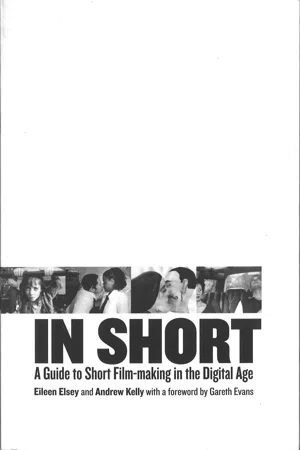
This work looks at the history of the short film and its current role. It focuses on contemporary short-film producers and directors, and its role as a training opportunity for new talent. It also covers issues of distribution, funding, exhibition, festivals, training and publications.
Information
1
Introduction: Shorts in the Field of Film
The invisibility of short film
Between 1999 and spring 2001 British and North American newspapers began to take an interest in the short film. The news covered first, the establishment of many digital short film websites and, second, the release of nineteen films, many of them shorts, of the complete works of Samuel Beckett. For a brief time, short films had a profile that had not been present since the early days of film-making. For many readers, indeed, it may have come as a surprise to learn that shorts still existed: even regular cinemagoers rarely see short films outside of festivals and television, still less see reviews of them. Despite this interest, the Beckett on Film project failed to secure more than a few screenings, and most saw the films on television, not at the cinema. Beckett's literary fame, and the publicity surrounding their release, were not enough to guarantee distribution. And after an early flurry of activity – when the best shorts were in huge demand – the Internet has still to deliver quick and easy viewing of films, and will not do so until broadband is widely adopted. The dot.com collapse has also led to retrenchment and less coverage.
Short films are nothing new, though, they have been present since film-making began. Shorts were the only films in the early days of cinema. National governments made them a tool of official propaganda in the First World War. During the development of sound, they became an experiment for the new order. Some of the great short films appeared in the 1920s and 30s – especially in cartoon animation and the comedy of Keaton, Chaplin, Laurel and Hardy and Langdon – and many of the best propaganda shorts in the Second World War have become cinema classics. It was only in the 1960s and 70s that the decline began, when short films went from being a staple part of the cinema experience to being present only in specialist cinemas and festivals.
More than one hundred years on from the birth of film, shorts remain a key part of cinema, however. There has been a small renaissance in recent years and some of the most innovative, exciting and thought-provoking short films that we have seen are being made today.
Short films are easy to ignore because they are hard to see. We lose a lot because of this: creativity and innovation, inspirational storytelling, and, simply, some great films. We believe it is time to look at short films so that we can celebrate the achievements of short film-makers and help new film-makers learn from current practitioners, to encourage the production of more and better short films in the future. We also believe it is time that the economic and creative importance of shorts within the British film industry is recognised.
Our book is the first for many years on the short film in Britain. Apart from a growing body of work on avant-garde film, books about the cinema are generally about features and their stars. The most popular short films – cinema and television commercials and music videos – receive little critical attention and their role in providing experience and income for film-makers is largely unacknowledged.
Following a short history of short films – which looks at education, animation, advertising, music video and the avant-garde – film-makers talk about their work. We are fortunate to have gathered together such an excellent group of film-makers, all of whom provide inspiration and vision as well as important information on the basics of short film production. Short films provide an ideal opportunity for a close investigation of the individual creative process, from initial idea to finished film, and that is what the interviews in Chapter 3 set out to do. Chapter 4 pulls together the main points raised, and the final two chapters look at the practical aspects of getting short films made, and includes a resource guide with details of websites, magazines and funding opportunities.
The authors are both involved in short film exhibition, production and teaching. Andrew Kelly founded Brief Encounters, the Bristol Short Film Festival, and we have both been on the board of the festival since the start. Eileen Elsey is also a screenwriter and principal lecturer in Time Based Media at the University of the West of England. Together, we bring such concerns as scripting and storytelling as well as management, marketing and funding to the discussion.
A definition of shorts
What is a short film? Sometimes, the term is used to describe any film under feature length. Most film festivals rule that a short must have a maximum duration of thirty minutes, and this is the definition we use here. A definition based purely on duration is arbitrary, and many superlative shorts are often very short. The impact of Anthony Minghella's Play (sixteen minutes, 2000), or Tessa Sheridan's Is it the Design on the Wrapper? (seven minutes, 1997) or Jonathan Glazer's Surfer commercial (one minute, 1999) is related to their dominance of the form and the dense layers of meaning built up in such a short time. The possibility of Web distribution – which we look at in detail in Chapter 5 – has raised interest in the very short piece of five minutes or less. But longer films may also use the space well. For example, Damien O'Donnell's Thirty- five Aside (twenty-seven minutes, 1995) is a beautifully sustained film which is both touching and funny. John Smith's Black Tower (twenty-four minutes, 1987) has a slower, more reflective pace. What all these shorts do share is the opportunity they offer film-makers to practise their art outside the pressures of feature film and television production. Unfortunately, what they also have in common – apart from the advertising commercial – is limited distribution, which means that most readers will not have had an opportunity to see them.
The scope and function of the book
Here we concentrate on narrative drama films of thirty minutes or less produced in Britain. We have omitted documentary, work for children and – in the main – abstract avant-garde work. We have included music videos and advertising commercials. These omissions and inclusions have come about in an attempt to draw a line round a subject area on which so little has been written, and represent an attempt to locate a community or network of film-makers. Because Britain does not have a sustainable feature film industry, most drama film-makers – both live action and animation – have worked on music videos and commercials. Although avant-garde production tends to be separate, their work is viewed by other film-makers at film courses and festivals and is often a source of innovative ideas or approaches. It may seem madly optimistic to aim to cover this breadth in one book after the long silence on short film, but it is important that the interconnectivity between drama and animation shorts, commercials and music videos is acknowledged.
Shorts are an important part of the film-making culture of Britain, but are largely ignored in both critical and distribution terms. It is time to re-evaluate their position and to raise their profile. We want to see more discussion about short films in their own right and not as a calling-card for a feature production (although this has a role). We want to see more high-quality short films made. To encourage this we need information and examples of good practice. Above all, we need to know, directly from those involved, how to make successful short films.
If you like short films, teach about them, make them now or want to make them in the future, this book provides the essential details. It is not a guide to short film production, though there is much guidance here, and the websites listed in Chapter 6 will provide information on commissioning and funding opportunities. As these details can become out of date quickly the book's centre is elsewhere – we look for advice and inspiration from today's film-makers. Through our interviews with contemporary short film directors in Britain and Ireland we discuss the creative and commissioning process of film-making, and the relationship between funding, distribution and creativity.
We cover a wide range of work including artists' film and video, live action, animation, commercials and music videos. There are huge differences in budgets, distribution, exhibition and working practices in the films we discuss. But all use sound and image to communicate a story to an audience in a short space of time, and do so creatively. Often, the people we interviewed work across different areas, with commercials and music videos helping to fund their independent productions. The combination of diversity of product and interconnectedness of practice is an important aspect of short film production.
The role of shorts in contemporary practice
Advertising commercials and music videos play an important role in sustaining a film-making culture in Britain, and most film-makers have been involved in their production. Commercials are more lucrative, but are usually more creatively constrained; there is more opportunity for film-makers to see their own ideas on the screen in music videos. But commercials have the highest production values and budgets (in relation to their duration) that film-makers will ever have the opportunity to work with. Thus they give the opportunity to try out expensive equipment or processes and to reward cast and crew who have worked on low-budget productions. They provide opportunities to build production teams and develop skills. They also reach a much wider and more populist audience than shorts which are often restricted to film festivals and late-night television.
Production experience is essential for film-makers to hone their skills, but there is a difference between developing the craft of film-making and finding an authorial voice (although the two are closely related). Films that have evolved from the creative processes of a writer/director or production team are also an essential part of development. Short films, with their limited production time and lower budgets, provide an essential space for experiment and innovation where directors can try different structures, different ways of working with actors, different subject matter, without feeling that failure will bring an end to their careers. The right to fail is an important aspect of all experimentation.
Short films can be emotional, funny, experimental, poetic, open-ended: a play space for both film-maker and audience. Experimentation and a powerful personal vision must be at its centre, and the best shorts have a resonance that lingers with the audience long after viewing. Recognising the high quality of films made in this area may help us protect them from being turned into inferior copies of Hollywood-style narratives or mini-soaps.
2
A Short History of Shorts
Short film and film history
In one hundred years short films have gone from being the only form of cinema to being marginal, and from a commercial venture to, presently, being made only through the generosity of public subsidy or business sponsorship. The first films were shorts. They were all about one minute long – fragments of documentary, music hall acts or dramas which relied on the audience's amazement with the new medium for their impact. As people became used to the wonders of the moving image, the complexity and length of films were increased, and a programme would be made up of a variety of films.
The Lumière Brothers gave the first public film show in Paris in 1895. It came to London in February 1896. In the following month, the first public showing of British work took place, organised by R. W. Paul. Interest in the moving image was high in Europe and the USA, and ideas for equipment, technique and content spread between countries. (Méliès, who became a specialist in fantasies using trick photography, bought his first camera from Paul when the Lumières refused to supply one.) Many film-makers were involved in the production or exhibition of older technologies – stills photography, magic lantern shows, theatre and vaudeville – which informed the film-makers' and audiences' approach to the new medium.
Moving image composition often used photographic conventions, while drawing on theatrical devices for framing and staging action. One of the films from that first show, Sortie d'usine (Workers Leaving the Factory, Lumière Brothers 1895, 48 seconds),1 begins and ends with the opening and closing of the factory gates, like theatre curtains to the action. The camera remains static, but the workers move towards and to one side of the camera, thus using depth of field in the manner of still photography.
Between 1896 and 1906, thousands of short films – drama and documentary – were produced by film companies scattered across Britain. The Hepworth Manufacturing Company at Walton-on-Thames, for instance, produced 100 films a year. More complex dramas, using spectacle or emotion to appeal to the audience, appeared. 'Trick' films using double exposure particularly appealed to audiences; for instance, G. A. Smith's The Corsican Brothers (1897), The Fairy Godmother (1898) and Faust and Mephistopheles (1898). The popular film Rescued by Rover (Hepworth 1905, 6 minutes 34 seconds) uses camera movements, low-angle camera, two studio sets and four different locations, and editing included elisions and parallel action. It shows filmic narrative structure in the process of development, including the use of continuity editing, and it works to emotionally involve the audience through the use of a baby victim and a dog hero. The story is of a baby from a respectable middle-class home being abducted by a gypsy while the nursemaid is canoodling with a soldier. When the family learn what has happened they are hysterical. Rover the dog tracks the gypsy to a slum area, and returns home to lead the father to the rescue. The gypsy has got drunk and fallen asleep, so she doesn't put up much of a struggle, and the baby is brought home in triumph.
Some of the elements of this plot, particularly the portrayal of the respectable middle class contrasting with the criminal working class, may point to the problems which British drama faced as narratives became more extended. British society was divided by class and was paternalistic in nature. Although technically advanced, middle-class film-makers were often making entertainment for working-class audiences and a moralising attitude could often result. Working-class heroes were usually restricted to comedy.
Increasing competition, particularly from the USA, led to both the number of British films being shown and the amount of money invested in the industry falling. Erratic funding – particularly of short film – and low investment has been a feature of the industry ever since. The 1914–18 and 1939–45 wars saw a decline in the European film industries. Cecil Hepworth's studio continued until 1923, when it went bankrupt. From 1927 onwards legislation was brought in to try to protect local product against imports and to encourage investment.
Since 1939 state subsidy in various forms has ensured that short films continue to be made. Government commissions –...
Table of contents
- Cover Page
- Title Page
- Contents
- Acknowledgments
- Foreword – Glimpse Culture: Celebrating Short Film – Gareth Evans
- 1. INTRODUCTION: SHORTS IN THE FIELD OF FILMThe invisibility of short film
- 2. A SHORT HISTORY OF SHORTSShort film and film history
- 3. CONVERSATIONS WITH FILM-MAKERSIntroduction
- 4. CONTEMPORARY FILM-MAKERS AND SHORTS PRODUCTIONThe creative process
- 5. How SHORTS (CAN) GET MADE AND SHOWN
- 6. SHORT FILM-MAKING RESOURCE GUIDEOn-line films
- Bibliography
- Filmographies of Contributing Film-makers
- Index
- eCopyright
Trusted by 375,005 students
Access to over 1.5 million titles for a fair monthly price.
Study more efficiently using our study tools.
Frequently asked questions
Yes, you can cancel anytime from the Subscription tab in your account settings on the Perlego website. Your subscription will stay active until the end of your current billing period. Learn how to cancel your subscription
No, books cannot be downloaded as external files, such as PDFs, for use outside of Perlego. However, you can download books within the Perlego app for offline reading on mobile or tablet. Learn how to download books offline
Perlego offers two plans: Essential and Complete
- Essential is ideal for learners and professionals who enjoy exploring a wide range of subjects. Access the Essential Library with 800,000+ trusted titles and best-sellers across business, personal growth, and the humanities. Includes unlimited reading time and Standard Read Aloud voice.
- Complete: Perfect for advanced learners and researchers needing full, unrestricted access. Unlock 1.5M+ books across hundreds of subjects, including academic and specialized titles. The Complete Plan also includes advanced features like Premium Read Aloud and Research Assistant.
We are an online textbook subscription service, where you can get access to an entire online library for less than the price of a single book per month. With over 1.5 million books across 990+ topics, we’ve got you covered! Learn about our mission
Look out for the read-aloud symbol on your next book to see if you can listen to it. The read-aloud tool reads text aloud for you, highlighting the text as it is being read. You can pause it, speed it up and slow it down. Learn more about Read Aloud
Yes! You can use the Perlego app on both iOS and Android devices to read anytime, anywhere — even offline. Perfect for commutes or when you’re on the go.
Please note we cannot support devices running on iOS 13 and Android 7 or earlier. Learn more about using the app
Please note we cannot support devices running on iOS 13 and Android 7 or earlier. Learn more about using the app
Yes, you can access In Short by Eileen Elsey,Andrew Kelly in PDF and/or ePUB format, as well as other popular books in Media & Performing Arts & Film & Video. We have over 1.5 million books available in our catalogue for you to explore.