- 96 pages
- English
- ePUB (mobile friendly)
- Available on iOS & Android
eBook - ePub
La Grande Illusion
About this book
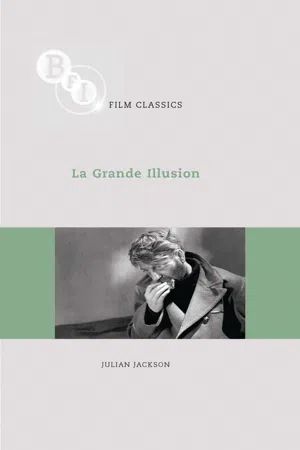
Jean Renoir's 1937 film La Grande Illusion is set during the First World War, but its themes of Franco-German conflict, divided loyalties in a time of war and the rise of anti-Semitism made it compelling and controversial viewing. Julian Jackson traces the film's historical context and its reception history.
Information
1 Renoir before La Grande Illusion
Jean Renoir was the middle son of the painter Auguste Renoir. He was born on 15 September 1894 in the Paris district of Montmartre, which still had the atmosphere of a bohemian artistic village. What influence did these origins have on his own artistic sensibility? He wrote towards the end of his life that, ‘I have spent my life trying to determine the extent of the influence of my father upon me.’4 In 1962, he published an affectionate memoir of his father drawing on long conversations they had had in 1915, just after the death of Jean’s mother, when they were both cooped up in Auguste’s Paris apartment – the latter immobilised by arthritis and his son by a war injury – when Renoir claims first to have got to know his father rather than seeing him through a child’s eyes. He portrays him as a sort of conservative anarchist who despised politicians, and refused to take sides in the Dreyfus Affair. Suspicious of intellectualism, he preferred to see himself as an artisan of paint than an artist. As remembered by his son, Auguste detested progress, science and the bourgeois world of money-making. His particular bêtes noires included the bleakly uniform Paris of Haussmann and the pomposity of the Opera Garnier. Renoir recalls his father musing already in 1915 that the war was the end of a world.5
Renoir my Father was written when Jean Renoir himself was disillusioned about the modern world. It is suffused with nostalgia about his belle époque childhood, to which he returned in his later films such as French Cancan (1955) or Elena et les hommes (1965). In his own film autobiography twelve years later, his opinions sound identical to his father’s. While one must not necessarily read this postwar Renoir back into the 1930s, La Grande Illusion certainly displays a fascination with the vanished world represented by the military career officers von Rauffenstein and de Boëldieu. Similarly in his next film, La Marseillaise (1938), ostensibly a committed work celebrating the French Revolution, the elegiac portrait of Louis XVI (played by Renoir’s brother) lingers in the memory more than the revolutionary heroes. Even in his most politically ‘progressive’ period, Renoir seems very much his father’s son.
In 1913, Renoir enlisted in the cavalry. The choice was influenced by his father, who had served in the cavalry during the Franco-Prussian War, but it also reflected the romantic adventurism characteristic of young men of his generation. In the 1960s Renoir wrote a novel about a French cavalry officer, drawing on his own experiences. At one point the hero recalls: ‘I still feel stirring of the blood at the memory of my finest moment as a cavalryman, the charge by the whole division which was the highpoint of the manoeuvres.’6 Renoir’s adolescent dreams of military adventure were shattered by the outbreak of a war different from what anyone had imagined. To experience the thick of the action, he joined the infantry of the Chasseurs Alpins until being badly injured in April 1915. The wound turned gangrenous and only the intervention of Renoir’s mother prevented the doctors from amputating his leg. Renoir pulled through, but limped for the rest of his life.
After recovering, Renoir signed up for the air corps, partly because it did not require a medical examination for entry and possibly because it also embodied something of the glamour of the cavalry: fighter pilots were celebrated as ‘knights of the sky’. It is striking that the two main French protagonists of La Grande Illusion, Captain de Boëldieu and Lieutenant Maréchal, are respectively from the cavalry and the air force. It was in an aeroplane that Renoir first used a camera professionally, photographing enemy positions. The opening scene of La Grande Illusion, when Maréchal is asked to fly de Boëldieu on an air reconnaissance mission, was directly inspired by Renoir’s own memory of the war. Unlike them, Renoir was never shot down, but on one occasion he came close when his twin-engine wooden plane was fired upon by a faster German one. Renoir was saved by a French pilot flying a more modern Hispano-Suiza.
That pilot, Major Pinsard, was, we shall see, to play his own part in the origins of La Grande Illusion twenty years later. Renoir was injured in a flying accident in 1917, and he spent the rest of the war deskbound in Paris. One does not have the impression that Renoir found his war experiences particularly traumatic, or that the enthusiasm with which he entered the cavalry in 1913 had turned into anti-militarism. In 1928 he made a mildly satirical military vaudeville, Tire au flanc, whose vision of army life is not unaffectionate.
After the Armistice, Renoir set up as a ceramicist on the advice of his father, who had started out the same way before becoming a painter. Auguste died in 1919, leaving his three sons financially independent. For a while Jean continued producing pottery, but in 1924 he suddenly decided to try his hand at making films. His love of cinema had been ignited in 1916 when the films of Chaplin hit France. Renoir became a fanatical cinemagoer, claiming sometimes to have seen 200 films a month. His passion was American cinema, since he found French films too imitative of the theatre. Renoir had two cinematic epiphanies in this period. The first was seeing in 1923 Le Braiser ardent (The Burning Brazier) by the Russian immigrant director Ivan Mosjoukine. Renoir claimed that this film proved to him that good films could be made in France. His second moment of revelation was Erich von Stroheim’s film Foolish Wives (1922), which he had soon watched over ten times. Writing in 1938, the year after La Grande Illusion, Renoir explained what von Stroheim had taught him:7
Something simple I had not known, that a Frenchman who drinks red wine, and eats Brie, against a grey Parisian vista, can only create a work of merit if he draws on the tradition of people who have lived like him. After Foolish Wives I began to look. It astounded me … I glimpsed the possibility of making contact with the public by the projection of authentic subjects in the tradition of French realism. I began to look around me and, amazed, I discovered many things purely French quite capable of transposition to the screen. I began to see that the gesture of a laundress, of a woman combing her hair before a mirror, of a street pedlar in front of his cart, often had an incomparable plastic value. I made again a sort of study of French gesture in the paintings of my father and the artists of his generation.
The importance of ‘realism’ and the need to make films ‘in a national tradition’ seem curious lessons to learn from the film of an Austrian émigré director using reconstructed sets of Monte Carlo in Hollywood, but Renoir was certainly influenced by von Stroheim’s filming techniques, in particular his use of plan séquences – long-held shots where the action occurs through movement within one frame rather than by cutting together different shots.

Foolish Wives: realism à la von Stroheim
The catalyst for Renoir’s move from watching films to making them was to create a showcase for his wife Andrée, who had been his father’s last model. Under her acting name of Catherine Hessling, she starred in five films made by Renoir in the 1920s. Film historians pore over Renoir’s early films to detect the film-maker that he would become, but had they not been made by Renoir it seems unlikely that anyone would remember these films today. In total Renoir made nine silent films between 1924 and 1929, experimenting with different genres and also assembling a team of associates who would stay with him in many of his later films. This often gives his films the feel of ensemble pieces, even family affairs (after all, he had started out making films for his wife). Many people who participated in La Grande Illusion had worked with Renoir before. The film’s editor, Margueritte Houllé-Renoir, Renoir’s partner (although never his wife) after the breakup of his marriage, had worked on five of his previous films; so had the film’s assistant director Jacques Becker (who also played the part of an English officer) and the assistant cameraman Claude Renoir, Renoir’s nephew. The sound engineer, Joseph de Bretagne, had worked three times previously with Renoir and the set designer, Eugène Lourié, once before. Renoir’s brother, Pierre, who had already acted in two of his previous films, was originally to have played one of the German officers until von Stroheim appeared on the scene.
Perhaps because Renoir had not established a distinctive style as a silent film-maker he could adapt to sound more easily than others. For some this was a hurdle to be surmounted, for Renoir an opportunity to be grasped. His first experiment with sound was On purge bébé (1931), a farce based on a play by Georges Feydeau. The film is famous for the sound of a real flushing toilet, and marked the start of Renoir’s obsessive attention to the use of realistic sound. His next film, La Chienne (1931), is probably the first Renoir film that would still be watched today even if he had never made another. The story of a respectable middle-class functionary who becomes obsessed by a semi-prostitute, killing her when he realises she is cheating on him, it is a Blue Angel in which the victim takes his revenge. It was followed three years later by Boudu sauvé des eaux (1932) where Michel Simon, the lead actor in La Chienne, plays a tramp who wreaks havoc in the household of a bookseller who has saved him from drowning. In both these films, Renoir transformed rather conventional boulevard comedies into something more unsettling.
Renoir once remarked that directors only make one film in different ways. If this is true, it is hard to discern from his output before 1934 what that film might be. On the other hand, one can detect recurring themes even if no overarching vision of the world links them together. He liked depicting water, which functioned for him as a symbol of freedom and escape; he was interested in master–servant relationships; he was drawn to transgressive outsider figures like tramps and poachers (there is a poacher in his first film La Fille de l’eau (1925), the hero of La Chienne ends as a tramp, and Boudu is the most famous tramp in cinema after Chaplin; poachers reappear in La Bête humaine (1938) and La Règle du jeu). In the same spirit was Renoir’s fondness for the figure of the woodland god Pan, representing sexual potency and freedom from the constraints of civilisation (Tire au flanc, Boudu sauvé des eaux). His sensibility seems gently anarchistic, playful and whimsical.
Renoir’s next film, Toni (1934), was a departure from his two previous satires on the respectability of the French bourgeoisie. Set in southern France, it was a story of passion and murder among a group of Italian immigrant workers. Because of its use of location shooting and non-professional actors, the film has been seen as a precursor of postwar Italian neo-realism. Although Toni was not politically engaged like Rome, Open City, it is not surprising that its treatment of ordinary working lives should have attracted some political attention at a time when, under the impact of the Depression, French politics was moving leftwards.
Renoir’s first clearly political film was Le crime de Monsieur Lange (1935). It describes how the workers of a print factory form a cooperative after their company goes bankrupt. On the strength of this film, the Communist Party invited Renoir to oversee the making of a propaganda film for the forthcoming elections. The parties of the left, united in the ‘Popular Front’, won those elections in May 1936, and Renoir was launched as France’s most prominent leftwing film-maker. The years between 1936 and 1939, when Renoir made eight films, were his most productive period. La Grande Illusion was the fifth of these works.
2 An Escape Story
La Grande Illusion opens in a French army canteen. Lieutenant Maréchal (Jean Gabin), a car mechanic in civilian life, is listening dreamily to a song on a gramophone record, and hoping to visit a local girl called Josephine. Instead, he is told to accompany a haughty staff officer, Captain de Boëldieu (Pierre Fresnay), on a reconnaissance flight behind German lines. The action moves to a German mess where Captain von Rauffenstein (Erich von Stroheim) is celebrating because he has just shot down the French plane containing Maréchal and de Boëldieu. The two Frenchmen are invited to dine with the German officers before being transferred to a POW camp.
De Boëldieu and Maréchal arrive at the camp of Hallbach. They find themselves sharing quarters with four other prisoners: Rosenthal (Marcel Dalio) from a rich Jewish family, Cartier (Julien Carette) a music-hall actor, a school teacher (Jean Dasté) and an engineer (Gaston Modot). Thanks to food parcels which Rosenthal receives from Paris, the prisoners lead a reasonable existence, eating better than their German captors. At night, they dig an escape tunnel, dispersing the excavated soil surreptitiously during the day. Meanwhile they also prepare a theatrical entertainment with costumes sent from Paris.
Just before the prisoners are to put on their show, news comes that one of the forts at Verdun has fallen to Germany. Defiantly they decide the production will go ahead regardless, and they invite the German guards to attend. During the performance, news arrives that Douaumont has been retaken. Maréchal jumps up on stage in excitement and the prisoners launch into a rendition of ‘La Marseillaise’ until the German guards break up the spectacle and send Maréchal to solitary confinement. He is released just before the tunnel is ready, but the night the prisoners plan to escape they are transferred to another camp.
Months later, having tried to escape from several more camps, de Boëldieu and Maréchal find themselves together again at the camp of Wintershorn. Located in a gloomy castle, this camp is reserved for the most intrepid POWs who have already tried to escape from other camps. Maréchal and de Boëldieu find that their former comrade Rosenthal is a prisoner in the same camp. There is also a professor of Greek, Demolder (Sylvain Itkine), who spends his time translating Pindar. The camp commandant is the same von Rauffenstein who had shot down Maréchal and de Boëldieu. He has subsequently been so badly wounded that he can no longer fight. Von Rauffenstein comes to treat de Boëldieu, whom he sees as his social equal, like a confidant and friend.
The prisoners hatch an escape plan: de Boëldieu will create a diversion while Maréchal and Rosenthal clamber down the castle walls using ropes. On the night of the esca...
Table of contents
- Cover Page
- Title Page
- Contents
- Acknowledgments
- Introduction: Paris 1937
- 1. Renoir before La Grande Illusion
- 2. An Escape Story
- 3. The Making of the Film: Auteur as ‘Ringmaster’
- 4. Variations on Realism: ‘Interior Truth’ and ‘Exterior Truth’
- 5. Boundaries and Crossing Boundaries
- 6. Politics: La Grande Illusion between the Popular Front and Vichy
- 7. Afterlives: Escape and Survival
- 8. What Illusion(s)?
- Notes
- Credits
- Bibliography
- eCopyright
Trusted by 375,005 students
Access to over 1.5 million titles for a fair monthly price.
Study more efficiently using our study tools.
Frequently asked questions
Yes, you can cancel anytime from the Subscription tab in your account settings on the Perlego website. Your subscription will stay active until the end of your current billing period. Learn how to cancel your subscription
No, books cannot be downloaded as external files, such as PDFs, for use outside of Perlego. However, you can download books within the Perlego app for offline reading on mobile or tablet. Learn how to download books offline
Perlego offers two plans: Essential and Complete
- Essential is ideal for learners and professionals who enjoy exploring a wide range of subjects. Access the Essential Library with 800,000+ trusted titles and best-sellers across business, personal growth, and the humanities. Includes unlimited reading time and Standard Read Aloud voice.
- Complete: Perfect for advanced learners and researchers needing full, unrestricted access. Unlock 1.5M+ books across hundreds of subjects, including academic and specialized titles. The Complete Plan also includes advanced features like Premium Read Aloud and Research Assistant.
We are an online textbook subscription service, where you can get access to an entire online library for less than the price of a single book per month. With over 1.5 million books across 990+ topics, we’ve got you covered! Learn about our mission
Look out for the read-aloud symbol on your next book to see if you can listen to it. The read-aloud tool reads text aloud for you, highlighting the text as it is being read. You can pause it, speed it up and slow it down. Learn more about Read Aloud
Yes! You can use the Perlego app on both iOS and Android devices to read anytime, anywhere — even offline. Perfect for commutes or when you’re on the go.
Please note we cannot support devices running on iOS 13 and Android 7 or earlier. Learn more about using the app
Please note we cannot support devices running on iOS 13 and Android 7 or earlier. Learn more about using the app
Yes, you can access La Grande Illusion by Julian Jackson in PDF and/or ePUB format, as well as other popular books in Media & Performing Arts & Film History & Criticism. We have over 1.5 million books available in our catalogue for you to explore.