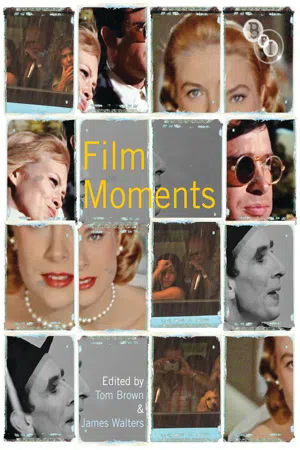
Film is made of moments. In its earliest form, the cinema was a moment: mere seconds recorded and projected into the darkness. Even as film has developed into today's complex and intricate medium, it is the brief, temporary and transitory that combines to create the whole. Our memories of films are composed of the moments we deem to be crucial: touchstones for our understanding and appreciation. Moments matter.
The 38 specially commissioned essays in Film Moments examine a wide selection of key scenes across a broad spectrum of national cinemas, historical periods and genres, featuring films by renowned auteurs including Alfred Hitchcock, Jean Renoir and Vincente Minnelli and important contemporary directors such as Pedro Costa, Zhang Ke Jia and Quentin Tarantino, addressing films including City Lights, Gone with the Wind, The Wizard of Oz, The Night of the Hunter, Wild Strawberries, 8 1?2, Bonnie and Clyde, Star Wars, Conte d'été, United 93 and Lord of the Rings: Return of the King.
Film Moments provides both an enlightening introduction for students to the diversity of approaches and concerns in the study of film, and a dynamic and vibrant account of key film sequences for anyone interested in enhancing their understanding of cinema.
eBook - ePub
Film Moments
Criticism, History, Theory
- 320 pages
- English
- ePUB (mobile friendly)
- Available on iOS & Android
eBook - ePub
Film Moments
Criticism, History, Theory
About this book
Information
PART ONE: Criticism
‘What is this film?’ The question at once seems a crude and inadequate summary of critical enquiry faced with the breadth of film moments, and the range of approaches to them found in the first part of this book. However, in comparison with the historical and theoretical approaches discussed in Parts Two and Three, which are more dependent (to varying degrees) on frameworks external to the film, the essays below are markedly more focused on the internal qualities of films and their moments. ‘Qualities’ can of course mean, fairly neutrally, observable characteristics: the arrangement of the mise en scène, the details of performance, systems of editing, the tone and timbre of a musical score, for example. However, ‘qualities’ can also imply judgments about value and, in particular, the value inherent in the film’s ability to shape and control those observable characteristics. Essentially, then, the issue of value is crucial to the critical analysis of films.
This theme is picked up in a series of accounts founded upon a sustained attention on the film moment. When prefacing his persuasive account of one such key moment from Vincente Minnelli’s The Band Wagon (1953), Stanley Cavell offers an explanation for his selection and its possible ramifications. He suggests that: ‘The judgement I make in discussing the sequence here expresses my pleasure and sense of value in it and awaits your agreement upon this.’1 This concentration upon and joining together of ‘pleasure’ and ‘sense of value’ strikes to the heart of film criticism, alluding potently to the ways in which personal feeling can form a strong foundation for film analysis. Cavell’s honesty regarding the role personal engagement takes in his critical work is matched by the candour of Robin Wood in describing his own approach and attitude to film criticism:
Here I am. I am writing this [italics in original]. I am not infallible. I am just a human being like yourself. What I have to say and the way in which I say it was determined by my own background, my own experience, my own understanding (or lack thereof). I make no pretence to Absolute Truth.2
The ‘fallibility’ that Wood describes is an underlying concern for any critic of the arts, connected as it is to the task of taking responsibility for personal interpretation and judgment. This sense of responsibility can understandably become a source of considerable anxiety for students encountering the study of film for the first time. Some, for example, may object to the film lecturer suggesting a particular reading. Here, more so than with the study of literature, in which interpretation and close reading have perhaps a more established cultural standing, it seems that the analysis of film is for some fraught with the worry of ‘reading too much into it’. These concerns can in fact become effective catalysts in the course of analysis and debate conducted in the classroom, providing an impetus for critical conversation. No approach can be sacrosanct. In this same spirit, to suggest a single reading or interpretation is not to resist the possibility of others; but the admission of a multitude of possible meanings is not the same as saying all interpretations are of equal value. Interpretations require careful reasoning, argument and demonstration in close proximity to the observable detail of a film (and, indeed, a film’s moments). As part of an arresting argument for the value of interpretation, John Gibbs and Douglas Pye suggest:
… processes of argument and of persuasion are involved, rather than merely the demonstration of a position: that what I have found in the film is not simply my view but represents an understanding capable of being shared or challenged and, in the process, enhanced reworked or replaced … . A central advantage of rooting interpretation in the detail of the film … is that it provides a material and verifiable basis for discussion.3
As Gibbs and Pye make clear, the conclusions of one’s analysis are always open to contention and challenge. This is, of course, a founding principle of critical debate. Nevertheless, there is a profound responsibility on the part of the critic to ensure that the evidence presented for such claims is precise, accurate and substantiated. How to select sufficient data from the film to support one’s argument then becomes a key concern. How much is enough detail? How much is too much? The pressure, experienced to varying degrees by different critics, is to avoid an account that is too generalised to hold firm, its indistinctness risking irrelevance. The most reduced example of this might be found in a newspaper column rating films simply by means of a system of stars ranging from one to five. One would have to trust the individual compiling such a system with absolute confidence, given that no discernible evidence is provided for their judgments. Here, Cavell’s earlier ‘sense of value’ would be articulated in only the shallowest terms, bereft of his stated impulse to discuss and invite agreement based on his judgments.
It is not only the brevity of a star-rating system that risks advancing broad or unsubstantiated judgments, however. Writing in 1962, Ian Cameron defines the journal Movie’s attitude towards contending with sequences from films in close detail by comparing that approach to the available alternatives:
For talking about one small section of a film in great detail, whether in an interview or in an article, we have been accused of fascination with technical trouvailles [meaning roughly ‘surprise discoveries’] at the expense of meaning. The alternative which we find elsewhere is a gestalt approach which tries to present an overall picture of the film without going into ‘unnecessary’ detail, and usually results in giving almost no impression of what the film was actually like for the spectator.4
Cameron’s contentions place at stake the issue of how one arrives at an expression of meaning in film and, in doing so, he proposes that the value of a film as a whole might profitably be articulated through the concentration upon a small section. Here, we can return to Cavell’s statement and speculate that, in laying out some of the achievements he believes to be found in a sequence from The Band Wagon, he is offering a judgment upon the value of the film as a whole, its ability to produce moments of excellence. In the context of this collection’s aims, we might read Cameron’s remarks as presenting a justification for centring evaluation upon moments from films as a means of measuring the work in exacting terms rather than giving only an ‘impression’ of its merits. The relating of this position to the film spectator is instructive. Cameron outlines Movie’s attempt at the time to return criticism of films to the immediacy inherent in the experience of watching: acknowledging the moment-by-moment process that forms patterns, structures and meanings in our minds. Thus, by staying with moments from films and discussing them in detail, the interpretative critic returns to the process by which we initially form an understanding of a film’s significance and meaning: moment by moment.
Following on from these suggestions, it is also the case that a detailed critical concentration upon a moment can reveal the level of complexity at which a film is shaping its themes, patterns and dramatic relationships. We might recognise this strategy in V. F. Perkins’s account of Alfred Hitchcock’s Psycho (1960) from his 1972 book Film as Film.5 Perkins’s understanding of the film is dependent upon his judgment of Hitchcock as a great artist. Although there had been a number of attempts to ‘take Hitchcock seriously’ (the most sustained being Robin Wood’s 1965 book on the director), at the time of Film as Film’s publication, the case for Hitchcock’s greatness still had to be made with a degree of forcefulness and, certainly, with careful precision. Perkins’s articulation of Hitchcock’s achievement centres upon the director’s ability to fluently, and seamlessly, establish profound stylistic resonances between moments within Psycho and, in doing so, create especially rich layers of meaning and significance. This understanding of the director’s technique is a hallmark of what Perkins terms the ‘synthetic’ in movies. He explains (in a section of the book contesting the presiding assumptions of montage theory) that:
Basic to the synthetic approach to movies which I believe most productive is the claim that significance, emotional or intellectual, arises rather from the creation of significant relationships than from the presentation of things significant in themselves … the more dense the network of meanings contained within each moment of film, the more richly these moments will combine and interact.6
In the case of Psycho, Perkins takes as his central focus the scene of Marion Crane’s (Janet Leigh) murder in the Bates’ Motel room shower, offering an especially close appreciation of the success of Hitchcock’s technique. But he then expands this precise critical description by relating the scene’s crucial actions to moments found elsewhere in the film. The knife is shown to relate to the beaks of the stuffed birds in Norman Bates’s (Anthony Perkins) office, its relentless downward motion echoing the sweep of Marion’s windscreen wipers from an earlier scene. The rush of water in the shower – a notionally purifying element that becomes ‘the means by which her life is “drained away”’7 – is prefigured in the sudden, persistent rain that falls across Marion’s windscreen in that earlier scene, the hiss of liquid meeting surface pre-echoing the noise of the water in the shower. The shot of Marion’s still, dead eye at the shower scene’s conclusion is related to Norman’s numb stare as his personality is finally consumed by a fantasy of his dead mother. And the motif of descent, inherent in features such as the water falling, the knife plunging, Marion’s blood draining and her finally falling to the ground, dead, is shown to encapsulate the film’s overarching descent into ‘an abyss of darkness, madness, futility and despair’,8 only to be reversed when Marion’s car is hauled up and out of the swamp in the film’s final image.
The depth and dexterity of Perkins’s account cannot adequately be conveyed in such a brief description of the synthetic relationships he observes and articulates. However, it should go some way to conveying the extent to which his understanding of the film’s complexity and richness is founded upon the matrix of significant relationships found within and across moments from Hitchcock’s masterpiece. That such resonances between moments should occur without heavy assertion or an emphasis that would drag the film out of shape is an indication of the director’s skill. As Perkins asserts:
It is a measure of the greatness of Psycho, and of Hitchcock at his finest, that the achievement of precise and densely interrelated imagery should seem to involve so little effort. Revealing moments accumulate without subjecting the drama to any apparent strain. It is only by thinking oneself into Hitchcock’s position after the experience that one realises what intensity of artistic effort must have been required.9
This final point is illuminating and leads us into a different area of interest regarding the study of moments in cinema. If Cameron earlier suggested that concentrating on small sections of a film can, in certain respects, help to bring the critic closer to the audience’s experience, then it is also true that such an approach goes some way to aligning critical appreciation with the film-maker’s experience of their craft. The director is charged with the task of composing an entire work from a whole array of fragmented moments that have been recorded, most often out of order, during the filming period. As with the case of Hitchcock, we can see how an accomplished director retains a firm sense of the film’s overall structure and coherence. However, it remains the case that the film-maker is concerned with one sequence at a time, often one small moment at a time, as they progress through the making of a complete picture in pre-production, production and post-production. As John Gibbs explains:
Making a film involves a myriad of choices. Every frame, every cut, every element of performance and every note on the soundtrack results from pursuing one option and refusing many others. When investigating a film, a valuable approach is to identify a decision, or a group of decisions, and ask ‘What is gained by doing it this way?’ Of all the thousands of ways of opening the film, say, what are the consequences of the particular approach employed? To think in such terms is to consider the crux of the artistic process: the relationship between decisions taken and a work’s meaning.10
By exploring in detail the effects of those decisions taken – focusing on a small sequence or moment from a film for example – the critic moves closer to appreciating the level of detail at which the fil...
Table of contents
- Cover
- Title Page
- Dedication
- Contents
- Notes on Contributors
- Preface
- Acknowledgments
- Part One: Criticism
- Part Two: History
- Part Three: Theory
- Index
- List of Illustrations
- eCopyright
Trusted by 375,005 students
Access to over 1.5 million titles for a fair monthly price.
Study more efficiently using our study tools.
Frequently asked questions
Yes, you can cancel anytime from the Subscription tab in your account settings on the Perlego website. Your subscription will stay active until the end of your current billing period. Learn how to cancel your subscription
No, books cannot be downloaded as external files, such as PDFs, for use outside of Perlego. However, you can download books within the Perlego app for offline reading on mobile or tablet. Learn how to download books offline
Perlego offers two plans: Essential and Complete
- Essential is ideal for learners and professionals who enjoy exploring a wide range of subjects. Access the Essential Library with 800,000+ trusted titles and best-sellers across business, personal growth, and the humanities. Includes unlimited reading time and Standard Read Aloud voice.
- Complete: Perfect for advanced learners and researchers needing full, unrestricted access. Unlock 1.5M+ books across hundreds of subjects, including academic and specialized titles. The Complete Plan also includes advanced features like Premium Read Aloud and Research Assistant.
We are an online textbook subscription service, where you can get access to an entire online library for less than the price of a single book per month. With over 1.5 million books across 990+ topics, we’ve got you covered! Learn about our mission
Look out for the read-aloud symbol on your next book to see if you can listen to it. The read-aloud tool reads text aloud for you, highlighting the text as it is being read. You can pause it, speed it up and slow it down. Learn more about Read Aloud
Yes! You can use the Perlego app on both iOS and Android devices to read anytime, anywhere — even offline. Perfect for commutes or when you’re on the go.
Please note we cannot support devices running on iOS 13 and Android 7 or earlier. Learn more about using the app
Please note we cannot support devices running on iOS 13 and Android 7 or earlier. Learn more about using the app
Yes, you can access Film Moments by James Walters, Tom Brown, James Walters, James Walters,Tom Brown,James Walters in PDF and/or ePUB format, as well as other popular books in Media & Performing Arts & Film History & Criticism. We have over 1.5 million books available in our catalogue for you to explore.