eBook - ePub
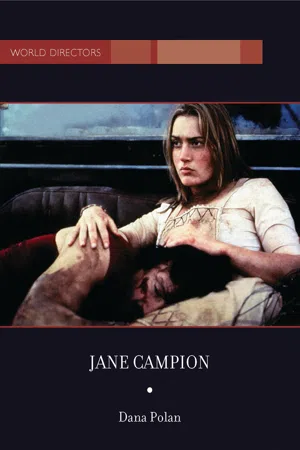
Jane Campion
About this book
With the phenomenal success of 'The Piano' (1993), Jane Campion became revered by many as the leading female film director of the 1990s. In this book, Dana Polan examines the phenomenon of 'The Piano' and how it develops from the early shorts and first features which evoke an often surreal and critical distanced style of looking at everyday issues. Looking at all of Campion's work before and since, including 'Holy Smoke' (1999), which returned again to the battleground of gender politics, the author concludes his survey of the director's work by offering some hypotheses about the erotic thriller 'The Cut' (2001) whilst asking what variety of approaches to the study of directors might now be fruitful.
Information
One
Resonant Melodies
The Iron Chef, a Japanese cooking show that has acquired a cult following on cable TV for its kitschy mix of samurai style and culinary intrigue, is a quintessential spectacle of machismo. Bedecked in samurai costumes, standing erect and brandishing their kitchen tools as if they were the fetish objects of an elite Ronin clan, the 'Iron Chefs' face 'Challengers' in the gladiator-style 'Kitchen Stadium', engaging in man-to-man combat over the 'secret' ingredient with which they have one hour to prepare a five-course meal for a panel of judges. Throughout, they are accompanied by the trappings of culinary manhood – knives wielded like swords, deferential sous-chefs and underlings, and, in particular, the swelling of imperial, martial music (lots of brass and percussion, with big crescendos). It's a macho extravaganza complete with excessive physicality (the utensils that swoop through the air to chop up fish and fowl), surly sweatiness, taunt, bravado and braggadocio.
Yet, an episode broadcast in May 2000 marked a departure from the exclusively masculine domain of Kitchen Stadium when a young woman chef came as the Challenger, necessitating a means to represent her difference from the male chefs within the highly stylised production. At first, the show tried to contain the difference of femininity by treating the woman's presence as not so different at all: initially, there was the same military music, the same fever-pitch narration that renders the competition as a veritable sports event of talented Titans in battle. But as the narrator began to discuss the personal triumphs and tragedies that the chef had faced and surmounted – especially a traumatic divorce – the music turned in abrupt fashion from military aggressiveness to none other than the lush romantic strains of the Michael Nyman soundtrack for Jane Campion's The Piano.
What strikes me about this dramatic shift into the register of the personal and, in particular, of personally felt emotional trauma is the matter-of-fact telegraphic directness of the reference to The Piano. The film's soundtrack is assumed to easily, automatically, inevitably and logically connote the realm of the feminine personal, a space of romance sparked and thwarted, a site in which emotional life asserts its irreducible importance even against the demands of a masculinised and professionalised world. The music so associated with The Piano becomes here a veritable fixed signifier of affect, emotion and inner value – all associated intimately with the particularity of being a woman. (Is it by accident that the videotape version of The Piano available in the USA begins with an advertisement for a free-phone number from which to order flowers and floral arrangements, set to the luxuriant music of Vivaldi?)
The Piano is now a major point of reference for our contemporaneity, an imposing artistic production that for many people encapsulates, for better or for worse, a stylistic and thematic impression of feminine feeling. The exemplary nature of The Piano as a condensation of the parameters of such a cultural representation allows it easily to lend itself to stereotyping, as its citation in The Iron Chef signals. It can lead as well to parody. For example, the TV show Saturday Night Live did a sketch called 'The Washing Machine' with a Holly Hunter look-alike caught in romantic mystery while her daughter cartwheels around her on the surf-swept beach in front of a large white washer. Similarly, All Men are Liars, the first feature film by Campion's former boyfriend and collaborator Gerard Lee, begins by chronicling how a piano taken away from a woman by her husband is smashed to smithereens in a highway accident while in transit! In a joint interview, Lee and the film's producer, John Maynard (who has also produced some Jane Campion films), make explicit that this opening intends a direct jocular reference to The Piano. For Maynard, 'We thought that opening a film with a woman who doesn't speak playing a piano – already a proven success – would be a good way to start an Australian movie.' And Lee is even more explicit about a need to demarcate himself from Campion: 'We're great friends with Jane and there's nothing personal in it, but I suppose it is taking the piss out of auteur film-making.1
Even more striking in its appropriation of motifs from The Piano as reuseable figures of romantic exoticism for directly commercial purposes is a television advertisement starring Anna Paquin (who plays the young daughter Flora in the film), produced the same year as The Piano for media giant MCI's Internet network services. To exotic indigenous music, Paquin dances lyrically in silhouette before a setting sun; then in close-up before a bonfire she extols in an awe-struck voice the virtues of new global communication: 'A brain inside a head in Ohio is studied by a surgeon in Tokyo. A mother's face in France appears on a telephone in New York. A virtual journey to any moment in time. The possibilities are endless.' As the last phrases are uttered, there is a quick shot to what seems to be an American Indian in tribal outfit and then an image of Paquin dancing on a beach in ways that directly approximate early shots from The Piano. Here, we can see many aspects of that film turning into shorthand clichés that ironically can be used to advertise technology-dependent global multi-nationalism: a fascination with elemental forms and forces (the light of the setting sun, the poetic glow of the bonfire); an expression of mystery and even of the mystical that implies deeper secrets to the universe (as Paquin lists the miracles of new communication, her voice fills with wonder, her eyes open wide in amazement, her face offers the most meagre hint of an enigmatic smile); an intimation that we can enter a mythic realm (the 'virtual journey to any moment in time') in which 'normal' physical laws of being are to be suspended (the mythic journey here being provided by new technology); a sense of life's deeper meanings as radiating through forms of affect (the music, the dance), rather than through rationality alone. There's even an echo of The Piano's enlistment (and for some critics, exploitation) of images of indigenous people as indexes of the exotic and ineffable mystery. The quick shot of the 'native' man hints at a timelessness while establishing indigenous culture as so obviously 'primitive' that it cannot enter the technologically modernised world (the 'native' does not speak, is not shown to have access to the promises of a media revolution that is indicated as having the potential to unify sites of advanced capitalism – for example, New York, Tokyo, France). The Piano here becomes an inspiring source for an intensely mythic and yet modern appropriation.
And the fact that The Piano stands for something special and does so in stylistically and thematically special ways – namely, the representation of womanly sensibility – can also make it a target for a re-masculinising disdain that would like to take a distance from all things feminine. For instance, in Kevin Smith's sophomoric comedy version of religious (or anti-religious) allegory, Dogma (1999), a battle between a lapsed angel (Ben Affleck) and two totally cool grunge dudes on a sacred mission is punctuated and resolved by the cataclysmic appearance of God on the scene. God is represented as a mysterious woman (played by rock star Alanis Morissette) with a Mona Lisa smile and bountiful pre-Raphaelite tresses of curly hair and dressed in a long flowing gown. This feminine God does not speak but moves through the battleground and makes miracles happen through ineffable mystery. The Gen-X dudes express relief at God's salvation of the world, but also guy-culture's impatience with her silence and enigmatic countenance (manifested by the knowing but unrevealing smile on her face that suggests her prepossessed grasp of the deep nature of things). As one of the two dudes angrily wonders, 'What the fuck is this? The Piano? Why isn't this broad talking?'
For better or worse, The Piano has become the symbol of what the 1990s came to term 'the chick flick'. As such, it could be used to symbolise a range of emotions and experiences associated with a feminine realm. Thus, in a moment of comic irony on the television show, Dharma and Greg – about a couple from varied backgrounds (his family is wealthy and waspy, her parents are hippies) – Greg realises that he doesn't know much about the personal emotional life of his gruff, reserved father and gets Dharma to charm the father into answering biographical questions. When they pore over the results, Greg is surprised to discover that his father has listed The Piano as his favourite film, since this choice does not seem in keeping with his father's conservative, no-nonsense masculinised approach to life. But Dharma then explains that the father picked this film since, for him, it reduces down to the story of a mute woman stuck on an island, an obvious wish-fulfilment image for how he'd like women, including his own wife, to be: silent and confined.2
The success of Campion's film makes it a key work in our historical moment. Both in the ways it was marketed in the global independent film business and in the ways this marketing was matched by the resonances its story and style seem to have had for many viewers, The Piano marks something special in the history of non-Hollywood cinema (even as it perhaps makes overtures to Hollywood, as we'll see). The overall statistics are telling. Jane Campion's two feature films before The Piano, Sweetie and An Angel at My Table, each made around $1 million in the US market, and £136,962 and £365,805 respectively in the British market. (According to the Australian Film Commission, The Piano made AUD 11.3 million in its release there, while Sweetie made 4 million.) Sweetie and An Angel at My Table were independent foreign films, distributed in very limited ways with limited promotional campaigns to a niche market of art-film audiences – the resultant box office for them is not surprising. In parallel fashion, Campion's two feature films after The Piano, The Portrait of a Lady and Holy Smoke, were not mass-market box-office successes, the former making a little less than $4 million in the USA and the latter a little less than $2 million (in Australia Holy Smoke made AUD1.4 million). The UK revenue was £681,08? for The Portrait of a Lady and £323,851 for Holy Smoke. (To put the implication of such box-office results in perspective, it might be noted that The Portrait of a Lady's budget was US$3o million.)
But The Piano, while costing between $7 and $8 million to produce, made over US$40 million in the US market (it was the tenth highest grossing film of 1993), AUD12,388,604 in Australia, £4,848,517 in the UK, and more than US$100 million worldwide. For a foreign film released by an independent distributor, this certainly easily qualifies as a smash hit. The Piano stands out in Campion's career as a major commercial sensation, one that moved beyond art-film audiences to cross over into a mainstream market.3
This financial success was matched by a success on the awards circuit. The recognition started with the film's appearance at the Cannes Film Festival where it won a Best Actress award for Holly Hunter and shared the Palme d'Or (the highest award) with the Chinese film, Farewell My Concubine. This represents the first time in the Cannes festival's history that a woman director won the top award. On its release in the New Zealand-born Campion's adopted country Australia, the film swept the Australian Film Institute awards, winning in eleven categories out of thirteen. In several countries, it revealingly won the Best Foreign Picture award (for example, this is the one category that it placed in at the César awards, France's parallel to the Oscars), but in the USA, undoubtedly because of its crossover success and its use of English language and American stars, it was clearly treated by the big award organisations less as a foreign film than as a mainstream film with a proper and appropriate place in the context of US film distribution and exhibition. Thus, it was nominated for a very impressive eight Oscars (Best Picture – a category that has admitted only a few foreign films during the history of the Oscars – Best Director, Best Original Screenplay, Best Editing, Best Cinematography, Best Costume Design, Best Actress, Best Supporting Actress) with Holly Hunter and Anna Paquin winning the Best Actress and Best Supporting Actress awards respectively, and Campion herself winning the Best Original Screenplay award. (The Best Film, Best Direction, Best Editing and Best Cinematography awards that year all went to Schindler's List.) We might also note that The Piano received great intellectual or scholarly attention (as witnessed in the bibliography to this volume). Campion's earlier films got some reviews and had a few essays devoted to them (some in Australian publications that evidently wanted to applaud what they saw as a new voice in Australian film-making). The later films get a fair number of reviews – as if critics felt impelled to judge if Campion could keep up her success after The Piano – and understandably, there is a dossier on The Portrait of a Lady in The Henry James Review. But to a much greater extent than the other films, The Piano receives discussion in the form of anthologies and critical essays. It is certainly a film that many people have felt impelled to write about (often for very affective and personal reasons, as we'll see).

Cartoon. Reproduced by courtesy of Paul Zanetti, Paul Zanetti Illustrations
Since its release in 1993, The Piano has come to be seen as one of the supreme signposts of the art of feminine sensibility. (For the moment, I would like to bracket out the question of the relationship of such sensibility to a more specifically feminist one.) While, as we will see, a focus on the feminine from a particular perspective of affect and personal suffering can also be said to characterise the earlier films of Jane Campion, the rich emotionalism of The Piano seemed, to many cinema-goers, to herald something new in the director's career and even in the overall cultural history of woman's representation. This film divides the career of its director. As a consequence, a traditional authorial analysis which would look at thematic continuities and artistic refinements in the unfolding of an overall aesthetic project crashes up against discontinuity, against the fragmentation of an oeuvre. This disjunction fuels much of the concern in the following pages to offer a close stylistic analysis of the films that Campion has signed. The purpose is not to find in each film a richness that can then be treated as a progressive unfolding of an overall genius; rather, it is to pinpoint the material particularity of each of the films and resist their assimilation to an expressive aesthetic that would need to see them as interconnected emanations of an artistic spirit. While we might not want to go to the extent of fully disavowing the director as deliberative agent in the work of film production – as did much of the anti-auteurist film theory of the 1970s –we need to put directorial agency in its proper place, seeing it as one factor only in stylistic and thematic decision.
Two
Desiring the Director
The process of the writing [of a life] may be set down as simply as laying down a main trunk line from Then to Now, with branch excursions into the outlying wilderness, but the real shape, the first shape, is always a circle formed only to be broken and reformed again.
Janet Frame, An Angel at My Table
The place of the director is a divided one – divided, for instance, internally by the complexities of the psyche (against authorship as conscious intention, psychoanalysis reminds us of all that is unconscious and even conflictual in expressions of will, intention, desire, deliberative agency), but also divided by social forces that mean that the director's voice is only one among many (the many others who work on the film, but also the many who distribute and promote the film and the many who consume it, all according to their own social agencies and agendas).
Indeed, in a general survey of issues in director studies today, film scholars Toby Miller and Noel King take the case of Jane Campion as showing some of the problems of assuming that the director's voice and vision offer an exclusive explanation of the signifi...
Table of contents
- Cover Page
- Title Page
- Contents
- Acknowledgments
- 1 Resonant Melodies
- 2 Desiring the Director
- 3 Dividing Lines
- 4 Beginnings: Intention and Method
- 5 After-Shocks
- 6 In Progress
- Conclusion: Rethinking Authorship
- Notes
- Select Bibliography
- Filmography
- Index
- eCopyright
Trusted by 375,005 students
Access to over 1.5 million titles for a fair monthly price.
Study more efficiently using our study tools.
Frequently asked questions
Yes, you can cancel anytime from the Subscription tab in your account settings on the Perlego website. Your subscription will stay active until the end of your current billing period. Learn how to cancel your subscription
No, books cannot be downloaded as external files, such as PDFs, for use outside of Perlego. However, you can download books within the Perlego app for offline reading on mobile or tablet. Learn how to download books offline
Perlego offers two plans: Essential and Complete
- Essential is ideal for learners and professionals who enjoy exploring a wide range of subjects. Access the Essential Library with 800,000+ trusted titles and best-sellers across business, personal growth, and the humanities. Includes unlimited reading time and Standard Read Aloud voice.
- Complete: Perfect for advanced learners and researchers needing full, unrestricted access. Unlock 1.5M+ books across hundreds of subjects, including academic and specialized titles. The Complete Plan also includes advanced features like Premium Read Aloud and Research Assistant.
We are an online textbook subscription service, where you can get access to an entire online library for less than the price of a single book per month. With over 1.5 million books across 990+ topics, we’ve got you covered! Learn about our mission
Look out for the read-aloud symbol on your next book to see if you can listen to it. The read-aloud tool reads text aloud for you, highlighting the text as it is being read. You can pause it, speed it up and slow it down. Learn more about Read Aloud
Yes! You can use the Perlego app on both iOS and Android devices to read anytime, anywhere — even offline. Perfect for commutes or when you’re on the go.
Please note we cannot support devices running on iOS 13 and Android 7 or earlier. Learn more about using the app
Please note we cannot support devices running on iOS 13 and Android 7 or earlier. Learn more about using the app
Yes, you can access Jane Campion by Dana Polan in PDF and/or ePUB format, as well as other popular books in Media & Performing Arts & Film Direction & Production. We have over 1.5 million books available in our catalogue for you to explore.