- 264 pages
- English
- ePUB (mobile friendly)
- Available on iOS & Android
eBook - ePub
About this book
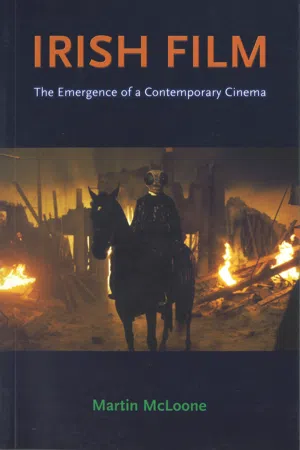
This is an exploration of the representation of Ireland and the Irish in British and US cinemas, as well as Irish-made films. The book offers readings of a wide range of key films such as The Butcher Boy (1997), Patriot Games (1992) and Angela's Ashes (1999). It discusses the full range of Irish cinematic productions from the low-budget work of Comerford and Breathnach, to the bigger Hollywood productions like Ron Howard's Far and Away (1992), and looks at the 'second' cinema of directors such as Neil Jordan and Jim Sheridan where medium-sized budgets allow for greater creative control in Ireland. Feeding into wider debates about national and cultural identity, post-national cinema and the role of the state, the book provides an overview of how a relatively small film culture such as Ireland's can live successfully in the shadow of Hollywood.
Information
Chapter 1
Nationalism, Popular Culture and the Cinema in Ireland
Just after he was assassinated in 1922, the writings and speeches of Michael Collins, subject of Neil Jordan’s 1996 biopic, were published in a short book called The Path to Freedom. These writings give an insight into the man himself and at the same time illuminate the character that emerges from Jordan’s film. In a short essay on ‘Distinctive Culture’, for example, Collins sets out his vision of independent Ireland which he locates in the peasant women of Achill Island:
… impoverished as the people are, hard as their lives are, difficult as the struggle for existence is, the outward aspect is pageant. One may see processions of young women riding down on Island ponies to collect sand from the seashore or gathering turf, dressed in their shawls and in their brilliantly coloured skirts made of material spun, woven and dyed by themselves, as it has been spun, woven and dyed for over a thousand years. Their simple cottages are also little changed. They remain simple and picturesque. It is only in such places that one gets a glimpse of what Ireland may become again, when the beauty may be something more than pageant, will be the outward sign of a prosperous and happy Gaelic life. (Collins, 1922/1968, p. 99)
It might seem difficult reconciling the brutal and brilliant military strategist of history with the writer of such romantic and essentially regressive sentimentality. However, these two versions of Collins were born of a political culture capable of nourishing and sustaining both without contradiction. Jordan was aware of this. The hard man of urban guerrilla warfare in Jordan’s film is appropriately played by Liam Neeson who has made a screen career out of portraying ‘gentle giants’, physical men with a deep and sensitive vulnerability (most famously in Steven Spielberg’s Schindler’s List [1993]). As Jordan himself says about the Neeson persona, ‘He could bury his grandmother in concrete and you would still sympathise with him’ (Jordan, 1996, p. 17).
The culture that could contain the dewy-eyed romanticism of Collins with a brutal genius for war was the cultural nationalism of late nineteenth- and early twentieth-century Ireland. Writing of cultural nationalism in general, John Hutchinson has observed that the primary aim of nationalists is ‘the moral regeneration of the historic community … the re-creation of their distinctive national civilization’. Typically this aim has always followed a certain pattern, involving the establishment of ‘informal and decentralized clusters of cultural societies and journals, designed to inspire a spontaneous love of community in its different members by educating them to their common heritage of splendour and suffering’. This cultural activity is designed to achieve a broad set of results. Hutchinson continues that nationalists ‘engage in naming rituals, celebrate national cultural uniqueness and reject foreign practices in order to identify the community to itself, embed this identity in everyday life and differentiate it against other communities’ (Hutchinson, 1987, p. 15).
The process that Hutchinson here describes is an echo of Benedict Anderson’s influential formulation of the nation as ‘an imagined political community and imagined as inherently limited and sovereign’ (Anderson, 1983, p. 15). It is cultural activity, of the kind referred to by Hutchinson, which brings this community into being and helps to maintain it against attack or threat. The irony is that the sense of national identity that emerges through this cultural activity becomes embedded so deeply in the common-sense experience of the community that the process of imagining is itself disguised or suppressed. This can result in a very essentialist definition of identity, one that is affirmed but rarely interrogated, narrow rather than embracing and pure rather than multifaceted. National culture is removed from history and rendered as a mystical process. It becomes a timeless entity or a deep essence, the rich achievement of a particular genius, that may have been suppressed at times in the past (thus Hutchinson’s notion of ‘splendour and suffering’) but which has a fundamental (often a ‘God-given’) right to exist or to be reasserted in a sovereign political state, through violence and armed struggle, if necessary.
In contrast, Anderson and Hutchinson suggest a more materialist definition of a concept that is so notoriously elusive and ethereal. National identity for them is constructed, not given or handed down in the inner spirit of the community. It is the product of human endeavour, artefact not nature; thus all national identities are ultimately cultural identities. National identity is contained in history, economics, ideology and class and though it often works hard to disguise its historical specificity, it can only be understood in terms of the material factors that have brought it into being and which continue to shape it. It is above all else, a product of modernisation. In the classical literature on nationalism, whether Marxist or not, the desire for self-sufficiency is seen to be the central economic impulse that has motivated nationalism everywhere. Nationalism aims to establish the political conditions free from colonial or imperialist exploitation in which native capitalism under the control of the native bourgeoisie might flourish, essentially a modernising movement (Kedourie, 1960; Nairn, 1977; Anderson, 1983; Gellner, 1983; Hobsbawm, 1990). If the ultimate political aim of nationalist movements is the establishment of a sovereign state, the justification for this is found culturally in the clearly defined nature of the community this state must serve. The ‘inherently limited and sovereign’ nature of the imagined community, therefore, requires substantial cultural work to establish what it is not, as much as what it is. Thus a process of sifting and selection, of inclusion and exclusion, is constantly being applied despite the nation’s supposed transparency or its apparent stability through time and space.
National identity exists, in other words, in a dialectical relationship between some notion of ‘us’ and the ‘other’ and this in turn can give rise to seemingly fixed binary oppositions. For small nations the crucial dialectic is often the relationship between the centre and the periphery and, as we shall see in the case of cultural nationalism in Ireland, this can have important ideological implications. Of course, the imagining of the nation is a centralising process and as well as disguising class, gender and regional differences it can also create internal oppositions, differently constructed notions of ‘us’ and the ‘other’ out of the very differences it has attempted to suppress. These internal minorities themselves often begin to construct an alternative imagining through their own versions of ‘splendour and suffering’, giving rise to national subcultures that exist in an intensely ambivalent relationship to the central imagining. Nationalisms everywhere, therefore, have had to work hard to contain oppositions between capital and labour, the country and the city, women’s rights and patriarchy or the tensions that arise from ethnic or religious minorities from within.
Cultural Nationalism in Ireland
If these theoretical propositions are applied to cultural nationalism in Ireland they illustrate quite well the way in which a specific set of assumptions about the nature of Irish identity came to dominate the cultural agenda and are implicit in Collins’ vision of a ‘happy Gaelic life’. Promulgated originally in the nineteenth and early twentieth centuries, these definitions of Irish identity were influential in shaping the political and social culture of independent Ireland. The influence of cultural nationalism has waned considerably in recent years but its legacy still carries major cultural force in contemporary Ireland. Thus cultural nationalism and its ingrained preferences and prejudices has inevitably had immense consequences for the cinema in Ireland. In fact, it is impossible to understand the nature of contemporary cinematic debates in Ireland without first considering in detail how cultural nationalism has had an impact on the traditions of cinematic representation and has moulded aspects of contemporary Irish sensibility. Six fundamental principles that underlay cultural nationalism in the early twentieth century are of particular interest:
•Irish identity was seen to be unique;
•the Irish were seen to constitute an historic nation, one of the oldest in Europe;
•this Irish nation was seen to be essentially Gaelic in culture and Irish-speaking in language;
•this Gaelic culture was essentially rural;
•Irish identity was closely linked to the Catholic religion;
•the Irish nation, therefore, should aspire to self-sufficiency, both economic and cultural.
The Uniqueness of Irish Identity
Irish cultural nationalism asserted a kind of primordial uniqueness for the Irish nation and a lot of cultural endeavour in Ireland in the late nineteenth and early twentieth centuries went towards establishing this uniqueness. Of course, there is nothing surprising in this, given that uniqueness is the basic characteristic of national discourse everywhere. It is, as Anderson has pointed out, one of the many contradictions about nationalism – the universality of nationalism as a socio-cultural concept as against the ‘irremediable particularity of its manifestation’. Thus, despite the fact that nationalism is found everywhere, each nationalism sees itself as sui generis (Anderson, 1983, p. 14). What is particularly interesting about the way in which the uniqueness of Irish identity was constructed is how it was defined against its ‘other’. Whatever its positive attributes, crucially Irish identity was not British.
In 1892, for example, Douglas Hyde, later to become President of Ireland under the constitution of Eamon de Valera, delivered a famous lecture entitled ‘The Necessity for De-Anglicising Ireland’. This later became the rallying cry for the Gaelic League, one of the most influential of those cultural societies identified by Hutchinson, and the main platform for what was known as ‘Irish-Ireland’ nationalism. Hyde’s opinion was that ‘within the last ninety years we have, with unparalleled frivolity, deliberately thrown away our birthright and anglicized ourselves … ceasing to be Irish without becoming English’ (Hyde, 1892/1986, pp. 153–170). He urged, therefore, the rejection of all things English or British and his sentiments were adopted over the following years in a series of campaigns designed to rid Ireland of the most popular forms of British culture. The aims of Maud Gonne’s women’s society the Daughters of Erin, for example, included ‘… to discourage the circulation of low English literature, the singing of English songs, the attending of vulgar English entertainments … and to combat in every way any English influence’ (Goldring, 1975/1982, p. 14). Thus blatant and residual anti-Britishness and a fear and distrust of popular forms of culture, including, of course, the cinema, continued to be an element of Irish national sensibility throughout the twentieth century.
There is, however, an important but often-neglected caveat to this anti-Britishness and it is alluded to in Hyde’s original lecture. As he saw it in the 1890s, the urgent need for ‘de-Anglicising’ Irish culture was that the Irish had actually embraced so much Britishness already, especially in the previous century, that the national culture was in danger of losing its historic uniqueness. The adoption of the English language and the decline of Gaelic symbolised a deep schizophrenia in the Irish, according to Hyde. ‘It has always been very curious to me how Irish sentiment sticks in this half-way house – how it continues to apparently hate the English and at the same time continues to imitate them’ (Hyde, 1892/1986, p. 154). If the defining element in cultural nationalism was ‘Irish-Ireland’ it is important to remember that ‘Anglophone’ Ireland has remained a defining characteristic of Irish culture as it is lived in day-to-day experience. As we shall see, this continues to be one of the country’s competitive advantages in the remarkable economic success of the 1990s and is held to be a key advantage for its developing film industry in a world dominated by English-speaking Hollywood.
The Historic Nation
Cultural nationalism asserted the historic longevity of the Irish nation – the fact that it pre-dated English or British involvement in Ireland and that it could only reassert itself by separation from the British state (‘a nation once again’, as Collins implied). This long history included, of course, both a long history of artistic achievement and a history of suppression under British rule (‘splendour and suffering’ again but also the splendour of the suffering). The emphasis on history has inevitably resulted in the valorisation of tradition and the past at the expense of the new and the modern, giving Irish nationalism a paradoxical radical conservatism. As we have seen, the literature on nationalism in general has stressed that it is essentially a process of modernisation, an inevitable path towards economic development that has been a characteristic of capitalist development universally. It is surely ironic, then, that this path so often leads backwards into a dim and distant past. Again, Anderson has pointed out another of nationalism’s paradoxes here – ‘the objective modernity of nations to the historian’s eye vs. their subjective antiquity in the eyes of nationalists’ (Anderson, 1983, p. 14). The central dialectic here is that between tradition and modernity and is a recurring theme in Irish cinema (the most complex exploration is again by Neil Jordan, this time in The Butcher Boy [1997]).
However, in a cultural climate in which the interpretation of history (and its inevitable reinterpretation) is so crucial to the foundational myths of both nation and state, it is hardly surprising that history itself is often the dynamic for heated debate. Thus Michael Collins (1996), dealing as it does with an important period and an emblematic personality in recent history, inevitably found itself at the centre of intense scrutiny and in many ways, it came to symbolise the deep cultural schisms of contemporary Ireland (discussed in Chapter Eleven). Many cinematic portrayals of the Irish down the years have been set in contentious historical periods or have dealt with similarly central personalities and events, and the context in Ireland governs how these have been received or how they might be read. This is particularly so with those films that might be described as ‘heritage movies’, for example, ‘the Big House’ cycle that includes Robert Knights’ The Dawning (1989), Pat O’Connor’s Fools of Fortune (1990) and Deborah Warner’s The Last September (1999). In these cases, the films’ careful evocation of a ‘heritage’ Ireland of the Anglo-Irish Ascendancy is skewed by the facts of history and the triumph of nationalism. Thus the context in Ireland reconfigures the debate about heritage in interesting and unexpected ways (Hill, 1999b; Barton, 1997).
The Gaelic Nation and the Irish Language
Irish national identity was constructed as essentially Gaelic in culture and Irish-speaking in language. This was, in fact, the main argument of Hyde’s famous and highly influential lecture and it dominated cultural nationalism throughout the revolutionary period and well beyond the foundation of the Irish Free State in 1922. Arguably, it is the one characteristic in cultural nationalism of this period that still carries a powerful charge in contemporary Ireland (though equally, its essentialist assumptions are also the most controversial aspect in contemporary cultural politics). The ethereal nature of Hyde’s conception of Irish identity is characterised by his allusion to the ‘dim consciousness’ of ancient Ireland, ‘which is one of those things which are at the back of Irish national sentiment’ (Hyde, 1892/1986, p. 156). He urged Ireland to recover its Gaelic past – the language, music, games, dress and mindset of the ancient Gael – and the influence of his vision of the past did much to perpetuate the hostile aversion to modern popular culture in ‘official’ nationalist Ireland down to the 1960s.
The revival of this Gaelic culture was to have mixed results in independent Ireland. Arguably, in Gaelic sports and in traditional music and dance, the revival was spectacularly successful and in these areas the distinctiveness of Irish identity is internationally acknowledged. The revival of the Irish language is another matter altogether.
From the foundation of the Irish Free State in 1922, Irish was established as ‘the first official language’ and the speaking of Irish became compulsory for all civil servants and other key state employees (including teachers). Irish became a compulsory part of the school curriculum and in all outward manifestations of the new state (in its bureaucracy, for example, but even in its street names) Irish was asserted as primary in a bilingual policy. The revival of the language was an important objective of state broadcasting when this was inaugurated in 1926 and remained a fundamental principle of state policy down to the present. In this regard the policy was a dismal failure and, by the end of the 1980s, the number of native Irish speakers was only about one-tenth that of 1922 (Lee, 1989, p. 673). Even so sympathetic a commentator as Lee has argued that the language policy was ineffective, self-defeating, self-deluding and hypocritical (Lee, 1989, pp. 658–74). Irish may have been designated ‘the first official language’ of the state but fewer and fewer of the Irish people knew how to speak it. In this way, the question of the Irish language in the overall construction of Irish identity continues to be a matter of bitter and protracted controversy. Its relevance to the study of Irish cinema is particularly complex.
For a start, indigenous Irish cinema, like Irish broadcasting, is overwhelmingly an Anglophone cinema. Despite the intentions of the language revival movement, the Irish language has come close to extinction. Now there are simply too few native speakers to justify wholesale investment in an Irish language cinema (in 1999, The Irish Times estimated the total number of native Irish-speakers to be about 20,000). Certainly, after many years of lobbying, a state-financed Irish language television station was finally established in 1996 (now called TG4) and this, in partnership with RTÉ and the Irish Film Board, has funded short film-making and the occasional feature. However, film-making in the Irish language remains a marginal activity and the debate about film being an expression of ‘national culture’ as well ...
Table of contents
- Cover
- Title Page
- Dedication
- Contents
- Acknowledgments
- Introduction
- Chapter 1: Nationalism, Popular Culture and the Cinema in Ireland
- Chapter 2: Traditions of Representation: Romanticism and Landscape
- Chapter 3: Traditions of Representation: Political Violence and the Myth of Atavism
- Chapter 4: Modernisation and Cultural Ferment
- Chapter 5: The Emergence of a Film Culture
- Chapter 6: The First Wave: Indigenous Film in the 1970s and 1980s
- Chapter 7: Short Films and Plural Visions
- Chapter 8: The Cinema of the ‘Celtic Tiger’: Themes and Issues
- Chapter 9: Cultural Identity: The American Friend and the European Neighbour
- Chapter 10: Urban Ireland’s Rural Landscape
- Chapter 11: The Abused Child of History: Neil Jordan’s The Butcher Boy (1997)
- Bibliography
- List of Illustrations
- Index
- eCopyright
Trusted by 375,005 students
Access to over 1.5 million titles for a fair monthly price.
Study more efficiently using our study tools.
Frequently asked questions
Yes, you can cancel anytime from the Subscription tab in your account settings on the Perlego website. Your subscription will stay active until the end of your current billing period. Learn how to cancel your subscription
No, books cannot be downloaded as external files, such as PDFs, for use outside of Perlego. However, you can download books within the Perlego app for offline reading on mobile or tablet. Learn how to download books offline
Perlego offers two plans: Essential and Complete
- Essential is ideal for learners and professionals who enjoy exploring a wide range of subjects. Access the Essential Library with 800,000+ trusted titles and best-sellers across business, personal growth, and the humanities. Includes unlimited reading time and Standard Read Aloud voice.
- Complete: Perfect for advanced learners and researchers needing full, unrestricted access. Unlock 1.5M+ books across hundreds of subjects, including academic and specialized titles. The Complete Plan also includes advanced features like Premium Read Aloud and Research Assistant.
We are an online textbook subscription service, where you can get access to an entire online library for less than the price of a single book per month. With over 1.5 million books across 990+ topics, we’ve got you covered! Learn about our mission
Look out for the read-aloud symbol on your next book to see if you can listen to it. The read-aloud tool reads text aloud for you, highlighting the text as it is being read. You can pause it, speed it up and slow it down. Learn more about Read Aloud
Yes! You can use the Perlego app on both iOS and Android devices to read anytime, anywhere — even offline. Perfect for commutes or when you’re on the go.
Please note we cannot support devices running on iOS 13 and Android 7 or earlier. Learn more about using the app
Please note we cannot support devices running on iOS 13 and Android 7 or earlier. Learn more about using the app
Yes, you can access Irish Film by Martin McLoone in PDF and/or ePUB format, as well as other popular books in Media & Performing Arts & Film History & Criticism. We have over 1.5 million books available in our catalogue for you to explore.