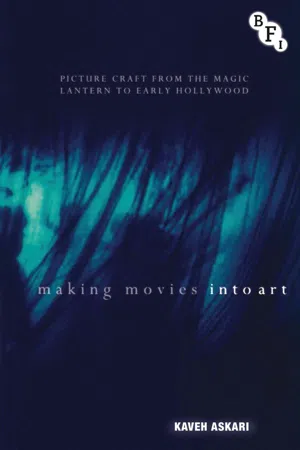
Focusing on early cinema's relationship with the pictorial arts, this pioneering study explores how cinema's emergence was grounded in theories of picture composition, craft and arts education – from magic lantern experiments in 1890s New York through to early Hollywood feature films in the 1920s.
Challenging received notions that the advent of cinema was a celebration of mechanisation and a radical rejection of nineteenth-century traditions of representation, Kaveh Askari instead emphasises the overlap between craft traditions and modernity in early film.
Opening up valuable new perspectives on the history of film as art, Askari links American silent cinema with the practice of teaching the public how to appreciate fine art; charts its entrance into arts education via art schools and university film courses;
shows how concepts of artistic production entered films through a material interest in the studio; and examines the way in which Maurice Tourneur and Rex Ingram made early art films by shaping an image of the film director around the idea of the fine artist.
eBook - ePub
Making Movies into Art
Picture Craft from the Magic Lantern to Early Hollywood
- 182 pages
- English
- ePUB (mobile friendly)
- Available on iOS & Android
eBook - ePub
About this book
Information
1
Moving-picture Art before Cinema: Alexander Black and the Lyceum
On 9 October 1894, at the Carbon Studio on 16th Street in Manhattan, the writer, photographer and lanternist Alexander Black premiered Miss Jerry, his first ‘picture play’. The much anticipated event attracted a crowd of noted intellectuals and artists, including novelist William Dean Howells, art educator William Merritt Chase, theatre critic Brander Matthews and Brooklyn mayor Seth Low. They gathered to discuss what was essentially a feature-length moving slide show that walked in close step with the emerging cinema. This new picture play consisted of a series of still images of actors posed, photographed and projected on a screen. Black read an accompanying narrative and dissolved from one slide to the next at regular intervals in order to suggest movement. The event was meant to provoke as much as entertain. Looking forward, it raised questions about a possible artistic future for motion pictures at a time when the American public was witnessing only the first glimpses of photographed movement on rotating disks and in peephole devices. Black sought input from his circle of writers and visual artists on how best to present this provocation on the public lecture circuit. On their advice, he fine-tuned the picture play format to a programme of around 250 slides, lasting about an hour and a half. He would spend the next decade performing his picture plays at community centres, schools and museums across the eastern USA. Although largely overlooked today, these performances were continually mentioned throughout the silent era when writers posed the question, ‘Who invented the cinema?’. For some critics, who had cinema of a certain artistic ambition in mind, the answer was Alexander Black.
Black toured with the picture plays extensively until 1904. Despite his large audience at the time, however, his picture plays did not develop into mainstream motion picture practice.1 It was not until the age of the silent feature film in the following generation that he was even recognised as a kind of inventor of cinema, but not one that fitted neatly into any narrative of film’s progress. Terry Ramsaye’s chapter on Black in A Million and One Nights illustrates this. Ramsaye’s pioneering 1926 motion-picture history contributed to Black’s rediscovery and is still one of the most enduring accounts of Black’s work. The picture play puzzled Ramsaye just as it had puzzled Black’s original audiences in the 1890s. Looking back, he was struck by the odd likeness between the respected feature films of his day and Black’s picture plays. Already, in the early years of the cinema of attractions, Black’s picture plays told multi-act stories, and they lasted about as long as a feature film. More importantly, their unusual suggestion of movement hinted, for Ramsaye, at the suggestive subtlety he believed to underpin all art. The problem was that Black had stopped touring several years before the production of the silent feature films with which Ramsaye allied his work. It troubled Ramsaye that the picture play format did not fit neatly into a narrative of the progress of cinema. To him, the discovery of the picture play was like a paleontological botanist discovering a fossil apple in a stratum where there were believed to be no apple trees.2 Black’s work, an evolutionary anomaly, confounded Ramsaye’s evolutionary model of film’s progress.
While Ramsaye’s evolutionary model may have long been replaced by more nuanced periodisations, what troubled Ramsaye, Black’s precocious cross-media moving images, are now more relevant than ever. Instead of struggling to find a definitive invention in Black’s work, I examine it as a vantage point from which to begin a history of artistically ambitious motion pictures parallel with the advent of cinema itself. Black’s work fits perfectly with the ongoing moves to open cinema history to other media. It reveals how media practices converged in this period and how these moments of convergence were shaped by discursive factors as much as by technical innovations. Furthermore, for current cinema historians concerned with the intellectual and social history of those who prophesied art cinema by forging early aesthetic theories of film, the connections between critics like Ramsaye and early experimenters like Black reveal underexamined intellectual networks. Ramsaye’s book is a historical artefact in its own right. He consolidated a history of the art of the silent feature film at the height of its prominence, bringing together technical and aesthetic developments under a broad arc. Black contributed to this larger intellectual tradition throughout his career. His work formed part of an entire spectrum of multi-media performances to which Ramsaye and numerous other critics compared it.3 The picture plays were uniquely relevant for these critics because they resolved some of their recurring aesthetic questions about the recorded moving image. Even though actual motion pictures were a rare part of his repertoire, and he retired long before anyone in the film industry was interested in selling a kind of art cinema, Black nonetheless brought together a recipe of aesthetic theories of movement, pictorial appropriation and arts-institutional support that very much appealed to 1920s film industry critics like Ramsaye and producers like Adolph Zukor searching back for an early template for a cinema of distinction. This recipe will become familiar in each of the chapters of this book.
More than anything else, the picture plays’ suggestion of movement underwrote their notoriety, for critics in the 1890s and for those a generation later. Why movement? Still photography had famously sparked anxiety in the art-loving public by removing the artist’s pencil from the picture. Motion photography, another order of complexity, fanned these flames. I contend throughout this chapter that the composed movement of the picture plays addressed issues at the heart of the emerging debates about the possibility of motion-picture art. By crafting a particular type of movement in his performances, Black staged a kind of cross-media confrontation between two opposing traditions. His work navigates between nineteenth-century pictorialist traditions such as the tableau vivant, pictorial staging in theatre and illustration, on the one hand, and the new media of instantaneous photography and cinema, on the other. Pictorialist traditions generally emphasise privileged moments, repose, restraint, purposiveness, whereas cinema and instantaneous photography are frequently said to have introduced the contingency of fragmented or discontinuous instants into the visual culture. Conceiving of these two analytic categories as aesthetically distinct has proven to be foundational for recent media theorists, from Friedrich Kittler to Gilles Deleuze, who have revisited these enduring questions.4 This does not mean, however, that multi-media historiography cannot enrich these categories by showing how they often productively overlapped. Upon close examination, it becomes hard to deny the ways that media producers exploited new creative possibilities in the period by selectively merging traditions associated with both of these aesthetic categories in their productions. In what follows I examine Black’s institutional affiliations and his writings in tandem with his moving-image techniques in order to show the overlap of the composed tableau and the fragment of the film frame. His lantern lectures and his picture plays make ideal studies because they bring together instantaneous photography, pictorial culture and cinema in thematic as well as practical ways. In other words, Black engaged the widespread philosophical debates among American educators about moving-image art, and at the same time he crafted his own type of moving-picture show that illustrated and resolved these very debates.
THE AMATEUR AND THE INSTITUTE
The photographic turn in Black’s writings and performances began in 1889 when he was elected president of the new department of photography at the Brooklyn Institute of Arts and Sciences.5 One of the most prominent American lyceum venues, the Brooklyn Institute provided an institutional grounding for the intellectual history about moving pictures’ relationship to art. The lyceum had served multiple constituencies throughout its long history. It was initially founded as a venue for the education of the working class, moving through several permutations until its energies filtered into the Chautauqua movement and other urban educational institutions.6 By the 1880s, venues like the Brooklyn Institute had become major centres where aesthetic questions were addressed as part of a broader culture of education as participatory democracy. Many lyceum members had very practical motivations for attending the lectures. Membership documents from the Brooklyn Institute in the 1890s reveal a full third of their membership to consist of private and public school teachers.7 The Brooklyn Institute also housed the meetings of other educational organisations such as the Association of Art Teachers. This professional participation in the institute suggests that these lectures satisfied a practical demand for teacher training in new developments in art pedagogy (beyond their often discussed value as morally suitable entertainment). As the teachers disseminated ideas discussed in the venue, so did educational outreach programmes like correspondence courses, which reached 180,000 subscribers by 1891.8
The lyceum has received less attention than it deserves given its central role as a venue for encountering moving-image technologies. Discussions of this period often bracket the significance of the lyceum with the epithet ‘genteel’. To use the term in a value-neutral way, as I do here, is not necessarily to disagree with the current critiques of arts institutions as effective instruments of social hierarchy.9 But to use the term pejoratively, as a matter of habit, can only limit the historical investigation of institutions like the Brooklyn Institute. It runs the risk of obscuring the flexible and varied member participation on which these institutes depended. There was hardly an American intellectual (or a European intellectual known in the USA) who didn’t spend some time lecturing on the lyceum circuit. While a great deal of genteel rhetoric did thrive in the lyceum, it is important to understand this historically as a point of debate within lyceum culture rather than as a blanket descriptor of the kinds of discussion to be found inside. Even George Santayana, who coined the pejorative phrase ‘genteel tradition’, found a receptive audience for these ideas in the same lyceum that also welcomed members of the older literary generation he held in contempt.10 It would be difficult to find some significant aspect of American public culture that was not debated, demonstrated, or contemplated in some way by lyceum participants.
As institutions of uplift go, the lyceum was remarkably open to film and instantaneous photography. When he founded the department of photography at the Brooklyn Institute in 1889, Black opened it up even more to practical demonstrations and to lectures by people such as Eadweard Muybridge on animal locomotion, Jacob Riis on the urban poor and Burton Holmes on exotic travel. Thomas Edison gave his first public demonstration of the Kinetoscope at the Brooklyn Institute, and emissaries of the Lumière company gave technical demonstrations there beginning a few years later.11 These demonstrations using new media technologies were presented side by side with lectures on aesthetics. One evening the members could see Jules Brulatour demonstrating the new Lumière autochrome process and the next evening they could hear the avid lecturer on pictorial aesthetics, Henry Rankin Poore, give a talk on ‘artistic [Pictorialist] photography’.12 In the lecture halls at the Brooklyn Institute amateur photographers, motion picture lecturers and art educators engaged in frequent conversations, many of which grew into publications by institute members and organisers like Black.13 Through his work at the institute, Black became a respected writer on amateur photography as well as a technician with an exacting knowledge of optical and photochemical details. He was among the educators who advocated the idea that teaching pictorial aesthetics furthered the lyceum’s goals of creating a participatory democratic culture, and he worked to bring new imaging technologies into these public debates about art and education.14
In the 1890s Black wrote and lectured on art and presented much of his early photography work in the company of painters like William Merritt Chase, but his approach to photography did not completely follow the fine-arts uses of the medium that were emerging in Europe.15 He kept at a distance from the Pictorialist photography promoted by British associations like the Brotherhood of the Linked Ring even as he claimed, like many early amateur photographers, that the aesthetic advancement of photography depended on the amateur. He was only tangentially associated with members of the Pictorialist movement in the USA through his organisational work at the Brooklyn Institute and his articles. Pictorialists found the sharp lines and machine-made quality of straight photographs made in professional studios to lack artistry. They countered the harsh objectivity of these photographs with a battery of softened shooting and printing techniques in an attempt to make photography more like painting. Black was clear...
Table of contents
- Cover
- Title Page
- Dedication
- Contents
- Acknowledgments
- Introduction
- 1. Moving-picture Art before Cinema: Alexander Black and the Lyceum
- 2. Moving Pictures Imagine the Artist’s Studio
- 3. Cinema Composition: The University and the Industry
- 4. Painting with Human Beings: Maurice Tourneur as Art-film Director
- 5. Rex Ingram’s Art School Cinema
- Conclusion: Moving Forward from the Slow Movie
- Notes
- Index
- List of Illustrations
- eCopyright
Trusted by 375,005 students
Access to over 1.5 million titles for a fair monthly price.
Study more efficiently using our study tools.
Frequently asked questions
Yes, you can cancel anytime from the Subscription tab in your account settings on the Perlego website. Your subscription will stay active until the end of your current billing period. Learn how to cancel your subscription
No, books cannot be downloaded as external files, such as PDFs, for use outside of Perlego. However, you can download books within the Perlego app for offline reading on mobile or tablet. Learn how to download books offline
Perlego offers two plans: Essential and Complete
- Essential is ideal for learners and professionals who enjoy exploring a wide range of subjects. Access the Essential Library with 800,000+ trusted titles and best-sellers across business, personal growth, and the humanities. Includes unlimited reading time and Standard Read Aloud voice.
- Complete: Perfect for advanced learners and researchers needing full, unrestricted access. Unlock 1.5M+ books across hundreds of subjects, including academic and specialized titles. The Complete Plan also includes advanced features like Premium Read Aloud and Research Assistant.
We are an online textbook subscription service, where you can get access to an entire online library for less than the price of a single book per month. With over 1.5 million books across 990+ topics, we’ve got you covered! Learn about our mission
Look out for the read-aloud symbol on your next book to see if you can listen to it. The read-aloud tool reads text aloud for you, highlighting the text as it is being read. You can pause it, speed it up and slow it down. Learn more about Read Aloud
Yes! You can use the Perlego app on both iOS and Android devices to read anytime, anywhere — even offline. Perfect for commutes or when you’re on the go.
Please note we cannot support devices running on iOS 13 and Android 7 or earlier. Learn more about using the app
Please note we cannot support devices running on iOS 13 and Android 7 or earlier. Learn more about using the app
Yes, you can access Making Movies into Art by Kaveh Askari in PDF and/or ePUB format, as well as other popular books in Media & Performing Arts & Film History & Criticism. We have over 1.5 million books available in our catalogue for you to explore.