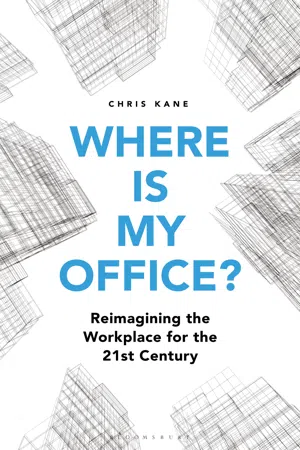
In the modern age of remote working and flexible work hours, why have most office spaces remained relatively unchanged for decades? In Where is My Office?, Chris Kane draws upon his extensive knowledge and experience in commercial property to investigate the new-found significance of innovative corporate real estate thinking in the modern workplace. With the rise of agile working, hot-desking and new technological innovations, the traditional office space no longer serves the needs of the modern workforce. With a foreword from Mark Thompson, CEO of The New York Times, this fascinating book highlights the bold new solutions to workplace practices which have the potential to invigorate employee productivity while simultaneously trimming excess costs.
Chris poses his ground-breaking 'Smart Value' formula which underpinned the success of his redevelopment of the property portfolio of the BBC, and which can be adapted to enact meaningful and lasting organizational change in any business. This formula is supported through in-depth case studies from Chris's prestigious career, while interviews with prolific industry insiders such as Ronen Journo, SVP of WeWork and Mark Dixon, founder of Regus, provide fascinating insights into the ground-breaking strategies that are transforming the commercial property sector. Where is My Office? is a must-read for any business leader looking to revitalise their workplace and develop a greater understanding of the beneficial impacts that innovative workplace strategies can have upon their organization's success.
- 272 pages
- English
- ePUB (mobile friendly)
- Available on iOS & Android
eBook - ePub
About this book
Information
PART ONE
A Fresh Perspective on Workplaces
1
Seeing the Forest for the Trees
Progress is impossible without change, and those who cannot change their minds, cannot change anything.
George Bernard Shaw
‘Why don’t we use spaces and places differently?’ I mused. It’s not often I get so philosophical stuck in a long traffic jam on a roundabout in Twickenham, London, on a typical Saturday morning and looking enviously at a completely empty bus lane. Dare I dart forward into that traffic-free lane and get ahead of the game? After all, it was perfectly legal – bus lane restrictions are only in force for part of the day and not on weekends. Yet here we all were, car, van and lorry drivers dutifully in line and waiting our turn; so organized, so automatic, not realizing we could actually use these lanes outside of restricted hours. I wondered why so few of us took advantage of this and it struck me that we are all such creatures of habit that nobody bothered to use the empty lane. This is what triggered my question: ‘Why don’t we use spaces and places differently?’
Hardly a ‘Eureka’ moment in the grand scheme of things, and not quite in the same vein as Archimedes jumping out of his bath and streaking around Ancient Athens. It was enough for me to just escape into that empty bus lane and power down that traffic-free road while thinking about all those lost opportunities we could take advantage of, where we do not remain stuck doing the same things over and over again unthinkingly. When in fact we could do something beneficial and productive just by thinking differently.
That roundabout lightbulb moment encapsulated what I seem to have spent nearly 30 years of my life working on: a smarter approach to how we use our spaces and places. Taking on the role of instigator and constantly asking that question: ‘why?’ Why do we do things in this way, especially in the anachronistic world of property and the workplace since the evolving nature of how we work in offices today is a game-changer?
Confessions of a Lapsed Chartered Surveyor
I guess the importance for changing perspectives in the workplace and wanting to effect change both for people working in offices and business, as well as for the benefit of the property industry and the wider community, stems from my roots. Rather appropriately, those roots lay in property and land since I come from the third generation of a family involved in auctioneering and land management in Ireland. It was growing up with that legacy and understanding the importance of land that led to my interest in the rather unromantic profession of chartered surveying; it was also the reason I came to London in the early eighties to complete my qualifications.
I suspect that being from a small place on a small island always made me something of an outsider and a bit of a maverick since I was not a member of the ‘Old Boys’ establishment’ property world. It certainly makes me question how the industry operates in the UK and beyond, as it is riddled with acronyms, complexity and jargon, all of which are crying out to be reformed and simplified. Despite my different attitude, I was lucky enough to get a job at one of Britain’s largest surveyors, Jones Lang Wootton – now known as leading worldwide estate service provider, JLL. I spent 13 years there and ended up as a partner, after helping to launch a new occupier client facility, their Corporate Real Estate Services. Working for a major world-leading organization, I came to see the power of brand and corporate culture in action – factors which were key to developing a successful business in every sector.
It was in the mid-nineties that I received one of those very unusual calls from a US-based headhunter in Los Angeles, asking me if I fancied a change. After much cloak-and-dagger activity and 17 interviews later, that mysterious phone call led to a job with The Walt Disney Company. This eventually culminated in me becoming vice-president of International Corporate Real Estate, which meant I was responsible for nearly all of Disney’s worldwide corporate real estate. This involved much travel, criss-crossing the globe, with the added good fortune of being exposed to diverse work cultures and ways of doing business. So, it was Mickey Mouse who shaped both my journey and understanding of what the workplace really is, how it serves business and indeed the broader community. Walt Disney’s famous quote, ‘If you can dream it, you can do it,’ was also my mantra and it served me well then, as it does today. Additionally, I also learned the ins and outs of the media world. I discovered broadcasting and TV studios – little did I know how useful learning that side of the business would become one day…
In 2003, I received another of those life-changing phone calls. This time from a very traditional English firm of headhunters, with an interesting proposition: a major organization needed someone to help them transform their property portfolio to the tune of £2 billion.
Six months after that call, I arrived at the imposing Art Deco entrance of the BBC’s Broadcasting House in London and was given the challenge of driving the biggest modern-day transformation of one of the UK’s most iconic cultural institutions. This resulted in a 40 per cent reduction in their real estate footprint, moving over 12,000 people around the country, delivering more than 20 projects, refreshing 60 per cent of the BBC’s property portfolio and achieving an annual saving of £47 million in their property by 2016–17. Additionally, it entailed shifting the BBC’s London-centric broadcasting production to other regional hubs, such as the flagship MediaCityUK in Salford, near Manchester, and Pacific Quays in Scotland; all done while keeping BBC programmes and broadcasting carrying on seamlessly.
This incredible multi-layered restructuring really opened my eyes to the link between workplace and business performance; many of the BBC’s property schemes were actually turned into business transformation projects, so the move to a new building became a major catalyst for organizational change and helped the BBC in its wider transition from analogue to digital.
My time at the BBC was also key to inspiring my Smart Value concept. This enabled me to navigate this vast project successfully, as well as generate unprecedented levels of creative and economic value for the BBC. However, the greatest benefit in deploying Smart Value was that it also considers the wider community, particularly in the cases of MediaCityUK in Salford and White City in West London. The basic premise of Smart Value was using the BBC brand as a catalyst to attract other leading creative organizations to these once-neglected sites, which provided the springboard to develop new attractive, thriving places to live and work in. The other bonus being it also galvanized the local economies by creating jobs, not just through the companies who moved there but also through building links with universities/schools, creating innovation hubs, leisure activities and community centres.
The Smart Value formula will be analysed at greater length in Chapter 5 and the way it impacted on both Salford and White City will be explored further in Part 2 – The BBC Story.
The other important lesson I learned as Head of the BBC’s Corporate Real Estate was understanding diverse groups of people, trying to bring them together and lead them to achieve a higher aim or bring about a successful result. This could only be accomplished by breaking down communication barriers and cutting across the silos which often divide sectors and individuals.
This, in a nutshell, is the practical background of where I have come from in the industry; it has been a case of ‘working the coalface’, and not just in terms of property and Corporate Real Estate. The role has included project and facilities management, but most importantly, it has featured change management and leading assorted teams of people through large-scale regeneration and development at the highest levels. Over my 30-year career I have worn many hats, as well as Mickey Mouse ears too. I have gone from being a typical adviser/surveyor to being on the client and consumer side of property facilities, so I have seen first-hand how all of these complex and convoluted areas of the property world function from all angles.
Also, over these three decades I have seen the shifts, both in the world of work and business itself, and the monumental impact it has had on where and how people can work. I have also concluded that it cannot be overlooked anymore. Nobody can really afford to sit herd-like in the slow lane, watching how much the world around us is changing, peering mindlessly at those taking the opportunity to whizz into the twenty-first century’s fast lane without transforming or innovating to keep pace. However, like most people I also suffered from a closed mind and tunnel vision. Along my career journey I was fortunate enough to come across many individuals who made me think that as an industry we have to step back and ask ourselves certain questions: How come we have different perspectives, even within the same sector? Who has the best view of the situation? They encouraged me to see the bigger picture and to challenge the status quo of the property world. They also inspired my other professional goal to integrate all the disparate elements of the real estate industry and the workplace, to instigate change for the better, and to make workplaces fit-for-purpose for the ways we work in the twenty-first century.
Inspiring Instigators and Interpreters
Everyone has their own interpretation of how they view the world and it would be a very boring, dull place if we all saw it the same way, but certain individuals really did broaden my vision regarding my sector and its role in the workplace. Namely former RIBA President Frank Duffy, founder of the pioneering architectural practice DEGW, who was an advisor for many years, and Professor Michael Joroff, former Senior Lecturer at MIT’s Laboratory of Architecture and Planning, who kickstarted my interest in turning property into strategic assets.
Having access to both Frank and Mike provided me with the perfect mix of viewpoints, which enabled me to navigate the complex world of spaces and places. With this cocktail of thoughtful counsel and MIT’s academic rigour, their combined outlooks were invaluable, as well as enlightening. However, the secret sauce to the relationships we developed over the years was that we connected well as people.
Frank Duffy’s importance in the evolution of workplace strategy cannot be underestimated: he introduced this US-inspired sector to Europe as far back as the 1970s. Together with his DEGW colleagues, he revolutionized the office environment by emphasizing the importance of an organization’s changing nature and the need for the workplace to reflect this. This also extended to incorporating developments in mobile and remote working. He also introduced trailblazing concepts such as the involvement of users in the design and management of their space and the significance of differing life cycles in buildings, from structural core to interior fittings. Instead of viewing buildings as static objects, DEGW looked at them as evolving entities.
I first met Frank when I was at JLL but it was not till I went to Disney that our relationship really blossomed. Frank and his DEGW colleagues were not only creative and innovative in their approach, they were also very thoughtful and passionate in their work. He and his European team assisted me on most of the international TV channel projects at Disney and with his business partner, Despina Katsikakis, they led the charge when I attempted to introduce a workplace strategy at their vast London headquarters in Hammersmith. They also gave me insights into the importance of securing senior management sponsorship and backing for projects of this nature. Frank’s wise guidance was also instrumental in helping me with the BBC’s estate transformation and in providing strategic support in building up solid engagement with the BBC boardroom.
Since Disney was such a global organization, it also gave me the opportunity to meet the wider DEGW community across the world. Many years later, I partnered with some of the DEGW diaspora on Six Ideas – a worldwide community of people and creative thinkers resolved to tackle issues around the way we work, learn and live.
Professor Michael Joroff specializes in the field of city planning, building technology and real estate development. He is considered a leading expert in twenty-first-century placemaking and pioneered the formation of large-scale entrepreneurial clusters. Mike has helped cities all over the world plan and launch districts designed to engender innovation and entrepreneurship, through large-scale, mixed-use developments designed to serve people’s lives and their work. He has been a great influence in my challenges to align real estate strategies with business proces...
Table of contents
- Cover
- Series
- Dedication
- Title
- Contents
- Foreword
- Introduction
- PART ONE A FRESH PERSPECTIVE ON WORKPLACES
- PART TWO THE BBC STORY: FROM ANALOGUE TO DIGITAL
- Glossary and Definitions
- References
- Bibliography and Further Reading
- Acknowledgements
- Index
- Copyright
Trusted by 375,005 students
Access to over 1.5 million titles for a fair monthly price.
Study more efficiently using our study tools.
Frequently asked questions
Yes, you can cancel anytime from the Subscription tab in your account settings on the Perlego website. Your subscription will stay active until the end of your current billing period. Learn how to cancel your subscription
No, books cannot be downloaded as external files, such as PDFs, for use outside of Perlego. However, you can download books within the Perlego app for offline reading on mobile or tablet. Learn how to download books offline
Perlego offers two plans: Essential and Complete
- Essential is ideal for learners and professionals who enjoy exploring a wide range of subjects. Access the Essential Library with 800,000+ trusted titles and best-sellers across business, personal growth, and the humanities. Includes unlimited reading time and Standard Read Aloud voice.
- Complete: Perfect for advanced learners and researchers needing full, unrestricted access. Unlock 1.5M+ books across hundreds of subjects, including academic and specialized titles. The Complete Plan also includes advanced features like Premium Read Aloud and Research Assistant.
We are an online textbook subscription service, where you can get access to an entire online library for less than the price of a single book per month. With over 1.5 million books across 990+ topics, we’ve got you covered! Learn about our mission
Look out for the read-aloud symbol on your next book to see if you can listen to it. The read-aloud tool reads text aloud for you, highlighting the text as it is being read. You can pause it, speed it up and slow it down. Learn more about Read Aloud
Yes! You can use the Perlego app on both iOS and Android devices to read anytime, anywhere — even offline. Perfect for commutes or when you’re on the go.
Please note we cannot support devices running on iOS 13 and Android 7 or earlier. Learn more about using the app
Please note we cannot support devices running on iOS 13 and Android 7 or earlier. Learn more about using the app
Yes, you can access Where is My Office? by Chris Kane in PDF and/or ePUB format, as well as other popular books in Business & Human Resource Management. We have over 1.5 million books available in our catalogue for you to explore.