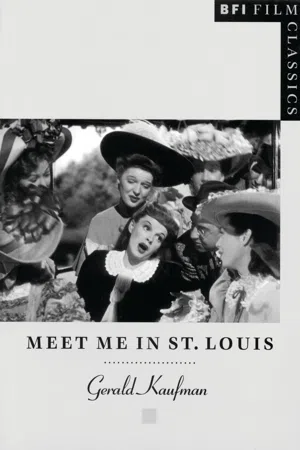
- 71 pages
- English
- ePUB (mobile friendly)
- Available on iOS & Android
eBook - ePub
Meet Me in St. Louis
About this book
In 'Meet Me in St Louis', one of the most popular MGM musicals, Judy Garland stars as the classic American teenager. For this book, Gerald Kaufman interviewed many of the stars. This text captures the essence of Miss Garland's performance and the machinations of the legendary MGM studios.
Information
MINNELLI

Sometimes life can provide bonuses beyond one's wildest imaginings. My early cinemagoing took place in small cinemas in rundown Leeds suburbs, where I would pay 4d (or, in extreme circumstances, 6d) to sit through an evening of transfixing glamour. I did not even conceive of the possibility that I might ever meet anyone involved in the making of the films I saw, especially anyone from the astronomically remote Valhalla of Hollywood. When I watched Gene Kelly in For Me and My Gal and, later on, in Singin' in the Rain, I never dreamt that the day would come when I would actually meet the man, let alone visit him in his own home in North Rodeo Drive, Beverly Hills, and pore over with him the original shooting script of Singin' in the Rain, scorched after its rescue from a fire. Nor did it occur to me that the time would come when I would discuss his films tête-à-tête with Vincente Minnelli.
I saw Minnelli's very first film, Cabin in the Sky, when it was released in 1943. I glowed with pleasure at the warm-heartedness of Meet Me in St. Louis when in 1945 Minnelli's third film found its way eventually to the Clock Cinema, Roundhay Road, Leeds. Seventeen years later I sat with Minnelli in a plush suite in the Dorchester Hotel, in Park Lane, London, drinking his (or MGM's) tea and discussing with him the filming of Meet Me in St. Louis.
By 1962 Minnelli had made twenty-four more films (including The Four Horsemen of the Apocalypse, whose British premiere had brought him to London), though in the following fourteen years he was to make only six others (due partly to the decline of the Hollywood studio system and partly to the slump in his own career caused by the flop of The Four Horsemen of the Apocalypse, which MGM had forced him to update when he would have preferred to retain its original First World War setting).
Between 1945 and 1962 I had come to idolise Minnelli. I had made it my objective to see all the films of his which I had missed on their first release (including even the strange thriller Undercurrent, which featured a Brahms symphony transformed into a piano concerto) and was willing to travel long distances simply to see the mannequin parade from Lovely to Look At (a poor remake of Roberta), which I had learned Minnelli had directed even though the film as a whole was credited to Mervyn LeRoy.
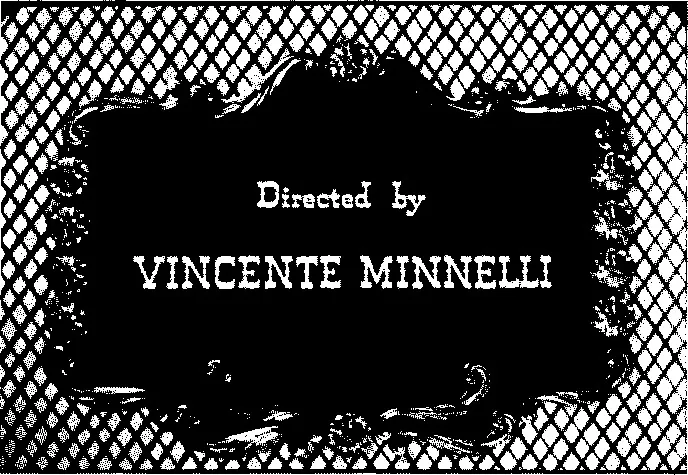
I never deluded myself that he was a great director, up there in the pantheon with Eisenstein and Renoir. Yet I had come to understand, observe, appreciate and cherish the characteristics which made him so consummately stylish a director, who put a gloss (gloss being, in some circumstances, one of his failings) on everything he touched. His role as director could easily have been discerned from the look of a film even if that film's credits had not climaxed with the words 'Directed by Vincente Minnelli'; words which aroused in me such a tingle, as I anticipated eagerly the opening frame of the film which I had practically run to the cinema to see.
Minnelli was not a great director because he had nothing to say, unlike, for example, Jean Renoir (whose La Grande Illusion, Minnelli told me, at our Dorchester meeting, he himself would like to have directed). In the perfervidly political years of the Hollywood witch-hunts by the House UnAmerican Activities Committee (HUAC), Minnelli, with his then wife Judy Garland, had, to his credit, attended a meeting held at Ira Gershwin's home in Hollywood to oppose the witch-hunts. He had signed a petition expressing 'disgust' at the 'smear' activities of HUAC. He did not, however, join some of the signatories in a subsequent visit to Washington.
When an attempt was made to excise from Minnelli's film The Bad and the Beautiful a scene featuring an actor (Ned Glass) who had been blacklisted after falling foul of HUAC, Minnelli fought successfully to retain the scene in the finished picture. His ardour was based not on grounds of political principle but because – as the producer John Houseman remembered – he 'fell in love with the sequence' and could not bear to lose it.
Otherwise, there is little in Minnelli's record to indicate that, apart from his meticulous and fastidious concern with the look of every frame of every film he ever made, he felt strongly about anything. Though reputedly a homosexual himself (though a four times married one), he is not known to have made any particular fuss about the almost total excision of references to homosexuality from the script of the film he directed of the Broadway stage hit Tea and Sympathy (whose subject matter dealt with the successful efforts of an older woman to 'cure' a young man of any homosexual propensities he might have had).
However, what I came to admire, and be captivated by, in Minnelli's films was that very concern with the look of every frame and the extraordinary results he thereby achieved. There was in Minnelli's pictures a voluptuousness which could be matched only by Max Ophüls and Luchino Visconti.
As a conversationalist Minnelli was almost inarticulate. Richard Schickel, who interviewed him for his compilation The Men Who Made the Movies, said, 'Next to Sir John Gielgud, Vincente Minnelli is the most difficult person I've ever interviewed.' When Minnelli came to London for a Guardian lecture at the National Film Theatre, the event was an almost total fiasco because the interviewer could hardly get a coherent sentence out of the eagerly awaited guest. During my conversation with him at the Dorchester, his then (third) wife, a formidable Yugoslav (I think) lady called Denise Giganti, had to act as a kind of interpreter to enable me to get anything out of him. Yet as a movie-maker, as his career both prior to and after Meet Me in St. Louis demonstrated, he was dazzlingly eloquent.
Minnelli was certainly not an auteur, the sole author of his films, in the way that the French Cahiers du Cinéma group of critics believed that a movie director ought to be and often was. In conversation with me, Gene Kelly – himself a director of quality – argued vehemently that the auteur theory was baseless because, unlike novels and poems and paintings and sculptures and symphonies which were created by one person alone, a film was the product of a team. Advocates of the auteur theory contend that many films endorse the theory: they are concepts of their director, even though the director needs actors, designers, a cinematographer and countless other collaborators (including, most essentially of all, a writer, who is sometimes the director himself) to put the picture on to the screen. François Truffaut, a propagandist for the auteur theory, could by this definition himself be regarded as an auteur, since his films would not have been made had he not directed them.
Of the films directed by Minnelli, it can be said that only two would not have been made had he not directed them. Two Weeks in Another Town, a movie about movie-making, was very consciously undertaken as a successor to Minnelli's The Bad and the Beautiful, even containing extracts from that film. A Matter of Time, his final movie, was a project launched, nursed and brought to fruition by Minnelli which, even in the butchered state in which it was released, bears all the characteristic signs of its director's craftsmanship. However, even Lust for Life, the Van Gogh biography which of all his films was the one which Minnelli most passionately wanted to make, cannot be said to owe its existence to its director. It was an adaptation of a highly popular novel and, even if Minnelli had not directed it, someone else almost certainly would have, even though the outcome could not possibly have been as beautiful and passionate as the Minnelli picture.
For almost his entire career Minnelli worked within the studio system, becoming the longest-serving director at MGM. Being under contract for that studio meant that he had access to all the best talents in Hollywood; it also meant that, in the end, he had to do as he was told: to make films, such as Kismet and The Four Horsemen of the Apocalypse, which he did not want to make and to make films he did want to make, such as Brigadoon, in conditions which he found profoundly unsatisfactory. Whether he liked those conditions or not, like other top-flight Hollywood directors he had to go to work, to clock in and to clock out.
Although The Wizard of Oz was credited to Victor Fleming, several other directors worked on it and Fleming himself left the film before it was completed, in order to start work on Gone with the Wind, from which George Cukor (who had also done some work on The Wizard of Oz) had been removed. Just as other directors took over films (such as Easter Parade) intended for Minnelli, so Minnelli took over films (such as The Clock) intended for other directors. For The Clock he was given sole credit, while for The Seventh Sin, which he took over from another director, he did not accept credit. He directed parts of pictures (Panama Hattie, Lovely to Look At, Till the Clouds Roll By) which were mainly directed by other men, and he was the main director of Ziegfeld Follies, to which other men contributed.
Was Minnelli, then, just a metteur en scène, one of countless Hollywood directors who was handed a script and then, with more (in his case) or less (in the case of many others) individuality, put that script on to film? Or was he something more?
The answer is that he was something very much more. It is not simply that his interpolations into the films of others are far superior to the remainder of those movies. The musical numbers he directed for Lena Horne in Panama Hattie transcend that dreadful picture. The numbers he directed for Judy Garland in Till the Clouds Roll By might have been part of another and far better film; 'Look for the Silver Lining' is especially touching in its expressive simplicity.
All his films, whatever their quality, are immediately recognisable as Minnelli films; they could have been made by no one else. Minnelli was the third director assigned to The Clock, but the picture is unquestionably his, with a final audacious boom shot no other director would have imagined, let alone attempted. Moreover, even though each of Minnelli's MGM films was an assignment, he made idiosyncratic and individual contributions to them in all kinds of ways.
Sometimes he would contribute to the script, as he did in The Band Wagon, for whose 'Girl Hunt' ballet he wrote the Mickey Spillane pastiche narrative. He interpolated personal jokes and allusions into his movies. On a cinema marquee seen in The Band Wagon can be discerned the title 'The Proud Land', the name of The Bad and the Beautiful's film within a film. Minnelli's comedy The Reluctant Debutante has the same musical theme as his earlier Designing Woman: the director's improvisation during a musicians' strike in Hollywood when The Reluctant Debutante was being completed. A Minnelli assignment might, on the face of it, be routine, even banal; but what eventually appeared on the screen, while it might be handicapped by the sheer crassness of the material (as with the absurd melodrama Undercurrent), was never routine or banal.
It was for this reason that Minnelli could attract to his films almost every one of the great stars of Hollywood, including not only Garland but Fred Astaire, Gene Kelly, Maurice Chevalier, Judy Holliday, Dean Martin, Barbra Streisand, Yves Montand, Katharine Hepburn, Robert Mitchum, Jennifer Jones, James Mason, Lana Turner, Deborah Kerr, Shirley MacLaine, Frank Sinatra, Edward G. Robinson, Richard Burton, Elizabeth Taylor, Liza Minnelli, Ingrid Bergman, Lucille Ball, Lauren Bacall, Gregory Peck, Rex Harrison, Kirk Douglas (his favourite) and Spencer Tracy (his second favourite). John Wayne, Minnelli told me, had a standing j...
Table of contents
- Cover Page
- Title Page
- Contents
- Acknowledgments
- 'A Merry Little Christmas'
- Ali Baba's Cave
- Minnelli
- Judy
- Feeling Good
- Credits
- Bibliography
- eCopyright
Trusted by 375,005 students
Access to over 1.5 million titles for a fair monthly price.
Study more efficiently using our study tools.
Frequently asked questions
Yes, you can cancel anytime from the Subscription tab in your account settings on the Perlego website. Your subscription will stay active until the end of your current billing period. Learn how to cancel your subscription
No, books cannot be downloaded as external files, such as PDFs, for use outside of Perlego. However, you can download books within the Perlego app for offline reading on mobile or tablet. Learn how to download books offline
Perlego offers two plans: Essential and Complete
- Essential is ideal for learners and professionals who enjoy exploring a wide range of subjects. Access the Essential Library with 800,000+ trusted titles and best-sellers across business, personal growth, and the humanities. Includes unlimited reading time and Standard Read Aloud voice.
- Complete: Perfect for advanced learners and researchers needing full, unrestricted access. Unlock 1.5M+ books across hundreds of subjects, including academic and specialized titles. The Complete Plan also includes advanced features like Premium Read Aloud and Research Assistant.
We are an online textbook subscription service, where you can get access to an entire online library for less than the price of a single book per month. With over 1.5 million books across 990+ topics, we’ve got you covered! Learn about our mission
Look out for the read-aloud symbol on your next book to see if you can listen to it. The read-aloud tool reads text aloud for you, highlighting the text as it is being read. You can pause it, speed it up and slow it down. Learn more about Read Aloud
Yes! You can use the Perlego app on both iOS and Android devices to read anytime, anywhere — even offline. Perfect for commutes or when you’re on the go.
Please note we cannot support devices running on iOS 13 and Android 7 or earlier. Learn more about using the app
Please note we cannot support devices running on iOS 13 and Android 7 or earlier. Learn more about using the app
Yes, you can access Meet Me in St. Louis by Gerald Kaufman in PDF and/or ePUB format, as well as other popular books in Media & Performing Arts & Film History & Criticism. We have over 1.5 million books available in our catalogue for you to explore.