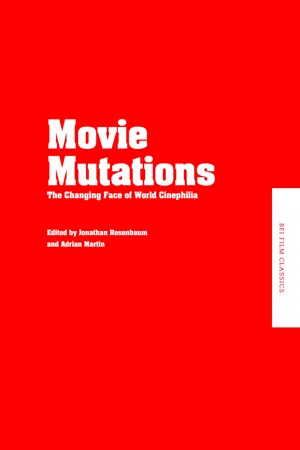
eBook - ePub
Movie Mutations
The Changing Face of World Cinephilia
- 208 pages
- English
- ePUB (mobile friendly)
- Available on iOS & Android
eBook - ePub
Movie Mutations
The Changing Face of World Cinephilia
About this book
The idea of cinephilia is a crucial one for students of the cinema, but it is often associated with a bygone arthouse era. At the beginning of the twenty-first century, corporatism, public relations and bottom-line accounting seem to govern mainstream film-making. Formula-driven Hollywood blockbusters dominate the world marketplace. In times like these can 'the love of cinema' still flourish? In fact contemporary cinema is stunningly varied and rich. From Taiwan and Iran to Brazil and the Baltic states, it is flourishing and constantly mutating. Directors like Abbas Kiarostami, Hou Hsiao-hsien and Tsai Ming-liang are making extraordinary films that are the equal of the great classics, previously unrecognised works from the past are being discovered, and new definitions and boundaries of genres are being formulated. Even when this work is not widely distributed it is seen at film festivals on every continent and available on DVD; and it is being discussed in a proliferating number of print and web publications. Those who follow and share such work, as contributors from around the world demonstrate in this book, are forming new kinds of critical communities that enable significant exchanges between cultures at a time when other forces seem bent on keeping them mutually isolated. In contrast to any talk of 'the death of cinema', Movie Mutations pronounces the art form alive, well, and still developing in new and unforeseen directions. In weaving together transnational discussions and debates, Movie Mutations shows why the idea of cinephilia is just as relevant today as it ever was.
Information
1
Movie Mutations: Letters from (and to) Some Children of 1960
Jonathan Rosenbaum, Adrian Martin, Kent Jones, Alexander Horwath, Nicole Brenez and Raymond Bellour (1997)
Chicago, 7 April 1997
Dear Adrian,
Almost a year has passed since I wrote in Trafic about ‘the taste of a particular generation of cinephiles: an international and mainly unconscious cabal (or, more precisely, confluence) of critics, teachers and programmers, all of whom were born around 1960, have a particular passion for research (bibliographic as well as cinematic), and (here is what may be most distinctive about them) a fascination with the physicality of actors tied to a special interest in the films of John Cassavetes and Philippe Garrel (as well as Jacques Rivette and Maurice Pialat)’.1 I named four members of this generation: Nicole Brenez (France), Alexander Horwath (Austria), Kent Jones (US) and you, Adrian Martin (Australia). Each of you, I should add, I met independently of the other three, originally through correspondence (apart from Kent), although Kent and Alex already knew each other. By now, I’m happy to say, all four of you have become acquainted, either by letters or in person, which has opened up many possibilities of both testing my hypothesis and, even more, of extending, refining, qualifying and better understanding it. I’ve noted, for example, other common enthusiasms among most or all of you, starting with Jean Eustache, Monte Hellman and Abel Ferrara. And differences that usually relate to your (and my) separate nationalities: Kent and I are much cooler towards Brian De Palma than the rest of you, and Nicole is the only one among the five of us not excited by the recent work of Olivier Assayas.
What fascinates me most of all about the ‘confluence’ I was discussing earlier (Nicole objects to ‘cabal’ for what she perceives as its right-wing connotations) is how it came into being. After all, the main message someone of my generation (born in 1943) hears almost daily is that cinephilia as we once knew it is dying; the cinephilia, that is, that took root in the nouvelle vague around the same time that you four were born. In the mainstream American press especially, articles by (among others) Susan Sontag, David Thomson and David Denby about the ‘death of cinema’ and/or cinephilia have become common currency – a position which of course becomes easier to take in a country where not a single film by Hou Hsiao-hsien, Edward Yang, Abbas Kiarostami or Mohsen Makhmalbaf has yet been properly distributed, and where the most important European and (in some cases) American features (such as Dead Man [1995] and Thieves [1996]) are usually acknowledged only in the alternative or underground press.
Though clearly my own tastes are not the same as yours, I still feel that your generation may be the first to have emerged since the 70s that is in rebellion against the amnesia regarding both film and criticism that affects nearly everyone else – which is why it seems relatively easy for me to communicate with all of you. I’m reminded of a beautiful novel of 1936 by my favourite science-fiction writer, Olaf Stapledon, Odd John, about a group of superhuman mutants scattered across the world who gradually come to know one another – in secret, of course, because an open acknowledgment of their special talents would frighten most people and threaten existing institutions.
What seems dangerous to me about your collective sensibility (if I can describe it as such) is a familiarity with the paradigms and master theories of the past combined with a willingness to update and alter them according to current needs. For much too long, spectators of my and Sontag’s generations have been arguing that if you weren’t around in the 60s when Jean-Luc Godard, Michelangelo Antonioni and others were changing the face of cinema, then you can’t be expected to understand what’s lost or missing today. But I would counter that if you don’t understand what morphing is and does – what the alteration of a pixel does to an on-screen event – then you can’t be expected to understand the contemporary relevance (or irrelevance) of André Bazin’s theories about the plan-séquence and deep focus. Moreover, if you fail to understand the changing face of film commerce since the era of Bazin – a subject involving such disparate matters as state funding, corporate ownership, video and publicity – you don’t stand much chance of perceiving contemporary film aesthetics and the formation of canons.
So much for the need for new paradigms and theoretical models. But what were the specific needs of your generation that gave rise to your particular brand of cinephilia? As you indicated when we discussed this in Melbourne last year, the specific lure of minimalism as evidenced in films by Garrel and Chantal Akerman and by Eustache’s The Mother and the Whore (1973) was a historical response to a certain surfeit of intertextual reference that grew out of the nouvelle vague – the sense that every text was to some extent an anthology of cross-references to previous texts, a palimpsest of film history that beyond a certain point became so encoded in its own textual processes that a certain simplification of concerns and affects became desirable. And, as you pointed out, this simplification appeared in different forms: Cassavetes, by stepping outside the usual process of contextuality, was injecting a new version of raw life and lived experience into the cinema, and so in a different way was Garrel. Akerman, whose minimalism derived in part from painting, was clearing away the cobwebs in a different if related fashion, and Hellman, who may have taken some of his cues from the theatre of Samuel Beckett, had his own ways of draining away outdated significations. The process can perhaps be seen most clearly in The Mother and the Whore, where Eustache was deliberately taking some of the most cherished emblems of the nouvelle vague – Jean-Pierre Léaud, extended dialogues in Left Bank cafés, literary aphorisms, black and white cinematography – and showing in his disillusionment how some of that era’s utopian notions of love and freedom could no longer be supported or sustained; how, in fact, they had become a certain camouflage and holding action for blocking despair. (The fact that this also implied a certain defeatism and conservatism, where Catholic bourgeois ‘necessity’ implicitly becomes a kind of biological truth – above all in Françoise Lebrun’s tearful extended monologue – was for me the limiting factor in this enterprise.)
An even clearer illustration of what was happening to cinema during this period can be traced though the career of Jacques Rivette in the early 70s. Two separate versions of the same threshold are crossed – the first roughly halfway through Out 1 (in both its 1971 and 1972 versions), the second between Celine and Julie Go Boating (1974) and Duelle (1976). I realise that you haven’t been able to see these pictures apart from Celine and Julie – such are the vagaries of Australian distribution, not to mention distribution of Rivette’s work in general – so I hope you can bear with my somewhat abstract interpretation of what took place, which in each case involved an emptying-out of meaning. It’s a process that Roland Barthes spoke about with Rivette and Michel Delahaye many years before: ‘The best films [to me] are those which best withhold meaning. To suspend meaning is an extremely difficult task requiring at the same time a very great technique and total intellectual loyalty.’2
Barthes’ model for this delicate operation was Luis Buñuel’s The Exterminating Angel (1962). But it seems to me that an even clearer illustration can be found almost a decade later in the master narrative of Out 1, which begins by accumulating all sorts of meanings – meanings related to conspiracy, to theatre, to all sorts of human interactions and exchanges (including implicitly the accumulation of meanings that clustered around such dreams as those of the nouvelle vague, those of the counterculture and those of May 68 – in short, utopian 60s’ dreams of collective effort) – and then remorselessly records the draining away of those meanings and connections, the gradual splintering of the very idea of collectivity into solitude, unsolvable puzzles, paranoia, madness. Perhaps it’s just another version of the dialectic Rivette (like many other film-makers) experiences between the collective adventure of shooting followed by the more solitary activity of editing, but in this case it provides a mythical and formal model for the artistic and political Zeitgeist of the 60s and 70s themselves, at least in that particular corner of the world.
A related threshold is crossed between Celine and Julie Go Boating and Duelle. The first of these features represents to my mind a final flowering (or is it last gasp?) of the referential aspect of the nouvelle vague, the aspect where Rivette’s previous career as a film critic is most apparent – an explosion of references to Hollywood musicals, Louis Feuillade serials, Alfred Hitchcock thrillers, other films of the nouvelle vague, and so on. All these references are allowed to interact with and enhance particular locations, actresses and actors, everyday moods and details. But in Duelle, which may have just as many references to other films (especially Hollywood noirs like The Seventh Victim [1943], The Big Sleep [1946], The Lady from Shanghai [1948] and Kiss Me Deadly [1955], but also fantasies by Jean Cocteau and Georges Franju), the references no longer connect with material reality in the same manner. The world of the characters seems congealed, under glass, disconnected from the natural locations and to some extent from the actresses and actors as well – a private and more obsessive world populated by the bodies of actors more than their faces or souls.
This, at any rate, is one version of what happened between the nouvelle vague and its aftermath – the version of someone seventeen years older than you who tends to see the nouvelle vague as a kind of nostalgic family homestead that has been levelled for the erection of a high rise. But there are other and I’m sure more fruitful ways of viewing this evolution, and I would be eager to hear yours.
Your pal,
Jonathan
Melbourne, 30 June 1997
Dear Jonathan and Kent,
Although I am technically – it is true – a child of the 60s (born 16 September 1959, the day after Godard completed shooting A bout de souffle), I don’t have the same magical relation to the cinema of that epoch that Jonathan and others of his generation have. As a child who grew up in the 60s – which is a rather more mundane way of putting the situation – my most intense memory of 60s’ cinema as it unfolded was dreaming in perfect clarity and detail, when I was seven years old, several scenes from Planet of the Apes (1968) several months before I knew the film even existed.
Actually, these days, my relation to the 60s finds its precise image in the dream or myth of that decade which I believe animates Assayas’ Irma Vep (1996): a whirlpool of cultural traces, Franju and Serge Gainsbourg and Chris Marker and the nouvelle vague, pulled through some foggy filter of longing and fascination into our confused and desperate present day. As for the tastes that align me with my brothers and sister in this cabal we have going here, I can more truthfully trace that moment of rupture and self-identification to a specific stage of the 70s. It is the time of high theory in full flight and force: Louis Althusser, Jacques Lacan, Christian Metz’s film semiotics, Stephen Heath and the British mob at Screen magazine, the feminist analyses in the first issues of Camera Obscura in America, Wollen and Mulvey’s ‘new talkies’ or essay films dutifully read (and taught) through the template of theory. Plus the various Australian outposts of this loose, broad but powerfully influential movement. I remember this as the era of hard words, of viciously exclusionary intellectual sects, of the ‘necessary destruction of pleasure’ and neo-puritanism, of political correctness before its time and anti-humanism, of signs and meanings, interpretative grids and avant-garde holy grails.
If I caricature this movement now for the purposes of shorthand, I lampooned it even more wildly back then through the sheer force of my angry, peeved passion. The 70s, at least within this circuit that I had to endure in the universities, was not the time or place for a starstruck, buffish cinephile like myself. Nor was it a time for any kind of poetry or lyricism or even simple fun in cinema or its critical writing; there was programmatic work to be done. When I was young and impressionable, I too wrote briefly under the sway of the march of theory, until the day that a wise, kindly friend said to me, ‘Adrian, why don’t you write your articles the way you write your letters?’ And that is, in a sense, what I have tried to write ever since: love letters to the cinema, if we remember to include in our working definition of love every kind of passion and need and exasperation and exacting, critical demand.
I like the way that Nicole Brenez’s survey ‘The Ultimate Journey: Remarks on Contemporary Theory’ politely sidesteps this whole nasty legacy of the 70s and starts its story with the freer, more creative intellectual moves of the 80s: for her, that means Gilles Deleuze, Serge Daney, Jean Louis Schefer . . . and also certain golden oldies skilfully excavated, reread, translated and inserted into the present tense, such as Vachel Lindsay.3 In my part of the world, I felt the need to trace a similar kind of loop: to join Manny Farber, Raymond Durgnat and others from the past to exemplary voyagers of the present like Bill Routt and Stanley Cavell.
But it was cinema itself that really led the way for me in the early to mid 80s. It is hard to recapture, to describe adequately, the overwhelming shock that came with key movie events of that time like Marker’s Sunless (1983), Wim Wenders’ The State of Things (1982), Godard’s Passion (1982), Akerman’s Toute une nuit (1982) and Raul Ruiz’s Hypothesis of the Stolen Painting (1978). Suddenly here were the films playing right outside the maps of 70s’ theory: free, lyrical, tender, poetic films, but also tough, savage, cruel, perverse, sometimes violent; films that were open diagrams, unashamed to link up raw fragments of human (or humanist) experience with the most severe or expansive kinds of experiments with form. These discoveries got drawn into a rich historical loop, too: suddenly I and my friends were seeing afresh the films of Jean Vigo, Humphrey Jennings and especially that unique pre-nouvelle vague figure, Jean Rouch.
Later, my love for an open cinema, for the ideal of a truly open, inclusive and above all impure cinema form, came to be crystallised in my personal discoveries of Cassavetes and Garrel – the single screenings in my home town of Melbourne of Love Streams (1984) in 1985 and Les Baisers de secours (Emergency Kisses, 1989) in 1994 count as primal scenes in my cinephile life. Cassavetes and Garrel stand for one sort of extreme that I love and cherish in cinema: a kind of arte povera fixed on the minute fluctuations of intimate life, on the effervescence of mood and emotion, and the instability of all lived meaning. A cinema which is a kind of documentary event where the energies of bodily performance, of gesture and utterance and movement, collide willy-nilly, in ways not always foreseen or proscribed, with the dynamic, formal, figurative work of shooting, framing, cutting, sound recording. A cinema open to the energies and intensities of life – and perpetually transformed by them.
I have always sought such life-affirming, life-enhancing energies and intensities from cinema. But I am aware that the energies that I like, the energies which feed me, do not come in just one form, from one stream. The arte povera of Cassavetes and Garrel gives me a quiet, clear, minimalist intensity. But I get a different kind of energy, no less necessary for the soul’s survival, from a completely commercial kind of cinema, a cinema of spectacle decri...
Table of contents
- Cover
- Title Page
- Dedication
- Contents
- Acknowledgments.
- Preface
- Notes on Contributors
- 1. Movie Mutations: Letters from (and to) Some Children of 1960
- 2. Open Spaces in Iran: A Conversation with Abbas Kiarostami
- 3. Here and There: The Films of Tsai Ming-liang
- 4. Sampling in Rotterdam
- 5. Two Auteurs: Masumura and Hawks
- 6. Musical Mutations: Before, Beyond and Against Hollywood
- 7. Squaring The Circle
- 8. The Future of Academic Film Study
- 9. On Four Prosaic Formulas Which Might Summarise Hou’s Poetics
- 10. Movies Go Multinational
- 11. Circumatlantic Media Migrations
- 12. Movie Mutations 2: Second Round
- Index
- eCopyright
Trusted by 375,005 students
Access to over 1.5 million titles for a fair monthly price.
Study more efficiently using our study tools.
Frequently asked questions
Yes, you can cancel anytime from the Subscription tab in your account settings on the Perlego website. Your subscription will stay active until the end of your current billing period. Learn how to cancel your subscription
No, books cannot be downloaded as external files, such as PDFs, for use outside of Perlego. However, you can download books within the Perlego app for offline reading on mobile or tablet. Learn how to download books offline
Perlego offers two plans: Essential and Complete
- Essential is ideal for learners and professionals who enjoy exploring a wide range of subjects. Access the Essential Library with 800,000+ trusted titles and best-sellers across business, personal growth, and the humanities. Includes unlimited reading time and Standard Read Aloud voice.
- Complete: Perfect for advanced learners and researchers needing full, unrestricted access. Unlock 1.5M+ books across hundreds of subjects, including academic and specialized titles. The Complete Plan also includes advanced features like Premium Read Aloud and Research Assistant.
We are an online textbook subscription service, where you can get access to an entire online library for less than the price of a single book per month. With over 1.5 million books across 990+ topics, we’ve got you covered! Learn about our mission
Look out for the read-aloud symbol on your next book to see if you can listen to it. The read-aloud tool reads text aloud for you, highlighting the text as it is being read. You can pause it, speed it up and slow it down. Learn more about Read Aloud
Yes! You can use the Perlego app on both iOS and Android devices to read anytime, anywhere — even offline. Perfect for commutes or when you’re on the go.
Please note we cannot support devices running on iOS 13 and Android 7 or earlier. Learn more about using the app
Please note we cannot support devices running on iOS 13 and Android 7 or earlier. Learn more about using the app
Yes, you can access Movie Mutations by Jonathan Rosenbaum, Adrian Martin, Jonathan Rosenbaum,Adrian Martin in PDF and/or ePUB format, as well as other popular books in Media & Performing Arts & Film History & Criticism. We have over 1.5 million books available in our catalogue for you to explore.