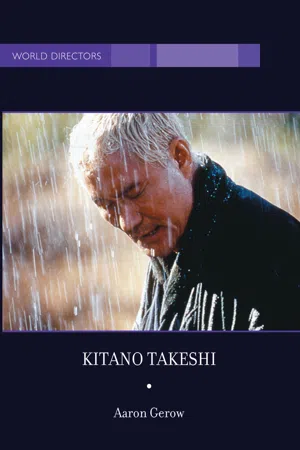
- 272 pages
- English
- ePUB (mobile friendly)
- Available on iOS & Android
eBook - ePub
Kitano Takeshi
About this book
Combining a detailed account of the situation in Japanese film and criticism with unique close analyses of Kitano's films from Violent Cop to Takeshis, the author relates the director to issues of contemporary cinema, Japanese national identity, and globalism.
Information
Edition
1Part I
Kitano Takeshi: The Auteur
Despite statements that Kitano is 'constantly rejecting [his] previous film while making the next one',1 a number of commentators insist that his work evinces the same concerns from Violent Cop in 1989 to Takeshis' in 2005. Even those who focus on Kitano's seemingly constant effort to reinvent himself still identify 'trademark' elements, from themes to stylistic figures, that render them recognisably 'Kitano films'. I want to explore these elements, less in order to confirm their basis in the texts, than to consider the image they create of Kitano and the problems they raise, especially with regard to the relation between the cinematic and the extra-filmic (personal biography, cultural context and politics) and to the politics of style and periodisation, both within Kitano's oeuvre and in Japanese film as a whole.
Between Biography and Fiction
Auteurist accounts of Kitano Takeshi almost always begin with a biographical summary. This is not simply because auteurism often tries to secure the unities of a film corpus in the biographical experiences of the director; nor just because Kitano often claims a biographical basis to episodes in his work. It is because he has made his life a public spectacle. Kitano has repeatedly narrated moments in his life in books like Yes, Takeshi! (Takeshikun, hai!), Asakusa Kid and Kikujiro and Saki (Kikujirō to Saki), which then became popular television shows or movies. His life is seemingly an open book, inviting viewers to connect it with his work on TV and film. Many people have done that, seeing the struggle between Beat Takeshi and Kitano Takeshi as rooted in the conflicts with his parents, Kikujirō and Saki,2 or the style of his humour in his childhood experiences.3 It is commonplace to credit his near-fatal motorbike accident in August 1994 with a shift in his films' thematics.
Such suppositions are not without merit, but we must be wary of grounding Kitano's films in his life. First, because Takeshi's accounts are not always truthful. Biographers have noted discrepancies between his accounts and those of others, especially those of family members.4 Takeshi does not necessarily hide that fact: Kikujiro and Saki, for instance, features both a disclaimer that it is a work of fiction and an afterword by his brother Masaru noting the events that differ from reality. The 'facts' about Takeshi's life should always be taken with a grain of salt. Second, a flesh-and-blood individual and the textual production of that individual are different entities. Tying interpretation to biographical facts rarely produces fruitful analyses of films because it ignores the rich creativity of both textual production and how texts are read. Takeshi appears to recognise this creativity, making the construction of his biography – its self-conscious fictionalisation – and the creation of alternative personalities part of his productive activities. The case of Kitano Takeshi thus demands that we read his biography not in terms of a one-to-one relation between fact and text, but as the formation of multiple personalities. What is important is not what really happened, but what has been constructed of his life and how it operates to shape his image and readings of his films.
Kitano was born on 18 January 1947 in Adachi Ward, Tokyo, to Kitano Kikujirō and his wife Saki. The couple had four children quite varied in age: Shigekazu was nineteen when Takeshi was born, Yasuko (his only sister) twelve and Masaru four. Since their father, who failed at most of his business ventures and worked primarily as a house painter, fulfilled few parental duties (he is often depicted as a violent drunkard), Shigekazu served as a substitute father. Saki, however, backed by Ushi, Kikujirō's aunt who lived with them, had undisputed authority over the children, becoming the epitome of the 'kyōiku mama' (educational mother). Takeshi often complained that she refused the children such entertainments as manga and movies and pushed them to become engineers (that being her image of success). In fact, Shigekazu and Masaru both studied engineering at college, the latter becoming a professor of engineering (as well as occasional TV talent). Takeshi too would enter the engineering faculty at Meiji University, but he became the first to rebel against his mother and dropped out. He spent several years doing odd jobs, including taxi driver and bus boy at a jazz club, but spent much of his time in Shinjuku, which was the centre of 1960s' counterculture. When he became fed up with that life in 1972, he headed to Asakusa to train to be a comedian.
Takeshi is said to have inherited several characteristics from his family, beyond his intelligence. Kitano says that some of the blood of Japan's traditional performing arts flows from Ushi, who performed musume gidayū (a narrative form of song accompanied by a shamisen, a three-stringed instrument);5 Beat Takeshi reportedly inherited his quick wit and fast tongue from Saki; and according to Masaru, all the boys in the Kitano clan developed their father's sense of embarrassment (tere).6 Although a performer known for his loquaciousness, Takeshi in person is shy and repeatedly cites 'embarrassment' as a reason for not doing something in a film.7 Some have even speculated that his predilection for violence stems from his bashfulness.8
Another influential factor was growing up in Adachi Ward. Adachi is part of Tokyo's shitamachi, and not too far from Asakusa. Shitamachi is the 'downtown', populated mostly by lower-class workers and merchants, opposed to the 'uptown' of high-class Yamanote. Shitamachi is often said to possess a distinct culture, one that was popularised by Yamada Yōji's It's Tough to Be a Man (Otoko wa tsurai yo) series featuring Tora-san, an itinerant peddler who wanders the country, occasionally returning to his family in Shibamata in Tokyo. Begun in 1969, the series represented Shibamata as a friendly Gemeinschaft oasis within the modern city. Kitano had long criticised this representation, stating not only that Shibamata was not shitamachi (if Adachi was marginal to shitamachi, Shibamata was the boonies), but that shitamachi was actually harsh, detached and discriminatory.9 Kitano states that far from representing that culture, his films 'are shot from the feeling that I hate shitamachi'.10 Nevertheless, he often says his worldview emerged from Adachi Ward, where yakuza and other socially ostracised figures lived nextdoor. Kitano's family itself may have been a member of such a group.11 This context may be the basis for the marginal and socially underprivileged characters that populate his films: gangsters, the handicapped, the ill, the menial labourers.
More importantly, his stories of childhood in Adachi have become a central source for Takeshi's adult image as a rambunctious, misbehaving child (warugaki). Takeshi's narration of his life mostly elides the process of becoming an adult and focuses on his adolescence and the period he learned comedy. In Yes, Takeshi! and Asakusa Kid, these are eras viewed with sentiment, nostalgia and a certain degree of continuity: even though Asakusa Kid is set in the 1970s, it is a world seemingly left over from the 1950s in Yes, Takeshi!. Some have criticised Takeshi's worldview as being stuck in the 1950s,12 but Beat Takeshi often treads the line between creating a sentimental shitamachi and criticising it. That duality is part of his pranksterism, an aspect of the childishness he located in 1950s' Japan. The childish Takeshi is one of the most attractive aspects of his persona. As one critic put it, Takeshi 'turned his back on life as a "sensible adult" and chose instead to keep on acting like a child. . . . His theory that "owarai [comedy] is like a never ending move [sic: endless motion]" can be interpreted as "Keep being a cheeky, naughty child who plays pranks, then runs off." '13 Beat Takeshi himself stressed that, 'the basis [of my stance] is to not become an adult. I am trying to live with the same sensibility I had when I did bad things in lower and middle school. '14 His primary way of doing that was comedy.
Framing the Clown
When Takeshi decided to end his wandering and become a comedian, it is significant that he chose Asakusa. Asakusa was the entertainment capital of Japan before World War II, the place where Tokyoites went to see a movie or popular theatre, vaudeville and comedy. There was a long, illustrious line of Asakusa comedians starting with Enomoto Ken'ichi before the war and continuing after the war with Hagimoto Kin'ichi, now famous on TV. By the time Takeshi arrived in 1972, however, Asakusa was mostly run down, and so Takeshi counts himself among 'the last generation of the traditional Asakusa comedian'.15 He may have picked Asakusa because of its familiarity, but it may have also matched his class outlook and nostalgic perspective.
The narrative of how he became a comedian is famous. Liking the work of Fukami Senzaburō, he wanted to work under him at the France-za, a club that had long featured comedians between strip shows, including Atsumi Kiyoshi (who played Tora-san) in the 1950s. Takeshi started out as an elevator operator but eventually began appearing on stage in comedy skits. Fukami was an Asakusa comedian in the prewar mould and he made Takeshi learn tap dancing and other arts. He was the only one Takeshi ever called 'teacher' (shishō) and his influence was considerable. As the owner of the France-za wrote,
The special trait of Fukami Senzaburo's skits was to put down and ridicule impudent country bumpkins and people acting like tin gods. When Takeshi became Beat Takeshi, that's the kind of comedy he did too. After Beat Takeshi started becoming popular, Hagimoto Kin'ichi was impressed and remarked, 'He's exactly like Fukami'.16
Fukami's comedy refused to curry favour with spectators and Takeshi mastered the 'technique of dragging the customer down from his position as customer and grabbing a laugh'.17 The philosopher Nibuya Takashi has seen this battle with the audience as fundamental to Kitano's cinema. Customers at the France-za did not pay to see comedy but naked girls; they were drunk and either rejected the comedy or laughed at anything, even what was not a joke. Fukami, and later Takeshi, fought that 'cruelty' with comedic talent (gei), but talent rarely mattered. To Nibuya, this audience later made its way into Kitano's films in the form of an awareness of the 'essential violence' of the audience/camera, which is a 'machine that enjoys taking in what goes on before it with disinterest'. Learning the violence of comedy from Asakusa audiences, Kitano made films that are 'shot against the camera, against the violence itself that is inherent in the camera.'18

The Two Beats: Beat Takeshi and Beat Kiyoshi (Courtesy of The Mainichi Newspapers)

Tsukkomi and boke in Kids Return
Yet just as Takeshi both sentimentalised and rejected shitamachi, he eventually declared that he was not 'from Asakusa', but came to fame 'after kicking Asakusa's butt'.19 He eventually turned his back on Fukami and, on the invitation of another Fukami disciple, Kaneko Jirō, formed a manzai comedy team in 1974 that was eventually called the Two Beats. It was then that Kitano Takeshi assumed the persona Beat Takeshi (with Kaneko becoming Beat Kiyoshi). They first followed the pattern of traditional manzai using gags written by Kiyoshi, but when that didn't sell, Takeshi took over the writing and changed the fundamental form of their manzai. While their gags were often racy and dangerous, they rode to fame on the manzai boom that took place around 1980, becoming national television stars.
Manzai is a dialogic style of Japanese vaudeville comedy that often features two performers: a straight man (tsukkomi) and a funny man (boke). Tsukkomi is the one who represents common sense and wields the words of everyday speech. Boke, on the other hand, neither fol...
Table of contents
- Cover page
- Title Page
- Dedication
- Contents
- Acknowledgments
- Introducing Two Takeshis
- Part I Kitano Takeshi: The Auteur
- Part II Another Kitano Takeshi: The Films
- Notes
- Select Bibliography
- Filmography
- Index
- List of Illustrations
- eCopyright
Trusted by 375,005 students
Access to over 1.5 million titles for a fair monthly price.
Study more efficiently using our study tools.
Frequently asked questions
Yes, you can cancel anytime from the Subscription tab in your account settings on the Perlego website. Your subscription will stay active until the end of your current billing period. Learn how to cancel your subscription
No, books cannot be downloaded as external files, such as PDFs, for use outside of Perlego. However, you can download books within the Perlego app for offline reading on mobile or tablet. Learn how to download books offline
Perlego offers two plans: Essential and Complete
- Essential is ideal for learners and professionals who enjoy exploring a wide range of subjects. Access the Essential Library with 800,000+ trusted titles and best-sellers across business, personal growth, and the humanities. Includes unlimited reading time and Standard Read Aloud voice.
- Complete: Perfect for advanced learners and researchers needing full, unrestricted access. Unlock 1.5M+ books across hundreds of subjects, including academic and specialized titles. The Complete Plan also includes advanced features like Premium Read Aloud and Research Assistant.
We are an online textbook subscription service, where you can get access to an entire online library for less than the price of a single book per month. With over 1.5 million books across 990+ topics, we’ve got you covered! Learn about our mission
Look out for the read-aloud symbol on your next book to see if you can listen to it. The read-aloud tool reads text aloud for you, highlighting the text as it is being read. You can pause it, speed it up and slow it down. Learn more about Read Aloud
Yes! You can use the Perlego app on both iOS and Android devices to read anytime, anywhere — even offline. Perfect for commutes or when you’re on the go.
Please note we cannot support devices running on iOS 13 and Android 7 or earlier. Learn more about using the app
Please note we cannot support devices running on iOS 13 and Android 7 or earlier. Learn more about using the app
Yes, you can access Kitano Takeshi by Aaron Gerow in PDF and/or ePUB format. We have over 1.5 million books available in our catalogue for you to explore.