- 328 pages
- English
- ePUB (mobile friendly)
- Available on iOS & Android
eBook - ePub
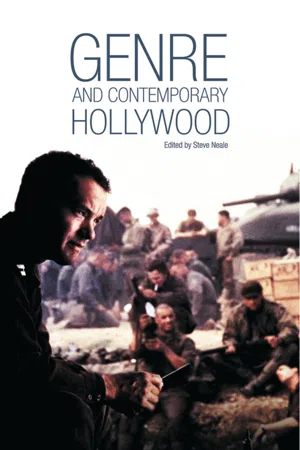
Genre and Contemporary Hollywood
About this book
This wide-ranging text is one of the first to look in detail at some of the principal genres, cycles and trends in Hollywood's output during the last two decades. It includes analysis of such films as Sense and Sensibility, Grifters, The Mask, When Harry Met Sally, Pocahontas, Titanic, Basic Instinct, Coppola's Dracula, and Malcolm X.
Information
1
Introduction
Steve Neale
The topics of genre and of ‘New’ or ‘contemporary’ Hollywood cinema are very much in vogue at the moment. Individual books such as Reconfiguring Film Genres, Film/Genre and Genre and Hollywood have pioneered new ways of thinking about genre, while the series of books launched by Wallflower and Cambridge University Press have sought to provide updated accounts of traditional genres.1 At the same time, an interest in Hollywood and its output since the early 1970s has led to at least one seminal essay, Thomas Schatz’s ‘The New Hollywood’, as well as to Jim Hillier’s book on the subject, a number of industry-oriented histories and two major collections of essays.2
One of the driving forces behind these developments has been the perception of an ever-increasing gap between the accounts of Hollywood and of genre available as starting points for teaching or research on the American film industry and its output since the studio and transitional eras of the 1930s, 1940s, 1950s and 1960s. Tino Balio’s The American Film Industry and Bordwell, Staiger and Thompson’s The Classical Hollywood Cinema were for some time the principal texts on Hollywood’s aesthetic and institutional history, and, while the former covers the history of the American film industry through to the late 1970s, the latter focuses mainly on the period between 1917 and 1960.3 Meanwhile most of the pioneering works on genre, including those by Buscombe, Ryall and Tudor, were written in the late 1960s and early 1970s.4 They therefore inevitably drew for their examples on the films of the studio era or the period of transition in which they were working. Subsequent work on melodrama and the woman’s film also focused on the studio and transitional eras, while overviews such as Genre and Hollywood Genres were either historically non-specific or else concerned, too, with the 1930s, 1940s and 1950s.5
Given the existence of this gap, it is hardly surprising that historians, theorists and and scholars have sought, particularly since the early 1990s, to narrow it. Given the dominance of the studio and transitional eras in accounts of Hollywood and genre alike, it is hardly surprising that they have tended to proceed by means of contrast and comparison, by means of an address to the similarities and differences between the old Hollywood and its genres and the New. This book is no exception. Its contributions are divided into two sections, ‘Tradition and Innovation’ and ‘New Cycles and Trends’. Both contain comparisons and contrasts, but where the former is weighted towards traditional genres and traditional generic categories, paying considerable attention in some cases to old as well as New Hollywood, the latter is weighted towards developments and trends originating in or specifically characterising contemporary Hollywood cinema and its history.
Inflected in varying ways and to varying degrees by recent revisionist work on genre, the contributions to both sections are designed to be exploratory rather than definitive, to open up the topic of genre and contemporary Hollywood from an array of different perspectives rather than provide an overview from a single omniscient position. Genre is itself a multi-faceted phenomenon. Genres can be approached from the point of view of the industry and its infrastructure, from the point of view of their aesthetic traditions, from the point of view of the broader socio-cultural environment upon which they draw and into which they feed, and from the point of view audience understanding and response. Readers will find examples of all these approaches in this book.
The opening contribution to ‘Tradition and Innovation’ is Sheldon Hall’s essay on the blockbuster. Blockbusters are often considered to be one of the defining features of New Hollywood cinema. The placing of Hall’s essay in this section and the argument put forward in the essay itself both suggest, though, that blockbusters are by no means a recent phenomenon. Hollywood has produced high-cost, large-scale films since the mid-1910s. During the 1950s and 1960s, when the term ‘blockbuster’ first came into use, the production of such films was central to the commercial and industrial strategies adopted by major Hollywood companies and mainstream independents alike. However, as Hall points out, there are at least two basic differences between the blockbusters of the studio and transitional periods and the blockbusters of the New Hollywood era. Where the latter are widely and rapidly released in the summer and at Christmas, the former were roadshown – released to select cinemas for long periods at prices and under conditions more akin to the theatre than routine cinema. Thus while an aura of specialness attaches to both, the specialness of the New Hollywood blockbuster is less apparently exclusive. It is also less culturally prestigious. New Hollywood blockbusters, unlike old ones, are principally addressed to the perceived tastes of children, young adults and families. They have therefore drawn heavily on a generic repertoire of science fiction, action and disaster that in the past would have been the province of the B-film, the serial and the programme picture.
A number of the essays that follow in this section focus on genres that have often been central to genre theory. My essay on Westerns and gangster films argues that, while the longstanding traditions of the Western were central, too, to at least one of the principal strands in its re-emergence in the mid-to-late 1980s, the gangster film was much more indebted to The Godfather (1972), Mean Streets (1973) and other films of the 1970s. Rather than interpret developments in either in accordance with the totalising protocols of traditional genre theory, I attempt to chart the diverse cycles and trends that have marked them both and to pinpoint some of the specific contextual factors that have governed their history since the late 1970s.
J. P. Telotte’s essay on musicals and Michael Hammond’s essay on war films both look at traditional genres as well. Telotte’s essay is specifically concerned with the changes that marked a group of late 1970s and early 1980s musicals – Saturday Night Fever (1977), The Buddy Holly Story (1979), Footloose (1984) and others. Running alongside more traditionally oriented films such as Xanadu (1980) and Grease (1978), these ‘new musicals’ were all marked by their focus on the often circumscribed place – and the often circumscribed expressive or transformative possibilities – of song and dance in the worlds they depict. This focus, he argues, is a mark in turn of their attempt to update the inherently ‘escapist’ conventions of the musical and render them more pertinent to contemporary society.
Michael Hammond, meanwhile, looks at the intermittent series of films set in Vietnam or during World War II that Hollywood has produced since the late 1970s. Produced in the wake both of the Vietnam War and the advent of ‘visceral cinema’, these films are often organised, he argues, around traumatic sequences of combat or atrocity the effects of which impact decisively not only on the consciousness and behaviour of the characters, but also on spectators and on the ways in which the films and the wars they depict are ‘memorialised’.
One of the most important developments in work on genre in the late 1970s and 1980s was a feminist-led focus on the woman’s film. As Karen Hollinger’s essay indicates, questions have been raised recently both about the provenance and the institutional existence of the woman’s film. In addressing the extent to which the traditional ingredients and approach of the woman’s film have their parallels in the 1970s, 1980s and 1990s, Hollinger identifies such cycles and strands as ‘the independent woman film’, ‘the female friendship film’ and ‘the new maternal melodrama’. Ranging widely across the independent sector as well as Hollywood itself, she also pinpoints ‘classic adaptations’ as an increasingly important site of and for female writers, directors and audiences. However transformed its ingedients have been, and however diverse its strands have become, it is clear that, although the woman’s film disappeared almost entirely in the late 1960s and early 1970s, it has returned in numerous guises since then.
In contrast to the woman’s film, the biopic has been somewhat neglected in writing on genre and Hollywood. Taking their cue from George F. Custen’s book on the biopics,6 Carolyn Anderson and Jon Lupo note the extent to which the biopic has remained a staple ingredient in Hollywood’s output since the 1970s, the degree to which it has been associated with directors such as Oliver Stone, actors such as Denzel Washington and other genres such as the musical, the Western and sports film, and the degree to which, too, it has for all its fixed formulae sought to accommodate both people of colour as subjects and occasional experiments in form and approach. Like Hollinger, Anderson and Lupo take account of the independent sector. They also pinpoint some of the ways in which biopics have been marketed and note the extent to which they have been commercially successful.
Frank Krutnik and Andrew Tudor look at romantic comedy and horror, respectively, and William Paul at comedy in general. Tudor considers the extent to which ‘postmodernism’ as a concept can be used to describe or account for the characteristics of horror series and films since the mid-1980s. Pointing out first of all that series, sequels and cycles have characterised horror production since the 1930s (and therefore that ‘franchises’ as such are nothing new), Tudor goes on to argue that an awareness of ‘sequelling’ is nevertheless now a major convention. He also notes the degree to which ‘comedy-horror’ is now ubiquitous and the extent as well to which what he calls ‘paranoid horror’ remains horror’s dominant mode. Sceptical as to the explanatory value of postmodernism, Tudor argues that these and many of the other social, cultural and stylistics features associated with it are in fact ‘products of modernity itself’.
William Paul provides on overview of various strands of comedy in the New Hollywood era. These include ‘animal comedy’, which he sees as a specific form of slapstick, the ‘comedian comedy’ of Bill Murray, Eddie Murphy and Jim Carrey, domestic comedy (a long-neglected area) and romantic comedy, which in an era of change and uncertainty always tends to set romance ‘in the quotation marks of self-referentiality or simply be impossible’. Frank Krutnik focuses on romantic comedy in more detail. Following a survey of dominant trends, he considers the various ways in which the films themselves have usually sought to reconcile traditional ideas and ideals of love with contemporary life and society, contemporary gender politics and contemporary sexual culture. In doing so, he suggests that what marks them is a self-consciousness deployment of generic and romantic conventions on the one hand, and a ‘passionate conformism’ on the other.
In concluding Section One, Roberta Pearson’s essay on Shakespearean cinema discusses films such as Romeo + Juliet (1996), Richard III (1995) and Shakespeare in Love (1998) in terms of a tradition of commercial Shakespearean production and adaptation that stretches back to the 1890s. Looking at such topics as spectacle, language and star-power, and at longstanding debates about commercialism and cultural value, Pearson suggests that what is new about the most recent New Hollywood films is their deployment of ‘a dense popular culture intertextuality’. This intertextuality could, of course, be labelled postmodern; however, as is clear from Tudor’s, from Krutnik’s and from my own contribution, there are times when what has now become the master discourse of postmodernism can confuse rather than clarify the issues at stake.
The developments dealt with in Section Two are of various kinds, but overall the focus here is less on longstanding generic traditions than on specific cycles and trends. The terms ‘trend’ and ‘production trend’ have in recent years figured prominently as alternatives or additions to ‘genre’ as means by which to chart the different strands in Hollywood’s output. They were first used extensively in Grand Design, Tino Balio’s contribution to Scribner’s multi-volume history of the American cinema.7 Balio here combines the use of these terms with box-office figures and contemporary reviews in order to identify the principal strands in Hollywood’s output in the 1990s. Among them he considers ‘disaster’, ‘science fiction’, ‘horror’, ‘action’ and ‘drama’. In these trends, as in others such as ‘animation’ and ‘comedy’, he notes that the biggest box-office hits have nearly always been films with an appeal to teenagers, children and families. He underlines as well, in his conclusion, the extent to which Disney as a company and Steven Spielberg as an individual have been consistently successful in this field.
Similar points inform Peter Krämer’s essay on children’s films and the family audience. His argument is that Disney’s family-oriented films and family-oriented ethos were central not just to the films and the figures who helped establish the New Hollywood in the mid-1970s and early 1980s, but also to Hollywood’s dominant commercial stategies since then. Following experiments with markedly ‘adult’ films in wake of the introduction of a ratings system in 1968, Hollywood turned to the family audience and to child-friendly films as its biggest and most stable source of income. In doing so, he suggests, its most successful films now parallel those made under the aegis of the Production Code in the 1930s and 1940s in that they are aimed at or can be enjoyed by an inclusive audience of teenagers, adults and children.
Ratings figure, too, in Kevin Sandler’s essay and, teenagers in the essay by Steve Bailey and James Hay. Sandler’s starting points are the discussion of ‘ratings as genre’ in Rick Altman’s influential Film/Genre and the persistent if numerically minor strand in Hollywood’s output since the 1970s which has continued to court adult audiences through the inclusion of erotic or violent themes. As adults-only ratings severely restrict the opportunities for distribution, exhibition and profits, the key for these films and their producers has been to qualify for what Sandler calls an ‘Incontestable R’, a ‘respectable’ rating which bars children, but which includes older teenagers. Through a series of case studies, he demonstrates the extent to which this rating has functioned since the late 1970s as a blueprint, a label, a set of representational conventations – and hence as a genre.
Bailey and Hay focus not on adult but on teen films. Rather than look at the transformations in convention or at the fluctuations in output that have marked them since the 1950s, however, they consider the ways in which teenagers and the teen film intersect with one another in terms of a series of spaces or sites (notably the home, the school and the shopping mall) and of a capacity to inhabit and move between them as part of a process of socialisation. Ranging widely across a broad array of films, Bailey and Hay offer a distinctive and thought-provoking perspective not just on teen films, but also on the ways in which cinema and its genres play a part in ...
Table of contents
- Cover
- Title Page
- Contents
- 1. Introduction
- Section One: Genre: Tradition and Innovation
- Section Two: Genre: New Cycles and Trends
- Index
- eCopyright
Trusted by 375,005 students
Access to over 1.5 million titles for a fair monthly price.
Study more efficiently using our study tools.
Frequently asked questions
Yes, you can cancel anytime from the Subscription tab in your account settings on the Perlego website. Your subscription will stay active until the end of your current billing period. Learn how to cancel your subscription
No, books cannot be downloaded as external files, such as PDFs, for use outside of Perlego. However, you can download books within the Perlego app for offline reading on mobile or tablet. Learn how to download books offline
Perlego offers two plans: Essential and Complete
- Essential is ideal for learners and professionals who enjoy exploring a wide range of subjects. Access the Essential Library with 800,000+ trusted titles and best-sellers across business, personal growth, and the humanities. Includes unlimited reading time and Standard Read Aloud voice.
- Complete: Perfect for advanced learners and researchers needing full, unrestricted access. Unlock 1.5M+ books across hundreds of subjects, including academic and specialized titles. The Complete Plan also includes advanced features like Premium Read Aloud and Research Assistant.
We are an online textbook subscription service, where you can get access to an entire online library for less than the price of a single book per month. With over 1.5 million books across 990+ topics, we’ve got you covered! Learn about our mission
Look out for the read-aloud symbol on your next book to see if you can listen to it. The read-aloud tool reads text aloud for you, highlighting the text as it is being read. You can pause it, speed it up and slow it down. Learn more about Read Aloud
Yes! You can use the Perlego app on both iOS and Android devices to read anytime, anywhere — even offline. Perfect for commutes or when you’re on the go.
Please note we cannot support devices running on iOS 13 and Android 7 or earlier. Learn more about using the app
Please note we cannot support devices running on iOS 13 and Android 7 or earlier. Learn more about using the app
Yes, you can access Genre and Contemporary Hollywood by Steve Neale in PDF and/or ePUB format, as well as other popular books in Media & Performing Arts & Film History & Criticism. We have over 1.5 million books available in our catalogue for you to explore.