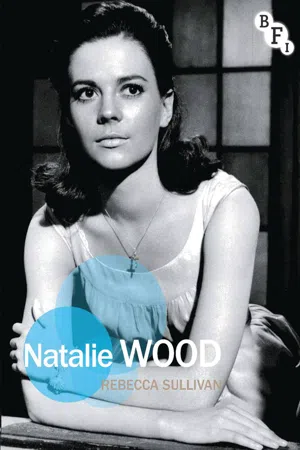
Throughout her career, Natalie Wood teetered precariously on the edge of greatness. Trained in the classical Hollywood studio style, but best mentored by Method directors, Wood was the ideal actress for roles depicting shifting perceptions of American womanhood. Nonetheless, while many of her films are considered classics of mid-twentieth century American cinema, she is less remembered for her acting than she is for her mysterious and tragic death.
Rebecca Sullivan's lucid and engaging study of Natalie Wood's career sheds new light on her enormous, albeit uneven, contributions to American cinema. This persuasive text argues for renewed appreciation of Natalie Wood by situating her enigmatic performances in the context of a transforming star industry and revolutionary, post-war sexual politics.
- 160 pages
- English
- ePUB (mobile friendly)
- Available on iOS & Android
eBook - ePub
Natalie Wood
About this book
Information
Edition
11 THE CHILD-WOMAN
It is a Hollywood truism that child stars can rarely transition to adult careers and are stranded in a netherworld where a ‘normal life’ can never be found (O’Connor 2008, 2). Natalie Wood is just one example of a juvenile performer who resists this cultural trope and thus demands more nuanced analysis of the cinematic child. Debuting in Hollywood in 1946, she was among the last of a generation of child actors to be fully immersed in the studio system. As Dick Moore, a former child star, recalls,
The 1930s and 1940s in America were a throwback to the Dickensian era a century earlier, when children were perceived as little adults. Important to Hollywood’s economy and the public’s need for escape, each of us was a representation, a cliché (1984a, ix).
By the end of World War II, however, as prosperity and stability returned to America, the escapist fantasy offered by such Depression-era darlings as Shirley Temple was tempered by more topical fare that invoked New Deal aspirations around childhood and the future of the nation. Wood featured in many such films that recast childhood as a collective project of nation-building. In the decade that encompassed her debut cameo in Irving Pichel’s Happy Land (1943), at the age of five, through to 1952, when her career temporarily transitioned to television, Wood appeared in eighteen features, thirteen of which were filmed between 1946–50. Granted, many of the films from Wood’s childhood career are forgettable, and she was never expected to carry a film as its lead star. She was most often cast as the kid sister or precocious surrogate daughter, there to provide adorableness and comic relief.
Wood’s acting success as a child was based on her ability to play a ‘no-frills’ child, unbedecked by ribbons, ringlets or ruffles. In plain clothes and severe braids, Wood seemed almost excessively average but for one feature: her large brown eyes. Always small for her age, Wood’s tiny frame barely took up any space on screen while her thin, high voice was easily drowned out by the declamatory vocal style of co-stars like Orson Welles, Maureen O’Hara and Walter Brennan. So she learned at an early age how to use her most distinctive feature to divert attention from her adult co-stars and overwhelm the screen with emotion. In Tomorrow Is Forever, Wood plays an Austrian war orphan brought to America by her guardian, a physically and psychologically scarred veteran played by Welles. In her best-known feature, Miracle on 34th Street, she plays Susan Walker, the sceptical daughter of a bitter divorcée who, with the help of a fatherly neighbour and Santa Claus, learns how to be a child. Finally, in The Green Promise, an independently financed piece of propaganda for postwar agricultural policy, she plays the youngest child of a farming family, who defies her stubborn libertarian father and becomes a member of the 4-H Club, a rural youth achievement organisation operated by the Department of Agriculture.
When stars like Jackie Coogan, Shirley Temple and the Our Gang children ruled the box office, the child actor was a fantastical figure almost completely unmoored from family life, whose interactions with adults were as an equal. A child star was expected to exude a complex combination of self-reliance and vulnerability through spectacular displays of idealised adorability (Balcerzak 2005, 54). They were often positioned as happy-go-lucky orphans pluckily navigating their way through life almost completely alone. Such behaviour fit neatly with the escapist fantasy Hollywood propagated to distract the nation from the hardships resulting from economic depression and war. By the mid-forties, children in cinema still served as symbols of good citizenship and national pride, but they relayed this less through spectacle and more squarely within the narrative conflicts of the plot as spirited but duty-bound children. Natalie Wood’s career begins at the same time as this transition.
In her early films, Wood hints at a kind of child-woman character in which the young girl possesses such emotional and intellectual maturity that, if not guided carefully, could lead to either greatness or destruction – of society as much as the self. Children were the objects of increased state and medical scrutiny as the government sought to build what Beth Bailey calls ‘a national system of culture’: a set of public strictures and expectations for the conduct of private life, including marriage, family and child care (1988, 7). Hollywood was firmly entrenched in this process, offering aspirational and indexical templates of what childhood could mean for the nation (O’Connor 2008, 3). In other words, Hollywood presupposed an imaginary of the child that legitimated the adult world (Lury 2010, 10). Building a nation around visions of prosperity, productivity and domestic stability altered conceptions of childhood from the Dickensian waif to a more socially aware child who could shepherd the traditional family into modern life (Sammond 2005, 193).
The story of how Wood became an actor mingles exemplary darlingness with technical proficiency and Old World quaintness. How much of it is true is not as important as how often the tale was repeated. In 1943, while visiting a film set on location in Santa Rosa, five-year-old Natasha Gurdin walked up to the director, Irving Pichel, climbed up on his lap and began to sing him a song. Enchanted, he gave her an uncredited scene at the beginning of the film. He also apparently asked her parents if he could adopt her and implored them to never ‘spoil’ the child by bringing her to Hollywood. Neither request was granted. The less charitable version of this story has Wood’s mother, Maria Gurdin, an imperious Russian immigrant who passed herself off as a relative of the Romanoffs, rehearsing Wood’s effort to seduce the director, teaching her an old-fashioned curtsey and training her how exactly to perform this act of childlike cuteness without annoying the adult with any un-cute childish behaviour. When the family uprooted to Hollywood in 1944, Gurdin pestered Pichel to give her daughter a screen test for his next film, the wartime melodrama Tomorrow Is Forever. The first attempt, at which the five-year-old was expected to cry on cue, was a disaster. Mindful of her obligation to be polite, poised and charming at all times, she simply refused to misbehave by crying in front of an adult. Upon discovering this, her mother was beside herself and badgered Pichel for a retake. It was then that Wood received her first acting lesson, from her sister Olga, who was herself studying Stanislavsky at drama classes. She recommended recalling a sad event, such as when she was younger and saw her dog get run over and killed by a car. With that image firmly planted, Wood sobbed so wretchedly that the director was delighted and her career was launched (Lambert 2004, 30; Moore 1984a, 21). Suzanne Finstad proposes a less charitable version of this story, claiming that her mother ripped a butterfly apart before the horrified child’s eyes, invoking the hysteria and ensuring that Wood would never disobey a director again (2001, 38).
Later in life, Wood recalled, ‘From that time on [after the screen test], whenever I did a movie, I always counted the crying scenes. That was a barometer of how difficult the part was going to be for me’ (Moore 1984a, 22). It also became a hallmark of her acting. Wood was barely five feet tall and less than one hundred pounds as an adult. She lacked any real singing or dancing talent. While actors such as Shirley Temple are remembered for their bouncy hair, chubby legs and dimpled smile, Wood is remembered for her static unremarkableness, and her tears. As the powerful columnist Hedda Hopper recalled, She wore Levi’s and sweaters, and stood out from other screen tots, many of them bleached, permamented, and beruffled. On screen she has a direct and simple approach, and she could cry in a way that tore your heart (Hopper 1955, 22).
In Tomorrow Is Forever, Wood has six important scenes and sobs passionately in two of them. Playing against the towering Orson Welles, it is no insignificant feat that the tiny child of five is able to maintain her presence on screen as the war orphan Margaret Ludwig. This stock weepie is a vehicle for Claudette Colbert. She plays a woman with an infant son who is widowed during World War I. She remarries a wealthy industrialist who raises her son as his own. When war breaks out again, her first husband returns in disguise as a badly disfigured Austrian scientist with a young orphan, the child of the doctor who saved his life. Eventually Elizabeth (Colbert) realises that Erich Kessler (Welles) is in fact her husband John but not before he convinces her to put aside her own fears and allow their son to join the army. When she visits his home to thank him for releasing her from her haunted past, she discovers that he has died in the night and she takes the young girl home to be raised as her own daughter.
Pichel commented on Wood’s ability to remain both childlike and suggest the woman-to-be underneath in the film. He said she possessed ‘the sensitivity, the temperament, the understanding of that cross between child and adult – the actress’ (Finstad 2001, 44). Such a definition presumes that a girl’s maturity depends on her ability to sublimate deep psychological angst into an appropriately feminine sense of familial and national duty. Wood’s Margaret certainly represents an idealised child, traumatised by geopolitical atrocities but not so badly that she cannot be a good and willing helper to the adults around her. Throughout the film, Wood uses her eyes to project a complex array of emotions. They could suddenly well up in a frenzy of tears, and just as quickly those tears would disappear and be replaced with a fixed stare indicating a host of repressed emotions. In an early scene introducing her character, she stands with Kessler waiting to have their immigration approved. He drops his hat and she quietly bends down to pick it up and hand it back to him before reclasping his hand, all without breaking her gaze. It is a superb piece of actorly business, so small is she in the frame, behind a large desk and beside a bear of a man, yet because of her eyes, all attention becomes focused on her. Later in the film, Margaret is frightened by the sound of a firecracker and begins to sob hysterically. Her guardian takes her on his knee and gives a speech – half to her, half to his son who does not know his identity but all for the audience’s edification – about how she is the future of society and therefore must always be brave and do good work. With one gulp the tears stop and she apologises gravely for her outburst.
With Wood in the role, Margaret’s relationship with Kessler hints at a more ambiguous (and fraught) sexuality than would be possible for the spectacularly white and innocent Shirley Temple. She is more wife and nursemaid than daughter, caring for Kessler and sublimating her own fears. This adult–child dynamic is typical in many postwar films where the young girl takes on a platonic heterosexual romance role with a strong, patriarchal surrogate. It is not the same as a Lolita-type relationship, but something far more complex (and maybe even more disturbing than the explicitly immoral sexuality of Nabokov’s creation). The surrogate father does not secretly desire the child sexually as much as he prepares her for her sexual future as a wife and mother (Lury 2010, 57). In the immediate aftermath of World War II, that future was the foundation of a new social unit, the efficient, civic-minded nuclear family (Moran 2000, 133). Yet the traumas of world wars were far from over, and Wood’s role as a war orphan compromises her status as innocent child. Safe from the ravages of war, Margaret’s struggle comes from within, signified by her eyes. Her moments of tears are also moments when she must realise her responsibility to future generations and sublimate any psychic darkness back into acceptable levels of desirability and maturity. It is not surprising, then, that one of the first movie fan-magazine tributes to the little actress, released even before Tomorrow Is Forever debuted, called her a ‘Six-Year-Old Siren’ (in Finstad 2001, 45). This darkness-infused sublimated sexuality is an aspect of Wood’s stardom that helped her progress into adult roles and is discussed in greater detail in Chapter 3.

Natalie Wood and Orson Welles in Tomorrow Is Forever (1946) (RKO/Photofest)
Tomorrow Is Forever opened to solid reviews and strong box office. Her next film, also for Pichel, was the forgettable romp The Bride Wore Boots (1946). Although the film failed to capture an audience, Wood’s reputation as a dutiful, pliant actress brought her to the attention of Twentieth Century-Fox, who signed her to a seven-year contract in 1947 after she appeared in two of their prestige films. She played Gene Tierney’s young daughter Anna in The Ghost and Mrs. Muir (1947), a small and largely insignificant performance especially since the most important scene for the daughter is played by another actress as the grown-up Anna. At the same time as shooting that film in California, she was also on set in New York for Miracle on 34th Street. In it she plays Susan Walker, the sombre and precocious child of Doris, a divorced career woman played by Maureen O’Hara. Doris works in the promotional department at Macy’s and they live in a highrise apartment in Manhattan where a handsome and kindly neighbour ingratiates himself into their lives with the help of a jolly soul by the name of Kris Kringle (Edmund Gwynn). Raised to reject fairytales, imagination and Santa Claus, Susan only agrees to let herself be a child if her one wish is granted: a Cape Cod home in Long Island. Together the smitten neighbour, Fred Gailey (John Payne), and Kris Kringle conspire to teach mother and child how to perform their feminine roles correctly, and thus be rewarded with the American Dream.
There is no crying in Miracle on 34th Street. Instead, Wood’s performance depends on her sceptical gaze on the adults surrounding her as they debate what’s right for a child until ultimately her cynicism gives way to boundless joy and the return of innocence. Thus, several pivotal scenes hinge on close-ups of Wood. At Macy’s, Fred takes Susan to see Kris – working as the department store Santa – against Doris’s wishes. Susan is nonplussed and looks unnervingly at the ‘silly’ adults. But her icy stare turns to astonishment when she witnesses Kris speaking Dutch to an orphan refugee, a little girl who looks a bit like Susan herself. As the camera jumps back and forth between the happy duo and a silent Susan lurking nearby, it is evident that the scepticism has all but disappeared and the little girl is ready to believe. It is now up to the mother to prove once again that there is no Santa Claus, no magic wishes and no fairytale endings – especially for girls. Her bitterness causes Kris to conspire with Fred, ‘Those two are a couple of lost souls. It’s up to us to help them.’

Natalie Wood and Edmund Gwynn in Miracle on 34th Street (1947) (20th Century Fox/Photofest)
Both men begin their self-assigned task by focusing on Susan. Kris decides to teach Susan how to play like a child by encouraging her to pretend to be a monkey. As in the department store, Susan moves from scepticism to wonder as she awkwardly starts prancing around the room scratching and grunting. The stilted and not quite successful attempt is more evidence of her natural rather than spectacular charm. One can hardly imagine Shirley Temple not instantly springing to life and executing the most dazzlingly perfect monkey imaginable. Susan then entrusts Kris with her secret dream to move out of their apartment and live in a real house ‘with a great big tree to put a swing on’ in the backyard. She lies still in bed with the covers up over her with her face in close-up. As her voice rises excitedly when she describes her dream home, her eyes widen and dart about, eyelashes fluttering. After Kris tucks her in, the film lingers on Susan as she practises blowing bubbles and snapping her gum, again revealing her natural instincts to be a child, which have been repressed by the unnatural environment provided by her mother.
Later that night, Fred confesses his own wish for a house, ‘Not a big place, just one of those junior partner deals around Manhasset’, a bedroom community on the North Shore of Long Island that to this day is considered a haven for young families. The film concludes with them all in a car, lost in Long Island, when they suddenly find themselves in front of the exact same house that Susan had shown Kris. At this instance she is finally a child, scampering around the house, calling her mother ‘Mommy’, and racing out to the backyard to try the swing. Fred realises that Doris does love him and they decide to buy the house. This conclusion, a real-estate transaction, not an actual marriage proposal, speaks to the importance of the suburbs in the postwar American imagination (Harris 2007). It also makes the fact that the child in the film is a girl all the more significant. Only a girl could be satisfied with a retreat to the suburbs. Furthermore, the kind of actor who can make this transformation believable cannot be known for her ‘spectacularness’. She must be ordinary and childlike in order to fit into this environment. Of course, the suburbs were far from natural, being carefully planned as a buffer between the competing ideals of modern, progressive urbanism and tradi...
Table of contents
- Cover
- Title Page
- Contents
- Acknowledgments
- Introduction
- 1. The Child-Woman
- 2. The Sexual Hysteric
- 3. Racial and Sexual Ambiguity
- 4. A Sexual Libertine in the Suburbs
- Conclusion: The Eternal Ingenue
- Bibliography
- Filmography
- Index
- eCopyright
Trusted by 375,005 students
Access to over 1.5 million titles for a fair monthly price.
Study more efficiently using our study tools.
Frequently asked questions
Yes, you can cancel anytime from the Subscription tab in your account settings on the Perlego website. Your subscription will stay active until the end of your current billing period. Learn how to cancel your subscription
No, books cannot be downloaded as external files, such as PDFs, for use outside of Perlego. However, you can download books within the Perlego app for offline reading on mobile or tablet. Learn how to download books offline
We are an online textbook subscription service, where you can get access to an entire online library for less than the price of a single book per month. With over 1.5 million books across 990+ topics, we’ve got you covered! Learn about our mission
Look out for the read-aloud symbol on your next book to see if you can listen to it. The read-aloud tool reads text aloud for you, highlighting the text as it is being read. You can pause it, speed it up and slow it down. Learn more about Read Aloud
Yes! You can use the Perlego app on both iOS and Android devices to read anytime, anywhere — even offline. Perfect for commutes or when you’re on the go.
Please note we cannot support devices running on iOS 13 and Android 7 or earlier. Learn more about using the app
Please note we cannot support devices running on iOS 13 and Android 7 or earlier. Learn more about using the app
Yes, you can access Natalie Wood by Rebecca Sullivan in PDF and/or ePUB format. We have over 1.5 million books available in our catalogue for you to explore.