
eBook - ePub
The Cinema of Michael Powell
International perspectives on an English Filmmaker
- 303 pages
- English
- ePUB (mobile friendly)
- Available on iOS & Android
eBook - ePub
The Cinema of Michael Powell
International perspectives on an English Filmmaker
About this book
The films of Michael Powell (1905-90) and Emeric Pressburger (1902-88), among them I Know Where I'm Going! (1945), A Matter of Life and Death (1947) and The Red Shoes (1948), are landmarks in British cinema, standing apart from the realist and comic mainstream with their highly stylised aesthetic and their themes of romantic longing and spiritual crisis. Powell and Pressburger are revered by film lovers and film-makers (Martin Scorsese has called them 'the most successful experimental film-makers in the world'). In this first-ever collection of essays on Powell, an international group of critics and scholars map out his film-making skills, providing new readings of individual films, analysing recurrent techniques and themes, and relating them to contemporary debates about gender, sexuality, nationality and cinematic spectacle. Powell, with and without Pressburger, emerges as a film-maker of lasting originality and significance.
Information
5‘History Is Now and England’: A Canterbury Tale in its Contexts
Ian Christie
‘Tell them all the tale, Sir Richard,’ says Puck, ‘It concerns their land somewhat.’
Rudyard Kipling, Puck of Pook’s Hill (1906)
There is such a thing as the English vision, and war, luckily, is only one stimulus that affects it.
John Piper, 19441
A Canterbury Tale reached the late 20th century like a time capsule. Thirty years after its making, the film was virtually unknown and could only be viewed in a shortened and rearranged version, apparently intended for the American market. Then, after being restored to its original length and structure in 1977, it began a rapid ascent to classic status – recognised as a key representation of the Second World War home front, and also as an important expression of Neo-Romanticism or the Romantic Right, within a renewed interest in the history of ‘Englishness’. Under these headings, it has already attracted at least five substantial readings, all of which offer different degrees of sympathetic contextualisation.2 But the question this essay poses is: can we go further in showing how the film draws on certain quite specific contemporary sources and offers its own inflection of these? Is it a film even more rooted in the propaganda and ideological themes of 1943–4 than has already been demonstrated, as well as belonging to the long tradition of the ‘Canterbury text’, and how do these considerations affect our continued reading of it today?
PROPAGANDA
The most obvious context in which to locate A Canterbury Tale is as a propaganda film, which is clearly how it was in large part first conceived and received. In his memoirs, Powell placed it in a logical series that had begun with 49th Parallel, which ‘told the Americans we were fighting their war as well as ours’.3 After Pearl Harbor, the issues became more complex and various. Powell describes the propaganda aims of One of Our Aircraft Is Missing and The Life and Death of Colonel Blimp as telling the world that Europe and Britain respectively ‘would never be conquered’. In this vein, A Canterbury Tale was to explain ‘to the Americans, and to our own people, the spiritual values and traditions we were fighting for’.
However Powell and Pressburger may have interpreted them, the issues canvassed for attention by the Ministry of Information in 1943 were more mundane, and more pressing. After America’s entry into the war in 1941, growing numbers of service personnel were stationed in Britain. From fewer than 5,000 at the beginning of 1942, the total rose rapidly to just under a quarter of a million in October, and, after a slight dip in mid-1943, rose again to 1.5 million in Spring 1944.4 (Shooting began on A Canterbury Tale in August 1943 and was trade shown in May 1944, then presumably held over on account of the D-Day landings of June, before being released in August). The problem that had emerged early in 1942 was how to counteract poor relations between the incoming US service personnel and the British civilian population, which is certainly where A Canterbury Tale started from.
Popular legend has identified the problem as essentially sexual, with American troops seemingly ‘over-sexed’ and English women over-impressed by their attentions. In reality, there were a number of factors simultaneously at work, starting with the reality that American troops were considerably better fed and paid than their British counterparts, and so able to afford much more when ‘on pass’. Added to this were very different attitudes to dating, and resentment at American personnel being forcibly billeted with British families between late 1943 and D-Day.5 Relations between GIs and local civilians simmered throughout 1942 to 1944, with many skirmishes remaining unreported under a general newspaper agreement, until the Daily Mirror ‘invited Britons and American to voice their mutual grievances’ at the end of 1943.6

Yanks in Britain: American soldiers fraternise with locals, after warnings about how to behave in pubs, during the US ‘invasion’ of 1943–4.
Behind the scenes, both British and American authorities were active in trying to understand and improve this largely unforeseen problem. The contributions of many experts were sought, including the poet Louis MacNeice, whose pamphlet Meet the U.S. Army was widely distributed in July 1943, and the anthropologist Margaret Mead. Best known for her work on social customs in the South Seas, Mead was commissioned by the US and British armies to distil her first-hand observations during 1943 into an article, ‘The Yank in Britain’, which analysed differences of attitude towards social interaction. Mead proposed a theory of mismatched ‘dating patterns’. According to this, Americans understood dating as a game or social ritual, rather than a prelude to a personal relationship. Successful dates, on this pattern, involved the man asking for everything and getting nothing ‘except a lot of skilful, gay witty words’.7 As British women were unfamiliar with these rules, they were either shocked, or produced shock by their acquiescence. One important underlying factor was the educational, as well as the material, disparity: 79 per cent of Americans reaching Britain had more than eight years of schooling, compared with only 17 per cent of the local population.
Against this background, The Archers’ strategy in A Canterbury Tale had to be ingenious to avoid cliché, while also relating to contemporary common knowledge. Without some eccentricity, it could easily have ‘turned into a self-praising documentary’, as Powell later admitted.8 However, its basic template is clearly that established by many orientation guides for GIs, and dramatised in a contemporary film that was widely shown. Welcome to Britain was made by the Ministry of Information in 1943 and featured the American stage and screen actor Burgess Meredith showing Americans what they could expect in Britain, including the usual warnings about behaviour in pubs, and the pitfalls of accepting hospitality from Britons. 9 According to John Sweet, the serving US soldier who eventually played Sgt Bob Johnson in A Canterbury Tale, Powell and Pressburger hoped at one stage that Burgess Meredith would play the part, and he reworked the character who had been written as ‘something of a wise guy’.10 In fact, the opening confusion of A Canterbury Tale, when blackout and country railway station customs conspire to leave Sgt. Johnson one stop short of Canterbury, recalls the comic-didactic tone of Welcome to Britain. And Bob’s subsequent adventures recall the three stages of GI acclimatisation identified by a Canadian adviser to the British government in 1943:
[first] the antiquities, old cottage, sight-seeing stage (a period dominated by garrulous guides); [then] the anti-coffee, anti-climate, anti-slowness stage (a longer period punctuated with rude encounters in trains and buses); and finally the adjusted stage when friendships begin to form.11
The Archers’ GI protagonist, Bob Johnson, is the least brash imaginable: a softly spoken country boy from Oregon with an interest in antiquities, while his friend Sgt Micky Roczinsky, seen only briefly at the end, embodies all the stereotypical attitudes of GI good-time behaviour (like the raucous US aircrew who treat heaven like a hotel in A Matter of Life and Death).
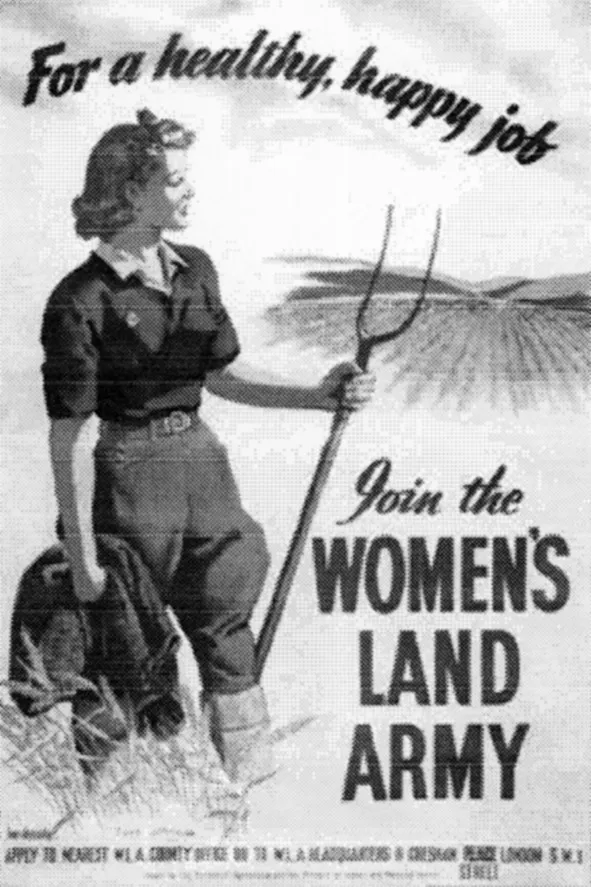
But Bob is not the only protagonist of A Canterbury Tale, and the ‘GI story’ is not its only underpinning. Alison Smith, whom he meets at Chillingbourne station, belongs to another ‘army’, the Women’s Land Army, revived in mid-1939 to provide an alternative source of agricultural labour when men were called up for the services.12 By 1943 there were over 50,000 women filling jobs previously done by men around the country, and a third of these came from London and other large cities. A ‘Short Guide’ to the proposed film, written by The Archers in April 1943, suggests that telling the story of a ‘land girl’ who comes to Kent from London may originally have been its main intention, prompted by an acute home labour shortage that led to a freeze on recruitment to the women’s forces.13 Alison had been an assistant in ‘a big London department store’, where ‘she used to sell garden furniture for rich people’s gardens and outfits for their picnics’. Much is made in this early synopsis of the poetic irony of the city-bound shop girl (‘who had lived all her life in Kensington’) who has come to love the country ‘with a deep, true love’ through her attachment to a geologist who brought her to Kent for a week, where they lived together in a caravan. The synopsis sketches how Alison heard about the WLA build-up on the radio, gave in her notice and ‘went with the first batch of girls to train in Scotland’, before requesting a transfer to the area in Kent she already knew. Behind this, there was already considerable anecdotal evidence of how many actual WLA members were badly treated by their farmer employers, becoming the butt of sexist mockery and humiliation. In A Canterbury Tale, this is transmuted into Colpeper’s brisk refusal to employ any women, balanced by Alison then finding work at an all-female farm.14 Although this may seem improbable and too schematic, the war provided many opportunities for both lesbian women and others impatient with pre-war restrictions on female ‘mobility’. The bisexual Vita Sackville-West became a leading chronicler of the WLA, and Lady Eve Balfour pioneered fertiliser-free organic farming at her Haughley Farm, publishing a manifesto, The Living Soil, in 1943.15
Both the GI story and the land girl story reflect contemporary priorities, and quite possibly resulted from briefing or direction by the Ministry of Information.16 Their combination, with the addition of a third ‘outsider’ character, Peter Gibbs, a British tank officer assigned to training, has the effect of cancelling any straightforward romance plot, as both Bob and Alison are effectively shown as mourning absent loves: he impatiently, because his letters are not answered, and she tragically, believing her fiancé killed in action. Meanwhile, the erotic motive of the film’s plot is supplied by an elaborate strategy of displacement in the ‘glue man’ mystery.17 Colpeper’s scheme to prevent local girls dating soldiers might have been understandable in a GI holding area, where tensions often r...
Table of contents
- Cover
- Title Page
- Dedication
- Contents
- Notes on Contributors
- Acknowlegments
- Introduction
- Beginnings and Endings
- Reassessing the Films
- Collaborators
- Gender Matters
- Filmography
- Index
- eCopyright
Trusted by 375,005 students
Access to over 1.5 million titles for a fair monthly price.
Study more efficiently using our study tools.
Frequently asked questions
Yes, you can cancel anytime from the Subscription tab in your account settings on the Perlego website. Your subscription will stay active until the end of your current billing period. Learn how to cancel your subscription
No, books cannot be downloaded as external files, such as PDFs, for use outside of Perlego. However, you can download books within the Perlego app for offline reading on mobile or tablet. Learn how to download books offline
Perlego offers two plans: Essential and Complete
- Essential is ideal for learners and professionals who enjoy exploring a wide range of subjects. Access the Essential Library with 800,000+ trusted titles and best-sellers across business, personal growth, and the humanities. Includes unlimited reading time and Standard Read Aloud voice.
- Complete: Perfect for advanced learners and researchers needing full, unrestricted access. Unlock 1.5M+ books across hundreds of subjects, including academic and specialized titles. The Complete Plan also includes advanced features like Premium Read Aloud and Research Assistant.
We are an online textbook subscription service, where you can get access to an entire online library for less than the price of a single book per month. With over 1.5 million books across 990+ topics, we’ve got you covered! Learn about our mission
Look out for the read-aloud symbol on your next book to see if you can listen to it. The read-aloud tool reads text aloud for you, highlighting the text as it is being read. You can pause it, speed it up and slow it down. Learn more about Read Aloud
Yes! You can use the Perlego app on both iOS and Android devices to read anytime, anywhere — even offline. Perfect for commutes or when you’re on the go.
Please note we cannot support devices running on iOS 13 and Android 7 or earlier. Learn more about using the app
Please note we cannot support devices running on iOS 13 and Android 7 or earlier. Learn more about using the app
Yes, you can access The Cinema of Michael Powell by Ian Christie, Andrew Moor, Ian Christie,Andrew Moor, Ian Christie in PDF and/or ePUB format, as well as other popular books in Media & Performing Arts & Film & Video. We have over 1.5 million books available in our catalogue for you to explore.