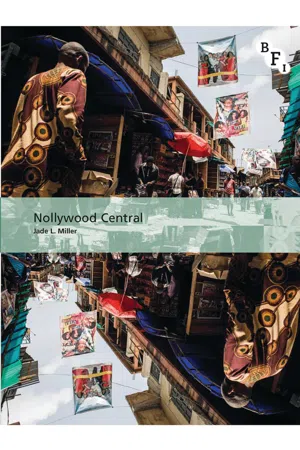
Nollywood is often portrayed by the popular press as an unruly industry, with mysteriously fast and cheap production and shadowy distribution networks. In the first overview of Nigeria's burgeoning video film industry, Jade L. Miller reveals that this portrayal is over-simplistic and often untrue.
Investigating Nollywood's complete global production and distribution chain, Nollywood Central presents a full portrait of the Nollywood industry as both highly organised and strategically structured. In doing so, it interrogates the position and rise of new cultural industry hubs, demonstrating how a creative industry can emerge, be sustainable and circulate globally even though it exists outside of formal global networks and government-supported infrastructure. Deepening understanding of this prolific industry while at the same time contributing to debates surrounding global flows of culture, this is a critical resource for students and scholars of Media and Communication Studies, Film Studies, Television Studies and African Studies.
- 184 pages
- English
- ePUB (mobile friendly)
- Available on iOS & Android
eBook - ePub
About this book
Information
1
History: Nollywood Rising
Nollywood has become something of a trendy topic for features in the popular press in recent years, garnering profiles from CNN to Esquire to The Economist. The theme of many of these articles is the idea that Nollywood created itself, rising from virtually nothing in just the past twenty years, the product of local creativity and ingenuity in a place marked by bad news and lack. As is often the case in popular press articles, this characterisation is related to the truth but only scratches the surface, leaving out both the (rich) cultural history upon which Nollywood is based and the (minimal) relationship of most Nigerian industry to governmental support or protection. In this chapter, I look in greater detail at the formation of Nollywood, the industry, as an example of cultural industry growth in a very specific place, on the flipside of dominant global networks. In order to draw a fuller picture of Nollywood’s history, we must look, first, at the specific political economic conditions and opportunities from which the industry emerged (certainly not ‘nothing’), as well as the context through which we can view and understand the content of Nollywood movies and, then, the themes that emerge in this narrative. If we take this history and map it onto previously held truths about cultural industry growth, largely based on case studies from what has traditionally been referred to as the ‘global North’, we see clear areas of disjuncture and divergence. In light of the specific context of Nollywood’s growth in Lagos and in Nigeria, this project allows us to look at cultural industry growth in light of the challenges and of the opportunities offered by location on the outskirts of dominant global networks and in a growing African mega-city: a context, perhaps, that is most relevant for cultural industry growth in the near future.
DEVELOPMENT OF NOLLYWOOD, 1990–2000: HUSTLE, HOPE AND HUBRIS
Nollywood, the industry, was born out of the combination of a number of conditions present in Nigeria at the beginning of the 1990s.1 As background, it is important to note the significance of this timeframe. The late 1980s marked the advent of the World Bank-fuelled series of economic severity policies known as the Structural Adjustment Program (SAP). This fuelled rapid naira (the Nigerian currency) devaluation, plunging existent cultural industries into disarray and re-sorting even entertainment-seeking patterns in Nigerian society as a result of increased violence and theft, and an accompanying reluctance to leave the home. From this context, ironically coming shortly after a late 1970s oil boom-led dramatic increase in entertainment consumption (Haynes and Okome, 2000; Larkin, 2004), the other conditions relevant to Nollywood’s growth also emerged.
First, there was the emergence of two different types of trained yet increasingly underemployed (and dissatisfied) pools of Nigerian creative talent. The first were actors, coming from a tradition of travelling theatre troupes among the Yoruba, who had for decades institutionalised a cultural tradition of acting as a paid profession, yet whose industry was experiencing a sustainability crisis by the early 1990s. The second were Nigerian Television Authority (NTA) employees. The NTA’s policies at that time were squeezing trained soap opera creative workers off the air, from directors to videographers to actors. Added to this was technological opportunity: as the world was phasing out initial VHS technologies, Chinese and Malaysian businessmen and women were selling deadstock very cheaply to Nigerian electronics dealers. These elements (actors, soap opera workers and inexpensive new technologies) came together and formed the basis for something new in a moment of entrepreneurial clarity. This entrepreneurial moment was itself the product of specific political and economic conditions and a culture allowing for such dynamic progression. Before drawing from the themes of this story, let’s first look in greater detail at the early years of Nollywood and the specific conditions of time and place, and of politics and economics, that provided both a window for the birth of the industry and the tools and opportunities it took to realise that opportunity. And before even that, let us begin with the story of Yoruba travelling theatre, a twentieth-century Nigerian popular entertainment phenomenon that predated, fed into and, in many ways, mirrors the Nigerian video boom of the past two decades.
Yoruba Travelling Theatre
We can begin with colonial Lagos of the early twentieth century: the milieu that gave birth to Yoruba travelling theatre. From the 1930s onward, Lagos was a magnet for aspirational migrants from a variety of backgrounds, and tiny Lagos Island, only a small corner of what is Lagos proper today, became a densely populated heterogeneous melting pot of diverse cultures, forming new societal norms (Barber, 2000). The groups flocking to Lagos at the time included former slaves returning from Brazil and Cuba, as well as anglophone countries, via Sierra Leone and significant rural–urban migrants. By 1931, new residents outnumbered those born in the area, and these new residents were hungry for educational and employment opportunities. Drawn by the promise of jobs, this new population was ‘exceptionally diverse in terms of religion, class, occupation, and ethnicity’ (ibid.: 23) and, perhaps most importantly for cultural production, was largely able to find waged labour. These jobs provided new workers with both leisure time and excess money, able to be spent on entertainment. Residents of Lagos, then, were open to money as a motor for their businesses and social lives, and were also open to any number of new foreign imports coming in through the ports. By the 1940s, amateur stagings of many different types of entertainment, from music to theatre, were seen (ibid.).
Cultural anthropologist Karin Barber attributes the birth of travelling Yoruba theatre in the late 1940s to the forces of urban expansion (Lagos tripled in size in just the 1950s alone), a post-war economic boom, a growth in education and anti-colonial nationalism that swept West Africa in the 1950s and 60s (Barber et al., 1997). But, perhaps more than anything else, Barber et al. attribute the birth of the Yoruba theatre movement to the expanding cities, ‘sites of entrepreneurship and innovation, the locus of new kinds of work … [where citizens] got used to paying for entertainment’ (ibid.: 4–5), paying for tickets and sharing space in the audience with strangers.
The first major successful Yoruba theatre troupe film came from the godfather of the twentieth-century travelling Yoruba theatre troupe: Hubert Ogunde. Not only was his troupe different stylistically from the Yoruba theatrical performances that had come before (performing without masks, for instance, and introducing realism and dialogue into the plays), but his troupe also marked a change in the structure of the industry, eventually restructuring business models for popular entertainment throughout southern Nigeria and West Africa (Clark, 1979). Most importantly, Ogunde’s troupe was the first to be supported solely via public patronage instead of that of elites (ibid.). This is important because it marks the emergence of a for-profit entertainment business structure in Nigerian-grown arts, a structure which directly paved the way for Nollywood’s self-supporting business structure fifty years later. Ogunde introduced box offices, extensive written (posters and newspaper advertisements) as opposed to oral publicity, lighting and sound amplification, payment instead of apprenticeship for actors starting out and the promotion of actresses as stars and draws to a production in their own right (ibid.). We can see the parallels between these changes and the structure of theatre as business in the UK, Nigeria’s colonial power. We can also see the offspring of these shifts in industry structure in the structure of Nollywood movies, incorporating a for-profit goal, written publicity, use of (relatively) contemporary technological equipment, payment on a per-job basis and a star system. Also significant was the reach of Ogunde’s troupe into the recorded entertainment business, selling gramophone records of their performances in markets and record stores. Ogunde’s troupe and the many similar troupes it spawned became a central part of southern Nigerian cultural production in the 1940s and ruled the entertainment scene through the 1970s, followed by an economic collapse-fuelled disintegration in the 1980s.
Nigeria’s Yoruba drama troupes were composed of tightly knit bands of actors bound to one another in a family-esque unit. These troupes were extremely popular as they toured Yoruba-speaking areas, but, by the 1980s, the troupes were becoming increasingly large and unwieldy, and were having an increasingly difficult time making money from touring. As a fix, some Yoruba theatre entrepreneurs began filming their performances with 35mm and, more usually, 16mm cameras for later exhibition (Ogunleye, 2004). These exhibitions were usually at makeshift small-scale ‘theatres’: churches or meeting halls fitted for the showing with portable projection equipment. Members of the troupe were responsible for renting the venue, arranging projection, marketing and promotion and ticket sales, just as if it were a live drama troupe performance. Troupe members would almost always be present in order to ensure profits from ticket sales weren’t falsified (ibid.). The first major Yoruba troupe film, Ola Balogun’s Ajani Ogun, was made in 1976. As the oil boom boosted entertainment consumption in the late 1970s, a small number of filmed Yoruba hits followed, including Ogunde’s Aiye (1979) and Jaiyesinmi (1983).
By the mid-1980s, these films had overtaken live theatre as preferred form of popular entertainment (Barber, 2000). While they were expensive to make, given the foreign post-production they necessitated, filmed performances were also popular among theatre troupes. For one, one film could feature star actors from a variety of productions, as a film was shot only once and didn’t require the star’s presence for an extended period of time. For a while in the 1980s, it appeared that Yoruba theatre troupe-driven films were set to become the new popular cultural form of choice in Nigeria. However, the economic collapse that came next severely delimited the ability of these troupes to finance such movies; live theatre was also in decline.
While some of these hits made the production of filmed theatre performances look promising to entrepreneurs, the reality was that film-making costs were too high for any serious profits to be made. All post-production occurred abroad, most often in London, as there were no facilities in Nigeria, and post-production costs (most notably, film processing) quickly dwarfed all other inputs to the film. It was similarly difficult to get funding and to distribute these Yoruba theatre-based films widely. However, production continued, though there was little thought that there was a sustainable industry hidden in the smattering of small-scale theatre troupe films.
VCRS, SOAP OPERAS AND THEATRE TROUPES ON SHIFTING GROUND
The second half of the 1980s introduced a number of particularly challenging conditions for the creation of any art forms in Nigeria, much less an expensive one requiring foreign exchange for post-production. These were the twin advents of economic hardships associated with the introduction of the World Bank-fuelled SAP and the spate of everyday hardships accompanying the Babanginda regime (see Haynes and Okome, 2000). In the SAP era, the naira underwent a rapid decline. Film-makers could no longer even hope to afford the expensive processing and post-production necessarily done in London. Any such entertainment would have to be remarkably inexpensive, as well as reliant only on a domestic production and distribution chain.
By the mid- to late 1980s, the Yoruba theatre troupes had moved on from 16mm to less expensive options. One was colour reversal stock (Adesanya, 2000). Colour reversal stock had the advantage of being much cheaper than film stock, and didn’t need expensive lab development. The downside, however, is that the film could not be copied. The only existing copy in colour reversal is the original. This sole copy usually degraded quite quickly as it was screened multiple times. Less than ideal, colour reversal stock was considered a temporary fix for troupes and producers looking to keep costs down. Even with these savings, the plummeting naira led to further decline in film production as raising money became even more difficult and seriously impacted the sustainability of Nigeria’s cultural movements, including Yoruba drama troupes and domestic soap opera production.
A number of other elements that marked these years also set the stage for the advent of Nigerian home video production. The Babanginda era was marked by increasing insecurity and violence in Nigeria’s southern cities, including Lagos. Violence and insecurity were so endemic that people took to shutting themselves indoors from sunset to sunrise, abstaining from evening entertainment outside the home.2 While this led to the death of most existent cinema houses in southern Nigeria, it opened space and demand for entertainment suited for home consumption.
As the era of the SAP and Babanginda began, there were still a number of popular soap operas produced, directed and acted in by Nigerian talent, on the air at the NTA.3 However, in the early 1990s, a number of shake-ups hit and ultimately disrupted the robust Nigerian soap opera industry. For one, the economic decline meant less programme sponsorship by the major soap companies that had been their traditional source of support, and the advertising agencies that acted as the bridge between producers and the major soap companies were falling behind in paying (and in some cases not paying at all) the advertising funds owed to producers (Obaseki, 2008). At the same time, the NTA was pursuing a model of increased programme ownership. As producers balked at these conditions, the NTA also began getting particularly inexpensive deals for bulk buys of Latin American (primarily Mexican) telenovelas, squeezing out room for Nigerian-made productions during prime-time programming hours and filling the airwaves with nightly shows like the global Mexican-produced hit The Rich Also Cry (Igwe, 2009).
As the NTA was the only outlet, and only large soap companies such as OMO, Joy and Elephant were ready sponsors, outlets for soap operas were highly limited and growing increasingly so. Not only was the NTA’s single station distribution suspected not to be meeting demand, but producers also believed that the NTA, acting as the sole gatekeeper, was keeping smaller and more daring entrepreneurs out (ibid.). Amaka Igwe, one of the prominent independent NTA producers from this era, reports that the disgruntled attitude of the top producers of the day was compounded by the new top-down NTA rules (meant to mitigate the squeezing of time slots) that, for example, restricted actors to acting in one NTA drama at a time, contributing to their exodus from soap operas (ibid.).
Against this SAP-fuelled background of disgruntled and squeezed-out soap opera talent on both sides of the camera, Yoruba drama troupes struggling to make money in the face of the falling naira and increasing insecurity came one more – vital – ingredient in the explosion of home video production. While these elements led to a glut of soap opera and Yoruba drama troupe creative talent, it was a glut of a different kind that opened up initial Nollywood development: the advent of VHS technologies purchased from Asian sources and dumped cheaply on the Nigerian market. Years before Nollywood was even born, a 1985 global technology report documented the boom in importation of television-based technologies that followed Nigeria’s 1970s oil boom (Boyd and Straubhaar, 1985). Initially, VCR technologies were only the purview of the wealthy, but, even in 1985, observers were able to report some penetration to the middle classes and those lower classes ‘seeking a means of earning a living from pirated cassettes’ (ibid.: 13). Segun Olusola, a then managing director of the NTA, reported as early as 1983 that a few ‘small local video production operations’ had emerged, mainly taping performances of popular musical artists for resale (see ibid.: 64). He also reported in 1983 that ‘video cassettes (blank, smuggled, pirated off-air or dubbed-off master copies) are available from roadside teenage vendors on all major roads in Lagos’ (ibid.) and that the famous Alaba electronics market was already full of VCRs and tapes for sale. It was the beginning of the 1990s, however, that brought a concentration of VHS technologies en masse to Nigerian markets, as some of the technologies had become increasingly dated in the First World and used and deadstock VHS technologies became available at cut-price rates on the global marketplace. These technologies, including both older model VCRs and massive extraordinarily inexpensive shipments of blank tapes, were bought up by electronics vendors supplying remaindered technologies to developing markets. This is a familiar path for technologies recently upgraded in their initial markets. Technologies will first sell at full cost to initial markets, such as the USA, Japan, or the UK. Once an upgrade is introduced, the remaindered merchandise can be shifted to warehouses in global trading hubs like Singapore or Dubai, and can be sold wholesale in a lot to the highest bidder. These bidders are generally traders tasked with supplying goods to electronics markets in countries that are not in the first market. Nigeria was (and remains) a huge potential market for such products, as Lagos is a hub in the West African electronics trade. It was the advent of this increasingly low-cost technology flooding local electronics markets that gave birth to what we now know as Nollywood.
VIDEO MOVIES
By the late 1980s, Yoruba drama troupes had begun experimenting with video-based productions as a substitute for their celluloid films. Some Yoruba troupes delved into video production at this time, but their videos were essentially a single camera capturing a live performance, less creative than the cinematic production that preceded them, and created for sale to the small Yoruba-speaking middle-class population with access to VCRs (Haynes, 1995; Barber, 2000). By most accounts, these Yoruba video films are the most immediate predecessors of today’s Nollywood films. Yet these video films were still entrenche...
Table of contents
- Cover
- Title Page
- Contents
- Acknowledgments
- Introduction
- 1. History: Nollywood Rising
- 2. Nollywood in Nigeria: Production and Distribution
- 3. Nollywood, the Nigerian Product: Style, Format and Audiences
- 4. Organising Nollywood: Government Policy and Guilds
- 5. Nollywood’s Global Circuits
- Conclusion
- Bibliography
- Index
- List of Illustrations
- eCopyright
Trusted by 375,005 students
Access to over 1.5 million titles for a fair monthly price.
Study more efficiently using our study tools.
Frequently asked questions
Yes, you can cancel anytime from the Subscription tab in your account settings on the Perlego website. Your subscription will stay active until the end of your current billing period. Learn how to cancel your subscription
No, books cannot be downloaded as external files, such as PDFs, for use outside of Perlego. However, you can download books within the Perlego app for offline reading on mobile or tablet. Learn how to download books offline
Perlego offers two plans: Essential and Complete
- Essential is ideal for learners and professionals who enjoy exploring a wide range of subjects. Access the Essential Library with 800,000+ trusted titles and best-sellers across business, personal growth, and the humanities. Includes unlimited reading time and Standard Read Aloud voice.
- Complete: Perfect for advanced learners and researchers needing full, unrestricted access. Unlock 1.5M+ books across hundreds of subjects, including academic and specialized titles. The Complete Plan also includes advanced features like Premium Read Aloud and Research Assistant.
We are an online textbook subscription service, where you can get access to an entire online library for less than the price of a single book per month. With over 1.5 million books across 990+ topics, we’ve got you covered! Learn about our mission
Look out for the read-aloud symbol on your next book to see if you can listen to it. The read-aloud tool reads text aloud for you, highlighting the text as it is being read. You can pause it, speed it up and slow it down. Learn more about Read Aloud
Yes! You can use the Perlego app on both iOS and Android devices to read anytime, anywhere — even offline. Perfect for commutes or when you’re on the go.
Please note we cannot support devices running on iOS 13 and Android 7 or earlier. Learn more about using the app
Please note we cannot support devices running on iOS 13 and Android 7 or earlier. Learn more about using the app
Yes, you can access Nollywood Central by Jade L. Miller in PDF and/or ePUB format, as well as other popular books in Media & Performing Arts & Film & Video. We have over 1.5 million books available in our catalogue for you to explore.